The Science of Inversions: or, Why and How to Get Off the Wall

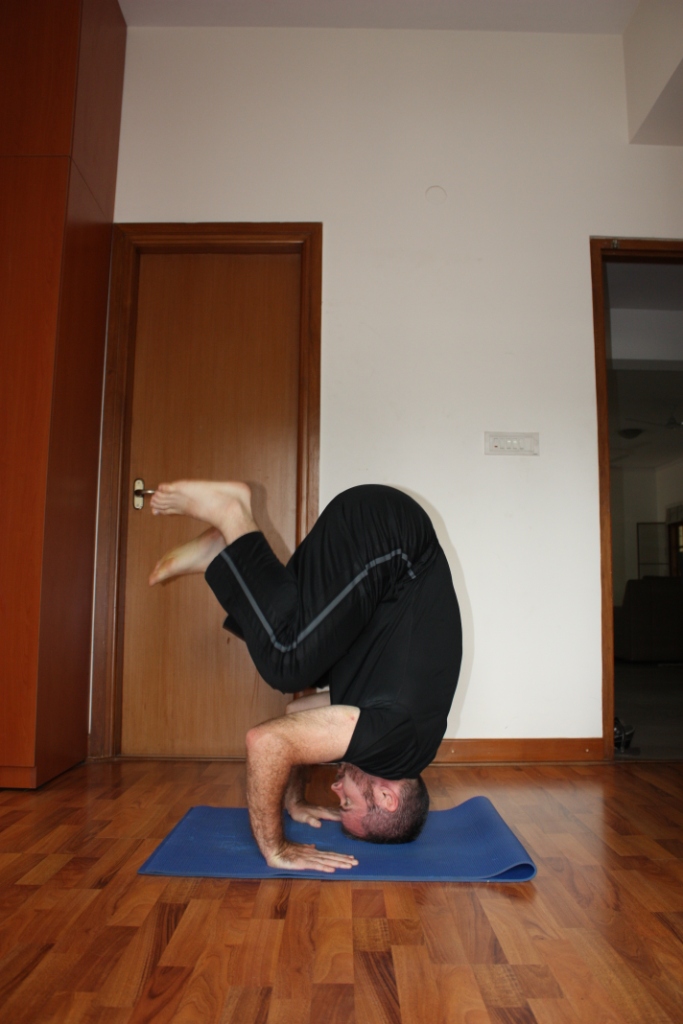
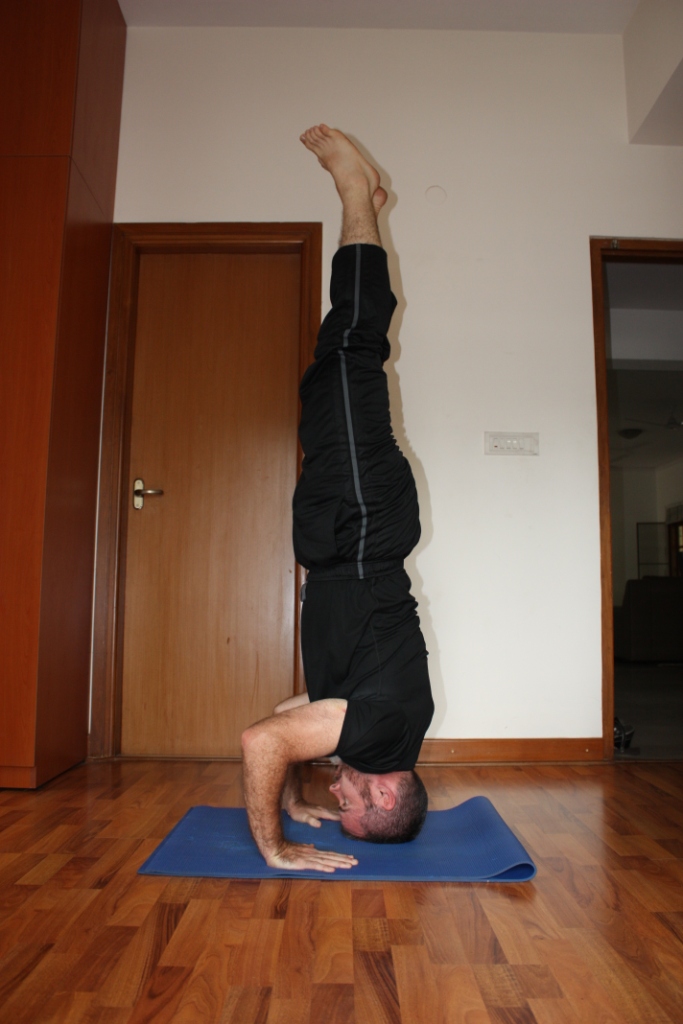
IMG_0835Inversions are a class of postures (asana) in which part or all of the body / limbs are raised above the head. The classic inversions are: headstand [shirshasana], shoulder-stand [sarvangasana], plow pose [halasana], forearm-stand [pinchamayurasana], and handstand [adho mukha vrksasana], but there are many more–some of which are easier and others of which are more challenging than these basics. Other than a few partial inversions (e.g. down-dog [adho mukha svanasana] and leg-up-the-wall pose), inversions tend to be daunting for beginners (and even intermediate students) at a mental as well as a physical level.

In this post I’ll focus on headstands. Most students seem to achieve shoulder-stands and plow pose relatively easily because it feels more stable. I’ll note that those two asana require as much or more care and caution as any inversion given the flexed state of the neck. On the other hand, by the time one is perfecting one’s handstand, one will likely be over the issues that I’m addressing in this post. I’ll save those poses for a later post with a different thrust.

Let’s first consider the effect inversions are supposed to have (and then the effect they tend to have in reality.)

What inversions are supposed to do:  The story is supposed to go like this: 1.) The body inverts. 2.) Our body’s sensors recognize that the blood flow to the brain is far beyond its needs.  3.) The body quiets our vital signs.

What inversions (too often) actually do: It may surprise some readers that inversions are supposed to have a calming effect because the chain of events is often as follows: 1.) The body inverts. 2.) The amygdala fires, triggering the physiological responses associated with fear. 3.) One’s conscious mind imagines the pain and suffering of falling. 4.) The amygdala fires some more. One is in “fight or flight” mode, and the flight the body wants to make is to a right-side-up position.

While I’ve had to work hard to improve my inversions, I had a much easier time with this issue than many. Before you dismiss me as a narcissist, let me state unequivocally that I have no special gift for inversions . I’m not claiming to be a yoga prodigy by any stretch. Why was it easier for me? I’ve practiced a martial art for many years that required training in breakfalls (ukemi.) Therefore, I had no particular fear of falling over onto my back, because my body is trained to tuck and roll. [My only fear when I first started doing headstands in studio sessions was that someone, e.g. the teacher, would walk into my blind spot. Note to all: don’t walk behind someone’s back when they’re inverted unless you’re sure you’re out of the “timber” zone.]

Why are breakfalls so beneficial to the development of one’s inversions?  Because it allows one to get off the wall. A lot of practitioners get addicted to the wall. “Addicted” may sound like a harsh term, but like addicts they think they can quit anytime and that they will quit at some undesignated point in the future–sometimes they do, but often they don’t. Reliance on the wall is reinforced by the fact that one may find one can only spend a couple anxiety-filled seconds inverted without the wall, but one can spend minutes comfortably against the wall. There’s a reason for this great disparity, and understanding this reason is crucial for knowing why doing 2 or 3 seconds unsupported (at first) is better for one’s long-term development than staying for three minutes leaning on the wall.

Here’s the deal. When you invert, your body needs to make subtle corrections to keep you on balance–at least until you reach the level of yoga genius. If you stand up with your feet together, your eyes closed, and you pay attention to your feet and legs, you’ll see that this is true when you’re upright as well. It’s just that your body is used to being upright. It knows how to make all these micro-corrections without conscious thought. The good news is that one’s nervous system rapidly learns to do the same thing when one is upside-down. When I say “rapidly” I’m not talking about the first, second, or even the twelfth time you try to do an inversion. [Trust me, despite what your mother may have told you about her darling genius, you didn’t achieve stability upright on your first few tries either.] The first several times, you’ll fall down almost immediately. However, if you keep trying, your body will learn and you’ll achieve progressively longer inverted stays. You can’t make these corrections at the speed of conscious thought. But the beauty part is that your body will learn to achieve stability solely through practice without any intellectual activity whatsoever.

Why doesn’t your body learn this when you use the wall? The cornerstone biological principle for those interested in fitness, movement, and sports is: Your brain and body are lazy; they will not develop any capability that you don’t force them to by challenging activity. Your muscles don’t get bigger without overloading them and causing little micro-tears in them that they must heal up better than before. Your bones don’t get more dense unless you put more load on them (see: Wolff’s Law.) And your nervous system will not wire itself to keep you upright in an inversion if you’re propped up against a wall. You can invert against a wall for a thousand years and not get the same benefits as from an hour of struggling to get off the wall. This principle is reflected in nature from Darwinian evolution onward.  Gazelles don’t learn to run 500 miles an hour. Once it can accelerate (on average) fast enough to survive the cheetahs that prey on it, it passes on genetic material and the evolutionary pressure is off. Gazelles don’t keep getting increasingly faster than their predators for shits and giggles.

Incidentally, this is also why you should keep challenging yourself, and not rest with getting the basic form. There’s always somewhere new to take it. For example, one can look at moving between splits like so:
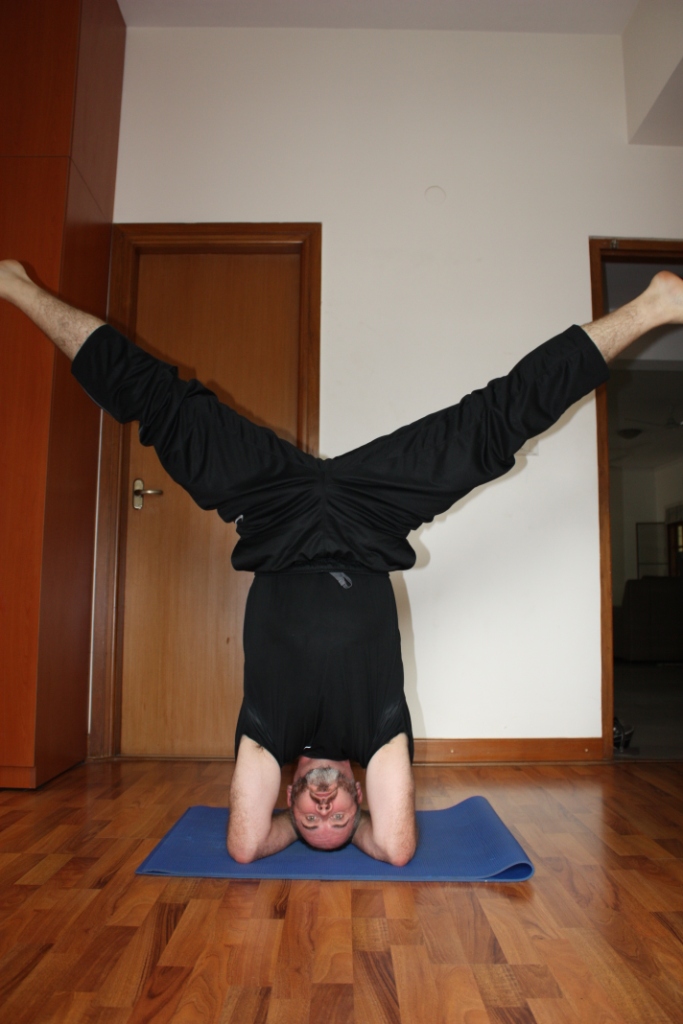
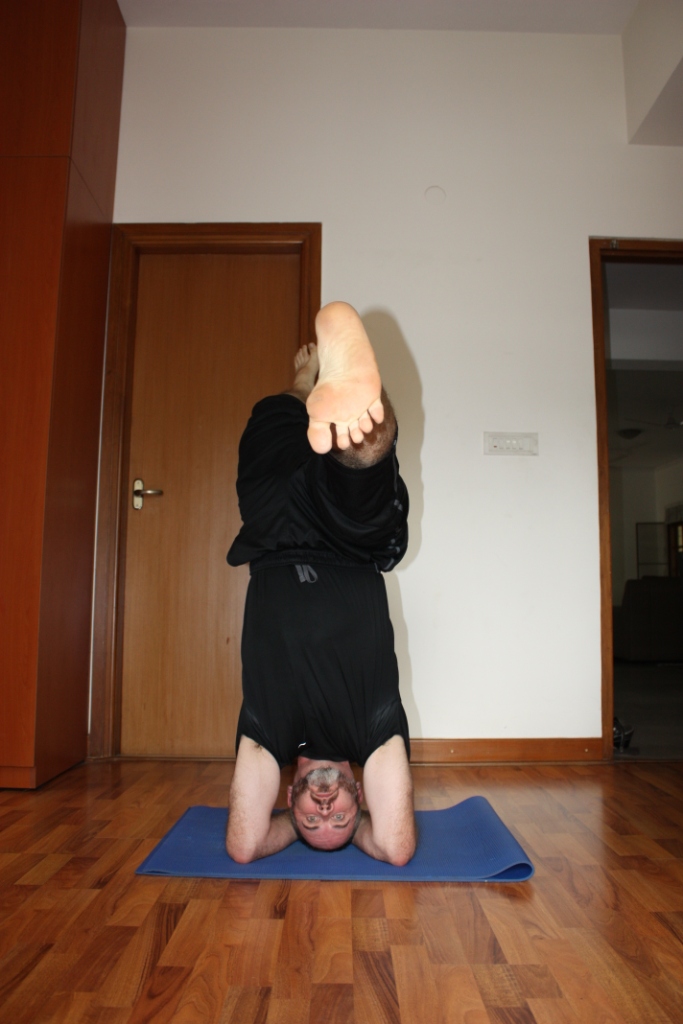
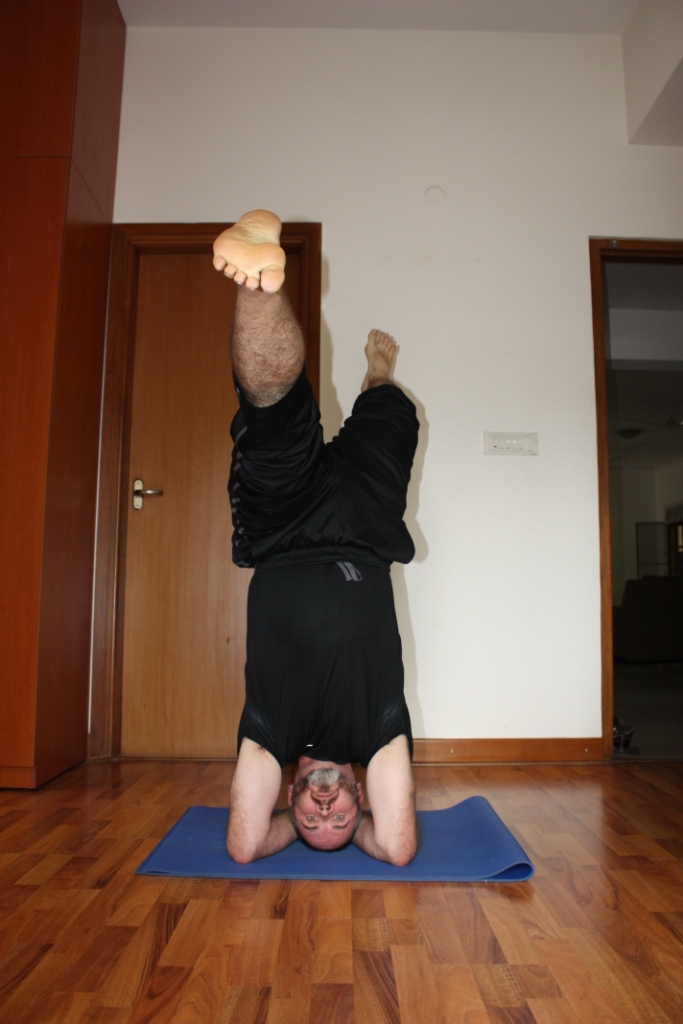
IMG_0834IMG_0836IMG_0837


Alternatively, one can work on a different form of the pose, such as the tripod headstand. Transitioning from crow pose [kakasana] to tripod headstand is a good way to start to learn the bodily control that will serve one well in intermediate and advanced practice.
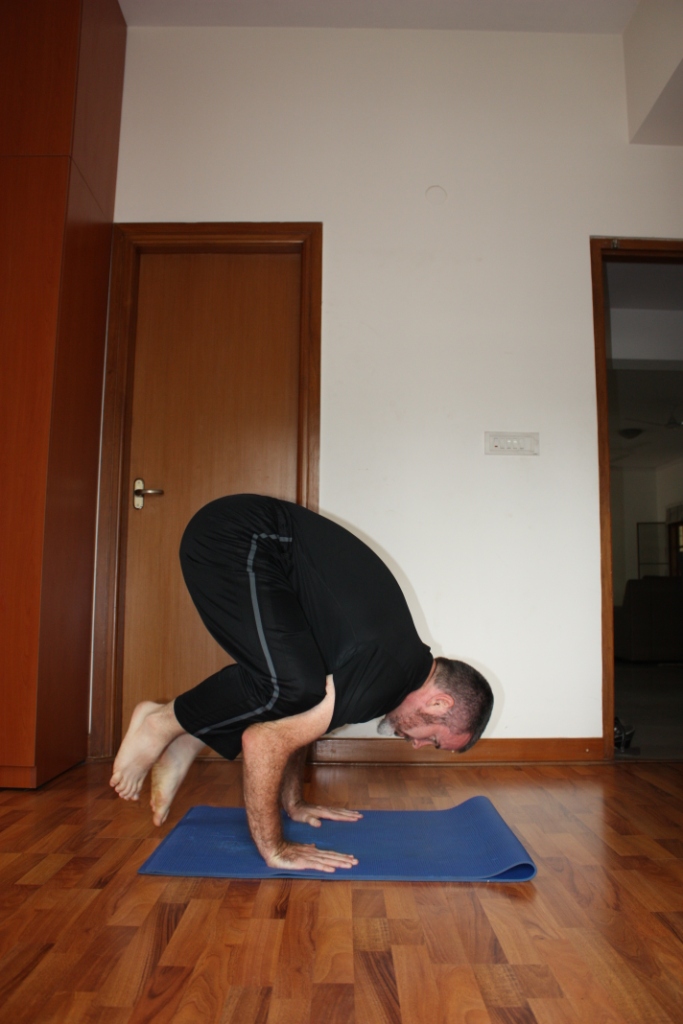


IMG_0851IMG_0853IMG_0859


Yet another option is to practice a controlled descent. The inverted “L” is quite a challenge. Not as one might think because it requires tremendous core strength, but because it requires gradually leaning into the direction of falling backwards in order to counterbalance the weight of your legs.
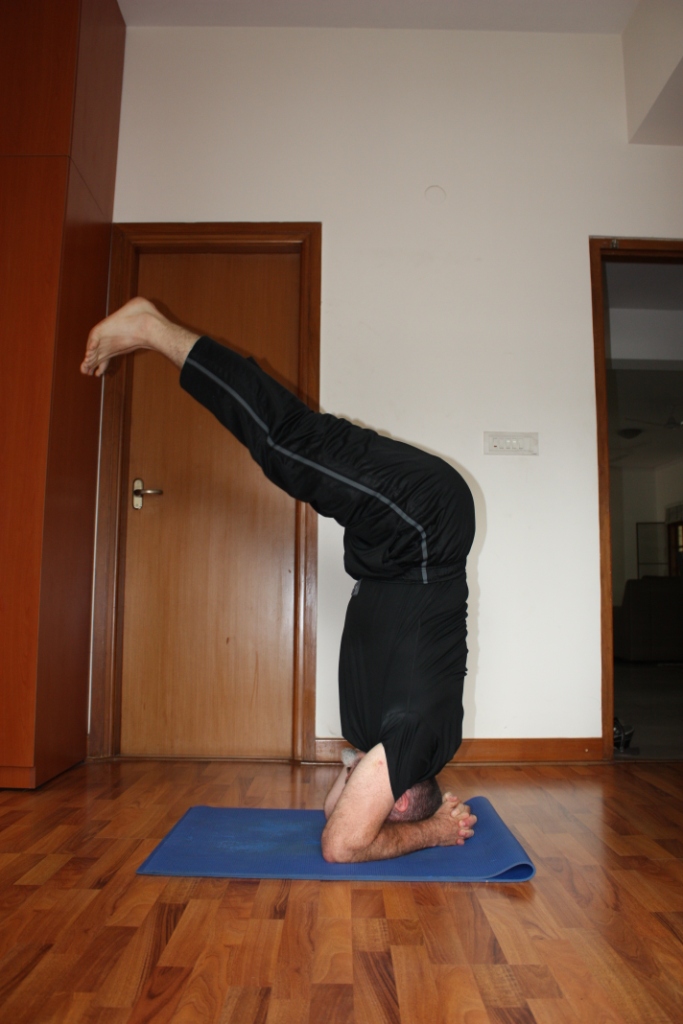
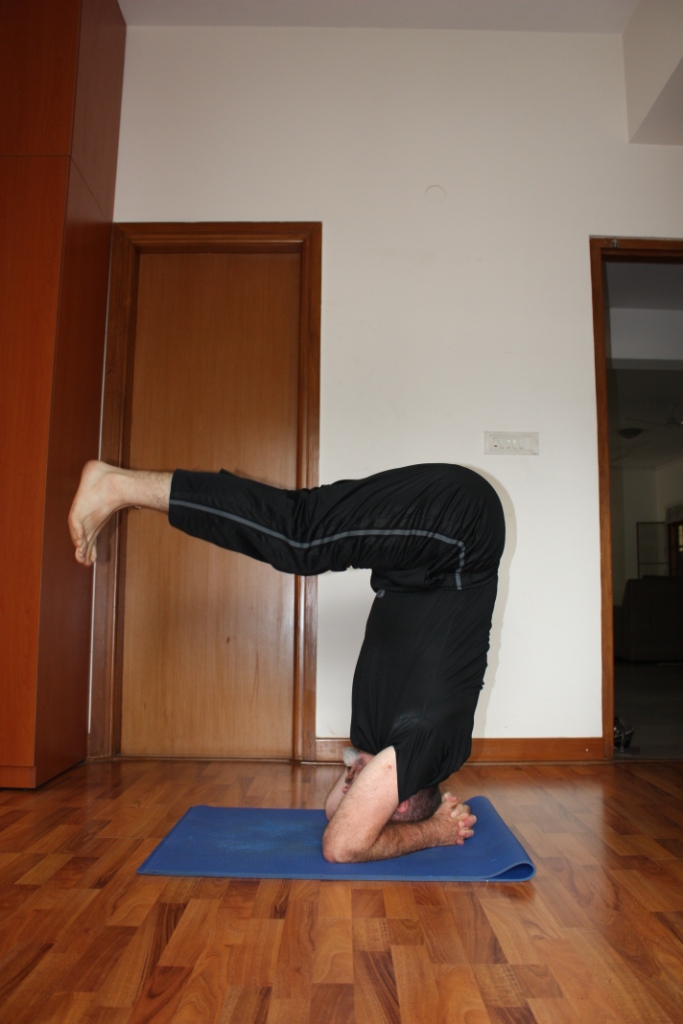
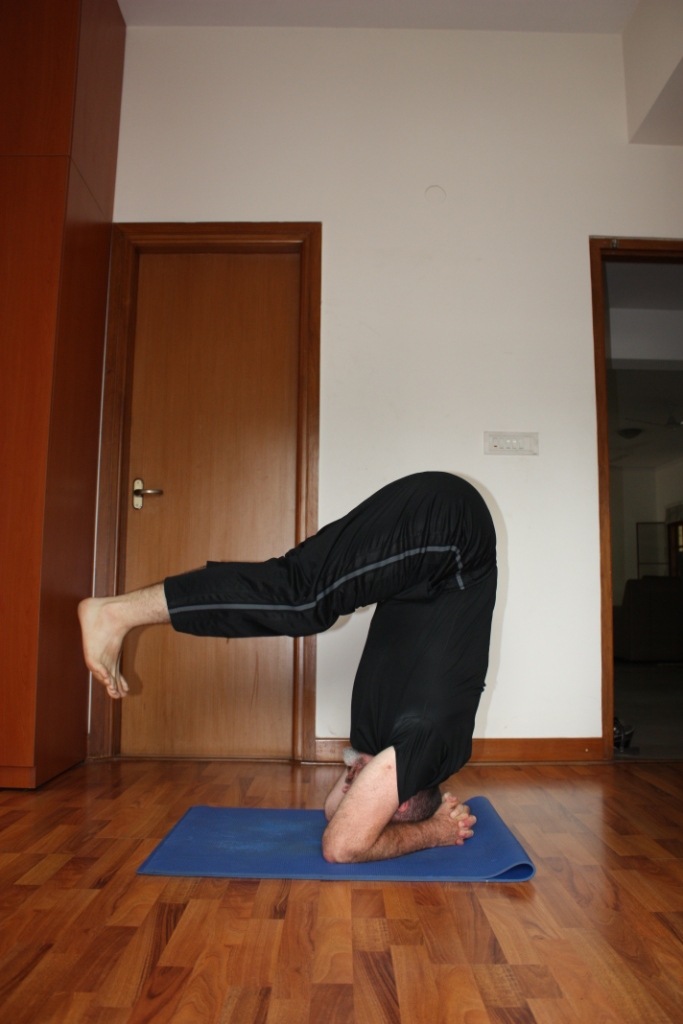
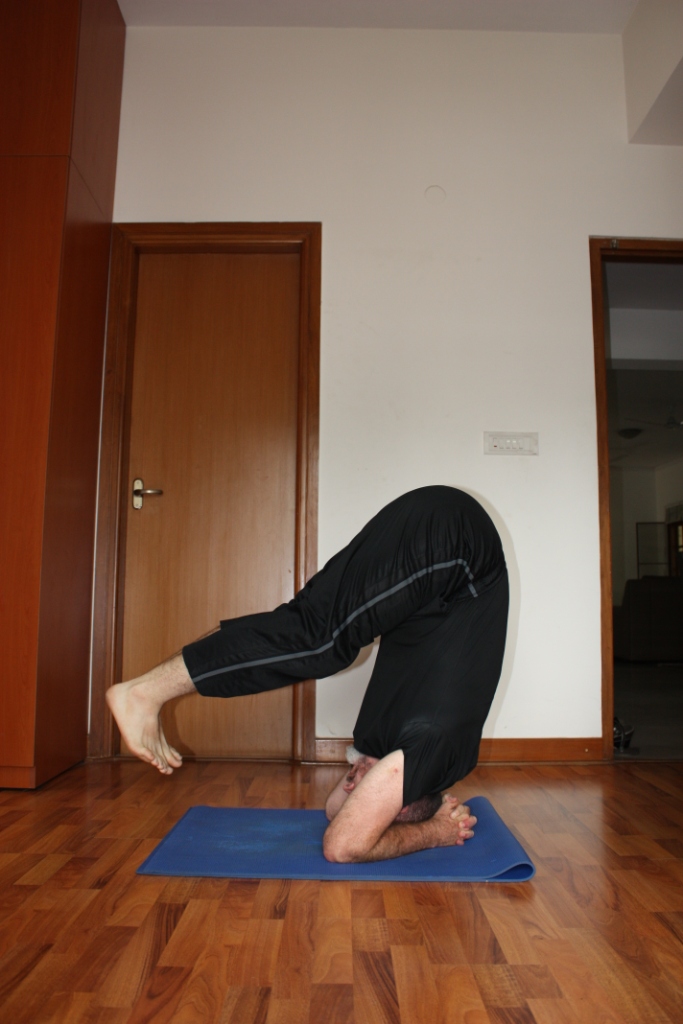
IMG_0844IMG_0846IMG_0847IMG_0849


A few notes on headstand breakfalls:

– Make sure you have room in all directions to fall without crashing into anything or anyone. While it would be nice to always fall back onto one’s feet, it’s neither realistic nor beneficial to your development. Why not? If you’re always distributing your weight to fall onto your feet, you will be keeping muscles tense and will have trouble finding a relaxed state of balance. Furthermore, there is a tendency toward panicked motion if one starts to lose balance in the wrong direction, and speed is your enemy in inversions.  (One wants to do everything from entering the inversion to falling in as slow and controlled a manner as one can possibly manage.) If you get your feet up high enough to be on balance, you need to accept the fact that you’re as likely to roll onto your back as on to your feet.

– If one is doing the basic forearm-supported headstand, don’t tightly interlock one’s fingers. “Tightly” is the key word here. It’s alright to interlock your fingers, but one doesn’t want to create ridged hands such that one’s neck rolls over a 3 to 4 inch (7 to 10 cm) ledge if one falls backwards.  One wants the hands to collapse.

– Tuck and roll. Don’t reach back with your foot / feet and try to arrest your fall. If you have enough strength, flexibility, and timing to make that work you probably don’t need my advice and haven’t read this far. (i.e. you have advanced gymnastic skill.) If you’re the more typical yoga practitioner, you’re more likely to injure your back, toes, feet, or some combination thereof by arching into a back-bend to arrest your fall.

– Counter-intuitively, you probably don’t want to put anything behind you to soften your fall. You don’t want your spine rolling over surfaces that are at different levels–even if one them is relatively soft. It’s usually best to roll over a level surface, even if that surface may be a bit hard. Furthermore, if you think you’re going to save yourself by working entirely on a softer surface, you’ll probably find yourself falling more often and for a longer period. Softer surfaces are harder to maintain balance on. That’s why one of the primary ways that we make an exercise more challenging is to do it on a softer (more rolly) surface.

– Don’t let your neck crumple. On a related aside, never look around while you’re in a headstand. If you need to see something, e.g. the teacher’s demonstration, come out of the headstand.

– However you come out of an inversion, don’t neglect the counter-pose. For the headstand, child’s pose is a common counter posture, and you should spend some time there upon exiting the pose.

– It’s best to begin one’s practice of inversions under the supervision of a qualified teacher. As one develops confidence and one’s body begins to learn how to maintain stability, one can make these postures an increasing part of one’s practice.

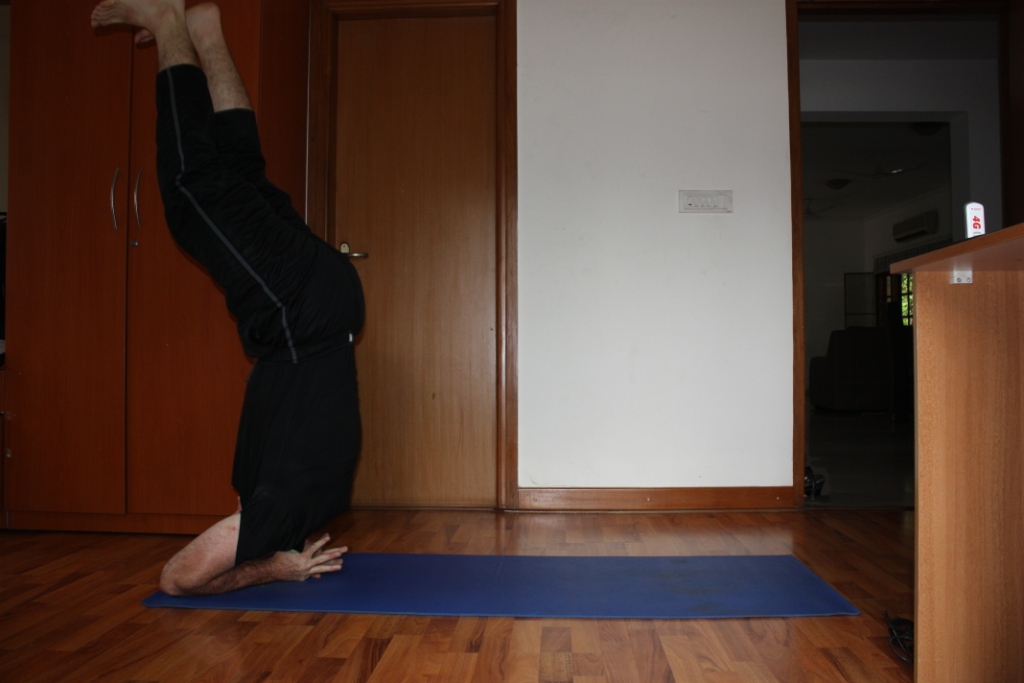
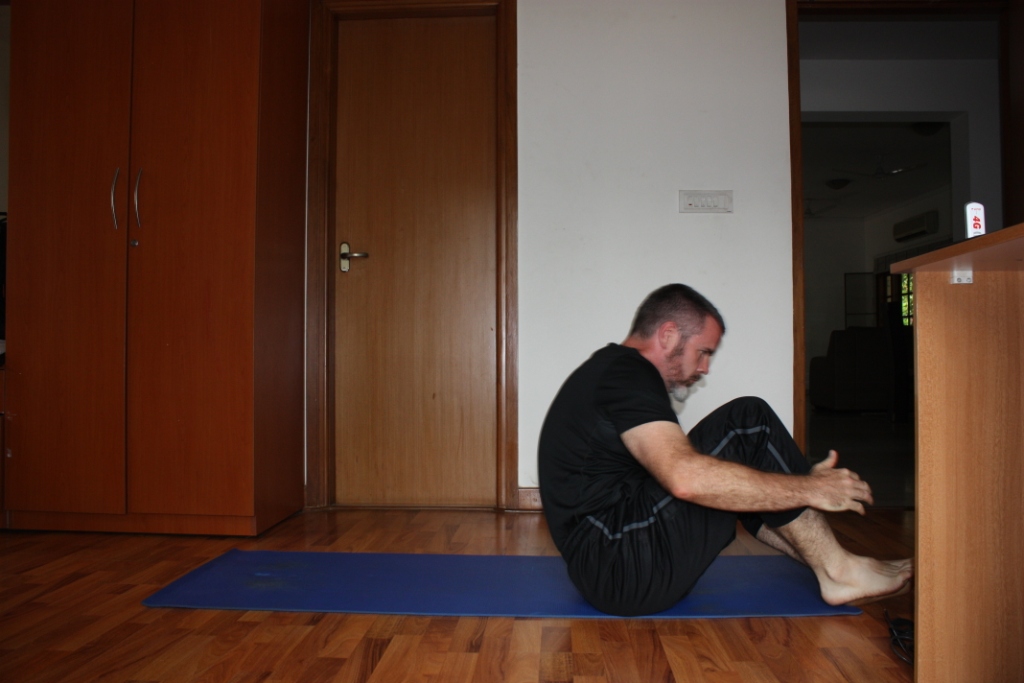
It’s hard to get get a good sequence of pics to show how to breakfall–given my limited photography skills, that is. But here’s my attempt.
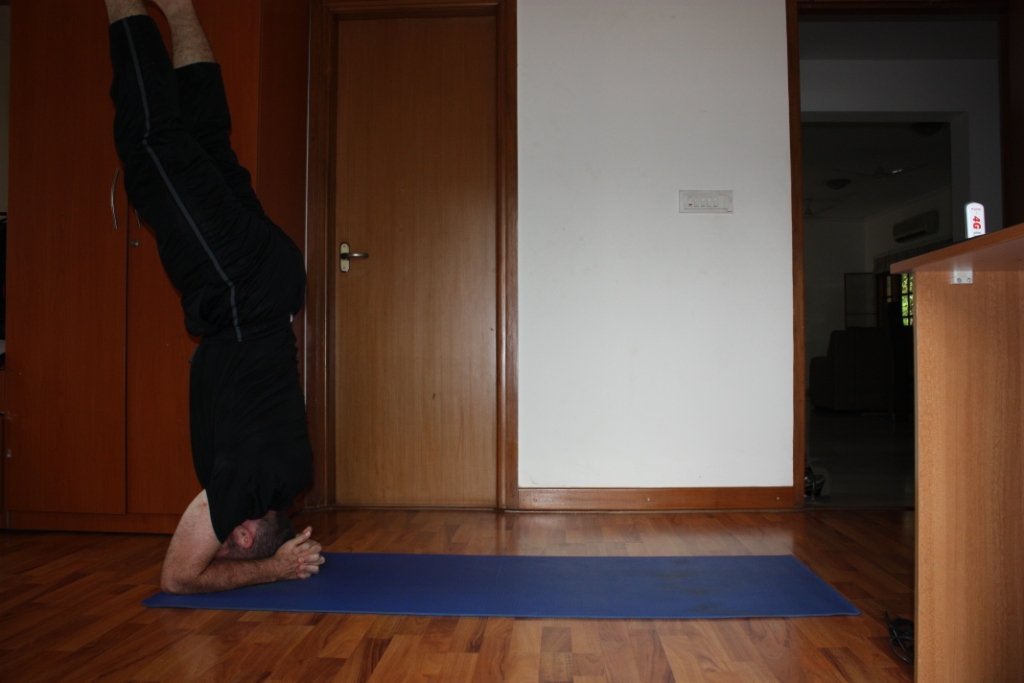
So it begins with crumpling balance
So it begins with crumpling balance

Get those fingers open so your neck doesn't flow over an interlocked fist

Get those fingers open so your neck doesn’t flow over an interlocked fist
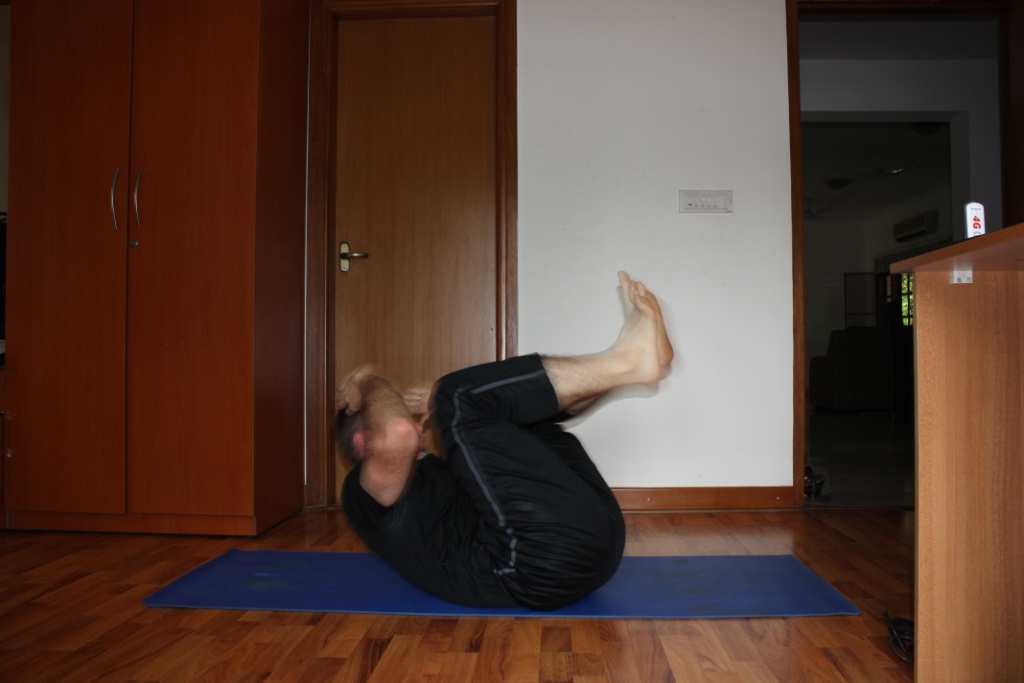
Tuck and roll
Tuck and roll

Don't arrest your roll.  Let momentum carry you forward. Gradually dissipate the energy.

Don’t arrest your roll. Let momentum carry you forward. Gradually dissipate the energy.

Happy inverting.

DAILY PHOTO: Kandy Dance

Taken on May 23, 2015 in Kandy, Sri Lanka

Taken on May 23, 2015 in Kandy, Sri Lanka

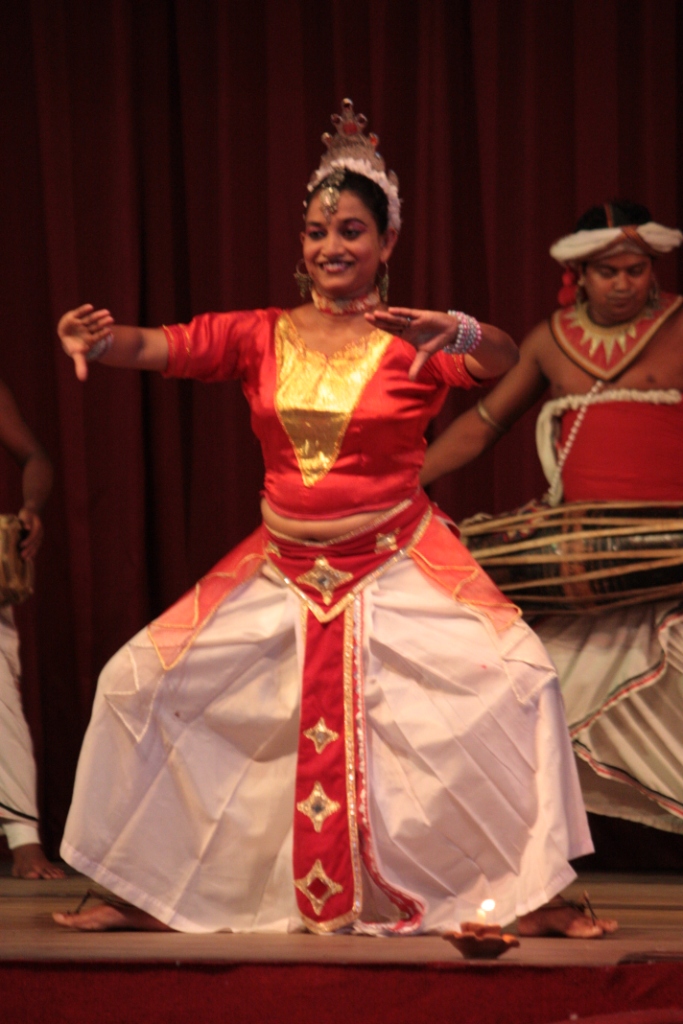
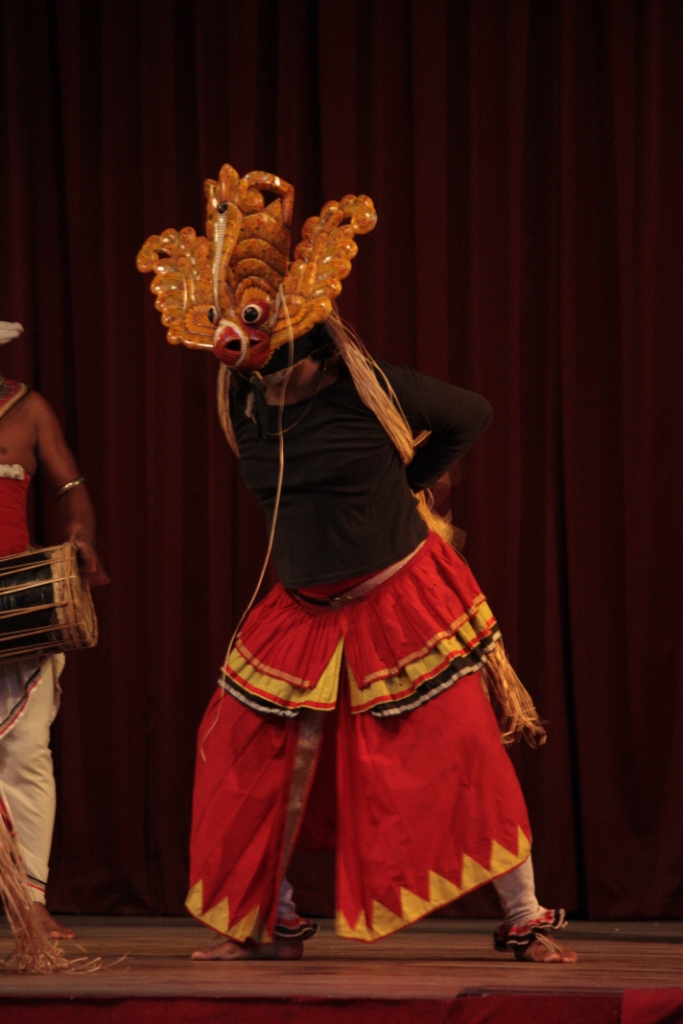
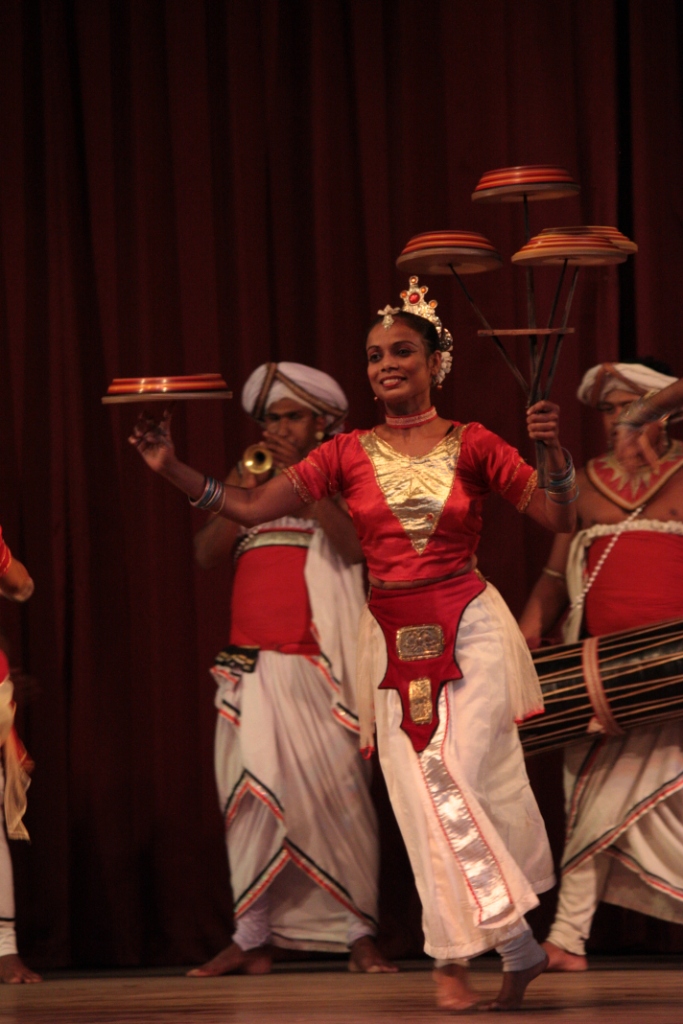
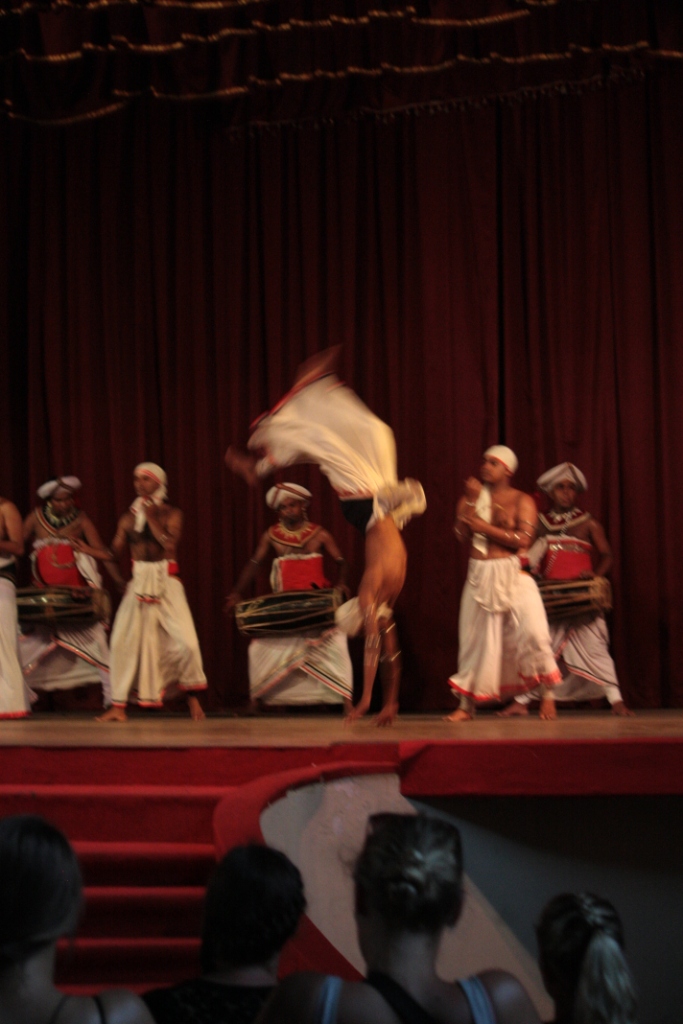
These are some shots that I took at the Kandy Cultural Centre. They do daily performances of indigenous dance and performance art.

IMG_0403 IMG_0385 IMG_0431

3 Levels of Movement Coach

I.) New teachers and coaches often over-rely on their personal experience. In other words, one may think that the skills that came easily for one will be a piece of cake for one’s students as well. Conversely, such a teacher tends to be more sympathetic and lax when it comes to skills that kicked his or her own ass. This may work for some students, but it’ll be way off the mark for others. There’s a risk of pushing students too hard on skills that may be dangerous for them, and / or not helping them achieve a breakthrough that they are capable of because of one’s own baggage.


II.) The next level of coach recognizes that there are different body types. Such teachers put this knowledge to use in determining what skills present greater or lesser risk for a student given the strength, power, speed, flexibility, etc. associated with such a body. This coach will recommend modifications and capacity building exercises based on the student’s body type.


III.) Then there is the coach or teacher who can see the individual idiosyncrasies of a given student’s body and make recommendations based the unique conditions, strengths, and weaknesses of a particular person.

9 Lessons Learned During Children’s Yoga Teacher Training

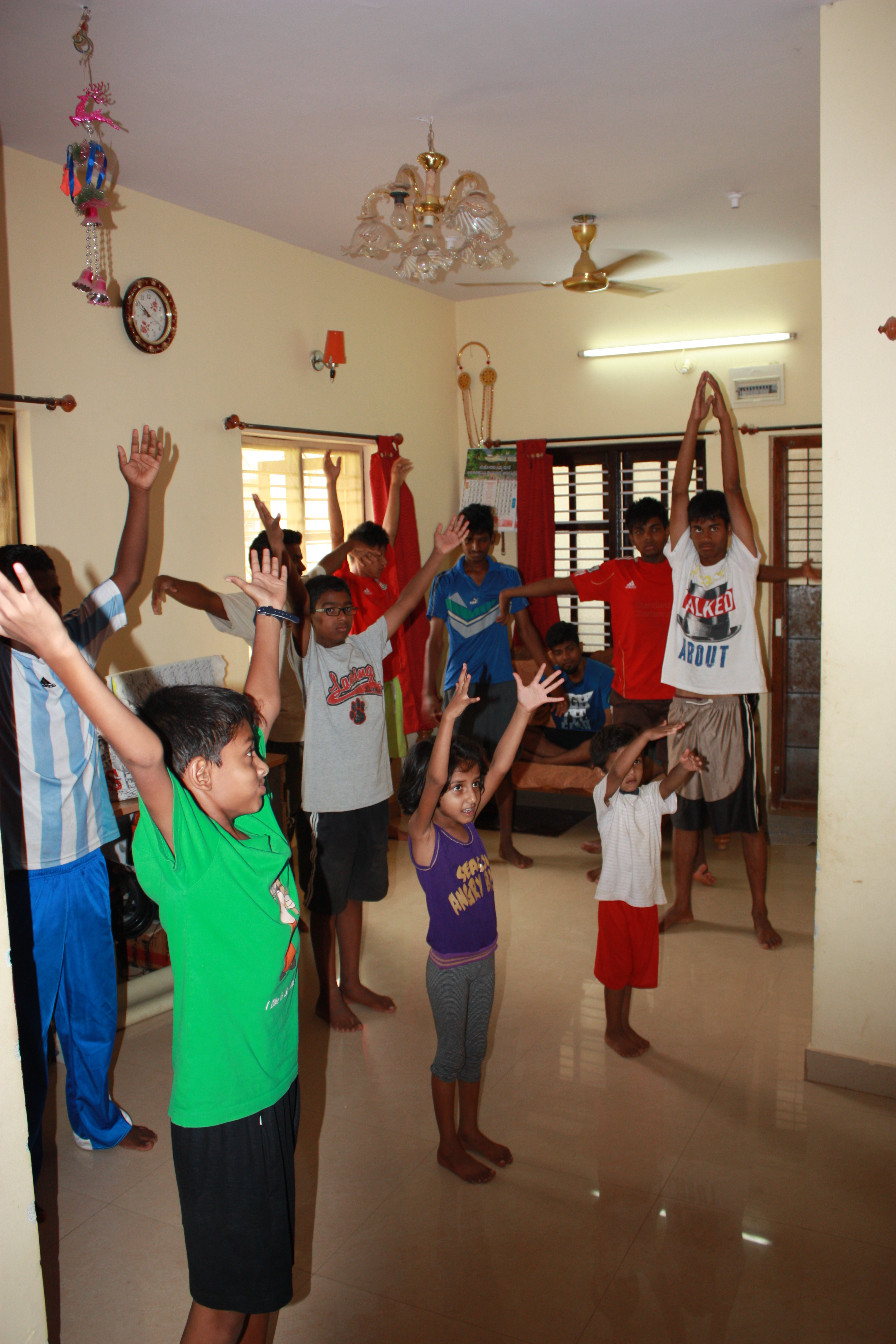
I recently finished the course requirements for Registered Children’s Yoga Teacher (RCYT) training at a1000 Yoga in Bangalore. (As of this writing, I still have a kid-specific teaching requirement to meet before I can add this to my Yoga Alliance certification portfolio.)  When I did my seva (charitable teaching) requirement for RYT-200 at an orphanage, I discovered that teaching kids was a different monster. That’s what led me to take up this specialization, and I thought I’d share some of what I learned.


IMG_1580

1. Eight is [soon] enough:  The traditional age for introducing children to a practice of yoga is eight. This doesn’t mean that kids aren’t taught postures (asana) or other yogic techniques earlier, but for younger kids it’s typically done as play. Traditionally, surya namaskara (sun salutation), nadi shodhana (alternate nostril breathing), and Gayatri mantra (a particular chant) serve as the core of the child’s practice.

Why eight? It has to do with a number of physical and mental development factors including lung development, the state of the pineal gland, and the arrival of abstract reasoning capacity.

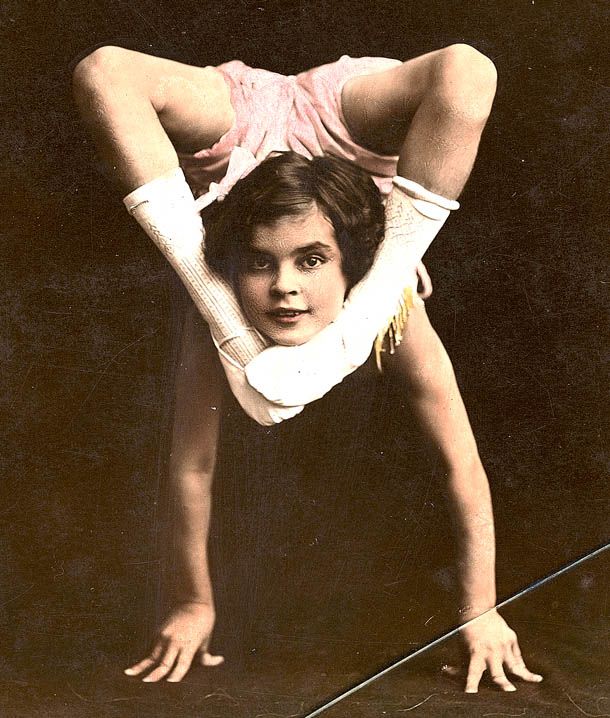
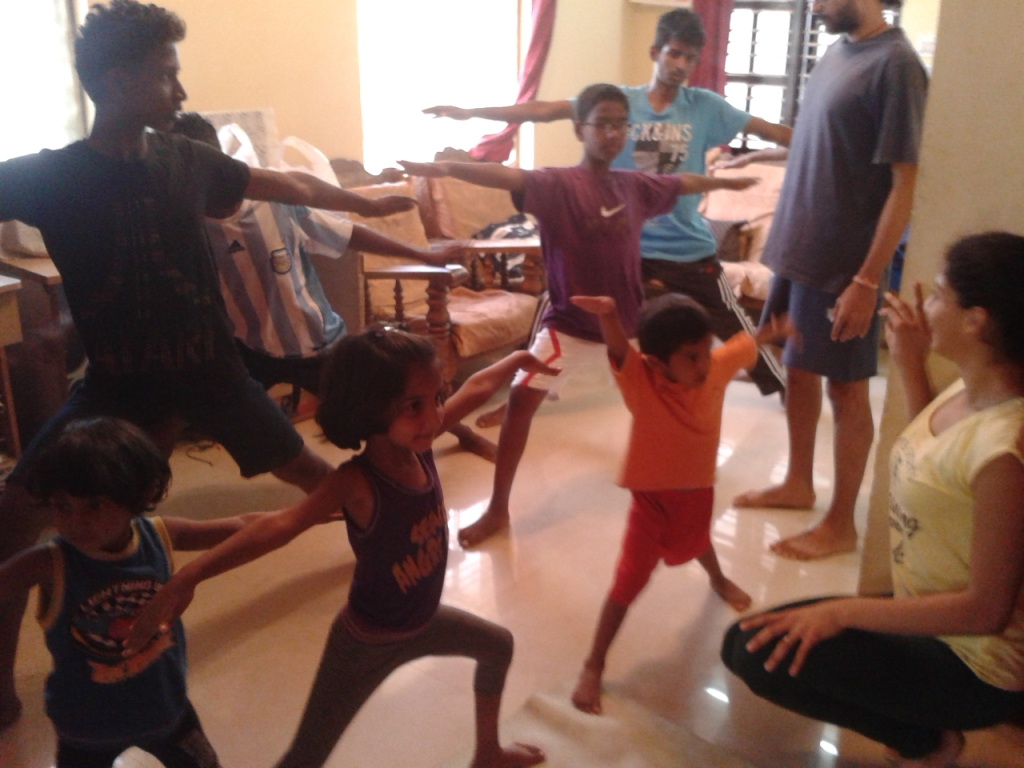
Kids_contortionism2.) There are no youth-related contraindicated postures: I expected to spend a fair amount of the course learning what postures one shouldn’t teach children and why. However, instead we were told that kids could be exposed to any Hatha yoga postures.

Of course, this is predicated on: a.) the fact that one is dealing with a child eight and up; b.) one recognizes that the strengths and weaknesses of children will need to be taken into account and modifications or capacity building may be necessary in some cases. (For example, the flexibility of kids may allow them to achieve postures that few adults can, but at the same time their lack of strength and balance may be limiting factors for some postures.); c.) obviously, one needs to take into account that kids may have contraindicated conditions that aren’t age-related but are due to their particular physical condition.

It should also be noted that children are typically not taught breath retention (khumbaka) as part of their (breath exercise) practice. So it’s not true to say that there are no contraindicated practices.

3.) In stillness, your results may vary: One of the nice things about a yoga practice for kids is that it acknowledges that most kids, by nature, don’t want to be still. As opposed to mainstream education, which attempts to force stillness upon them, yoga offers a mixture of activity and stillness. However, it was interesting to see the range of abilities to remain motionless during yoganidra (“yoga sleep,” i.e. a hypnogogic state) practice. There is, of course, an age component to this. That is, young kids have a harder time staying still than older kids. However, that isn’t all there is to it. A few of the older kids couldn’t stay still in savasana (corpse pose) for five seconds, but a few of the young seemed able to be still for as long as required–not necessarily awake, but still.

the exception

the exception

4.) Balance isn’t in a child’s wheelhouse:  I knew that strength was ill-developed in prepubescent children, but I didn’t realize how challenging kids would find even simple balance postures. They’re a little like drunks in this regard.

Obviously, kids tend to be freakishly bendy, and so it’s not a surprise that most of them could learn to do chakrasana (wheel pose, i.e. a full back bridge) from a standing position in short order. In fact, the challenge for those who had one was more likely to be confidence with not falling on one’s head than with a lack of back-bending flexibility.

The moral of the story is that one must recognize that children are a little like senior citizens in this one domain. That is, consideration must be given to the risk that they will fall down during balancing poses. Unlike seniors, they don’t have too far to fall, and they’ll heal lickety-split if they do, but–still–they’ll fall like a drunken sailor.

5.) Teaching kids’ partner yoga requires a different approach:  The usual advice is that one should teach kids from “inside the circle.” That is, one shouldn’t set oneself off at the head of a class like one would usually do with an adult class. One sits with with the kids and does the class with them. (You probably won’t be doing 6 classes a day that way.)

I had the opportunity to teach a pairs yoga class and found that an entirely different approach was needed. First let me say that pairs (partner) yoga is a great approach for teaching kids. Many kids will enjoy the interaction, and they can learn about teamwork and (in some cases) take advantage of the stabilization of additional limbs / grounded surface area. However, because it requires so much attention to be focused on the partner, it’s best not to teach it from inside the circle. One won’t necessarily be able to see what one’s students are doing, and that can be dangerous.

6.) There’s a yoga for special needs children: Among our guest speakers, we had a yoga teacher from Prafull Oorja, which is an organization that teaches special needs children using yoga, dance, and various other methods. These approaches are used to increase bodily awareness, which is a common problem across many different afflictions. We learned about the range of challenges faced by such children and how the usual approach is varied to adapt to their needs.


The course included information about several non-yogic methods that could be used to complement yoga practice to achieve the objectives of a yoga course. I write this by way of explanation as to why the last few lessons seem to have little to do with yoga.


7.) Stories must be physical, animated, and repetitive for small kids:  These features serve to help adjust to the child’s limited vocabulary, while helping them to build vocabulary. We had a speaker from Kathalaya (House of Stories) who offered a great deal of insight into story-telling for kids.

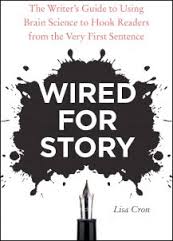
Lest one think that story-telling is just filler in the yoga context, I’ve been learning a great deal about how our minds need stories, and am inclined to believe that one’s insight into the mind will be limited if one doesn’t understand story and why stories appeal to our minds. I recommend the book Wired for Story by Lisa Cron.

8.) Games used in theater can go hand-in-hand with yoga practice:  I was completely new to the idea of theater games before this course, but we had someone teach us a number of these games, and the logic behind building our own. Games which aren’t too cerebral can go help build some of the same skills that are sought in a course of yoga. Such games include practices that help develop one’s voice and physical expressiveness. These games can also help bring some kids out of their shells so that they are more ready to actively participate in a yoga class.

9.) We need mental hygiene as much as dental hygiene: This actually comes from a quote by Sir Bat Khalsa, a Harvard Neurologist who studies the effects of yoga. When I was doing research for my final presentation, I ran across said quote, which goes:

“There’s no preventive maintenance. We know how to prevent cavities. But we don’t teach children how to be resilient, how to cope with stress on a daily basis… We’ve done dental hygiene but not mental hygiene.”

IMG_1582

READING REVIEW: April 24, 2015

I completed three books this week. The first was Richard Wiseman’s Night School. I wrote a lot about this book in my last Reading Report. Night School examines what happens when we sleep, what happens when we don’t, and a host of events that happen in and around our sleeping life (i.e. nightmares, night terrors, sleep walking, etc.)  The notion that dreams and nightmares are our subconscious working out waking life problems is well established, but there was some interesting discussion of how to change one’s dreamscape (i.e. lucid dreaming) that was fascinating.

NightSchool


The second book I finished was Sam Harris’s Free Will. I had high hopes for this book, but they didn’t pan out.   It’s a very short book (less than 100 pages) on the subject of free will–or the lack thereof. There’s a well-established scientific literature supporting the notion that free will is an illusion. This conclusion was reached by observing that subconscious parts of the brain involved with decision-making light up well in advance of the conscious parts of the brain. The most illuminating example offered is an experiment in which participants were asked to press a button to select a letter or number of their choosing from among a string of rotating letters / numbers. Some subjects became convinced that the scientists had mastered precognition (a class III impossibility according to physicists–i.e. impossible according to the laws of physics as we know them.)  What was really happening was an exploitation of the lag between when the individual’s subconscious decided and when they became aware of their decision.

While I’m normally a big fan of brevity, Harris could have put some more pages to good use. First, he barely mentions a couple of the neuroscience experiments, and expects that the reader will treat this all as law. That is, we are to accept that always and everywhere people’s subconscious minds decide some measure before their conscious minds. Harris also scoffs at the suggestion that perhaps the conscious can overrule the subconscious. He seems to deem this as not worthy of study because it would just be the subconscious making a second decision. So we learn about a couple of studies in which a.) the decision-maker has no stake in the decision (is it possible the mind treats decisions about picking a spouse or a house differently than picking a letter or number in which there is no more costly outcome?) b.) those studied are a random sample of individuals who have no particular expertise with their minds. (If I drew a random sample of people and asked each to lift 300 lbs over his or her head. If no one could do it, would I be safe in concluding that lifting 300 lbs was something forever beyond the capacity of every member of the human race? In other words, what if exercising conscious control over decision-making requires training and expertise with the mind.) Maybe all of this has been studied (e.g. high stakes cases and cases with monks and meditators), and we can safely conclude that free will is always and everywhere an illusion–but Harris didn’t make this point. He concludes we will take it as a given just as he has. (Much like he suggests that anyone who truly studied their mind would understand this point already. Would it surprise Mr. Harris to learn that there are people who have spent far longer alone with their minds than he, who have concluded quite the opposite?)

Second, if the conscious mind is just a Matrix Revolutions-style (and Rube Goldberg-style) machine for tricking us into thinking we have choice and control over the direction of our lives (what happened to evolution not over-engineering?), what guides all of these “decisions?” Given that they produce, I might point out, a fairly orderly world. Harris doesn’t answer this. One might guess that he would point to Dawkinesque suggestion that it’s all about genes advancing their own agenda. (A proposition that seems to me has trouble explaining a corporeal who throws himself on a grenade to save his comrades.) I shouldn’t put words in the author’s mouth. Quite frankly, I have no idea whether he believes there are rules or some guide to these subconscious decisions, because he doesn’t tell us. (Maybe he thinks they are random neuronal firings, but I doubt it.) From what I’ve heard of his other books, he doesn’t think it’s a god making these decisions–a sentiment I share. However, there must be something underlying these decisions, and an author writing about this topic should at least make some effort to address it. Black boxes aren’t persuasive.

FreeWill


The final book I finished this week is entitled The Sensual Body. This is a book that discusses a number of systems of movement and bodily activity as means to increase bodily awareness. Among the systems included are Tai chi, Eutony, Kum Nye, running, Aikido, and massage. It’s an interesting overview, but without sufficient detail of anything in particular to be of practical value. It’s the kind of book one might read to see what kind of classes one should take or what more focused books would be of benefit.


Besides the aforementioned books, I spent most of my reading time on two books that look at two very different subjects from the viewpoint of neuroscience. The first is Wired for Story, and it’s a how-to book for writers that sets itself apart by explaining how humans are hardwired by evolution to love stories. Just as a few notes produce an infinite variety of music. There is an inherent limiting / shaping structure to stories that is ignored at the writer’s peril. Much of the advice offered isn’t that different from other books on writing or storytelling, but one gets insight into which advice one should really treat as inviolable because it touches upon something fundamental to our human nature.


Wired for Story


The other book is the only book I purchased this week. It’s entitled Brainwashing: The Science of Thought Control and is by Kathleen Taylor. So far the book is intriguing. The chapters I’ve read so far provide an overview of brainwashing and cults. The middle section of the book delves into the neuroscience behind brainwashing, and the final section gets into practical matters such as how one can make oneself resistant to thought control techniques.


Brainwashing_Taylor


BOOK REVIEW: The New Rules of Posture by Mary Bond

The New Rules of Posture: How to Sit, Stand, and Move in the Modern WorldThe New Rules of Posture: How to Sit, Stand, and Move in the Modern World by Mary Bond

My rating: 4 of 5 stars

Amazon page

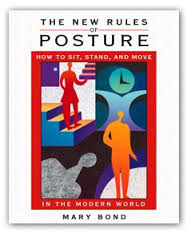
This book’s author, Mary Bond, was a UCLA-trained dancer who became an Ida Rolf-trained Rolfer. If that sentence makes no sense, you’re probably unaware Dr. Ida Rolf and her self-named system. Rolfing was popular decades ago, but fell out of favor—possibly owing to its reputation for being agonizing. (However, I did recently read an article suggesting renewed interest in this practice.) Rolf’s system is generically called Structural Integration, and it’s intended to better align the body with respect to the force of gravity. The heart of the practice (though not addressed in this book) is a massage-like system that focuses on fascia (connective tissue) rather than musculature (as massage generally does.)

[This paragraph is background, but isn’t about the book per se. Feel free to skip it if you are familiar with structural integration or don’t care.] It should be noted that Rolfing is controversial. I’m not sure what to make of this controversy. On the one hand, the system hasn’t been helped by zealous advocates and practitioners. In any such system, zealots often suggest their beloved system is a panacea for all that ails one. Furthermore, the more hippie-esque practitioners try to reconcile / unify Structural Integration with ancient systems like Ayurveda or Traditional Chinese Medicine (TCM.) This neither helps to validate those ancient systems nor improves the case of Rolfing as a methodology rooted in science. On the other hand, not even yoga has been free of haters. There is a sector of humanity that is openly hostile to the notion that the only way for many people to feel better is for them to do the work of improving their bodies (e.g. posture, range of motion, strength, etc.) (i.e. If your problem is rooted in your shoulders not being over your hips or you have an imbalance in your core between your ab and back muscles, there is no pill nor surgery to cure you—you’ve got work to do. And—it should be noted–both of my examples can cause a person to feel like crap in a number of different ways.) Another element of controversy is that Structural Integration places special emphasis on fascia (connective tissue.) While it’s not clear from scientific evidence that fascia deserve special attention, I’m also not sure that Rolfers don’t have a point when they note that everyone else completely ignores this tissue.

Having written all that, The New Rules of Posture isn’t a book about Rolfing as massage-like practice. Instead, as its subtitle (how to sit, stand, and move in the modern world) suggests, this is a book about how one can improve one’s posture, breathing, and movement (i.e. most notably walking). It’s arranged as a workbook, and it contains over 90 exercises and observations for the reader to perform. The author calls these exercises “explorations” and “practices”; the latter are more extensive and are more likely to require revisiting.

The ten chapters are arranged into four parts: awareness, stability, orientation, and motion. Each part has two or three chapters. The author divides the body into six zones (pelvic floor, breathing muscles, abdomen/core, hands, feet, and head)—the first three of which are associated with stability and the latter three with orienting the body. The six middle chapters (parts 2 and 3) are each tied to one of these zones. The book uses vignettes and side-bars in an attempt to make the material more palatable to readers who aren’t deeply interested in the topic.

The author gives attention to a wide variety of modern-day activities that can have an adverse impact on bodily alignment such as driving, computer time, and rushing about. I suspect this book will offer something useful to almost anyone.

The book’s graphics are line drawings—some are anatomical drawings and others demonstrate postural problems or exercises. The drawings are clear, well drawn, and useful. In addition to the usual front and back matter, there’s a brief bibliography and a resources appendix.

I’d recommend this book for yoga teachers and those interested in the body generally and movement and postural improvement specifically. If you’re having problems that you think may be linked to postural problems, this isn’t a bad place to start thinking about how one might improve one’s situation. It’s very readable and clear.

View all my reviews

READING REVIEW: March 20, 2015

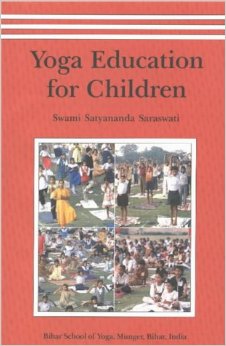
I started a Registered Children’s Yoga Teacher (RCYT) training course this week, and so it’s not been a big week for reading. The only new book I acquired and have begun reading is that course’s text, Yoga Education for Children, Vol. 1. That book is put out by the Bihar School (Swami Satyananda), which has done a vast amount of work and research about educating children through yoga.

YogaEdforChildren


I will probably finish Mary Bond’s The New Rules of Posture over the weekend, which I only have two chapters left to complete. I discussed that book in last week’s reading report.

NewRuleofPosture

Other than that I’ve been plugging away at some of the books that I’ve mentioned in previous reports when I have a moment here or there.  It’s been sort of a technical week for reading. I hope to have more to say next week.

DAILY PHOTO: A Story in Expressions

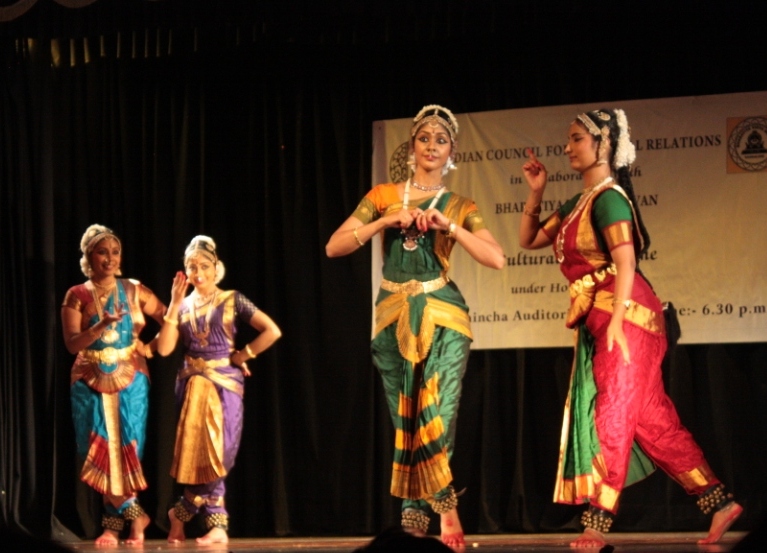
Taken on March 14, 2015 at the Bharatiya Vidya Bhavan in Bangalore

Taken on March 14, 2015 at the Bharatiya Vidya Bhavan in Bangalore

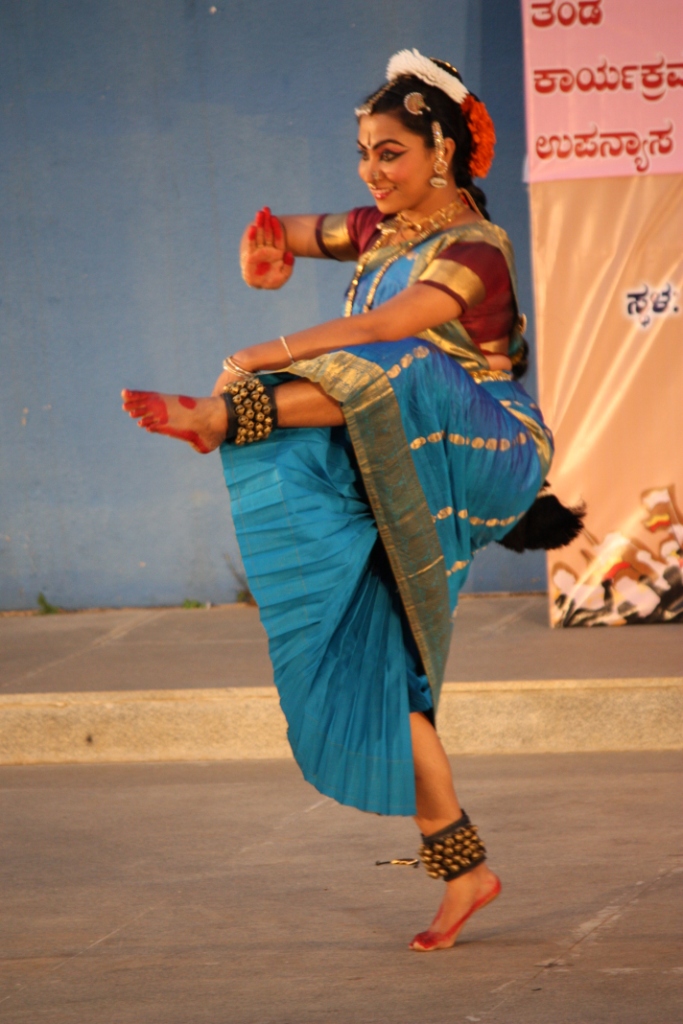
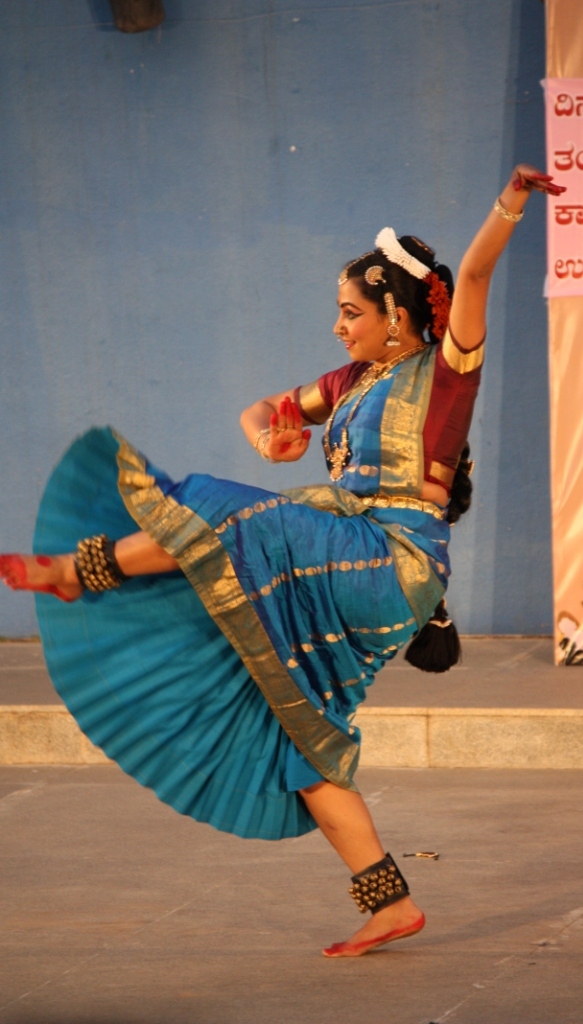
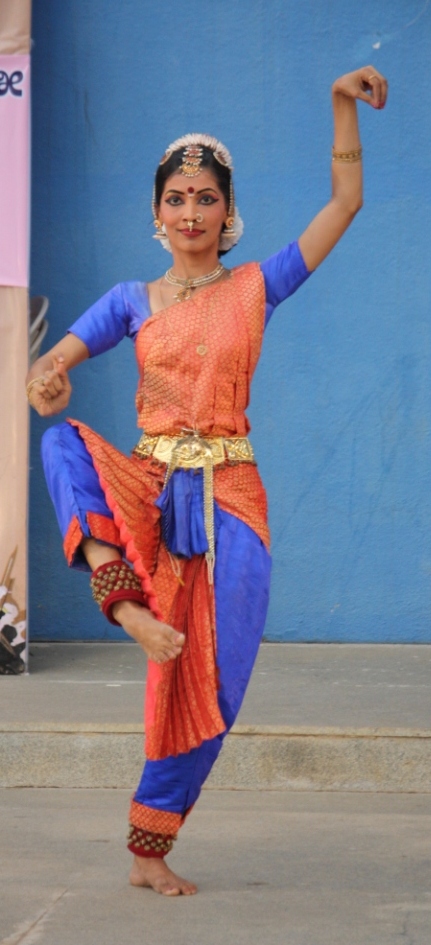
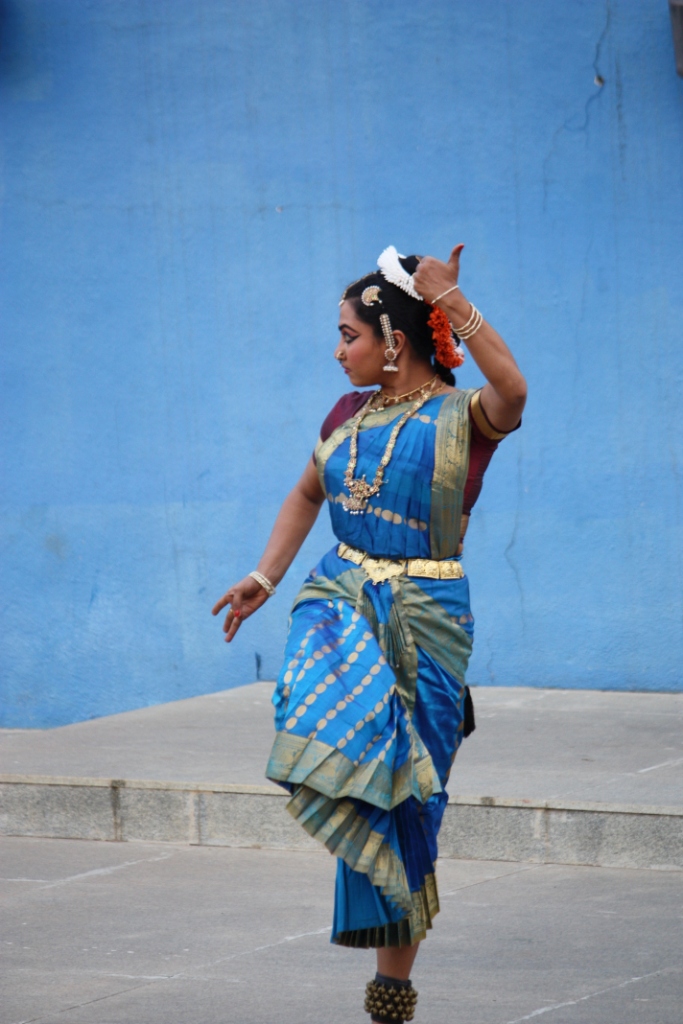
There aren’t many activities in which one can capture an entire story in a single still photo as well as one can with Indian dance. There’s so much expressiveness in the form. There’s an entire art to the eyes, let alone fine control of the rest of the body.

DAILY PHOTO: Blue

Taken on March 1, 2015 in Freedom Park, Bangalore

Taken on March 1, 2015 in Freedom Park, Bangalore

IMG_2032

IMG_1925 IMG_1891 IMG_1831

BOOK REVIEW: Zen Mind, Strong Body by Al Kavadlo

Zen Mind, Strong Body: How To Cultivate Advanced Calisthenic Strength--Using The Power Of Zen Mind, Strong Body: How To Cultivate Advanced Calisthenic Strength–Using The Power Of “Beginner’s Mind” by Al Kavadlo

My rating: 3 of 5 stars

Amazon page

This book discusses issues related to a calisthenics-centric approach to fitness. The first thing that one should be aware of is that the book has no such unifying theme as would be suggested by the title. Really, this is a sort of “best of” collection of Al Kavadlo’s blog posts, but—of course—that makes for a really unsalable title. The title is a take-off on Shunryu Suzuki’s Zen Mind, Beginner’s Mind, which is quoted in the front matter. Don’t expect Zen or the mind to formally enter the picture in a major way. I will say that Kavadlo has a Zen approach in that he emphasizes simplicity and paying attention to what one is doing throughout (so many people try to drown out their workouts with music or entertainment.)

I had mixed feelings about this book. On the pro side, Kavadlo is clearly knowledgeable and has a sound and pragmatic approach to fitness. Not only is he not trying to sell you on supplements and fitness fads, he tries to discourage such profit-driven nonsense. You’ll get some good information and sound advice from reading this book. You’ll find out why Kavadlo eschews dietary supplements, how he prepared for a marathon and a triathlon, what advantages calisthenics hold over other strength building activities, and how to avoid injuries.

So what’s the problem with the book? The first problem is rooted in the fact that I paid full price for the book soon after it came out, and–at said price—it’s overpriced for what it is—a rehash of blog posts. It looks like Amazon has dropped the Kindle price. As I said above, I respect Kavadlo’s approach to fitness, and think that he offers some useful insights, but the question is whether you couldn’t get the same insights for less–I think you can. At half the price I paid for this book, I would have been much happier with it. Alternatively, if they had beefed it up a bit—particularly with useful graphics—I might have found it a good buy at the price I paid. The bottom line is it’s a thin book of blog quality material.

My second problem is that they waste too much space with pictures of Kavadlo standing around shirtless in front of random minor NYC landmarks. I understand that a cut, muscular body is the ultimate resume for a personal trainer. However, I suspect that even the ladies and gay men will at some point say, “Enough with the standing around shirtless photos, Al.” For us heterosexual males, the number of these shots is way over the top.

Now, I’m not saying that the number of photos is excessive. They could have used some of that photo space for instructional photos of how to better do the exercises, or to build up to the more challenging exercises. Kavadlo has an excellent YouTube channel, so I know it would be possible to get more photos of him actually doing exercises. (They do have some pics exercise pics, particularly in the sample workout section at the back.)

The book’s 26 chapters are arranged in four parts that deal with background information, calisthenics, cardiovascular workouts, and diet respectively. There is a section at the back that presents a series of sample workouts divided into beginner, intermediate, and advanced levels.

As for my recommendation, I’d say that if you are interested in fitness and see this book at a price of around $4, buy it. However, if it’s at $10, it’s overpriced for what it is. Of course, your views of a fair price may vary. (I should note that I purchased it in Kindle e-book format.)

View all my reviews