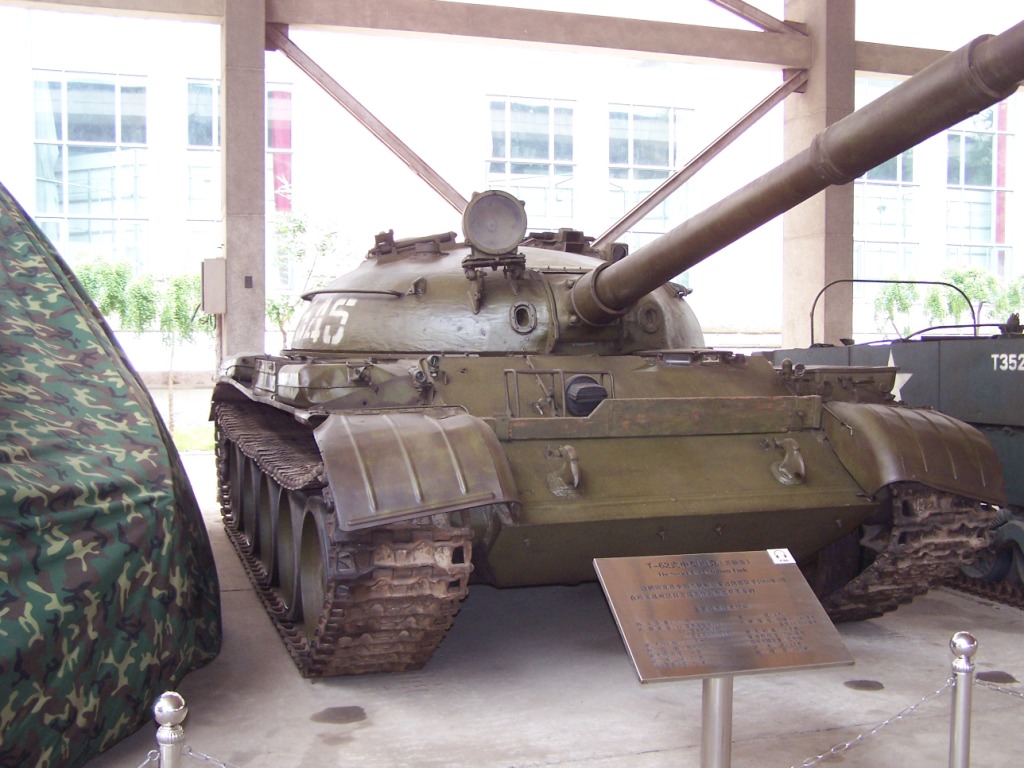
Taken in July of 2008 in Beijing’s Military Museum

Taken in July of 2008 in Beijing’s Military Museum
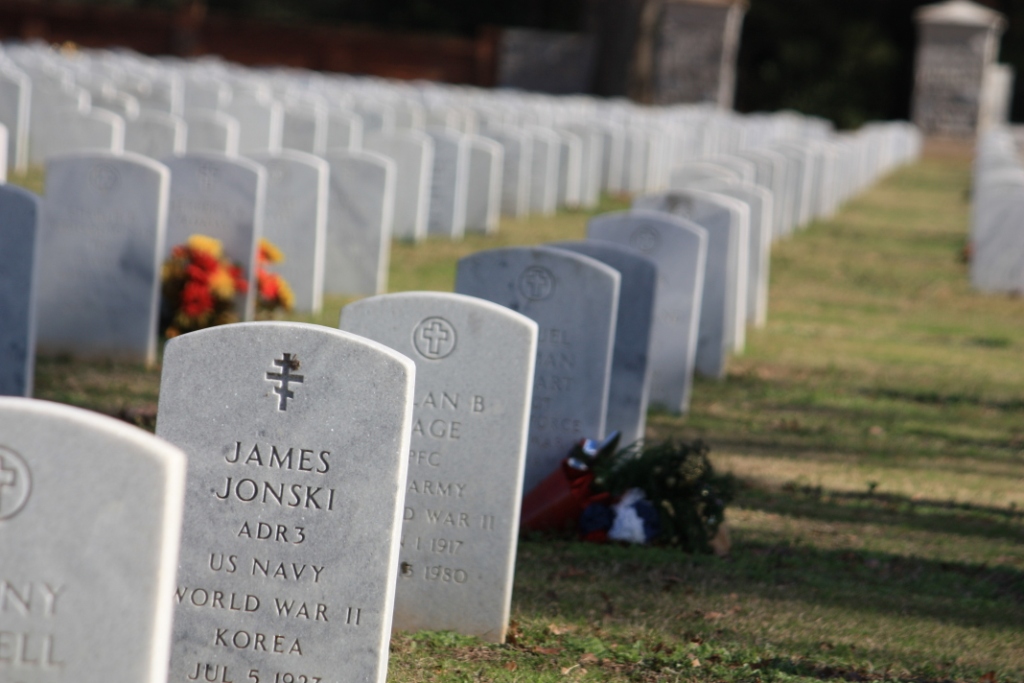
Taken December of 2012 at Andersonville National Cemetery
At a military cemetery like this one, a poem always plays in my mind. It was the first poem I ever memorized in full (not including snippets of some disturbing mandatory children’s poems like “Ring Around the Rosie” [said to be about the Black Death] and–in Indiana–“The Little Orphan Annie” [about an enslaved orphan threatened with goblins.])
At any rate, the poem in question is In Flanders Fields by John McCrae. Sadly, I chose to memorize this poem for a school assignment of poetry recitation because it seemed short and it rhymed. However, in many subsequent re-readings it has become a very powerful bit of verse for me. It may not be perfectly apropos for Independence Day as it was written by a Canadian and is about an entirely different war. However, in some sense it’s about all wars and one motive that drives soldiers of free nations to fight them.
In Flanders fields the poppies blow
Between the crosses, row on row,
That mark our place; and in the sky
The larks, still bravely singing, fly
Scarce heard amid the guns below.
We are the Dead. Short days ago
We lived, felt dawn, saw sunset glow,
Loved and were loved, and now we lie
In Flanders fields.
Take up our quarrel with the foe:
To you from failing hands we throw
The torch; be yours to hold it high.
If ye break faith with us who die
We shall not sleep, though poppies grow
In Flanders fields.
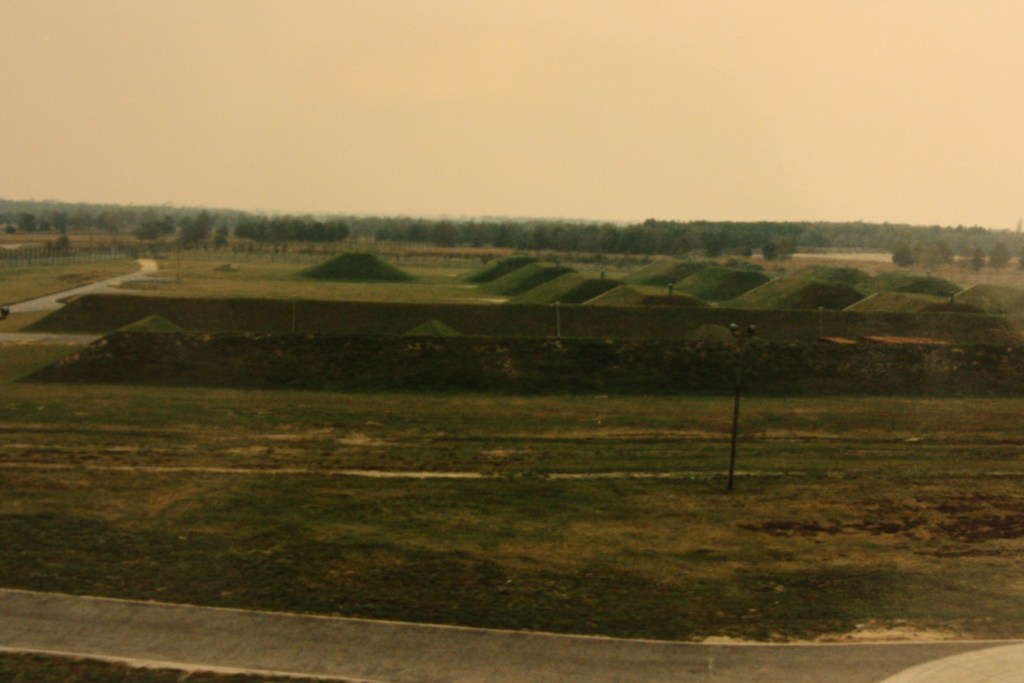
Taken in 1988 or 1989 at RAF Woodbridge.
This is the Non-Nuclear Munition Storage Area at RAF Woodbridge. Those berms are the backside of storage bunkers where munitions were stored. Apparently, long before I was stationed here, they had had a small tactical nuclear storage area whose boundaries (not shown) were easily discernible in my time by the decaying remnants of doubled fences, razor wire, a concrete guard bunker, and a tower.
Anyway, it was a source of great hilarity / headache that the local anti-nuclear groups refused to believe nuclear weapons were no longer present. They would occasionally try to break in to show that security was inadequate for (the non-existent) nuclear weapons. Occasionally, they would succeed–because there weren’t nuclear weapons and so one airman–often on foot–provided security for the whole area, and nothing was line of sight because of the ubiquitous berms. It would take either a long time or a lot of noise to bust into one of the bunkers and one would probably gain access to nothing more than small arms ammo or bomblets for A-10s. So the security risk was not particularly great (compared to tactical nuke storage.)
I preferred the “ghost hunters” that regularly came around over the anti-nuclear crowd, the former were a little more willing to accept evidence than the latter.
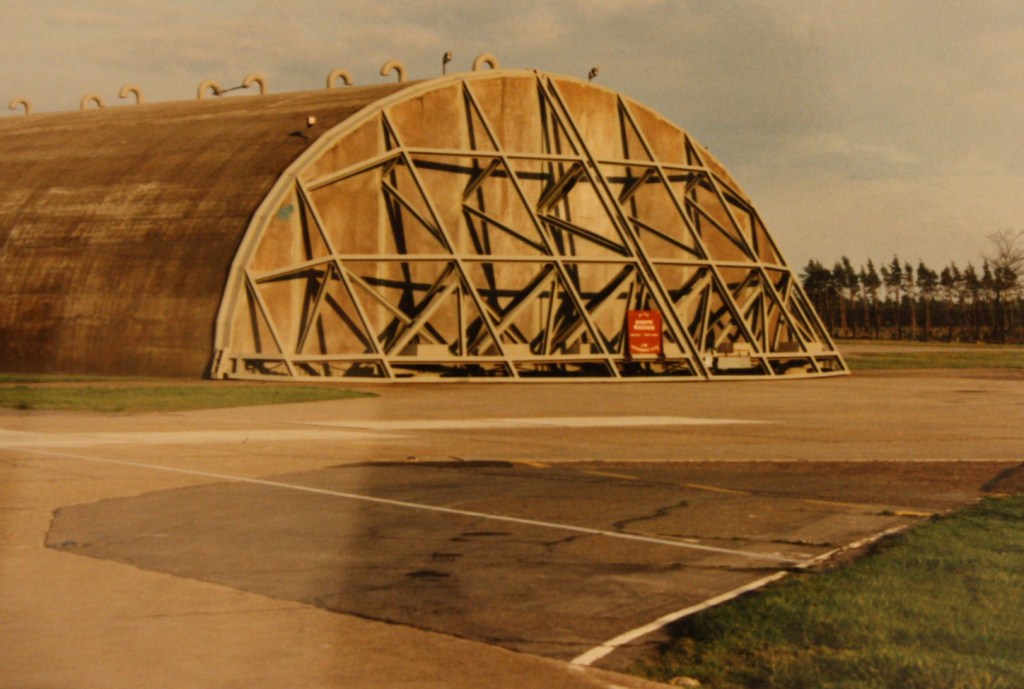
Taken in 1988 when I was stationed at RAF Woodbridge.
Hardened Aircraft Shelters (HAS) are heavy-duty aircraft hangers designed to prevent the wholesale destruction of planes as witnessed in the movie Independence Day at Marine Station El Toro. However, I think the Soviets were considered a more urgent concern than aliens at this particular time. (Oh, how times change.) This particular HAS contained A-10 “Warthogs”– a slow ugly plane that was built around a Gatling gun and that we were about to scrap until we started getting into wars that showed that if one wasn’t fighting dogfights with the Soviets–but rather fighting ground troops and armor of militaries devoid of operational air forces, e.g. in Iraq or Serbia– the A-10 was pretty much the most useful combative plane in the inventory.
I guess there were plenty of sunny days like this, but somehow my memories of England only come when it’s raining.
[Yes, it has come to this–the last bastion of a weary scoundrel. I am rerunning “greatest hits” posts from my first blog. But, if you haven’t seen it, it’s new to you.]
It is easy enough to forget that one is in an authoritarian Communist country when visiting Beijing. They have gone to great lengths to avoid that which Communists around the world have most excelled–constructing buildings that display both a complete lack of creativity and not the slightest hint of visual appeal. On the contrary, the Chinese are putting up some very cutting-edge architecture such as the trouser-leg building, the bird’s nest stadium, and they have even been known to bolt visually interesting facades onto buildings constructed in an era during which they were practicing a more traditional form of Communism. Also, there are few places in the world where market economics thrive more apparently. When I first visited Hungary in the early 1990’s, I was surprised to go into shops and be totally ignored by the sales staff – in some cases while vigorously trying to get their attention. They were simply lagging behind in getting a hang of capitalism. In China, on the other hand, no one would complain that one is being ignored by the sales staff. On the contrary, one is more likely to feel smothered by them. One sales girl of about 1/5th my size actually tried to physically restrain me from leaving by grabbing my wrist.

Oh, there are the hints of the nature of the regime. When one is in Tiananmen Square, there are lists of rules played squakingly over loudspeakers in the manner reminiscent of a concentration camp. However, this is the rare exception. In many cases the Chinese have gone to great lengths to put rules in a positive form. You won’t see “Don’t Walk on the Grass”, but rather signs that say things like “Please Protect the Greenery.” I was told second-hand that someone saw a van pull up and whisk away a local wearing a Tibetan Independence T-shirt while I was visiting, but I cannot corroborate that was true. In general, what I saw was reflective of a market economy in a country that mixed prosperity and poverty in a way not unlike other developing nations that are transitioning upward.

I suggest a visit to the Military Museum for two reasons. First, it houses a sizable and impressive collection of weapons, sculptures, and displays, and it covers a lot of history (mostly 20thcentury, but not exclusively so.) It also seems to be a secret of sorts. It is not a secret in terms of being hard to find. It is located right above a Line 1 subway station that bears its name. That is, where most stations have a name showing in both Chinese characters and the romanized alphabet spelling of the Chinese word, this stop is labeled “Military Museum” in English. However, we had two Beijing guidebooks from large and well-known travel book publishers, and neither had coverage of the museum. This seemed odd because military history is not exactly a rare interest among tourists, and, once inside, it became apparent that this was an extensive museum. My wife and I were two of five non-Chinese tourists that we saw at the Museum, and there were probably a couple hundred visitors throughout the museum at the time.
I think the reason for the lack of visitation by non-Chinese is related to the second reason I recommend a visit here. That is, it gives one a reminder that one is in a Communist country and insight into the nature of what a Communist regime is, and what it does. It is not for those who take umbrage in the face of propaganda, and it is not nearly as friendly as other tourist destinations. There are many statements, such as reference to the Korean War as something like the “Proud War to Overthrow US Aggression in Korea”, that would probably be offensive to many. However, if you are one who can find amusement in an Orwellian framing of events, this museum is for you. Sign-after-sign gives the impression that Mao’s forces were able to crush the Kuomintang, who were armed with the latest and best American arms, while relying on pitchforks, spears, and halberds – because , of course, they always employed superior strategy and had the support of all of the people.

To be fair it doesn’t take an authoritarian regime to put out propaganda, all manner of nationalist forces do this. (In some ways, China reminds me more of a heavily nationalist country than a Communist one. I am told that China has a lesser proportion of its economy owned by the government than some Western democracies, and so the definition of a communist country as one in which the government controls the means of production may not be entirely reflective of China.) While I visited Tokyo on this same trip, I did not get a chance to go to Yasukuni Shrine, which has a museum apparently as full of propaganda as this Chinese Military Museum. Obviously, the two museums mentioned have polar opposite perspectives. The Yasukuni Museum portraying Japan as the victim, rather than perpetrator, of aggression during the Second World War.
However, I am still curious why this is not a destination for the tourists? It is not the case, by any means, that the propaganda is all over the top. In fact, it is, in some cases, subtle. It is also not the case that the museum is altogether hostile to the US and other Western countries. (It should be mentioned that there are some well-deserved anti-Western statements such as those relating to the Opium War.)

There are a few distinct displays of positive relations. For example, among the small arms exhibitions there are cases that pay respect to American gunsmiths such as Samuel Colt.

If imitation is the sincerest form of flattery, then there are quite a number of examples of such flattery in the museum. As I was walking around on the first floor, which holds tanks, missiles, artillery pieces, and other sizable weapons, I came upon what I thought for a moment was an American Humvee. I briefly wondered where they would have gotten one. They have a large number of US World War II era weapons that were either left during that war or shipped to the Kuomintang during the Chinese Civil War, and even a few Viet Nam-era US weapons that presumably made their way from the Communist Vietnamese. However, I was soon disabused of the notion that it was an American Humvee by the placard that said that it was, in fact, a Chinese made “Mengshi” FAV. I have since read that a company in China is actually licensed to make them, and buys a number of the parts from US firms. They also had the spitting image of a Claymore Mine. I have no idea if it was legally licensed or not (but I suspect not.)

There is also a Hall of Friendship that houses a wide range of gifts given to the Defense Minister and other Ministry personnel over the years from various countries. The largest block of these seem to be from Warsaw Pact era countries during the Cold War. However, there are a wide range of countries represented including the US.

Last but not least, in the gift shop you could actually buy “US Ranger” T-shirts and other American military logoed goods (not authentically logoed, mind you, but rather the type of over-the-top imagery that is sold in “Soldier of Fortune” magazine), but the fact that it is sold in a Museum run by the People’s Liberation Army (PLA) is interesting to say the least. As an aside, we came across the PLA surplus store while we were there, and they also sold such US military related wears.
I highly recommend a trip to Beijing. You may need an oxygen supply occasionally, but the food is good, the people friendly, the goods inexpensive, and the history amazing. For anyone interested in history, and particularly military history, the museum has a lot to offer as well– just suspend your disbelief at the audacity of the propaganda at the door.
Those interested in the museum can see more on my other blog .

Taken in 1989 at RAF Mildenhall
I heard that this was the biggest military airshow in Europe that year because a horrible crash at the 1988 Ramstein Air Show shut down that show and maybe some others in 1989. (I stipulate “military” airshow because there is huge airshow in Paris each odd year that features military aircraft but also commercial craft, and that show is not exclusively a Ministry of Defense or Department of Defense endeavor.)
Oddly enough there was also a crash at the 1989 Paris Airshow, but it resulted in no loss of life (the 1988 Ramstein crash caused 70 fatalities and several times that number injured.) There was no crash at Mildenhall in 1989 though. I remember the F-18 being about the most impressive thing that flew that year. This, I believe, is a Panavia Tornado, but I’m not that familiar with planes–particularly non-US models–so I could be wrong.
 On Killing: The Psychological Cost of Learning to Kill in War and Society by Dave Grossman
My rating: 5 of 5 stars
Grossman’s work reports on a line of research started by Army historian and author of “Men Against Fire” S.L.A. Marshall. Grossman not only brings us up-to-date on this thesis, he shows us its ramifications for modern society-at-large.
A two-part thesis was advanced by Marshall and continued by Grossman and others.
First, humans, like other species, are reluctant to kill within their species. (Marshall noted that in World War II about 75% of soldiers would not fire on the enemy when they had the opportunity. There is evidence this was true for earlier wars as well.
Second, the percentage of soldiers firing on the enemy could be increased by training that conditions them to shooting targets that look more human. i.e. Instead of shooting bulls-eyes, they should at least shoot a shape that looks like the silhouette of a man’s head and shoulders.
It turns out that the ability to condition combatants proved correct. There was a progressive increase in genuine engagement of the enemy by soldiers in subsequent wars (i.e. the Korean and Vietnam Wars.)
Grossman goes on to say that this type of conditioning is not limited to soldiers and police officers. He suggests that video games in which gamers shoot at humans and humanoid creatures will desensitize players to trigger pulling. Many scoff at this idea because they think that he is saying that such games make killers. What he is suggesting is a bit more subtle than that. He is saying that a person who is pre-dispossessed to go on a killing spree will be less reluctant if they have undergone the conditioning of this type of gaming. In essence, an high barrier to going on a killing spree will be lowered.
Grossman covers many other issues related to killing, such as the importance of distance. One intriguing fact is that an infantryman that kills a single enemy soldier in war is more likely to have problems such as Post-Traumatic Stress Disorder (PTSD) than a bombardier who drops bombs that may likely resulted in hundreds or thousands of deaths.
The book also talks about the role of authority, famously addressed by the Milgram experiments. Stanley Milgram found that most people would turn a knob that they believed was delivering a severe shock to a complete stranger, if they were told to do so by someone who seemed to be an authority figure.
I highly recommend this book for those interested in the subjects of:
– PTSD
– the role of violent video games in mass killings
– the psychological effects of killing
 Matterhorn: A Novel of the Vietnam War by Karl Marlantes
My rating: 5 of 5 stars
Marlantes gives one insight into what it was like to be a soldier, in particular a young officer, during the Vietnam War. For those confused by the name, “Matterhorn” is the name of a fictional encampment in central Vietnam in the book.
In Matterhorn, war is as it has famously been defined, “long periods of intense boredom punctuated by brief instants of sheer terror.” The author builds his characters such that the periods of intense boredom are informative. We see how the tension of the war boils over into fresh hell that interrupts the boredom.
Racial issues play a major part in the drama of the book. The main character, Waino Mellas, is white and of the variety who are almost apologetic in the presence of blacks. However, within the unit there are both black-power movement types as well as good ole boys, making for one powder kegs that erupts during the course of the book.
Race is not the only fault line we see in Matterhorn. There is also a tension between “lifers” and draftees. However, the bigger tension is between the front line troops and those who direct them from afar. The most intense section of the book involves a raid on a hill for which the men are undernourished and under-supplied.
The author was a Marine in Vietnam, and this experience no doubt contributed to the book’s authenticity.
I highly recommend this book as a powerful examination of the role that valor and vice play in war.
 We Are Soldiers Still by Harold G. Moore
My rating: 3 of 5 stars
This book is a mix of the story of meetings between American and Vietnamese military men a couple of decades after the war and a treatise on leadership and war –plus some filler material. It’s a follow-up to a book written by the same authors on the Battle of Ia Drang, We Were Soldiers Once… and Young. That book was the subject of a movie starring Mel Gibson.
Both parts of the book are interesting, but this book is at its best when it discusses the meetings with Vietnamese officers. General Moore (Lt. Col. at the time of Ia Drang) gets to meet with the opposing commander at Ia Drang, Lt. Gen. Nyugen Hu An, and get his perspective on the battle. While the meetings go from being tentative to cordial with changing political winds, one gets a feel for the tension and the melting away of those tensions. With the latter meetings, additional U.S. fighters from Ia Drang are present, and not all have as easy of a time letting bygones be bygones as Gen. Moore. The group of U.S. soldiers spends the night on the Ia Drang battlefield (in an area that was near the border and not entirely settled at the time of their return.)
I don’t wish to suggest that the second part, which talks about leadership strategies and views on war, is not worthwhile, but it very much felt like padding to get the book up to a salable thickness. Gen. Moore is obviously quite competent to address these subjects, but the shift in the book is glaring and jarring.
This is very different kind of book than its predecessor. If you are expecting a tale of war, that’s not what you’ll find. If you are interested about how mortal enemies can be come close friends, you’ll find this book intriguing.


 Tiger Riding for Beginners