“Crossing 16” by Rabindranath Tagore [w/ Audio]

You came to my door in the dawn and sang; 
it angered me to be awakened from sleep,
and you went away unheeded.
You came in the noon and asked for water;
it vexed me in my work,
and you were sent away with reproaches.
You came in the evening with your flaming torches.
You seemed to me like a terror and I shut my door.
Now in the midnight I sit alone in my lampless room
and call you back whom I turned away in insult.

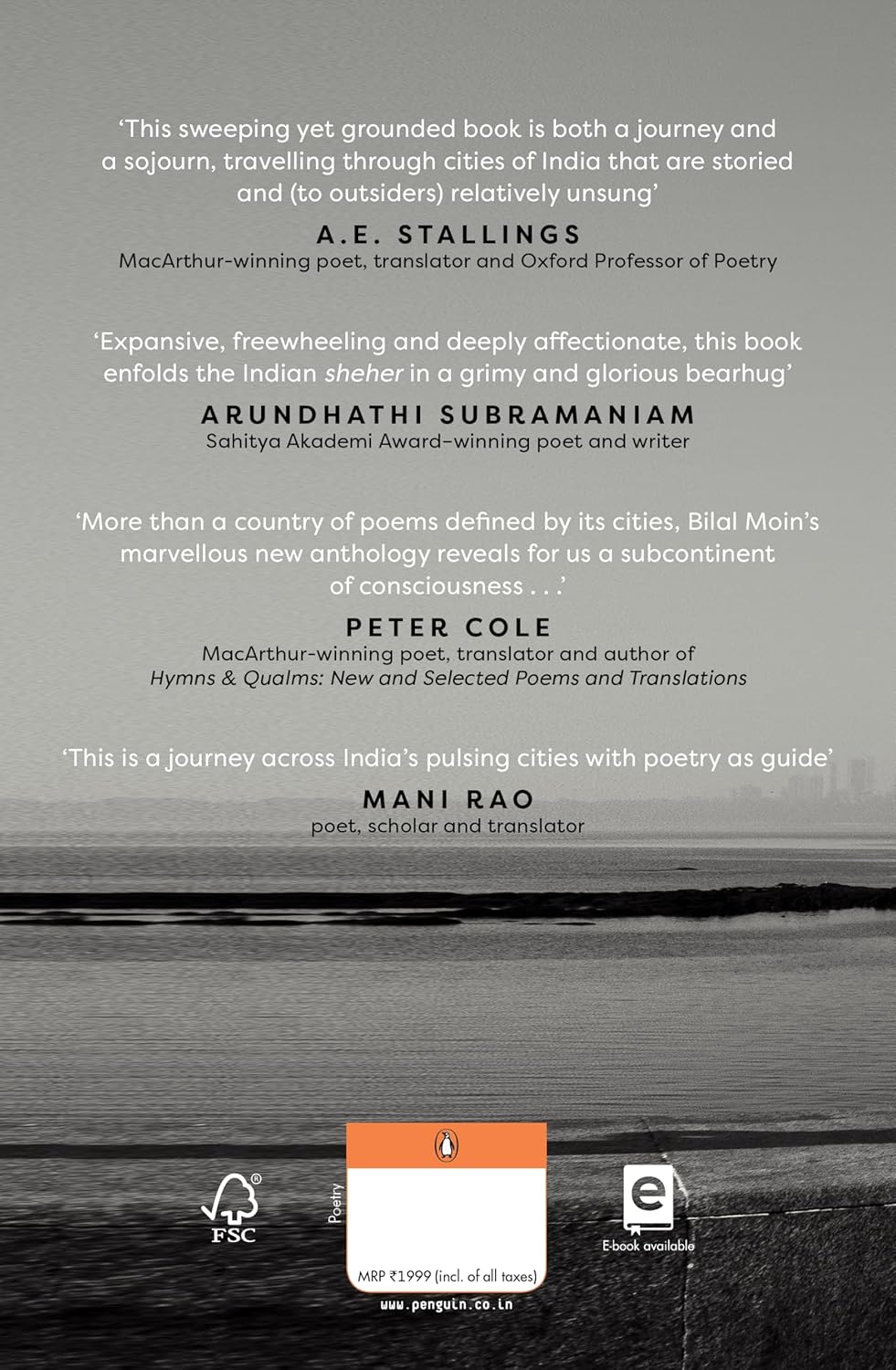
shamless plug: THE PENGUIN BOOK OF POEMS ON THE INDIAN CITY

I have a piece in this new collection, out today (May 30, 2025) in the Indian market and later in the year for international markets.

GoodReads Page Amazon.in Page

shamless plug: THE PENGUIN BOOK OF POEMS ON THE INDIAN CITY

I have a piece in this new collection, out tomorrow (May 30, 2025) in the Indian market and later in the year for international markets.

GoodReads Page Amazon.in Page

BOOKS: “The Penguin Book of Indian Ghost Stories” ed. by Ruskin Bond

Penguin Book of Indian Ghost StoriesPenguin Book of Indian Ghost Stories by Ruskin Bond
My rating: 5 of 5 stars

Publisher’s Website

This is an anthology of stories of the supernatural set in India or built around characters and contexts of India. About half of the stories are by writers of non-Indian ancestry, though some were born or lived extensively in India (e.g. Rudyard Kipling and C.A. Kincaid.) Not all of the pieces are “ghost stories” in a technical sense, but they all revolve around the supernatural or surreal experience.

I enjoyed all the stories in this collection, but among my favorites were: “The Brown Hand” by Arthur Conan Doyle; “The Strange Ride of the Morrowbie Jukes” by Rudyard Kipling; “The Fire-Jogi” by A.C. Renny; “Fritz” by Satyajit Ray; “Anath Babu’s Terror” by Satyajit Ray; “The Yellow-Legged Man” by Sudhir Thapliyal, and “Topaz” by Ruskin Bond.

If you enjoy scary stories, I’d highly recommend this book.

View all my reviews

“Gitanjali 7” by Rabindranath Tagore [w/ Audio]

My song has put off her adornments.
She has no pride of dress and decoration.
Ornaments would mar our union;
they would come between thee and me;
their jingling would drown thy whispers.

My poet's vanity dies in shame before thy sight.
O master poet, I have sat down at thy feet.
Only let me make my life simple and straight,
like a flute of reed for thee to fill with music.

NOTE: This poem is sometimes titled, “My song has put off her adornments,” or – simply – Song VII.

BOOKS: “How to Love in Sanskrit” Trans. by Anusha Rao & Suhas Mahesh

How to Love in SanskritHow to Love in Sanskrit by Anusha Rao
My rating: 4 of 5 stars

Amazon.in Page

As one can tell from the title and cover, this is an anthology of poems translated from Sanskrit to English on the subject of love, relationships, and eroticism. The source poems come from a diverse collection of writings.

The translators made an editorial / translation decision to place the translations in a modern context. By that I mean that the poems, most of which were written hundreds of years ago, have references to cell phones and dating apps, as well as many colloquialisms and expressions du jour. Some readers will love how this makes it readable and relatable in the present-day. Others will find that it distracts and takes one out of the experience of reading classical literature. I’m not saying the decision is good or bad, but it is something of which a potential reader should be aware. The only critical comment I have on the matter is that, if you should be reading the book ten years from now, there will likely be both language and technical references that have not aged well, and which you will probably have to go to your AI historian to figure out. (Some expressions are cliched now.)

I did enjoy how much ground the collection covered. The poems are grouped into categories sticking to the “How To” motif of the book, e.g. “How to Flirt,” “How to Yearn,” etc. I will say I went through a period early in the reading in which it seemed like poem after poem was confusing teeny-bopper lust for love, seemingly celebrating pathologies like jealousy and co-dependence. Throughout this phase of the book there were a number of poems that read like bad schoolboy poetry. However, in later chapters there were more poems that were dignified and reflected a more mature grasp of the subject.

There were some features of the book that I loved. First of all, most of the poems have explanatory notes at the end that can be very helpful both because (as mentioned) most of the poems were written long ago and because I am a foreign reader. Secondly, there is an appendix with romanizations of the original Sanskrit.

Ultimately, I’d say a major factor in whether this anthology is for you will be whether you enjoy the colloquial tone and free verse form or find it off-putting.

View all my reviews

BOOKS: “One Hundred Poems of Kabir (1915)” Translated by Rabindranath Tagore

One Hundred Poems of KabirOne Hundred Poems of Kabir by Kabir
My rating: 4 of 5 stars

Amazon.in Page

Kabir was a fifteenth century Indian poet and mystic. This collection was translated by the Bengali Indian Nobel Laureate Rabindranath Tagore, and Tagore’s stylistic imprint is felt in these poems. The poems are overwhelmingly of a mystic / spiritual nature. Kabir was non-sectarian but extremely oriented towards mystic belief. He references the Koran and Vedas alike, but is more likely to communicate in secular, if mystical, terms.

How much the godly emphasis works for the reader will vary greatly. For me it was a bit excessive, often reading more like prayers than poems, but your results may vary.

The only thing I found actually disturbing was the repeated romanticization of sati, a practice in use during Kabir’s lifetime in which widows would be burned alive on their husband’s funeral pyre. Kabir repeatedly writes of sati as if it was always a completely voluntary act of raw passion and connection and was never motivated by being old and destitute (not to mention being societally pressured or, even, physically forced into it.)

The poems are well composed and engaging, and if you can get past the periodic sati propaganda, it’s a pleasant, almost euphoric, read.

View all my reviews

“There Is a Bird in the Tree” by Kabir [w/ Audio]

On this tree is a bird:
It dances in the joy of life.
No one knows where it is:
And who knows what the burden
Of its music may be?
Where the branches throw a deep shade,
There does it have its nest:
And it comes in the evening
And flies away in the morning,
And says not a word
Of that which it means.
None tell me of this bird
That sings within me.
It is neither coloured nor colourless:
It has neither form nor outline:
It sits in the shadow of love.
It dwells within the Unattainable,
The Infinite, and the Eternal;
And no one marks
When it comes and goes.
Kabir says, “O brother Sadhu!
Deep is the mystery.
Let wise men seek to know
where rests that bird.”

NOTE: This is the translation by Rabindranath Tagore from the 1915 text, One Hundred Poems of Kabir. This is poem #30 (XXX) of that volume.

“Gitanjali 35” by Rabindranath Tagore [w/ Audio]

Where the mind is without fear and the head is held high;
Where knowledge is free;
Where the world has not been broken up into fragments by narrow domestic walls;
Where words come out from the depth of truth;
Where tireless striving stretches its arms towards perfection;
Where the clear stream of reason has not lost its way into the dreary desert sand of dead habit;
Where the mind is led forward by thee into ever-widening thought and action
Into that heave of freedom, my Father, let my country awake.

NOTE: This poem is often entitled “Let My Country Awake,” particularly when it is anthologized independently of the larger Gitanjali poem.

“The Gardener – 85” by Rabindranath Tagore [w/ Audio]

Who are you, reader, reading my poems my poems an hundred years hence?
I cannot send you one single flower from this wealth of the spring,
  one single streak of gold from yonder clouds.
Open your doors and look abroad.

From your blossoming garden gather fragrant memories
  of the vanished flowers of an hundred years before.
In the joy of your heart may you feel the living joy that sang one spring morning,
  sending its glad voice across an hundred years.