Living Root Bridge (both has plants growing in it and roots still growing); Taken in Riwai on April 19, 2017

One of the longer root bridges; Taken near Nongthymmai on April 18, 2017

Double Decker Root Bridge; Taken on April 18, 2017 near Nongthymmai

Living Root Bridge (both has plants growing in it and roots still growing); Taken in Riwai on April 19, 2017
One of the longer root bridges; Taken near Nongthymmai on April 18, 2017
Double Decker Root Bridge; Taken on April 18, 2017 near Nongthymmai

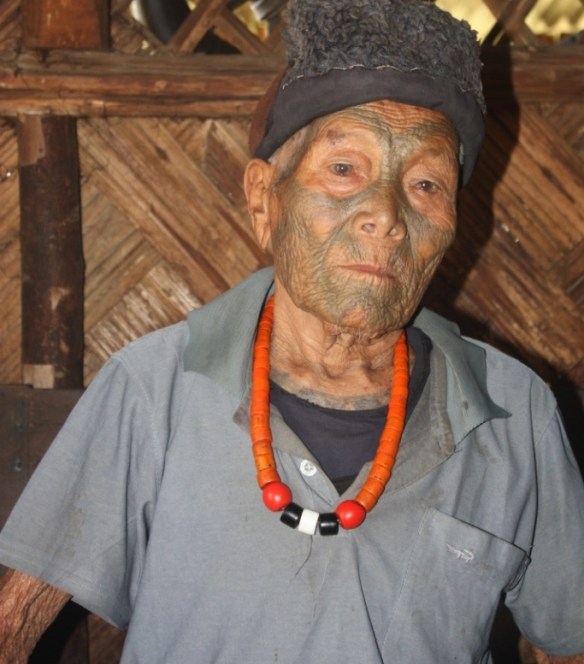
The Chief; Taken on April 27, 2017 at the Hungpoi Village in Nagaland, India
Nagaland is a fascinating place. Back in the days before colonialism and proselytizing missionaries, the tribes practiced headhunting. The Chief’s wife would tattoo the face of any warrior who returned from battle with the head of a fallen enemy. Hence, you see the blue tint to these men’s faces. Hungpoi, which is a short drive from Mon, has one of the highest concentrations of those who lived during this time, but they are a disappearing breed.
I was fascinated to discover how many features of their tribal experience echoed what one reads about in Chinua Achebe’s “Things Fall Apart.” That book is considered to be one of the quintessential novels of the African experience, but it seems that these Asian tribes shared many features. Their hyper-masculine societies morphed as Christian missionaries came in, backed by the might of colonial powers, and converted the population. Internecine killing–accidental or purposeful–was punished by a seven-year period of exile. Shaming was used as punishment much more than is possible in our–to use Desmond Morris’s term– super-tribes.

Some of these elder warriors wear necklaces showing the number of heads that they collected in warfare. This is in contrast with other elements of ornamentation which, according to one of these men, were more about attracting a mate.


In a sacred forest
a Rodent roamed
who owned a sword
it freely loaned.
This was no hacking
machete blade,
but made of metal
of unmatched grade.
One day Lightening
made a request:
To borrow the blade
believed the best.
Lightening zigged,
sliced, and zagged.
Claiming ownership
in its boastful brags.
The rightful owner
requested its return.
But the rodent’s
plea met only spurn.
So the critter devised
a clever, sensible plan
in order to bridge
the requisite span.
It needed to climb
from Earth to the sky
because it had no
wings with which to fly.
But it wasn’t just wings
which Rodent lacked.
It had only one item
to be skyward stacked.
So it piled its poop
as high as it could,
from the base of a tree
past the top of the woods.
Stacking and piling, the
poop nearly touched cloud.
When a thunder crack
struck ear-splitting loud.
Lightening saw rodent
would reclaim the sword
that Lightening had come
to so ardently adore.
Down fell the Rodent
to a pile of fried dung
that had once been its
steps and its ladder rungs.
You may think that
Lightening got its way.
But the Rodent piles
its poop to this very day.
Someday when Lightening
is momentarily distracted,
Rodent’s sword will be
surreptitiously extracted.

Taken on April 23, 2017 at Kaziranga National Park in Assam
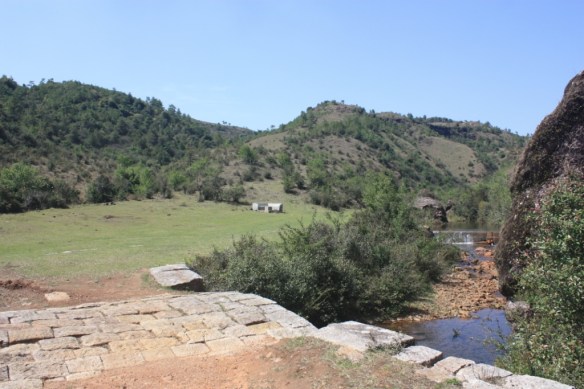
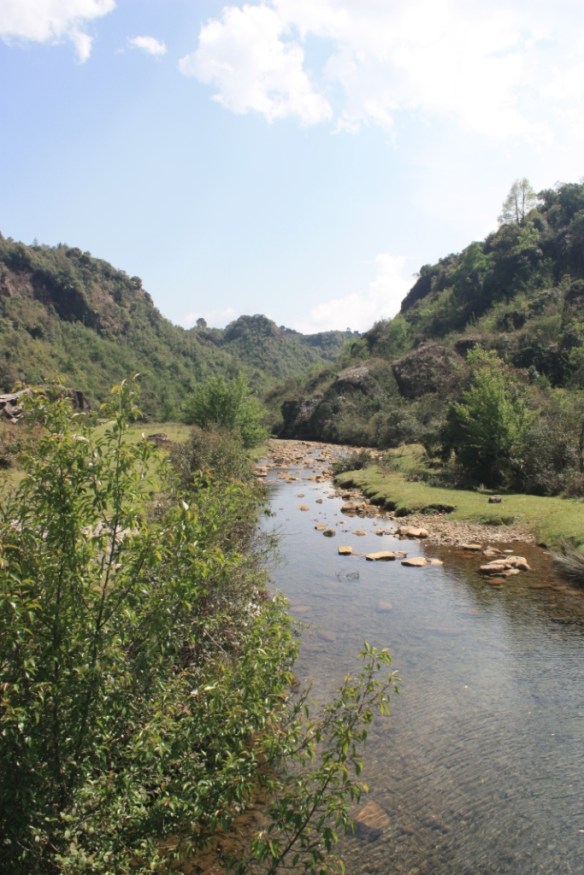


Taken on April 17, 2017 on the David Scott Trail

This was the view were we came off the trail near Lad-Mawphlang
I’m back after three weeks traveling about the Indian Northeast, i.e. the states of Meghalaya, Assam, Nagaland, and Manipur. And I’ve got a pile of pics.
The David Scott Trail is a hiking trail that was built as a carriage trail from Burma into India at the behest of the British colonial leader whose name it bears. Since it was made for traffic by animal-drawn carriages, it makes for easy hiking. It’s a scenic trail. It should be noted that (like most trails in India) it isn’t well-marked, however, the fact that it is wider than most trails and has old paving stones along much of the route makes it fairly easy to avoid getting lost.
We hiked only the section from Mawphlang to Lad-Maphlang. It’s an easy day hike.
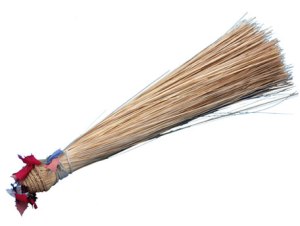
Bristles flex against the flagstone.
Like Bruce Lee with his nunchaku,
she works two brooms at once.
Unlike Bruce,
she lacks fury and showmanship.
She’s oblivious an audience has formed.
Like Bruce, her body is coordinated,
capable of describing two arcs,
in two separate directions,
at once.
The soft scraping sounds
of two bundles of bristles
is the neighborhood’s wake-up call.
The hush whispers of leaves skittering
is the subdued scream
that cannot be ignored.
Like a demonic whisper,
all that’s quiet is not gentle.
[National Poetry Month, Poem #23]
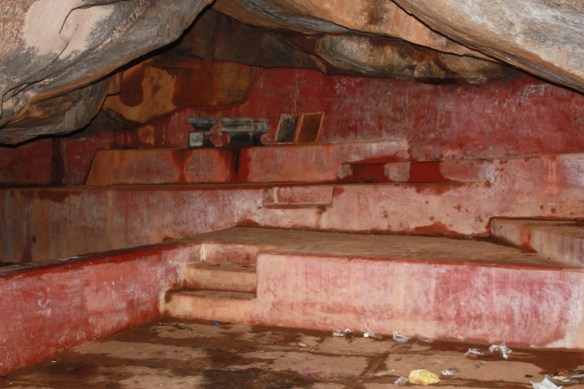
Taken in October of 2013 at Nandi Hills
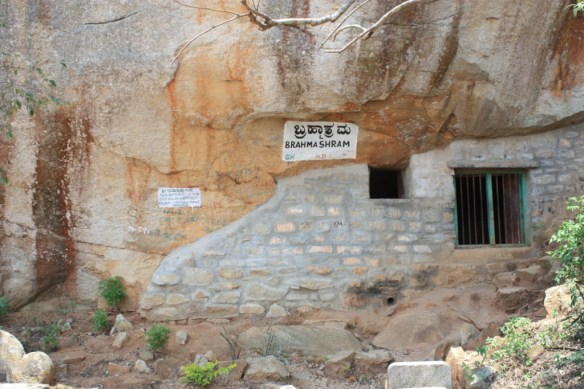
Brahmashram is an ascetic’s cave located on the hillside at Nandi Hills. It’s most famous occupant was the sage Ramakrishna Paramahansa (1836 – 1886), who was a teacher of Swami Vivekananda.
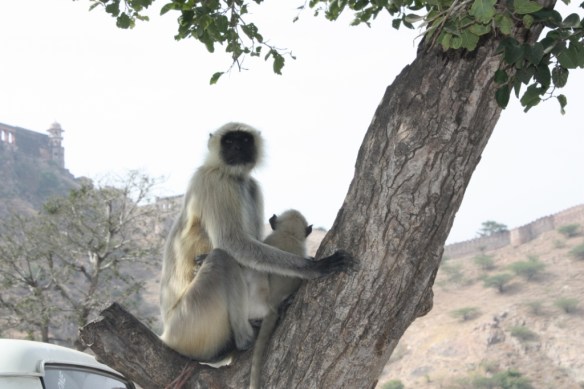
Taken in Jaipur in November of 2015