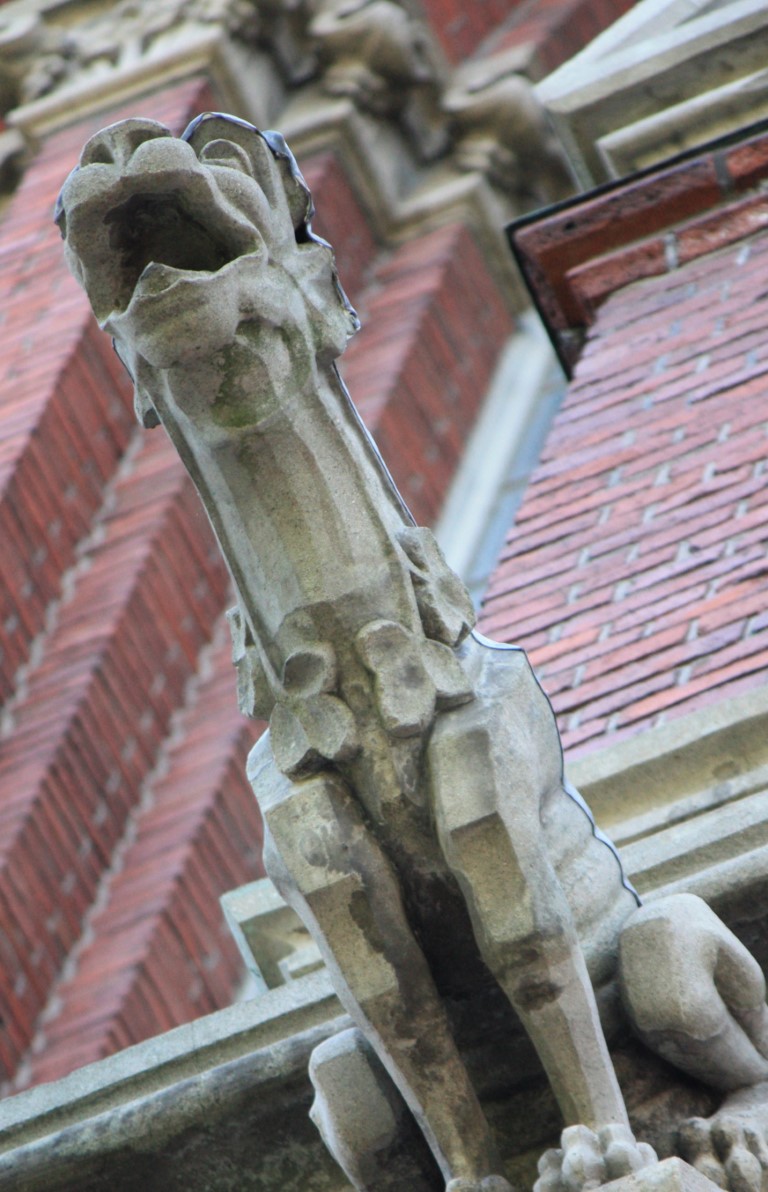
I first saw the stone beast by the light of a bright day -- frozen, still & placid My second sighting was on a rainy night, a steady, careless rain, the kind of rain that seems to have declared itself the new default mode. I saw it in the space of lightning flash -- the silhouetted gargoyle. It lacked the fine detail of its sculptor's effort. It lacked the clean edges and ornamental effects. Imagination filled in the lost detail with scales rippling under muscular flesh. And while the lightning felt prolonged, it was still just a flash -- leaving me to wonder whether I'd really seen it rear back, preparing to lunge off the wall? And then I saw the world through its eyes and all was better... and then all was worse.
Category Archives: horror
Dreaming Evil Clowns [Spencerian Sonnet]
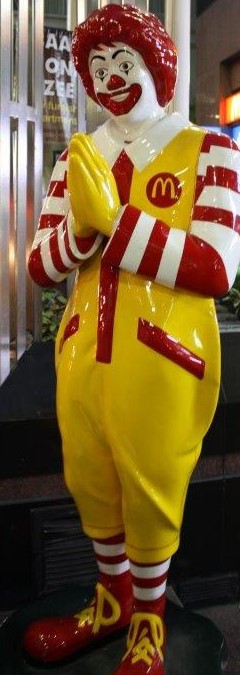
My lungs were burning as I ran through town, and tried to escape the streets of cobbled stone and he from whom I ran, that evil clown, whose paint obscured a face I once had known, but how could I know something that's unknown and, thinking that, I knew it made no sense, though I knew it true deep within my bones. Then stirred by eyes so burning and intense, I picked a pointy stick for my defense, and chucked it at the creature's beastly heart. I missed its heart by width of a ten-pence. The clown, in turn, tossed it back like a dart. Awaking to sharp pains in my frail chest, the clown had slayed me, or so I guessed.
Necropolis [Free Verse]
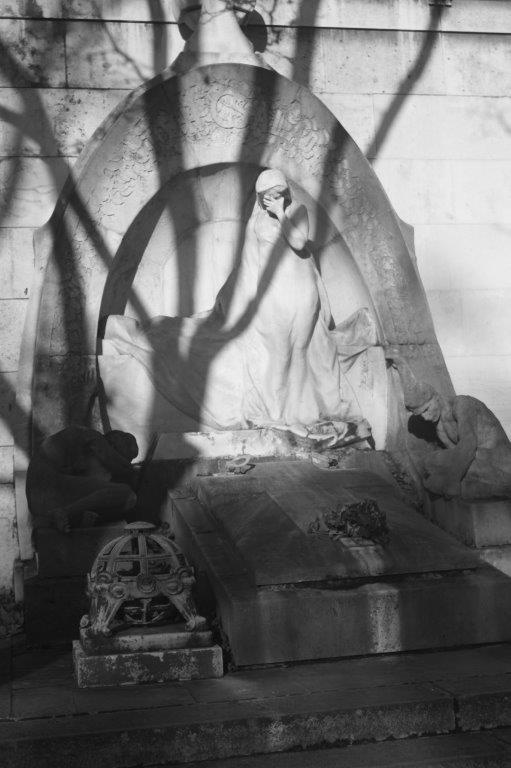
a city of the dead tunneled under the living, awaiting the flip, a shift in who's who -the living & the dead, -the dead & the living -the alive and the existent -the living dead & those dying alive all jumbled together in a sea of inhumanity, tumbling past each other, scrambling for humanity - for the breath of life, for life in a breath the musty scent of decay in the living city was the first sign... those in the necropolis smelled flowery scents -- clean and bright -- and found those fragrant perfumes as revolting as the living found the rot stench in the brief time it took to become acclimated to the stink, all found themselves in the churn, struggling for more of something they didn't understand
BOOK REVIEW: The Gold Persimmon by Lindsay Merbaum
The Gold Persimmon by Lindsay MerbaumMy rating: 4 of 5 stars
Amazon.in Page
Out: October 5, 2021
This book consists of two stories with the common connection of being set in strange hotels. The first story is split between parts one and three (of three.) This allows part one to tell a story that feels like straightforward realism (while part three is where the story gets a bit trippy and where – in that trippiness – the reader may see connections between the two stories that may or may not be intended.) It’s the story of Cly, an employee of a fancy hotel [The Gold Persimmon] that specializes in serving a grieving clientele, and her love affair with a regular guest, Edith, who is a physician. The strangest thing in this story is that Cly is probably the most attached to her job of any low-level hotel employee in the history of low-level hotel employees.
The second story’s protagonist, Jaime, is an aspiring writer of nonbinary gender identification who is about to take a job in another hotel, a Japanese-style love hotel. [For the unfamiliar, that means a place with themed rooms where people come for short-term stays to get their freak on – think: dungeon, subway train interior, etc.] This story gets weird almost immediately as a fog descends over the city leaving only a few employees and customers trapped together inside the hotel. This is a much more engaging story than the other. The few people in the hotel inexplicably go all “Lord of the Flies,” and the reader can’t be sure whether it’s descent into madness from whatever fog has enveloped the hotel, or whether they are mostly unstable from the start.
It’s extremely difficult to write surreal- / madness-based stories that aren’t distractingly unclear about what – if anything – is real. I felt this story suffered from two difficulties. First, Jaime’s internal monologue sways radically from what seems like extreme paranoia to very reasonable states, but we don’t know the character enough to have a baseline. Second, many of analogies used in describing events read a bit clunky, causing one to need to re-read to try to make sense of whether what is said is what is actually being seen or whether it’s just a confusing metaphor.
That said, I was engaged throughout the story, and found it compelling enough to need to keep reading. I’d say if you don’t mind some ambiguity and experimentation in writing, you’ll enjoy this book. If not, not.
View all my reviews
BOOK REVIEW: When a Robot Decides to Die and Other Stories by Francisco García González
When a Robot Decides to Die and Other Stories by Francisco García GonzálezMy rating: 4 of 5 stars
Amazon.in Page
Out: November 15, 2021
This book isn’t for everyone. There are two factors I believe a reader needs to be aware of going forward. First, shocking and taboo plot devices are used throughout; so, one needs to be mentally ready for bestiality, necrophilia, cannibalism, and enslavement. Second, while this is nominally science fiction, it’s not nerd’s sci-fi, but rather English Lit / Humanities major sci-fi. Which is to say, scientifically- / technologically-minded people are likely be occasionally distracted by thoughts like: “that’s not how that would work,” or “why did he use that word? It doesn’t make sense in that context. Is it just because it sounded vaguely techy?”
For those who are still reading, the stories are more than just shock for shock’s sake. They are thought-provoking, and the taboo topics both engage readers on a visceral level, but also engage readers on an intellectual level as symbolism. While it’s far from great sci-fi, it’s fine psych-fi (a subgenre that – like sci-fi – deals in speculative futures, but which focuses more on changes in human modes of interaction and ways of behaving – rather than on the effects of technological advances.) “The Year of the Pig” was probably my personal favorite. That story explores family dynamics, cultural proclivities, and personal psychology in a smart way.
If the opening paragraph didn’t scare you away, you’ll probably find some compelling stories in this collection.
View all my reviews
BOOK REVIEW: I Breathed a Body by Zac Thompson
I Breathed a Body by Zac ThompsonMy rating: 4 of 5 stars
Amazon.in page
Out: October 5, 2021
This is one creepy commentary on technology run amok, and the alienation, desensitization, and disconnection that can result. [Or, at least that’s how I interpret it.] The protagonist is a driven social media executive who finds herself in territory that even she believes is over the line, despite her near psychopathic emotional disconnection. Another way to interpret the story is that the fungi that has taken parasitic control over humanity is making people see the world more as they would – i.e. with less cringing about death, decomposition, and deformation. [I happen to think that the fungi infection is a clever plot device to get across ideas about technology and modernity, but I could be wrong.]
Either way, I do think this is a clever story. There’s a species of Cordyceps fungi that takes control of the brain of an ant, steers it to the top of the nearest tree, and bursts out of the ant’s head to spread its spores from its new, elevated vantage point. This book reminded me of the Cordyceps fungi, and I wouldn’t be surprised if it inspired the story — with the requisite growth in sophistication to account for taking over a much more complex brain. This is a compelling and thought-provoking story, but it’s also gruesome and at times chaotic. If you can take horror, you’ll probably find it worth reading.
View all my reviews
BOOK REVIEW: Crueler than Dead, Vol. 1 by Tsukasa Saimura
Crueler than dead, vol.1 by Tsukasa SaimuraMy rating: 4 of 5 stars
Amazon.in Page
Out: October 12, 2021
A teenage girl regains consciousness in a bland institutional setting to discover that she has been part of medical experimentation. Her mission, should she choose to accept it, is to get a vile of vaccine tested on her and the young boy who will be her traveling companion (as well as, on a bunch of people who didn’t survive) to a stadium in the heart of a Tokyo, a city overrun by Zombies. This is a manga-style graphic novel (i.e. black-and-white panels read right to left.)
I found the work to be in the meaty middle among the vast Zombie subgenre – neither among the best nor the worst. What I think the book did well was set up stakes for intense action. They have to journey to the center of the world’s most populous city to the only un-Zombified people known to remain living. So, the stakes are the continued existence of our species. What the book doesn’t do so well is maintain pace and a clear narrative thread. Textless panels are used to make transitional jumps and it’s not clear to me that most readers will follow the flow smoothly.
If you enjoy Zombie stories and manga comics, you may want to look into this one. It has a video game like aesthetic and feel which may (or may not) appeal to gamers more than the average reader. If you find Zombies overplayed and are looking for only the best of the best in Zombie stories, you’re unlikely to find that here.
View all my reviews
BOOK REVIEW: Nightmare in Savannah by Lela Gwenn
Nightmare in Savannah by Lela GwennMy rating: 4 of 5 stars
Amazon.in Page
Out: November 9, 2021
Like New Orleans, Savannah is one of the few American cities that can pull off Old World occult-centered stories in a way that is on par with Prague or Budapest. While this is a fine story, I was underwhelmed at the degree to which it harnessed the promise of that setting. Mostly, the story plays out as teenage drama that could take place anywhere in America, with the novel addition of fairies [as opposed to the overplayed vampires or zombies.] I will say the book does a better job of getting mileage out of Fairy folklore than it does out of Savannah’s spook factor. These are not Peter Pan’s Fairies.
If you are looking for something akin to “Mean Girls” with less comedy, more angst, and a supernatural element, this book is definitely worth checking out. However, if the title “Nightmare in Savannah” has you expecting a deeply disturbing work of gothic horror, this is probably not the one for you.
View all my reviews
BOOK REVIEW: Van Helsing vs. Dracula’s Daughter
Van Helsing vs. Dracula’s Daughter by Raven GregoryMy rating: 3 of 5 stars
Amazon.in Page
Out: July 13, 2021
This comic book imagines the daughter of the Van Helsing character (from Bram Stoker’s) pitted against the daughter of Dracula in what appears to be more-or-less the present day. It is action-packed, if juvenile and prone to rely on hackneyed dialogue and story points. To clarify, it’s a small team of scantily clad supermodel vampire hunters taking on a scantily clad supermodel Vampiress and her army of expendables. I liked it in the way that one likes movies that one picked on Netflix while mentally exhausted and uninterested in anything mentally or emotionally draining, but rather just some vapid entertainment.
It’s part of a serialized universe of stories, and so, while it can be understood as a standalone story, it is not optimally organized to be read in a standalone fashion. It sort of begins with some action that the [standalone] reader has no context for, and which will not be circled back to in the way a story opening in media res typically would. Put in another way, in the second half of the story, I had to consciously reflect back and try to piece together what the opening material had to do with the overall story being told. I suspect (but cannot confirm) that if one binge read the whole collection, it would probably make more sense.
Besides the ridiculously untactical (virtually painted on) outfits, there is some reverse villain monologuing – which is to say the hero interjects into the action to explain her plot to snatch victory from defeat. Granted that victory would be completely deus ex machina, i.e. out of the blue, otherwise, but that’s not really a redeeming point. [The most (I presume) unintentionally hilarious line involves Van Helsing telling Dracula’s Daughter that VH can’t blame the vampire progeny for missing VH’s super-stealth colleague as the reader sees a pictures of one of the aforementioned supermodels with her skirt slit up two inches above her pelvic crest operating a spade with one leg bare from toes to waist, standing as models do to accentuate the shapeliness of the calf. It’s the most conspicuous ninja operation one could possibly imagine.
As I say, I found this an okay story for a mindless read, but I wouldn’t have too high of hopes for it beyond that.
View all my reviews
BOOK REVIEW: The Neil Gaiman Library, Vol. 3 by Neil Gaiman
The Neil Gaiman Library Volume 3 by Neil Gaiman
My rating: 5 of 5 stars
Out: June 1, 2021
This series collects short fiction of Neil Gaiman and presents it via the medium of the graphic novel. While there are four works listed, because two of these works contain multiple stories, there are actually eight stories contained in this volume. The selection is diverse both in terms of genre and artistic style. With respect to genre, the stories cut across fairy tale, fantasy, horror, supernatural, and tales of the weird. The artistic styles range from art nouveau to comic strip style. While this is the third volume, the included stories all stand on their own, and so there is no necessity to have read previous volumes. Because Gaiman draws heavily on fairy tale source material, parents might assume these are kid-friendly stories, but you should check them out first yourself as “Snow, Glass, Apples” and “The Daughter of Owls” both present somewhat sexually explicit content (the former both graphically and with respect to story events and the latter only with respect to story,) and while the horror stories are pretty calm as horror stories go, they are still works of horror.
“Snow, Glass, Apples” is a dark take on the princess-centric fairy tale. It imagines a vampiric young nymph who appears as challenger to the Queen. This is probably the most visually impressive work, being illustrated in a style that mixes art nouveau with Harry Clark’s stain glass artworks. It is definitely not the run-of-the mill graphic novel, graphically speaking. The art is exceptionally detailed and stunning.
“The Problem with Susan and Other Stories”: As the title suggests, this is one of the two multi-story entries in the collection. The titular main story features a retired Professor who is plagued by Narnia-like dreams, and who receives a visit from a reporter for a college paper. The art for this one is much more reminiscent of the typical graphic novel of today. There are three other stories included. “Locks,” the comic strip-esque illustrated story, is a take on “Goldilocks and the Three Bears” as it’s being told to – and imagined by – a little girl. “October in the Chair” imagines a kind of story competition taking place around a campfire by anthropomorphized “months.” It’s a bit more artistically rendered than the other stories in this [sub-] collection (although that may have to do with the dark tone that is used to reinforce that the stories are being told in the middle of the night in the middle of a woods.) The final story is a brief, but artistically dense, story that imagines a day in which everything goes wrong at once.
The sixth story, “Only the End of the World Again,” revolves around a man / werewolf who wakes up to find that he has clearly turned in the preceding night. The tale is set in a small and remote village, where everyone seems to know everything about everyone, and it doesn’t shock the man when select people let slip that they know his secret. As the story unfolds, it’s clear that the man / werewolf is caught up in something bigger than his own tragedy.
The last entry is a two-parter. The first is one of my favorite Neil Gaiman short stories; entitled, “The Price,” it offers an answer to the question of why some indoor / outdoor cats constantly come home battered and bleeding. The second story, “The Daughter of Owls,” revolves around “the baby left on the church steps” plot mechanism. Because the girl is enveloped in owl accoutrements, she is shunned by the village and forced into exile at a dilapidated former abbey. Both of these stories have a more brush-painted style that the usual graphic novel.
I enjoyed this collection immensely. While not all of the stories were new to me, the way they were illustrated shone a new light on the familiar tales. All of the stories are masterfully crafted and illustrated. While Gaiman draws heavily on well-known fairy tales, there is nothing banal about these stories. I’d highly recommend this book, even if you’ve read some of the stories already.