


Nothing that involves wearing a leisure suit, or a suit of any kind. Except, perhaps, a swimsuit or my birthday suit, or playing a suit in a game of cards… What were we talking about?
PROMPT: Leisure Time
Reply

Nothing that involves wearing a leisure suit, or a suit of any kind. Except, perhaps, a swimsuit or my birthday suit, or playing a suit in a game of cards… What were we talking about?
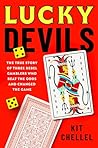 Lucky Devils: The True Story of Three Rebel Gamblers Who Beat the Odds and Changed the Game by Kit Chellel
I go through periods of playing chess on my phone. I guess I enjoy that as much as anything. It’s a fine time pass. Though I’m not any good. If one were to go by what I do reasonably well, that would be more word puzzles or Scrabble — things that rely upon verbal skills. I’ve never been big on games of any variety.
Chess. You can play it anywhere (online, on a phone, on a board, etc.,) everyone knows the rules, and it’s a cognitive workout – rather than being a tedious timepass.

summer berries:
 to pick or let ripen?
  what will birds do?
 Reality is Broken: Why Games Make Us Better and How They Can Change the World by Jane McGonigal
My rating: 4 of 5 stars
The provocative title of this book captures why people are so drawn to games while they are, simultaneously, discontented with their real lives. McGonigal argues that all aspects of human activity could benefit from gamification, and that we should stop thinking of games as trivial endeavors to be engaged in in our spare time. After reading the book, I have a much better understanding of how turning activities into games can increase motivation, productivity, and – if done right – even human interaction. That said, I remain unsettled as to whether her overall thesis is sound.
On one hand, games are unambiguously motivating and captivating. To see it, one needn’t look further than the people playing games for free with at least as much (re: more) enthusiasm and attentiveness as they do those activities for which they are paid a salary. The mechanism by which games spur us is understood. Considering the question from the perspective of Mihaly Csikszentmihalyi’s “Flow” (as McGonigal does in ch. 2) we can see that constant feedback and an impetus to reach ever beyond our current capacity make games Flow-prone activities. Given that Flow is associated with both high productivity and positive mental states, that’s a sound argument in support of McGonigal’s ideas.
That said, I’m afraid that the need for constant, instantaneous feedback and the inability to remain mentally engaged for long periods when one must focus on something dull could have dire consequences for our species. Homo sapiens once had to follow wounded prey for days with constant vigilance, without instantaneous feedback, and with the possibility that the payoff could be lost at any moment. We developed attentiveness and mental discipline in the face of unstimulating conditions at great cost, and it has helped us to achieve great things. What will happen to our mental machinery when no one can pay attention for two minutes if there isn’t the possibility of an instantaneous virtual reward for it? To be fair, McGonigal does acknowledge — and to some degree discusses — these issues, but fails to take on such questions in much detail or with much objectivity. (It should be noted that she does extensively challenge the belief that gaming leads to lonely people living on their couches and never talking to real people in the real world.) The book is extremely thought-provoking, but shouldn’t be taken as an unbiased examination of the rise of gamification.
The fourteen chapters of the book are divided into three parts. The first part (ch. 1 through 6) both introduces what games are and offers insight into what they do for us. This includes an examination of what positive psychology (e.g. Csikszentmihalyi, as mentioned) has to say about games, as well as how games can foster collaboration and give us the ability to take on problems bigger than our individual capacities would allow. Chapter four offers one of McGonigal’s most powerful arguments: that games are a way for people to learn to fail with grace and resilience. Adult humans tend to be severely averse to failure. (There’s a great meme featuring a baby sitting like she just plonked down on her butt, and the caption reads, “What if babies decided after four or five falls, ‘This walking thing just isn’t for me?’”)
The second part (ch. 7 through 10) is entitled “Reinventing Reality,” and it considers how games can be brought into real life to make reality more invigorating. A great example of this can be seen in the discussion of “Chore Wars,” which is a game designed to take household chores out of the realm of mundane drudgery and to make them a competitive activity that excites people. McGonigal uses the story of real games that have been developed for various purposes extensively in both part II and part III. Another example is the “Tombstone Hold ‘Em” game that was designed to address the problem of declining visits to cemeteries. While there are games that address less unusual topics, these two examples are insightful in that they show how virtually any endeavor can be gamified.
The final part (ch. 11 through 14) suggest how games can be used to take on large and difficult problems. Such challenges often remain insufficiently addressed (or unaddressed altogether) because of a lack of immediate motivation to take them on or a structure to organize activities – games can help provide both the motivation and the organization. Readers learn how the wisdom of crowds can be harnessed, as well as how incentives to change behavior can be created. In this section, McGonigal highlights games such as one designed to help humanity move beyond our oil supply.
The book has a few graphics and appendices, and is annotated to support the author’s thesis.
I found this book to be thought-provoking and insightful. As I mentioned, it doesn’t address my fears that humans will become incapable of sitting down and reading Joyce’s “Ulysses” or weeding a garden if we tread the path needing some sort of Pavlovian pat-on-the-back every time we do anything. (Again, to be fair, the author does suggest that one limit time devoted to gaming – e.g. Appendix 2.) The book does do a good job of showing how games can be used to make people more motivated, productive, and happy. I would recommend it for people considering that question, as well as those trying to figure out how they might go about gamifying some activity that they think needs to be more motivating.
WitW #14 (skyline) was Montreal, Canada.
Knowing your international foods may help with guessing the location of this little food shop.

Where was I?
WitW #13 (Coca-Cola Sign) is in Atlanta, Georgia.
This time one gets to see the big picture. This is most of a city’s skyline.

Where was I?
WitW #12 (the market) was in Siem Reap, Cambodia.
This one’s US only, and there are a couple of hints contained in the pic.

Where was I?
WitW #11 (War monument) was in Indianapolis, Indiana.
Markets are markets, everywhere. That makes this a tough one.

Where was I?


 Tiger Riding for Beginners