BOOK REVIEW: Running Anatomy, 2nd Edition by Puleo and Milroy

Running Anatomy 2nd EditionRunning Anatomy 2nd Edition by Joseph Puleo
My rating: 4 of 5 stars

Amazon page


This book explores anatomy (and to a lesser degree physiology) as it pertains to running, and shows how one can strengthen anatomy to increase one’s performance as a runner.

I will divide the book up into three parts, though that division is not explicitly made by the authors. The first three chapters discuss running fundamentals. Chapter 1 explores the nature of movement in running. The reader learns about the phases of the running gait and the muscle activation relative to said phases. The second chapter focuses heavily on the anatomy and physiology of the cardio-vascular system and the impact it has on muscle performance. Chapter 3 discusses external factors that can influence running performance such as air temperature, humidity, terrain, and altitude.

The second part of the book consists of the middle five chapters, and gets to the heart of the subject. These chapters investigate the role of musculature in running and show numerous exercises that can be used to strengthen said muscles as well as describing the activation of muscles in those exercises. Starting from the ground up, these chapters proceed as such: feet and ankles, legs, core, shoulders and arms, and chest and back. One might not think that the upper body is critical to running, but the authors demonstrate otherwise.The exercises selected assume the availability of a full range of fitness equipment: machines, free weights, as well as elastic bands and BOSU – though some bodyweight exercises are included.

The third part of the book explores some odds and ends that are crucial, but not covered in earlier chapters. Chapter nine explains how to avoid injuries. Running is an activity that offers plenty of opportunity for repetitive stress injuries because it’s an endurance activity involving iterated actions. Chapter ten explores alternative training programs (e.g. training in the swimming pool or on treadmills), and the pros and cons of such activities. The last chapter is about gear, and – not unexpectedly – much of it is devoted to shoes and questions such as whether one needs orthotics. It should be noted that the authors are firmly in the camp that favor footwear. (There are many advocates of barefoot running in recent years.)

There are many color drawings that show which muscles are activated by movements. The drawings are clear and effective. There is an index of exercises at the end that makes it easy to find various exercises.

I’d recommend this book for runners and trainers who are interested in how muscles can be strengthened and stretched to increase performance and minimize the risk of injury.

View all my reviews

BOOK REVIEW: Perfect Breathing by Al Lee and Don Campbell

Perfect Breathing: Transform Your Life One Breath at a TimePerfect Breathing: Transform Your Life One Breath at a Time by Al Lee
My rating: 4 of 5 stars

Amazon page


It’s not an exaggeration to say that there is no set of yogic practices with a greater power to transform one’s life than breathing exercises (pranayama.) With this in mind, I’m always on the look out for new sources of insight into breathing – be it from free-divers, Buddhists, sports scientists, yogis, martial artists, or else-wise. This book provides an overview from a diverse set of experts with descriptions of a number of different breathing practices (e.g. Taoist qi gong, yogic pranayama, a practice for runners, etc.,) but it takes as its central tenet a six-second breath that it recommends as the titular “perfect breath.”

Breathing practices are often underestimated. People, after all, figure that they’ve been breathing every day of their lives, so who can teach them anything on the subject. The idea of reading a book on breathing is right up there with watching the paint dry or the grass grow for excitement. Unfortunately, in parts – many densely pack up front – the authors do too little to dissuade readers of this belief. In early chapters and sprinkled throughout, the book is rife with truisms and banal comments that will leave the rankest neophyte thinking they aren’t going to learn anything of value. That said, I’m glad I kept with it, because the authors convey some powerful insights by telling the stories of people from various walks of life who’ve achieved great things by improving their breath.

The book is organized around a central structure of breathing as a tool for improvement of body, mind, emotion, and spirit. This is sound approach to covering the topic, and the discussion of breath as a means to emotional control is particularly beneficial and welcome. It could be argued that the coverage of the topic of spirituality could have been jettisoned without much loss. The authors talked around the subject in away that was vague and insubstantial. To be fair, they may have been trying to avoid running afoul of individuals who were either secular / scientific (non-spiritual) or who had strong sectarian beliefs on spiritual matters.

The book has seven parts. Part I consists of two chapters that offer an introduction into the topic. These could have been pared down without substantial loss of value. Part II (Ch. 3 – 8) is entitled “Your Perfect Breath” and it discusses developing awareness of breath, body, emotion, spirit, and introduces the fundamentals of how one should breath the “perfect breath.” Part III (Ch. 9 – 12) explores the role that breathing practices can have on improving health outcomes. It’s well established that the body puts healing / rebuilding on hold under high stress, when the sympathetic nervous system is engaged. Breathing practices can help trip parasympathetic (rest and digest) activity. Part IV (Ch. 13 – 15) is of particular interest to athletes and those who want to perform better at some physical or mental activity. In addition to discussing both physical and mental performance, the authors devote a chapter to what is sometimes called Flow (Csikszentmihaly) or The Zone, and how breath can play into quieting the mind to facilitate said state. Part V (Ch. 16 – 19) is about breathing as a means to take control of one’s emotional life. People in the throes of emotional turmoil are unlikely to notice how that turmoil influences their breath, but it has a major impact — and it’s a two-way street, i.e. one can help mitigate excessive emotional response through breath. Part VI (Ch. 20 – 21) is devoted to spirituality and the nexus of breath and prayer or meditation. The final part (Ch. 22) explores the idea of the final breath. I thought this was a valuable discussion, given the tremendous anxiety of coming to one’s last breath and its impact on people’s lives.

There are no graphics in the book. They aren’t greatly missed, but might have been useful in places. (It’s probably more accurate to say the authors could have gone into more depth if they’d used graphics and not stayed in such vague territory.) There is an appendix that lists and briefly describes the included exercises, and the e-book / Kindle version includes hyperlinks to the detailed description in the book’s interior. Having a link to the practices is a useful feature. There is also a short section of recommended readings.

While it took me a bit of time to get traction in reading this book, once I did, I learned a great deal. I would recommend it for anyone who is interested in an overview of breathing practices for health, emotional control, and increased physical performance. The authors transmit expertise from a broad range of experts from various walks of life.

View all my reviews

BOOK REVIEW: Plyometric Anatomy by Derek Hansen

Plyometric AnatomyPlyometric Anatomy by Derek Hansen
My rating: 4 of 5 stars

Amazon page


This book performs two tasks at once. First, it’s a guide to the broad range of plyometric exercises and how they can be conducted safely. Plyometrics take advantage of a phenomenon in which rapidly stretched muscles contract more forcefully and rapidly. However, you may recognize them as exercises involving jumping and other explosive movements that are used to build power. (Power being the ability to generate a force in as short a time as possible. This is in contrast to strength — a measure that’s only concerned with the amount of force generated.) I would go as far as to say the book could be useful for many individuals who don’t need any particular insight into anatomy, but who want to learn to do a wide range of plyometric exercises. (That said, if you are said person, you may want to shop around because you may find the one or two drawings per exercise may not be adequate for your purposes, and you may discover you need more guidance if you’re new to fitness activities.)

Second, the book educates the reader about what musculature is used in each exercise, and differentiates the primary movers from the secondary muscles. The book provides a happy medium useful for coaches and trainers. It doesn’t get bogged down in the anatomical and physiological minutiae, but provides enough information for individuals who want to see what muscles are working without drilling down into depths of great precision.

The book consists of nine chapters. Of these, the first two chapters provide fundamental background information. Chapter one examines how and why plyometric exercises work in a general sense. Chapter two gets into more logistical issues such as what equipment is needed (e.g. hurdles and medicine balls), what surfaces are ideal for practice (no small issue considering the loads generated), and how training progressions should be formulated.

Chapters three through eight are the core of the book. These are the chapters that describe exercises as I mentioned above. The first of these chapters presents foundational exercises. Plyometrics tend to be physically intense and so many individuals will need to build capacity before moving straight into a full-fledged plyometric exercise regime. The next five chapters explore (in order): bilateral lower body exercises, unilateral lower body exercises, upper body exercises, core exercises, and combination exercises (e.g. exercises that combine jumps with sprints or medicine ball throws with jumps and so forth.)

Each of the exercise descriptions consists of five parts: an anatomical drawing showing the action and the musculature involved, a description of how the exercise is safely performed, a text list of the muscles involved (divided into primary and secondary muscles as is the drawing), notes exploring unique considerations for that particular exercise, and variations for those who need to make the exercise more or less challenging.

The last chapter investigates injury prevention and rehabilitation. One learns how to evaluate some of the more high-risk behaviors and misalignments that must be corrected for exercises to be done safely. One also learns how a swimming pool can be used to help athletes rebuild their capacity after an injury, as well as how rehab activities can be done out of the pool.

There are graphics throughout the book. For the most part, these consist of anatomical drawings. These drawings show the body in transparent form so that one can see the muscles involved in each exercise. There is a reference section at the end of the book.

I found this book to be informative and thought-provoking, and I’d recommend it for anyone who is seeking to expand their depth of knowledge about exercise science – particularly coaches, trainers, and teachers.

View all my reviews

BOOK REVIEW: Running Flow Mihaly Csikszentmihalyi, et. al.

Running FlowRunning Flow by Mihaly Csikszentmihalyi
My rating: 5 of 5 stars

Amazon page


This book examines how Flow can be achieved by runners. Flow, in this usage, means a specific state of mind in which the activity at hand becomes effortless, self-criticism quiets, and one becomes pleasantly fixated on a task. It’s a term coined by the book’s lead author, Mihaly Csikszentmihalyi, based on his research into how some people were able to slip into a mental state in which even mundane activities could become an almost blissful obsession. This was part of a broader inquiry into how people can achieve a higher quality of life at work or at home.

The book is divided into two parts. The first four chapters lay out the concept of Flow in detail, and provide the necessary background for readers who may not be familiar with the concept. These chapters describe the role Flow can play in running, examine the components of Flow (i.e. necessary conditions and outcomes), and explain what personality traits are most conducive to achieving Flow.

The second part consists of five chapters, and it delves into how a runner can achieve Flow. Chapter five explores in detail three of the nine components that were introduced in chapter two, and tailors the explanation for runners. These three are the antecedents of Flow: clear goals, a match of challenge level and skill level, and immediate feedback. Chapters six and seven suggest the ways in which Flow can be facilitated in non-competitive and competitive runs, respectively. Chapter eight discusses the limits of flow. Because Flow is associated with feelings of effortless performance, some think of it as a sort of panacea for all that plagues their running. Furthermore, it’s not a state that easily happens and consistently returns; it’s often fickle and elusive. This chapter not only disabuses one of such notions, but also explains how failing to achieve Flow need not be the end of the world (or of one’s race.) The final chapter takes Flow beyond the concept of running and suggests what it’s pursuit can do for an individual more broadly.

The chapters use mini-case studies in which the authors describe the experience of professional runners in races and the effects of Flow on their performance and their experiences of races. There are numerous graphics. Many of these are color photos of the athletes who the authors spoke to, but there are also diagrams used to clarify key concepts. There is a glossary and references section as well.

I enjoyed this book. I’ve always thought of running as a task for which Flow would be hard to achieve because the matching of skill level to the amount of challenge is so crucial to achieving Flow and the movement pattern of running is so repetitive and monotonous. (The reason this matching is important is that if one’s skill level is far beyond the challenge, then one is bored, and if it’s the other way around, one is frustrated and overwhelmed – and neither boredom nor frustration facilitates Flow.) The book is a quick read that offers runners everything they need to make their mental experience of running more enjoyable and productive.

View all my reviews

5 Considerations for Sun Salutations


Sun Salutations (i.e. Surya Namaskara) are a sequence of poses (asana) popular in Hatha Yoga for warming up both the joints and the core — among other reasons. There are a number of variations on this practice. The version I demonstrate in the video is common, and is often associated with Swami Sivananda. Below are a few points for consideration.


5.) Don’t forget the quad when in the Lunge (Ashwa Sanchalanasana): While stepping back and forward into the lunge position (ashwa sanchalanasana), sink the thigh of the backward extended leg down to get a stretch in the hip flexors and quad. This is commonly glossed over, missing a good opportunity. Secondary note: look forward in the lunge or at least not back and down between the legs (the latter suggesting excessive rounding of back.)


4.) Lift up into Plank (Utthita Chataranga Dandasana): If you have a valley between your shoulder blades, engage the serratus anterior, lift the torso up away from the floor, and turn that valley into a small, gentle-sloping hill. In other words, try to get the shoulder blades to come further apart.


3.) Place the ankle under the knee in the return Lunge (Ashwa Sanchalanasana): This is a challenge for many students depending upon a range of factors from flexibility to thigh girth to waist girth. It’s better to put the back knee down and use your hand to pull the lower leg into place than to try to stand up with the knee considerably forward of the toes. The latter puts a lot of load on connective tissues rather than transferring it down the length of the shin into the foot and floor.


2.) Keep hips up in “Knees-Chest-Chin-Down” (Ashtanga Namaskara), if you can safely do so: This is another challenging one for many students, particularly given the common nature of thoracic hyperkyphosis (i.e. excessively rounded upper back.) If one does have hyperkyphosis, one doesn’t want to force the matter. However, this does counteract that forward rounding tendency by stretching tight muscles out.


1.) Keep shoulders down and away from ears in Cobra pose (Bhujangasana): Unlike the previous common errors, this one seems to come down to lack of awareness or effort as much as it does to physical limitations. Of course, thoracic hyperkyphosis can also make Cobra challenging because the spine wants to bend the other way. I see students who have trouble keeping their navel on the ground and their arms bent because they have an almost “S” curve in their backs.

5 Reasons to Practice Yang Style 24 Form

With slight variations, this taijiquan (tai chi chuan) sequence is alternatively called: Yang Style 24 Form, the Yang Style Short Form, Beijing Standard Form (occasionally Peking Standard Form), or Simplified 24 Form. Here are some reasons to give it a try.


5.) Widespread: It’s the single most popular taiji form in the world. This means, if you’re the gregarious type, you can join groups in parks all over the world.

4.) Balance: It’s good for your balance and you don’t want to fall and break a hip.

3.) Moving Meditation: It’s a great way for fidgety individuals to work up to meditation. All the meditation without having to stay perfectly still.

2.) Scalability: It’s scalable to fitness level. Because taiji is popular with older people, many modifications have been developed for those who aren’t ready for the classical expression of the form.

1.) Gentleness: There’s virtually nothing to go wrong — as long as you “know thyself.” i.e. There are no contraindications, at least for the simplified form.

5 Fun Arm Balance Transitions

5. Eka Hasta Bhujasana to Astavakrasana


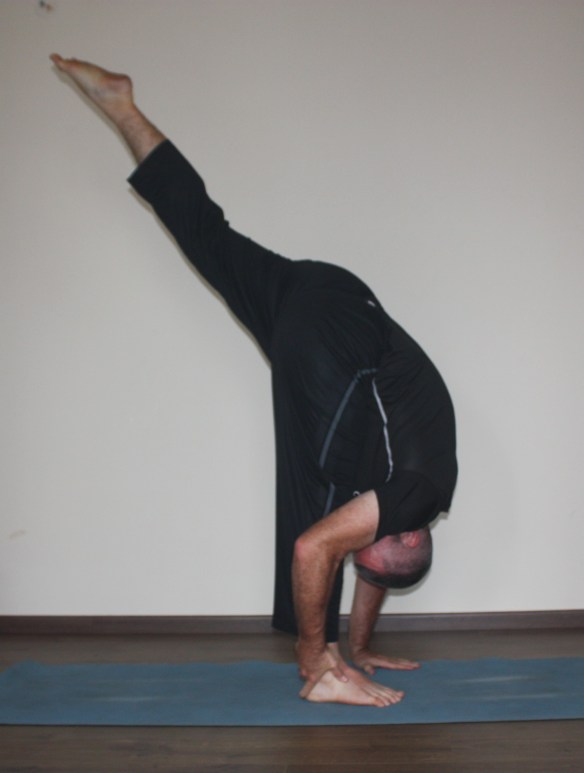
4. Adho Mukha Svanasana to Eka Pada Koundinyasana


3. Bakasana to Salamba Shirshasana II


2. Utthita Ardha Padmasana to Eka Pada Galavasana


1. Parivrtta Utkatasana to Parivrtta Eka Pada Koundinyasana

BOOK REVIEW: Taoist Yoga & Chi Kung by Eric Yudelove

Taoist Yoga and Chi Kung- For good health,better sex,and longer life.Taoist Yoga and Chi Kung- For good health,better sex,and longer life. by Eric Yudelove
My rating: 4 of 5 stars

Amazon page


This book was originally released under the title: “100 Days to Better Health, Good Sex & Long Life.” It offers a 14 week qi gong practice that proposes to improve health, sex life, and longevity. It’s presented as a step-by-step explanation of the practice aimed at those who intend to carry out the practice—as opposed to those who are looking for a more general explanation or overview.

The book offers a systematic presentation of the 14 week / 100 day practice. It’s divided into two parts. The first is a short explanation of Taoist concepts as they pertain to health building practices, and particular emphasis is given to the concepts of chi (energy / breath), jing (body), and shen (mind.) That emphasis is valuable as each of the chapters (i.e. the description of each week’s practice) is outlined according to these three concepts. So, each week there is a new breath practice, new bodily practices, and a new meditation or visualization practice. That said, these practices build on each other—i.e. starting with very basic activities and either adding to them or shifting to more complex variations.

The sections on breath and mind are fairly straight forward and mostly involve one practice each per week. Those practices become quite complex over the course of the book, but it’s one practice per week. This is in contrast to the middle section that has three or four subsections of activities per week. The middle section on Jing, or body, includes subsections on making sounds, self-massage, “sexual kung fu” (exercises intended to tone the reproductive system and prevent chi “leakage”), and the movement exercises that one might most closely associate with qi gong (chi kung.)

The book has many graphics in the form of line drawings used to clarify anatomy or how one is to visualize the practices. There is a glossary to help explain both Chinese terms and terminology in English that is specific to qi gong. There is also a two page bibliography that includes many works by one of Yudelove’s teachers, Mantak Chia, but also including works by individuals from other lineages and systems.

I have practiced through week eight. One may find the parts of the practice vary in their usefulness, but there doesn’t seem to be any harmful practices and there are many from which one will benefit. I’d recommend the book if one is looking for practices—as opposed to background. The explanations are systematic and the overall practice is well-organized. It’s not the kind of book that is much of a pleasure to read for reading’s sake. Much of the book is lists and bullet points of step-by-step explanation.

View all my reviews

BOOK REVIEW: Complete Calisthenics by Ashley Kalym

Complete Calisthenics - The Ultimate Guide To Bodyweight ExerciseComplete Calisthenics – The Ultimate Guide To Bodyweight Exercise by Ashley Kalym
My rating: 4 of 5 stars

Amazon page


“Complete Calisthenics” delivers an overview of body-weight exercises, as well as the information needed to begin a calisthenic workout program. It covers advanced exercises such as planches, levers, and flags, but it also provides simplified modifications and progressions for said advanced exercises for those who aren’t ready to leap into gymnast level practice. I’d say this book is ideal for an intermediate level practitioner or, at least, someone in sound physical shape who can knock out several push-ups and at least a few pull-ups. It offers one the information necessary to gradually progress toward the most advanced levels. While there are simplified modifications, a beginner who is out of shape may need more content on capacity-building and simplified modifications to get started.

The first six chapters form an introduction and give essential background information on equipment, nutrition, rest / recovery, warming up / mobility, and flexibility. The warming up and stretching sections provide many photos and explanations of key points, just as the latter exercise sections do.

Chapters seven through twenty describe and demonstrate the various exercises. These chapters can be divided into the first five chapters (ch. 7 through 11) that cover upper-body push and pull exercises (i.e. push-ups, pull-ups, dips, muscle-ups, and handstands.) Each of the aforementioned exercises has a range of variations offered–some easier and many harder than the basic. Chapters 12 through 16 explore levers (planche, front lever, back lever, half lever, and human flag) and these offer progressions, variations, and various approaches to entering the pose—since most practitioners will not be able to proceed straight to the full expression of the technique. Chapters 17 through 20 delve into the core, lower body, and full-body exercises. These are: floor core exercises (17), leg raises (18), lower body / leg exercises (19), and conditioning exercises–i.e. the full-body exercises that get the heart pumping (20.)

The last two chapters suggest an approach to building a training program and offer an FAQ, respectively. The approach suggested involves four levels. The first is called “the fundamental five” and it is built around push-ups, pull-ups, dips, hanging knee raises, and squats. The next builds upon the first and prepares one to transition to the third, which focuses on learning to do the levers. The final is called “complete calisthenics” and it incorporates all the advanced. The author also describes how one might approach optimizing one’s program to one’s needs and abilities.

The one thing that I missed is a discussion of intervals. Even if the author doesn’t use or recommend such an approach (timed work/rest), I expected he would discuss his rationale. In the FAQ, he does mention that the reason that he doesn’t discuss periodization (having occasional light spells for long-term recovery) is because they must be tailored to the needs / fitness level of the individual. At any rate, the role of time in workouts was conspicuously absent.

That said, I found this book to be quite well done overall. The pictures are explicit. The write-ups mention important points of consideration—e.g. safety challenges. There’s a thorough coverage of progressions and modifications. I’d recommend this book for anyone who practices calisthenics. Again, it’s probably a little more suitable for someone who either has an existing practice that they’d like to ramp up, or at least someone who has a reasonable level of fitness starting out.

View all my reviews

5 False Dietary Beliefs that Sabotage Weight Loss


5.) Vegetables are vegetables. If the potato is your go-to vegetable, you’ll probably have trouble shedding the pounds. That’s not to say that there is anything inherently wrong with potatoes. But, because of their high glycemic index value (i.e. they’re quickly digested and cause a sharp blood sugar spike), they should be lumped in with bread or rice when considering portions and meal make up. The same is true for sweet corn. Some people consider carrots (and carrot relatives) to be high glycemic, but one has to eat a pretty massive amount to have a problem. Most vegetables have a relatively low glycemic index score and are great foods to fill up on.


4.) Cola is mostly water, how bad could it be? At the right temperature, one can dissolve 2 kilograms (4.4lb.) of sugar in one liter of water. Wrap your head around that.


3.) I worked up a good sweat; now I can eat whatever I want. If you’re in the process of training for an ultramarathon or the Olympics, this might be true, but an hour in yoga class or run in the park doesn’t float you a free pass to kill it at Häagen-Dazs. There’s no getting around the math, the dietary half of the ledger is the 800 pound gorilla (no pun intended) of weight-loss. [That doesn’t mean that there aren’t many, many benefits to exercise, or that it doesn’t contribute to weight loss in more ways than one.] The Mayo Clinic has an excellent table of calories burned for a wide range of exercises and physical activities. You may be demoralized to note that the calories burned in an hour of Power Yoga are completely replenished by a medium size french fry.


2.) I will treat myself with sweets [or pizza.]  I’m not suggesting there’s anything wrong with treating oneself, but making food the treat sets a bad precedent. For many, this notion of food as reward or comfort source was introduced in one’s youth, and it can be extremely difficult to dislodge it later in life. One might try music or fun activities as alternative sources of reward.


1.) I shouldn’t have eaten that Snickers on Wednesday. This may seem like a contradiction of the previous item, but being doctrinaire about food creates its own problems. Specifically, sustainability may be a challenge–especially if one has had that “food as treat” story inculcated into one’s psyche. It’s not the once and while caloric splurge that kills most people, it’s creeping portion sizes.

Some people swear by a “cheat day.” Others say that that’s a bad approach because one might feel forced to cheat even when you’re really not feeling a desire for junk food. Some advocate an 80/20 rule, whereby 80% of the time one follows a strict dietary regimen, while the other 20% of the time one takes it more free and easy (though not totally insane.) Personally, I think different approaches work for different people, but I do agree that the dietary Nazi approach isn’t the way to go.