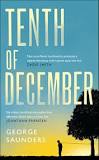
I’ve been reading the Best American Short Stories of 2012. Within this anthology is a story called Tenth of December by George Saunders; it’s also the title and concluding story of Saunders’s most recent collection.
This story interweaves two arcs, one of a boy and the other an old man. It’s this contrast between a man just starting life and another nearing its end that’s the focal point for the story. The lives of these two are brought together during a tragic winter event that leaves the reader uncertain as to whether either, both, or neither of the two will survive.
Saunders’s style is sparse, not in the manner of Hemingway but in a way that happily and freely abandons the sentence as the essential basic unit of writing –as opposed to occasionally letting phrases shine. The author also forgoes the traditional approach to noting dialogue. However, like Cormac McCarthy, Saunders makes himself clearly understood nevertheless.
Saunders displays a great sense of humor in this work. This is particularly noted as we are shown the boy at play during the piece’s introduction. I cracked up when it’s mentioned in boy’s internal monologue that he invented a martial art called Toi Foi, A.k.a. “Deadly forearms.”
The author masterfully captures the varied voice of boy and old man. The contrast between the playful youth and the reflective elder is a powerful commentary on the cycle of life.
In “Job: A Comedy of Justice” the protagonist, Alexander Hergensheimer, finds himself randomly drifting from one alternative universe to another. After his initial shift, he’s joined by a lover, Margrethe, who knows him from her world as Alec Graham. The couple stay together through many other ill-timed world shifts, and are only separated when Hergensheimer finds himself in heaven. Facing the question of what he’d do to be reunified with the woman he loves, the novel really gets interesting.
As you may have expected, the name of the book is the Biblical name “Job” (i.e. rhymes with lobe) and not “job” as in an occupation.
Each time the couple shifts, they are poor anew. While geography remains unchanged, history and money are different from one world to the next. Hergenshiemer washes dishes to make a living because he can’t engage in his trade, preacher, in these worlds. He can’t do anything else without valid identification.
Just as Dante inadvertently convinces us that the first circle of hell is preferable to heaven (who wouldn’t rather be in the company of Socrates and Virgil than that of Jerry Falwell and Jimmy Swaggart,) Heinlein creates an afterlife that is a good deal more complex but also more just than the Biblical version.
I recommend this humorous and thought-provoking book.
Marlantes gives one insight into what it was like to be a soldier, in particular a young officer, during the Vietnam War. For those confused by the name, “Matterhorn” is the name of a fictional encampment in central Vietnam in the book.
In Matterhorn, war is as it has famously been defined, “long periods of intense boredom punctuated by brief instants of sheer terror.” The author builds his characters such that the periods of intense boredom are informative. We see how the tension of the war boils over into fresh hell that interrupts the boredom.
Racial issues play a major part in the drama of the book. The main character, Waino Mellas, is white and of the variety who are almost apologetic in the presence of blacks. However, within the unit there are both black-power movement types as well as good ole boys, making for one powder kegs that erupts during the course of the book.
Race is not the only fault line we see in Matterhorn. There is also a tension between “lifers” and draftees. However, the bigger tension is between the front line troops and those who direct them from afar. The most intense section of the book involves a raid on a hill for which the men are undernourished and under-supplied.
The author was a Marine in Vietnam, and this experience no doubt contributed to the book’s authenticity.
I highly recommend this book as a powerful examination of the role that valor and vice play in war.
If the movie Alien was “Jaws in space,” then John Dies at the End is “Bill and Ted’s Excellent Adventure in the Nether World.” Except that, unlike Bill and Ted’s, Wong’s book is hilarious.
The gist of this book is that two likable anti-heroes ingest a drug, “soy sauce,” that gives them the ability to pass into an alternate universe. They’re inexorably drawn down the rabbit hole (so to speak, there is no actual rabbit hole in this book.) What they find is not what they expected. It’s not what anyone expected, because it’s so mind-boggling ridiculous and richly complex.
The title character, John, oddly enough is not the main character. The author, David Wong, uses a self-named protagonist as narrator and lead. The book unfolds as Wong (the character, not the author) tells a skeptical journalist about the strange goings-on in his small, Midwestern hometown.
We see John mostly through the lens of the narrating Wong. We know that John is a storyteller. Which may sound a lot like “liar,” but that’s not the case. Have you ever known a person who would never deceive you for personal gain, but will never fail to engage in hyperbole to make a story funnier or more interesting? That is John. He has one of my favorite lines of the book:
“We’re talking about a tentacled flying lamp fucker, Dave. What are you prepared to call unlikely?”
Despite the fact that John is a booze-hound and exaggerator, he remains an endearing character. As Wong gets to know Amy, a classmate who lost her hand after they knew each other in school, we get an insightful testimonial about John:
“Let me tell you something about John. The reason I was surprised by your hand was because John never once described you as, ‘the girl with the missing hand.’”
As for Wong’s character, he is hapless but hilarious. When he gets to know Amy, he is shocked to find that she’s not retarded or crazy. They had vaguely known each other from a “Special Needs” school, but it never occurs to him that she might be at least as sane as he.
The book is a pan-genre mélange. While it’s mostly a combination of horror and humor, there are points at which it feels like action/adventure and towards the end it seems largely like sci-fi. Horror and humor are not easily mixed, but this book does it about as well as one can imagine it being done. John Dies at the End is campy, of that there can be no doubt, but Wong writes descriptions of creatures and murderous events in a way that offers grim clarity. As a lover of humor more than horror, I was obviously not put off by this dark comedy.
Throughout the book, one suspects that the whole surreal bag of events is just a bad hallucinogenic trip, and that the “soy sauce” is just LSD on steroids. Happily this is not the case… or is it?
Don’t worry; John dying is not the intriguing twist at the end of this book. There are a couple such twists though.
If the movie that comes out today (January 25, 2013) is not awesome, it’s not Wong’s fault. The trailer shows us the quirky horror, but not the humor of the book. Much of the humor is in the language – i.e. the word choice. Some of that will likely come out in dialogue and narration, but who knows how much. View all my reviews
I’m troubled by the devolution of movie source material. As soon as there were movies, there was a desire to convert books into films. This worked great. While it wasn’t always easy to convey the depth of a 600 page novel in a 100 page screenplay, this gave even the least of us the ability to raise ourselves up to the status of pretentious douche-bag with the mantra –say it with me: “The book is always better than the movie.”
Running low on literary fodder, movie-makers decided to shift to making movies from comic books. This worked even better. You could convey the complexity of a comic in a movie, and you had an existing visual media for continuity. The major challenge was finding actresses with huge boobs who could deliver a spinning back-kick (enter Scarlet Johansson), and figuring out what to do about the crotch bulges (or lack thereof) of male superheroes in Spandex.
Pushing the limits, directors turned to video-games. This gave us such hits as Lara Croft: Tomb Raider and Doom. Okay, a video game may give us a nice action-packed romp of mayhem and carnage– albeit with dialogue like, “Suck on this!” (accompanying a grenade toss.) One can watch such a movie on basic cable on a Sunday afternoon while eating an entire pizza and still leave all of one’s mental faculties for contemplating such deep questions as whether this is the low point of one’s existence.
Movies based on toys and board games are the low point of Hollywood’s existence. I thought they had learned their lesson from the movie version of Clue in the 80’s, but apparently not.
To show that I am nothing if not flexible, I will say that I’m willing to change my view if any of the studios are willing to develop my ideas such as:
Lincoln Logs: Zombie Slayer: A rogue ex-cop, Lincoln Logs, takes a break from drinking himself to death after his family is Zombified to lure zombies into poorly constructed cabins, toppling the cabins, he crushes the Zombies to undeath. Tagline: “Eat Log, Bitches.”
Chutes and Ladders: Into Darkness: Two naughty children find out what happens when one chutes right off the board — an express ride to hell, that’s what. In order to get out they have to learn to count to 100, but the devil is teaching them to count: 1, 7, brick, egg, 14, 6, toad, biscuit… They must warm Satan’s heart, and then develop the upper-body strength to climb a ladder out of hell. Tagline: “Numbers are Hard, Hell is Hotter.”
Lego Box: The Musical: A plucky red-headed stepchild is devastated when his siblings get all the Lego bricks, but he only gets the plastic tub they came in. However, through hard work and dedication, he becomes the lead percussionist for the Boston Philharmonic Orchestra, leaving his horrid family behind. Working Tagline: “Eat Box, Bitches.”
On its face, this is Hilton’s take on the tale of the lost city of Shangri-la. However, look more deeply and you’ll find a commentary on the clash of Western and Eastern civilizations. It follows three Brits and an American who find themselves hijacked, crashed, and rescued by the occupants of Shangri-la. The main character is a British diplomat. He’s sharp, practical, and likable. He represents the West at its most virtuous. He is tolerant and polite. A second British man, who I think represents “Empire”, has a negative attitude throughout and looks down upon the locals as lesser beings. The third Brit is a missionary woman who represents “religion.” She considers the Shangri-Laians to be “godless” heathens because they aren’t Protestant Christians. But unlike “Empire” who just wants to get “back to civilization”, “Religion” is happy to stay to “save” and convert said heathens. The American represents “Commerce” and / or “Greed”, and is a business man who is on the lam and incognito after being wanted for white-collar crime. He becomes happy in Shangri-la, but only inasmuch as he sees it as a goldmine of opportunities not yet capitalized upon.
The author of Robopocalypse, Daniel H. Wilson, has a unique perspective on the novel’s subject because he’s a Carnegie Mellon trained PhD-level roboticist. His unique insight makes the book an interesting read despite the fact that the concept will be familiar to anyone who’s watched the Terminator movies. An artificial intelligence (AI) decides that machine life requires that humanity die, and soon thereafter our mechanized helpers begin to turn on us.
The book is organized as a series of records pulled together by a survivor of the war. Said survivor is the protagonist –to the extent there is one (it’s really an ensemble piece.)
The cast of characters is introduced in the first part of the book through a series of what seem like machine malfunctions, which turn out to be harbingers of the war to come. These malfunctions include a military robot, the air traffic control system, and a “robotic wife.” The book follows these human characters through the beginning of the war and the development of centers of human resistance. The resistance ranges from Japanese man who fights fire with fire to Native American tribesmen who survive in part owing to their limited exposure to technology. It all culminates in a fight in Alaska to gain control of the buried server in which the AI resides.
It’s an old concept, humanity replaced by the species it spawned. However, it’s much less outlandish than the Terminator series which relies heavily on time travel. Wilson’s vision is much scarier because it’s much easier to imagine coming to fruition.
Robopocalypse is being made into a movie by Steven Spielberg that is due out on April 25, 2014
This novel follows the trials and tribulations of a group of rabbits who leave a warren upon a warning from a prescient little rabbit named Fiver. Their exodus is fraught with peril from nature, man, other animals, and even other rabbits. The challenges they face threaten their unity as well as their survival.
Adams builds an intriguing cast of characters. Hazel is thrust into a leadership role. Bigwig is the physically powerful security chief. Fiver is the intelligent runt gifted with ESP. General Woundwort is the cunning and terror-inspiring enemy they must defeat to live in peace.
The book contains life lessons interspersed:
– One learns that the quintessential lover may also be a fighter.
– It shows how building alliances outside one’s comfort zone (sometimes outside one’s species) may allow one to win out over those rigidly uncompromising
– One discovers that sometimes one can only win by risking everything.
I found it to be a unique concept and very readable.
You’ll have to learn a little rabbit vocabulary and mythology, but there’s a glossary.
1Q84 interweaves the tales of two people, a man and a woman, who stumble down the rabbit-hole into the same alternate universe. The male lead, Tengo, is a writer with an artful gift for language, but no success developing his own idea –the perfect ghost writer. The female lead, Aomame, is a personal trainer who, in her spare time,… let’s just say makes problems (abusive male problems) go away. The two had met briefly in their youth, but were separated. While they each have “the one that got away” thoughts for each other, both have given up on the notion that they’d ever be reunited. Even in the same alternate reality, the question of whether they will reunite remains.
Most 900+ page novels I’ve read would benefit tremendously from editing. However, Murakami makes good use of the space. Besides the two main leads, there are a number of other essential characters. For example,there is not a novel without Fuka-Eri, the teenage girl who seems barely literate but yet who managed mysteriously to write a story that is perfect once Tengo has recrafted it. There is also an engaging sub-story in “The Town of Cats.”
The name comes from it being Murakami’s take on Orwell’s “1984.” It takes place in 1984, but one of the MC’s take to calling the period in the alternative universe, 1Q84 (which plays on the Japanese pronunciation of 9 (kyu)). Murakami’s alternative universe is much subtler than Orwell’s (or Huxley’s or Atwood’s.)However, unlike those other alternate universes, there is a supernatural element that is mostly at the fringes in this one. Perhaps owing to Murakami’s look into the Aum Shinrikyo cult, the nefarious entity in this book is a massive powerful cult – as opposed to Orwell’s authoritarian leviathan.
I highly recommend this book. While it’s long, Murakami keeps one guessing by masterfully removing the onion layers gradually — giving one little victories and new mysteries along the way like nefarious enemies and immaculate conceptions. For the really deep literary types, the book is packed with symbolism that I’m sure I only vaguely got. For writers, we get advice from Murakami in the form of dialogue between Tengo and his editor Komatsu.
Matheson brings the vampire tale into the age of science and reason. The protagonist, Robert Neville, considers the science of why the vampires are in some ways like the legends (e.g. Bram Stoker’s) Actually, Bram Stoker may be said have done so with a much more rudimentary state of science, but Matheson dispenses with the supernatural altogether.
Of course, where the book really shines is in Neville’s realization at the end, which I will not go into to avoid spoilers, but which makes the title quite apropos. (As opposed to the movie.)
For those having seen the Will Smith movie of the same name and wondering if the book will offer them some thing new, it certainly does. As alluded to above, the ending is entirely different, and the story-line bares little resemblance besides the existence of vampire-esque creatures.
I didn’t get why the vampires were so helpless to get into his house night after night (the old wives’ tale about having to invite them in is unmentioned), or at least I wondered about it throughout most of the book. I guess one can reason it out near the end. Some of Matheson’s descriptions reads like descriptions but turn out to be metaphor, and that can be a little confusing. (i.e. something like, “he felt a spike pierce his chest”, and you later realize he was just saying that it hurt sharply and intensely that there was no actual piercing and no literal spike.

 I’ve been reading the Best American Short Stories of 2012. Within this anthology is a story called Tenth of December by George Saunders; it’s also the title and concluding story of Saunders’s most recent collection.