BOOK REVIEW: Abraham Lincoln Vampire Hunter by Grahame-Smith

Abraham Lincoln: Vampire HunterAbraham Lincoln: Vampire Hunter by Seth Grahame-Smith

My rating: 3 of 5 stars

In this alternative-history / paranormal novel, Abraham Lincoln is re-invented as a man who experiences great tragedy at the hands of vampires and then devotes his life to hunting them- a battle which culminates in the Civil War. In the Civil War of this book, slaves are not just valued as plantation labor but also as vampire food.

Grahame-Smith’s book is written in the mold of Bram Stoker’s, as a series of journal entries, letters, and missives.This helps to give it a feel of authenticity as that seemed to be a common device in the late 19th century.

Lincoln comes into contact with a number of contemporaries, some vampire but most humans knowledgeable about vampires– such as Edgar Allen Poe.

The perspective jumps can be a bit confusion, but all-in-all it is entertaining.

A movie was made about this book, which I haven’t seen.

View all my reviews

How to Kill a Rogue Yard Gnome, Part 2

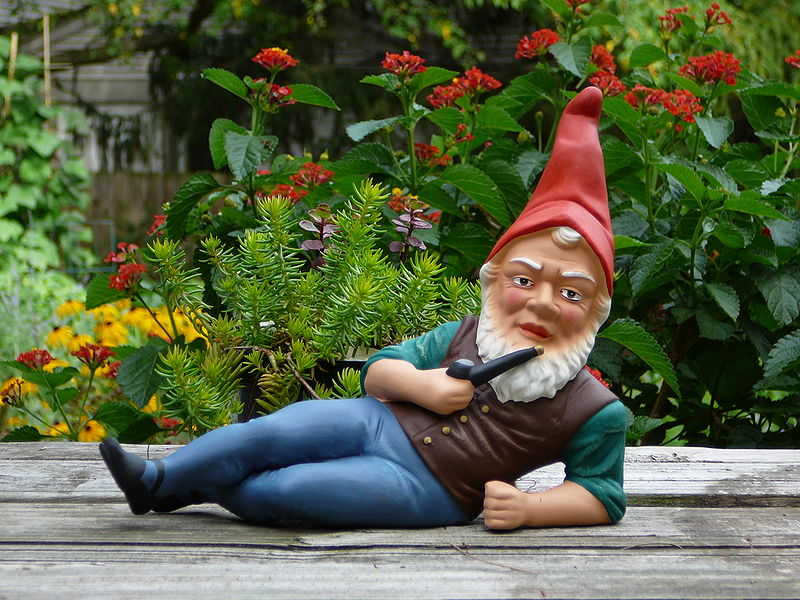
[Don't overthink the symbolism]Attribution: loannes.baptista

[Don’t overthink the symbolism]
Attribution: loannes.baptista

[Part I can be read here.]

Five nights ago, as the sun sank below the horizon and the glow of vibrant colors faded, we three were visited by a fourth from our world. It was the Hargo Chetti. Like us, he had a long flowing beard and a pointy hat, but, unlike us, his face was twisted into a menacing glower. His shell was monotone brown, it was just a temporary husk pulled together from the earth for our meeting. There was no point in a permanent shell; Master Hargo couldn’t stay in the world of humans for long. (Humans thought of the gnome’s shell as the gnome, but to us it was just a container for our noncorporeal selves.)  It’s the scowl. The shell must reflect the gnome’s nature, and no one wants a scowling gnome in their garden. Well, there may be demented people who would like such a gnome, but those people are already beyond our assistance.

In gnomish, a language that doesn’t register in human hearing organs, Hargo said, “I come bearing orders from the Council. They want you to be more active in your man’s dream state.”

I was impressed by Hargo’s ability to project his voice to us, given our wide spacing. We three can only communicate in close proximity, or in the man’s dream state. I was less pleased with the content of his message. I bristled in my response, “I assure you that we are intervening when necessary to keep the man’s dream world from falling into darkness.”

Hargo huffed, “The Council’s orders go beyond maintaining the status quo.”

I said, “We’ve seen nothing suggesting the man needs an injection of cheer into his dream state. Surely, you’ve read our reports.”

Hargo replied, “The Council, which I needn’t remind you has more vision and wisdom than a mere worker gnome, isn’t requesting an injection of good cheer. They desire shadow-mares.” Shadowmares were like nightmares but the ones that cannot be remembered in the waking state. Humans imagine that a nightmare that they can’t remember is inconsequential and has no impact on their waking lives. They are wrong.

Furk, one of my peers, just said, “Yes.” Furk was bored. He thought three gnomes for one man was excessive, particularly when that one man wasn’t important. I suspect because one of the neighborhood cats liked to wee on his shell, Furk had soured on our assignment. Though correlation not being causation, I couldn’t eliminate the possibility that the cats peed on him because he was such a jerk.

I was momentarily speechless. Hookl was also speechless, but that was his usual state.

After a long pause, I said, “I would like confirmation that this is the will of the Council.”

Hargo’s scowl seemed to tighten. Icily, he said, “Are you calling me a liar?”

I felt a shudder rise up through me, but still managed to reply, “No. I just think such a rare and unusual order demands great care.”

“You have your orders.” Hargo said, and then his shell collapsed into a pile of dirt, which was then caught up in the breeze and spread over the lawn. By morning there would be no trace of him.

I didn’t trust the Hargo Chetti. He looked like Santa, sans the jolly. What screams lie more than a scowling Santa. Yet, he is our only point of contact with gnome world while we are on assignment. I’ve always thought that was a weakness in our system.

As Furk began to plan and Hookl resumed being Hooklish (which is to say disinterested), I strained to propel my shell toward the driveway. I moved as swiftly as I could, but it was still a pace that would make a turtle proud by comparison.

A few hours later, I noticed lights stretching down the road toward the drive, the twin beams — with the car— decelerated. The car swung into the drive nearly crushing my shell. Had the shell been crushed, I would have been evicted back to our home world. Gnomes required a shell. I wasn’t powerful enough to summon a shell from the dirt, like Hargo had, not even for a short time. My plan had been to get onto the driveway and block access to the garage. In retrospect, it was not a well-thought plan, but it was the only warning I could give the man in his waking state. Once he went to sleep, it might be too late.

The man seemed to take note of my changed position, but he didn’t return my shell to its original position. He just shrugged and walked into the house.

I wanted to persuade Furk to hold off on obeying the order for now. Silently screaming gnomish across the lawn wouldn’t work, I didn’t have Hargo’s power of projection. The distance between us was too great.

I would have to subvert Furk in the man’s dream state. It would be difficult; Furk would have a plan by now, and I would have to improvise, injecting characters into the dream as needed to counter the shadowmare. In the dream state, I wouldn’t look dwarfish – unless that was called for. I could morph into any character that I could imagine. If you’ve ever had a dream and seen a face that looks totally unfamiliar, you’ve had a gnome dream. If you aren’t sure if you were the lead character in your dream, a gnome has probably been monkeying around in your noggin.

*

Four nights ago, I convened a meeting to the side yard. I wanted to be out of sight. Humans often won’t miss a gnome if it’s gone, but seeing three cavorting draws undue attention. I migrated across in front of the house, a two bedroom ranch, and nudged Hookl, who was positioned midway between my usual position and Furk’s. We then proceeded to meet up with Furk. This would put me at a disadvantage. Moving the gnome shell by force of consciousness is exhausting, and if I had to battle it out with Furk in the man’s dream state that night I would be weaker than usual.

For Furk, who was positioned near the corner of the house, the journey to the side yard and back would short. This was probably why he agreed.

I said, “As you well know, I want to hold off on initiating shadowmares.”

Furk said, “An order has been given by the Council. It may be unusual, but I’m sure they have a good reason, and it is not ours to challenge.”

Hookl said nothing.

I replied, “Maybe they do, and if they confirm their order I will comply. But this is serious, and if there is not an explicit order from the Council, then it is high crime against the Gnome Code of Conduct. You know what shadowmares can do to humans after a time. The humans might not consciously recognize the effects, but we know them well.”

Furk retorted, “If the Council didn’t give the order, then the Hargo Chetti is a liar. Are you prepared to make that accusation, because I’m not?”

Hookl said nothing.

I said, “I’m not calling anyone a liar. I’m just saying this is an extremely rare order and since there is only one gnome linking the Council to us, the possibility for miscommunication exists. If it were a less risky order it might not justify my concern. What if the man does something disastrous because of our mental mischief?” I was lying. I did think Hargo was a liar, but saying that would serve nothing.

Furk said, “It’s like Hargo said, you can’t see the whole picture.”

Before we could even begin our retreat back to our proper positions, we heard the car slow and turn into the drive. There was no use in moving now.

I said, “The man is home. Furk, it is clear that we will not be able to persuade each other. I want to hear where Hookl stands, and we will decide by majority.”

Hookl was not happy to be put in the role of tie-breaker. Making decisions was not his strong suit. “Gee, I’ll get back with you tomorrow.”

We three were well-attuned to the man’s brainwaves. We knew when he went into the house. We all knew that he noticed we were missing. We knew when he was about to come back outside with his flashlight. Soon he was shining the light on us. His forehead was crinkled and his lips pursed. It was an expression of puzzlement. He was trying to figure out how we had gotten into the side yard.

*

Three nights ago, one of us was ejected from this world. As darkness fell, in the feeble light, I approached Hookl to inquire about how he intended to vote. I had no intention of reconvening the group. Furk could come to us if he wanted. He did so.

Hookl said, “I mean, I don’t think we should be hasty. We should take our time, and figure things out. Rushing now won’t help any…” He just went on like that, noncommittally, for some time.

It must have sounded to Furk like Hookl was siding with me because Furk kept migrating, pushing into Hookl’s side. I don’t know if Furk just wanted to persuasively intimidate Hookl, or if his intentions were more nefarious. At any rate, there is a slope to the land in the front yard, and many loose rocks. This contributed to Hookl’s shell begining to tip; Furk did not let up. There was nothing I could do but watch as Hookl’s shell tipped.

There was a hole in the bottom of Hookl’s shell from the manufacturing process. It didn’t matter as long as the hole was sitting on the ground. If the shell tipped over, Hookl could maintain himself inside as long as there was only on hole in the container. It was the same principle as a bucket being inverted and pushed down into water. The bucket captures air inside. Add a second hole, and the water plunges in to push the air out. When Hookl’s shell tipped, its shoulder landed on a rock and the ceramic cracked. In a whoosh, Hookl was ejected and forced back to our world, to our dimension.

There would be at least one more night of battling it out with Furk

*

Two nights ago, my fight with Furk continued beyond the dream state and into the physical world. It ended with a gnome sumo match, and Furk was sent home much as Hookl had been.

I didn’t know how long it would be before someone showed up, Hargo or someone on the Council’s behalf. If I was right, and Hargo had gone rogue, it might be never. He might cut his losses.

I began to rest easy in the belief that I could protect this man’s dream state. And then the putz put a baseball bat through the side of my head.

TO BE CONCLUDED

How to Kill a Rogue Yard Gnome, Part 1

Attribution: Colibri1968

Attribution: Colibri1968 (Is this gnome too sexy?)

Five nights ago, coming home at days end, nosing my car into the drive, I startled. Where my headlights should have roamed over a patch of bare grass, instead the light glared off of the white beard and ruddy cheeks of one of my three lawn gnomes. I braked and swung the wheel hard to avoid grazing the gnome with my bumper. I could have sworn that gnome was always much closer to the house.

Somebody must have moved it.

By the light of the next morning, a ring of flattened, brown grass confirmed my suspicions from the previous night. I had no time to consider who might have moved the gnome.

No harm, no foul.  

*

Four nights ago, coming home, the gnome was not at the edge of the drive where it had been. I assumed that whoever had moved it put it back where they found it. But it wasn’t there either.

Rummaging through a drawer of loose tools and hardware, I grabbed a flashlight. I went through the front yard, swinging the beam of light in wide arcs, intent on finding the missing gnome. It was then that I noticed that the others were missing. I was considering whether it was worth calling the cops for the theft of a few cheap yard gnomes when I turned and my light reflected off something white in the side yard.

I rounded the corner cautiously, not wanting to piss myself if some prankster youths jumped out from my shrubs. There were no youths, just the three errant gnomes. The trio faced into the center of a circle as if they were conversants at a cocktail party. I looked around, in case this prank was being caught on some sort of candid camera. Not that I would be able to see the conspirators in the darkness, for I didn’t want to go shining my light into the neighboring properties. So I shrugged and went back in the house leaving the gnomes to their silent cabal.

The next morning, the gnomes were back in what— as far as I could tell— were their original positions.

*

Three nights ago, I came home hoping the prankster had gotten it all out of his system. But when my headlights washed over the front lawn, I gulped. One of the gnomes lie on his back. The other two stood gazing into each other’s eyes, one at the downed gnome’s feet and one at his head.

This is getting to be enough already, I’d thought.

Given the ominous tone of the latest prank, I didn’t venture outside to reset the gnomes that night. I had a largely sleepless night, wondering if this was more than a prank, if it was some sort of dire message. I put my sleepless night to good use devising my plan.

In the morning I found that two of the gnomes were back in their original positions and the third was missing altogether. That sealed it. I would move forward with my plan.

*

Two nights ago, I came home later than usual, having stopped at an electronics store to buy a video camera with night vision and a tripod. You’ll not be surprised to learn that one of the two remaining gnomes was smashed to shards while the other stood casually at its feet.

Anger now trumped fear, and I was prepared to catch the culprit in the act. Without turning on the light in the front room in order to avoid alerting my tormentor, I set up the tripod. In my bedroom, where nobody could observe me, I made sure the camera worked. I recorded the cat yawning and played it back. I cut the lights and made sure the night vision worked. I confirmed that I had sufficient memory for the entire night. Returning to the front room, I trained the camera on the gnome and gnome remnants. I checked and double-checked the power, memory, and the settings. Confident that all was set to capture the ne’er-do-well, I retired to bed for a sound night’s rest.

The next morning, I strode into the front room. I could see through my front window that the gnomes, broken and whole, were both gone from where they had lain, and that the camera’s red light was still showing recording in progress. I stopped the camera, confident I had captured the scallywag on video. I would call the police, and I would have the evidence I needed.

I pressed “play” and watched the green grainy video. There was nothing but stillness and the occasional branch trembling in the wind. In the interest of getting to work on time, I fast forwarded. When I was at eight times (8X) speed, I noticed there was and impression of movement, an inexplicable gradual shift of the standing gnome. The gnome shards also seemed to become faint, as if they were dissolving. I thought my eyes were playing tricks. At 32X speed, the standing gnome migrated itself out of the frame while the shards seemed to dissolve into thin air. No person or animal — other than a common squirrel– ever entered the frame.

Leaving the house that morning, hoping that the evil was now at an end, I was shocked to see that the remaining gnome hadn’t liberated itself from my property. It was right where I had set it years before. Unsettled and convinced that something wicked had taken up residence in my front yard. I grabbed an aluminum baseball bat from my garage and I swung hard into the gnome’s ear. The head flew off, revealing its hollow core. I must have looked like a madman to my neighbors as they went to work, gawking at me as I smashed the gnome to shards and then the shards to dust.

So you must be wondering why this is Part 1 and why there is further writing below. I just told you how to kill a rogue yard gnome. Did I?

*

Last night I came home to find a gnome sitting indignantly in the place of the gnome I had smashed that morning. It looked very much like the one that I had dashed to smithereens eleven hours before; except that instead of a big, beaming smile, its face was a scowl.

TO BE CONTINUED

BOOK REVIEW: Something Wicked This Way Comes by Bradbury

Something Wicked This Way ComesSomething Wicked This Way Comes by Ray Bradbury

My rating: 4 of 5 stars

Bradbury creeps us out by showing us a carnival through the eyes of two young boys. The month is October, and the carnival arrives in the dead of night. Everything about this story is meant to make one ill at ease, but at first we don’t know they boys minds are just playing tricks on them. The author gradually reveals the carnival is pure evil.

The boys, best friends, end up in over their heads, and being pursued by the carnies. Believing his son’s fanciful tales of time-bending carousels and a hall of mirrors that distorts more than light, a father plays a key role in the battle to restore normality to their town.

The strength of this book is Bradbury’s use of language. The book exudes creepiness, and in doing so captures just the right tone.

The weakness is its ending (which I will not get into to avoid spoilers.) It falls a little flat, particularly given the great build up.

View all my reviews

SHORT STORY REVIEW: Tenth of December by George Saunders

10thDecI’ve been reading the Best American Short Stories of 2012Within this anthology is a story called Tenth of December by George Saunders; it’s also the title and concluding story of Saunders’s most recent collection.

This story interweaves two arcs, one of a boy and the other an old man. It’s this contrast between a man just starting life and another nearing its end that’s the focal point for the story. The lives of these two are brought together during a tragic winter event that leaves the reader uncertain as to whether either, both, or neither of the two will survive.

Saunders’s style is sparse, not in the manner of Hemingway but in a way that happily and freely abandons the sentence as the essential basic unit of writing –as opposed to occasionally letting phrases shine. The author also forgoes the traditional approach to noting dialogue. However, like Cormac McCarthy, Saunders makes himself clearly understood nevertheless.

Saunders displays a great sense of humor in this work. This is particularly noted as we are shown the boy at play during the piece’s introduction. I cracked up when it’s mentioned in boy’s internal monologue that he invented a martial art called Toi Foi, A.k.a. “Deadly forearms.”

The author masterfully captures the varied voice of boy and old man. The contrast between the playful youth and the reflective elder is a powerful commentary on the cycle of life.

BOOK REVIEW: Job by Robert Heinlein

Job: A Comedy of JusticeJob: A Comedy of Justice by Robert A. Heinlein

My rating: 4 of 5 stars

In “Job: A Comedy of Justice” the protagonist, Alexander Hergensheimer, finds himself randomly drifting from one alternative universe to another. After his initial shift, he’s joined by a lover, Margrethe, who knows him from her world as Alec Graham. The couple stay together through many other ill-timed world shifts, and are only separated when Hergensheimer finds himself in heaven. Facing the question of what he’d do to be reunified with the woman he loves, the novel really gets interesting.

As you may have expected, the name of the book is the Biblical name “Job” (i.e. rhymes with lobe) and not “job” as in an occupation.

Each time the couple shifts, they are poor anew. While geography remains unchanged, history and money are different from one world to the next. Hergenshiemer washes dishes to make a living because he can’t engage in his trade, preacher, in these worlds. He can’t do anything else without valid identification.

Just as Dante inadvertently convinces us that the first circle of hell is preferable to heaven (who wouldn’t rather be in the company of Socrates and Virgil than that of Jerry Falwell and Jimmy Swaggart,) Heinlein creates an afterlife that is a good deal more complex but also more just than the Biblical version.

I recommend this humorous and thought-provoking book.

View all my reviews

BOOK REVIEW: Matterhorn by Karl Marlantes

Matterhorn: A Novel of the Vietnam WarMatterhorn: A Novel of the Vietnam War by Karl Marlantes

My rating: 5 of 5 stars

Marlantes gives one insight into what it was like to be a soldier, in particular a young officer, during the Vietnam War. For those confused by the name, “Matterhorn” is the name of a fictional encampment in central Vietnam in the book.

In Matterhorn, war is as it has famously been defined, “long periods of intense boredom punctuated by brief instants of sheer terror.” The author builds his characters such that the periods of intense boredom are informative. We see how the tension of the war boils over into fresh hell that interrupts the boredom.

Racial issues play a major part in the drama of the book. The main character, Waino Mellas, is white and of the variety who are almost apologetic in the presence of blacks. However, within the unit there are both black-power movement types as well as good ole boys, making for one powder kegs that erupts during the course of the book.

Race is not the only fault line we see in Matterhorn. There is also a tension between “lifers” and draftees. However, the bigger tension is between the front line troops and those who direct them from afar. The most intense section of the book involves a raid on a hill for which the men are undernourished and under-supplied.

The author was a Marine in Vietnam, and this experience no doubt contributed to the book’s authenticity.

I highly recommend this book as a powerful examination of the role that valor and vice play in war.

View all my reviews

Book Review: JOHN DIES AT THE END by David Wong

John Dies at the End (John Dies at the End, #1)John Dies at the End by David Wong

My rating: 5 of 5 stars

If the movie Alien was “Jaws in space,” then John Dies at the End is “Bill and Ted’s Excellent Adventure in the Nether World.” Except that, unlike Bill and Ted’s, Wong’s book is hilarious.

The gist of this book is that two likable anti-heroes ingest a drug, “soy sauce,” that gives them the ability to pass into an alternate universe. They’re inexorably drawn down the rabbit hole (so to speak, there is no actual rabbit hole in this book.) What they find is not what they expected. It’s not what anyone expected, because it’s so mind-boggling ridiculous and richly complex.

The title character, John, oddly enough is not the main character. The author, David Wong, uses a self-named protagonist as narrator and lead. The book unfolds as Wong (the character, not the author) tells a skeptical journalist about the strange goings-on in his small, Midwestern hometown.

We see John mostly through the lens of the narrating Wong. We know that John is a storyteller. Which may sound a lot like “liar,” but that’s not the case. Have you ever known a person who would never deceive you for personal gain, but will never fail to engage in hyperbole to make a story funnier or more interesting? That is John. He has one of my favorite lines of the book:

“We’re talking about a tentacled flying lamp fucker, Dave. What are you prepared to call unlikely?”

Despite the fact that John is a booze-hound and exaggerator, he remains an endearing character. As Wong gets to know Amy, a classmate who lost her hand after they knew each other in school, we get an insightful testimonial about John:

“Let me tell you something about John. The reason I was surprised by your hand was because John never once described you as, ‘the girl with the missing hand.’”

As for Wong’s character, he is hapless but hilarious. When he gets to know Amy, he is shocked to find that she’s not retarded or crazy. They had vaguely known each other from a “Special Needs” school, but it never occurs to him that she might be at least as sane as he.

The book is a pan-genre mélange. While it’s mostly a combination of horror and humor, there are points at which it feels like action/adventure and towards the end it seems largely like sci-fi. Horror and humor are not easily mixed, but this book does it about as well as one can imagine it being done. John Dies at the End is campy, of that there can be no doubt, but Wong writes descriptions of creatures and murderous events in a way that offers grim clarity. As a lover of humor more than horror, I was obviously not put off by this dark comedy.

Throughout the book, one suspects that the whole surreal bag of events is just a bad hallucinogenic trip, and that the “soy sauce” is just LSD on steroids. Happily this is not the case… or is it?

Don’t worry; John dying is not the intriguing twist at the end of this book. There are a couple such twists though.

If the movie that comes out today (January 25, 2013) is not awesome, it’s not Wong’s fault. The trailer shows us the quirky horror, but not the humor of the book. Much of the humor is in the language – i.e. the word choice. Some of that will likely come out in dialogue and narration, but who knows how much.
View all my reviews

TODAY’S RANT: Toy Movies

Uggh!

Uggh!

I’m troubled by the devolution of movie source material. As soon as there were movies, there was a desire to convert books into films. This worked great. While it wasn’t always easy to convey the depth of a 600 page novel in a 100 page screenplay, this gave even the least of us the ability to raise ourselves up to the status of pretentious douche-bag with the mantra –say it with me: “The book is always better than the movie.”

Running low on literary fodder, movie-makers decided to shift to making movies from comic books. This worked even better. You could convey the complexity of a comic in a movie, and you had an existing visual media for continuity. The major challenge was finding actresses with huge boobs who could deliver a spinning back-kick (enter Scarlet Johansson), and figuring out what to do about the crotch bulges (or lack thereof) of male superheroes in Spandex.

Pushing the limits, directors turned to video-games. This gave us such hits as Lara Croft: Tomb Raider and Doom.  Okay, a video game may give us a nice action-packed romp of mayhem and carnage– albeit with dialogue like, “Suck on this!” (accompanying a grenade toss.) One can watch such a movie on basic cable on a Sunday afternoon while eating an entire pizza and still leave all of one’s mental faculties for contemplating such deep questions as whether this is the low point of one’s existence.

Movies based on toys and board games are the low point of Hollywood’s existence. I thought they had learned their lesson from the movie version of Clue in the 80’s, but apparently not. 

To show that I am nothing if not flexible, I will say that I’m willing to change my view if any of the studios are willing to develop  my ideas such as:

Lincoln Logs: Zombie Slayer: A rogue ex-cop, Lincoln Logs, takes a break from drinking himself to death after his family is Zombified to lure zombies into poorly constructed cabins, toppling the cabins, he crushes the Zombies to undeath. Tagline: “Eat Log, Bitches.”

Chutes and Ladders: Into Darkness: Two naughty children find out what happens when one chutes right off the board — an express ride to hell, that’s what. In order to get out they have to learn to count to 100, but the devil is teaching them to count: 1, 7, brick, egg, 14, 6, toad, biscuit… They must warm Satan’s heart, and then develop the upper-body strength to climb a ladder out of hell.  Tagline: “Numbers are Hard, Hell is Hotter.”

Lego Box: The Musical: A plucky red-headed stepchild is devastated when his siblings get all the Lego bricks, but he only gets the plastic tub they came in. However, through hard work and dedication, he becomes the lead percussionist for the Boston Philharmonic Orchestra, leaving his horrid family behind. Working Tagline: “Eat Box, Bitches.” 

Book Review: LOST HORIZON by James Hilton

Lost HorizonLost Horizon by James Hilton

My rating: 4 of 5 stars

On its face, this is Hilton’s take on the tale of the lost city of Shangri-la. However, look more deeply and you’ll find a commentary on the clash of Western and Eastern civilizations. It follows three Brits and an American who find themselves hijacked, crashed, and rescued by the occupants of Shangri-la. The main character is a British diplomat. He’s  sharp, practical, and likable. He represents the West at its most virtuous. He is tolerant and polite. A second British man, who I think represents “Empire”, has a negative attitude throughout and looks down upon the locals as lesser beings. The third Brit is a missionary woman who represents “religion.” She considers the Shangri-Laians to be “godless” heathens because they aren’t Protestant Christians. But unlike “Empire” who just wants to get “back to civilization”, “Religion” is happy to stay to “save” and convert said heathens. The American represents “Commerce” and / or “Greed”, and is a business man who is on the lam and incognito after being wanted for white-collar crime. He becomes happy in Shangri-la, but only inasmuch as he sees it as a goldmine of opportunities not yet capitalized upon.

It’s an interesting read.

View all my reviews