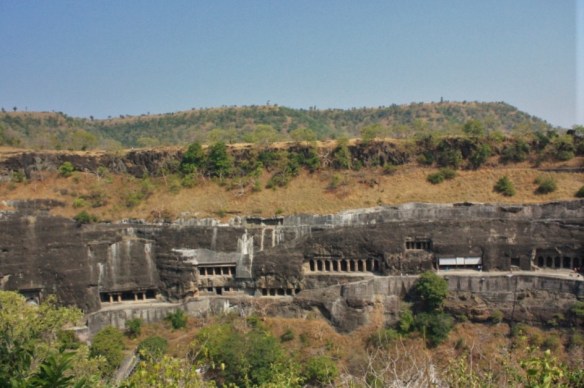
While these Buddhist caves look quite prominent now, in 1819, they’d been grown over by vegetation and were long forgotten until rediscovered by Captain John Smith, who was engaged in a tiger hunt at the time.
Category Archives: Buddhism
DAILY PHOTO: Kannon in Stone, Noda City
BOOK REVIEW: Teachings of the Buddha ed. by Jack Kornfield
Teachings of the Buddha: Revised and Expanded Edition by Jack Kornfield
My rating: 5 of 5 stars
This is a collection of excerpts and short writings conveying Buddhist teachings. The pieces range in length from about a stanza of verse to a few pages in length. Each lesson tells what book it comes from and who the translator was, which can be a nice feature if one will be comparing different translations.
Unlike Walpola Rahula’s similarly named “What the Buddha Taught,” which focuses entirely on what Gautama Buddha taught while he was living, this book includes many teachings from long after the life of the Buddha. Which is to say, this is more a book of Buddhist teachings than an elucidation of what the Buddha, himself, taught. [Not to offend, but religious teachings seem to inevitably shift and evolve over time, and so what is taught by various sects of Buddhism today is by no means a perfect reflection of what the Buddha, himself, taught.] That said, the writings toward the beginning of the book tend to be closer to the Buddha, himself – i.e. from the “Dhammapada” and other early Pali works. While the teachings toward the end of the book tend to be more from much later (e.g. from the Zen tradition.)
I found the book to be quite readable and to feature some intriguing food for thought. If you are interested in an English translation of Buddhist sutras, scriptures, koan, etc., this is a good work to check out.
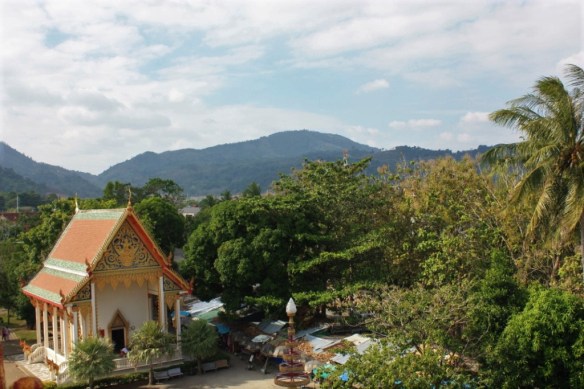
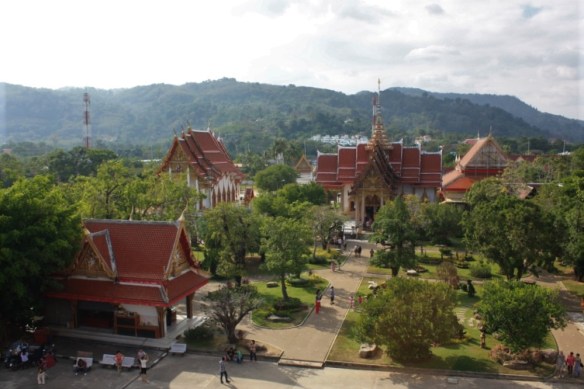
DAILY PHOTO: A Phuket Temple
POEM: Mustard Seeds
She’s chasing after mustard seeds
from a household that’s known no Death.
With eyes that droop and feet that bleed,
she’s out of the village and into the weeds.
Finding a family that’s known only life
is like finding one that’s known but good deeds.
Not finding a one, she finally concedes
knowing her suffering is not unique,
and with that realization she is freed.
DAILY PHOTO: Sri Dalada Maligawa, Kandy
DAILY PHOTO: Vajrayana Buddhist Art, Namdroling
DAILY PHOTO: Scenes from Spirit City
Xieng Khuan (which translates to “Spirit City”) is what this statue park outside Vientiane, Laos is apparently called by locals. In English, it’s usually listed as “Buddha Park.” I used the former translation because it’s way more intriguing, but if you’re looking to find the place…
It should also be pointed out that some of the artwork is Hindu in origin, rather than Buddhist.
DAILY PHOTO: Inside the Caves of Ellora
BOOK REVIEW: Dhammapada trans. by Venerable Acharya Buddharakkhita
Dhammapada: a practical guide to right living by Acharya Buddharakkhita
My rating: 4 of 5 stars
The Dhammapada consists of 423 sayings attributed to the Buddha. There seem to be numerous versions of the Dhammapada as translated by Venerable Acharya Buddharakkhita in circulation, so your results may vary for good or bad from what I report here. (Not to mention there are many other translations which may vary tremendously)
The 423 sutras or maxims included in the book are arranged into twenty-six topical chapters. The version I have presents no analysis, it’s just the text of the verse in Pali (i.e. the Roman / English language alphabet spelling out the phonetic Pali words) with an English translation below.
First, the pros of the edition I read: There are some explanatory notes offered as necessary (38 of them,) there are a few graphics (drawings and photos in B&W,) and there are two indexes. The first of the two indexes wouldn’t be of much use to me, but it would be for the Pali literate because it indexes the Pali verse. The second index is in English and is organized by analogies (i.e. analogies employed in the verses,) and that could be a tremendously useful feature. For the Pali literate, having the original phonetic Pali included must be an excellent feature. (There’s also a page in the front matter that shows how the pronunciation works.)
As for the cons of this edition: First, there were a few typos (mostly of the type that wouldn’t be caught by spellcheck – though this translation was pre-spellcheck — so I’m referring to the kind of typos that aren’t easily caught.) Second, while all the verses are translated, there is some text that remains in Romanized Pali [I suspect prayers, but can’t say for sure.]
This is the second translation of the Dhammapada I’ve read, and I found it worthwhile. It’s easily readable, not too flowery, and not bogged down with needless analysis or exposition. I can’t say how it compares among all translations (either in terms of skill of translation or in accurately capturing the Buddha’s meaning,) but it reads pretty fluidly.