Unknown's avatar

About B Gourley

Bernie Gourley is a writer living in Bangalore, India. His poetry collection, Poems of the Introverted Yogi is now available on Amazon. He teaches yoga, with a specialization in pranayama, and holds a RYT500 certification. For most of his adult life, he practiced martial arts, including: Kobudo, Muay Thai, Kalaripayattu, and Taiji. He is a world traveler, having visited more than 40 countries around the globe.

POEM: Neuron Fire

Source: NIH

flip the switch
the lights go out
but for random flashes and flickers
playing pieces of your past
shuffled into unrecognizable dream stills
like lightning illuminating
and old farmyard
a flash…
a monster appears on the horizon
a flash…
the monster is bigger
with each flash the monster looms larger
but it’s not getting bigger
it’s getting closer
when it’s no longer a silhouette
when it has features
all hope will be lost


Bamboo Haiku


bamboo copse
groans in subtle wind
no space between


crows rule

the bamboo arch

over the road


bamboo grove
carpeted in grainy beige
alien landscape


plastic cup

gripped in crow’s beak

frat boy style


pink blossoms
will soon bleed onto
bamboo pollen

DAILY PHOTO: Petronas Towers by Night and by Day

By Night; Taken in December of 2013 in Kuala Lumpur


By Day

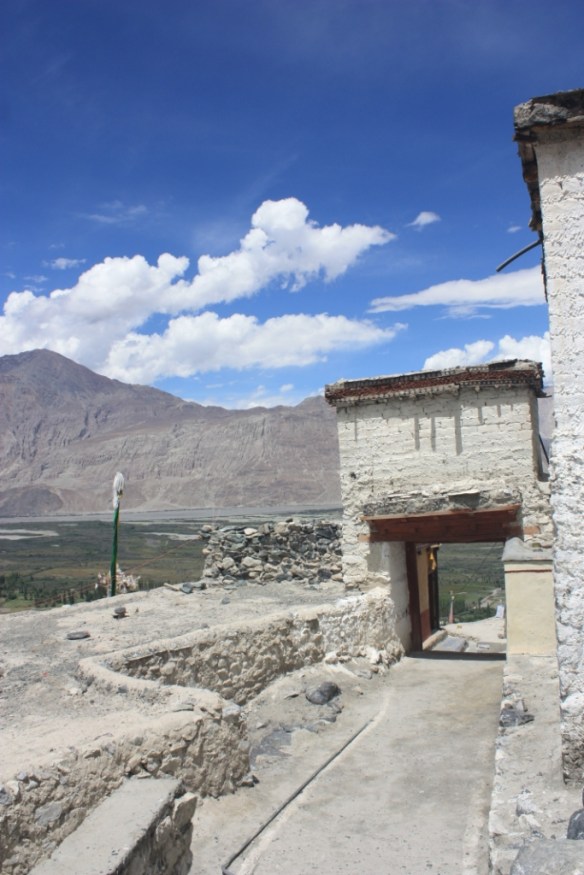
DAILY PHOTO: Looking out from Diskit Gompa

Taken in August of 2016 at Diskit Monastery in Nubra Valley


DAILY PHOTO: And It Was All Yellow

Taken in Cubbon Park, Bengaluru on March 7, 2018.


POEM: Dreams

dreams, my friend, are lost on you
you think them false when they are true
you think them true when they are truer
you think them from a subconscious sewer

you feed your monsters, but make them ride alone
then can’t tell the imposters when they’re full-grown
they say that nature outstrips nurture
and the seeker outwits the searcher

but who can know such things

POEM: Smoke

turrets turned as tires burned
forming a cloak of jet black smoke
oh hell! oh hell! for a tank shell
will pass right through, belching smoke of its own like a chimney flue
and when the wall is blown apart, and spall flies as from a cart of darts
I’ll long for naught, just I thought, while I wonder just what man hath wrought

DAILY PHOTO: Lal Bagh’s Glass House

Taken in January of 2017 in January of 2017 during the Republic Day Flower Show


Inside the Glass House during the 2017 Republic Day Flower Show

BOOK REVIEW: Plyometric Anatomy by Derek Hansen

Plyometric AnatomyPlyometric Anatomy by Derek Hansen
My rating: 4 of 5 stars

Amazon page


This book performs two tasks at once. First, it’s a guide to the broad range of plyometric exercises and how they can be conducted safely. Plyometrics take advantage of a phenomenon in which rapidly stretched muscles contract more forcefully and rapidly. However, you may recognize them as exercises involving jumping and other explosive movements that are used to build power. (Power being the ability to generate a force in as short a time as possible. This is in contrast to strength — a measure that’s only concerned with the amount of force generated.) I would go as far as to say the book could be useful for many individuals who don’t need any particular insight into anatomy, but who want to learn to do a wide range of plyometric exercises. (That said, if you are said person, you may want to shop around because you may find the one or two drawings per exercise may not be adequate for your purposes, and you may discover you need more guidance if you’re new to fitness activities.)

Second, the book educates the reader about what musculature is used in each exercise, and differentiates the primary movers from the secondary muscles. The book provides a happy medium useful for coaches and trainers. It doesn’t get bogged down in the anatomical and physiological minutiae, but provides enough information for individuals who want to see what muscles are working without drilling down into depths of great precision.

The book consists of nine chapters. Of these, the first two chapters provide fundamental background information. Chapter one examines how and why plyometric exercises work in a general sense. Chapter two gets into more logistical issues such as what equipment is needed (e.g. hurdles and medicine balls), what surfaces are ideal for practice (no small issue considering the loads generated), and how training progressions should be formulated.

Chapters three through eight are the core of the book. These are the chapters that describe exercises as I mentioned above. The first of these chapters presents foundational exercises. Plyometrics tend to be physically intense and so many individuals will need to build capacity before moving straight into a full-fledged plyometric exercise regime. The next five chapters explore (in order): bilateral lower body exercises, unilateral lower body exercises, upper body exercises, core exercises, and combination exercises (e.g. exercises that combine jumps with sprints or medicine ball throws with jumps and so forth.)

Each of the exercise descriptions consists of five parts: an anatomical drawing showing the action and the musculature involved, a description of how the exercise is safely performed, a text list of the muscles involved (divided into primary and secondary muscles as is the drawing), notes exploring unique considerations for that particular exercise, and variations for those who need to make the exercise more or less challenging.

The last chapter investigates injury prevention and rehabilitation. One learns how to evaluate some of the more high-risk behaviors and misalignments that must be corrected for exercises to be done safely. One also learns how a swimming pool can be used to help athletes rebuild their capacity after an injury, as well as how rehab activities can be done out of the pool.

There are graphics throughout the book. For the most part, these consist of anatomical drawings. These drawings show the body in transparent form so that one can see the muscles involved in each exercise. There is a reference section at the end of the book.

I found this book to be informative and thought-provoking, and I’d recommend it for anyone who is seeking to expand their depth of knowledge about exercise science – particularly coaches, trainers, and teachers.

View all my reviews

BOOK REVIEW: Up the Down Staircase by Bel Kaufman

Up the Down StaircaseUp the Down Staircase by Bel Kaufman
My rating: 5 of 5 stars

Amazon page


This is a humorous novel about a rookie teacher’s first year in a New York City public school with all the frustrations and victories that experience entails. It’s an epistolary novel – meaning it’s conveyed through a series of documents. Some of the humor is of a “kids say the darndest things” nature – though these are high school students, so the humor isn’t so much born of naiveté as it is a combination of teenage snarkiness and a maddening ignorance of concepts that students should have grasped by that age (i.e. laugh so you don’t cry style humor.) The humor from kids is largely conveyed by students’ comments in the teacher’s comment box as well as via homework assignments.

There’s a second kind of humor in the form of bureaucratic absurdism. Bureaucratic wrangling and lack of resources cause most of the protagonist’s frustrations. This humor is largely conveyed through memos – some school-wide and some specifically to the protagonist, Sylvia Barrett. Barrett also commiserates with her co-workers, and we see some of her frustration playing out through the post-it note equivalent of water-cooler conversations.

The epistolary form offers a challenging format for both character development and story presentation. However, the novel is strong on character development. It achieves this in large part by mixing long-form letters to a close friend with the short memos and comment box entries. The reader gets to see events unfold and responses by way of different documents. The longer letters give us some depth of feeling. There is even a point where Barrett is being swamped by correspondence and we hear nothing back from her, and in this we can feel the degree to which she is overwhelmed.

The book isn’t story-centric. However, there is a narrative arc that revolves around the question of whether Barrett will stay on at the public high school or move on to teach at a liberal arts college. She is torn because she feels she can do good at the public high school and that would be satisfying, but at the same time she is bureaucratically frustrated and demoralized by perceived failures. There are dramatic events here and there to elevate the tension from the run-of-the-mill school events, but not so much that the book ever moves away from feeling like the real experience of a rookie teacher.

The book uses drawings here and there, usually presented as student doodles, to add to the humor.

I enjoyed this book, finding it to be both humorous and illuminating. I would highly recommend it for those interested in the challenges of secondary education or who can appreciate the [bittersweet] humor of it.

View all my reviews