POEM: King of Infinite Space

I have room to breath —
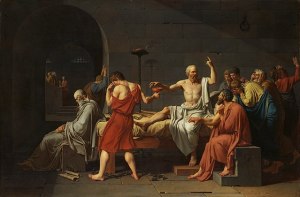
my ribs can’t catch the edge

of this expanding universe,

and, so, I suppose the cage is irrelevant.

I can reach an arm as far as my shoulder allows —

as long as my hand slips through the slats.

With eyes shut, and cage in sway,

I’ve no reason to feel I’m in any particular place.

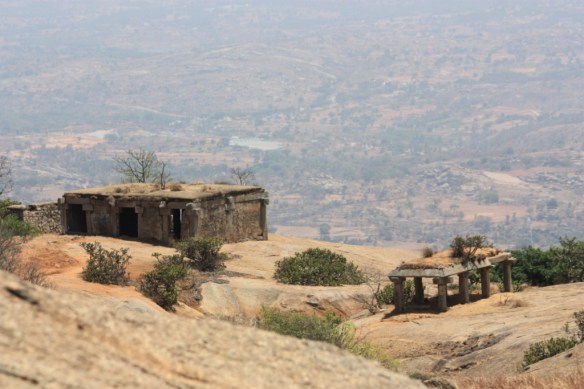
DAILY PHOTO: Old Stone Ruins, Savandurga

Taken in March of 2015 at Savandurga.

POEM: Disappearing Act

Some shake in fear that all will disappear —
from bone to soul — that all will disappear.


They hug it close, squeezing it so tightly
as to thwart the time when all disappears.


But that binding pressure only heightens
the dire urge to struggle to disappear.


Though nothing ever really vanishes,
but fades to the moment it disappears.


The secret is to be with each moment
in that slow fade, ’til it all disappears.

BOOK REVIEW: Simulacra & Simulation by Jean Baudrillard

Simulacra and SimulationSimulacra and Simulation by Jean Baudrillard
My rating: 4 of 5 stars

Amazon.in page


This is a collection of 20-ish essays that share as a theme the idea that we live not so much in a world of events, information, and things, but in a world of simulacra in which those things represent or symbolize something (either the true version of that object or something else altogether.) After an opening that introduces the idea of simulacra and simulations, the chapters each look at an example of illusion and simulation in our world. The book’s strength is in suggesting outside-the-box, thought-provoking ideas. This is not to say that said ideas are all sound or unassailably true. A reasonable reader might conclude that much of the book consists of crackpot ideas. I tended to find that there was a kernel of truth in the points that Baudrillard was making, but that he often blew that kernel up into an absurdity.

To clarify, let’s discuss a couple examples of events that Baudrillard says that we don’t know, but instead we know a simulacrum of. These two examples are very different, and I believe one is a stronger argument for Baudrillard’s ideas than is the other. One is the Holocaust and the other is the nuclear accident at Three Mile Island. In both cases, Baudrillard argues what we “know” is not the event itself, but a representation that has been created through fictionalized accounts and “common knowledge” with varying degrees of accuracy. In my view, his point was more clearly made regarding the Three Mile Island nuclear plant accident. What people think they know of the event is more representative of what happens in the movie “The China Syndrome” than what actually happened. Most people grossly overestimate the costs and consequences of the event because they have a fictional representation of it in place of a factual understanding.

Besides events, Baudrillard considers a number of other ways we might be considered to be living in a representational world. The hypermarket doesn’t perform the same function as markets historically did. It exists to provide some hyperreal experience that is as much entertainment as it is the acquisition of necessary goods and services. Baudrillard also talks about how the media and advertising provide a façade in place of the real because of disincentives to provide accurate information. Journalism benefits from sensationalizing. Advertising benefits from hyperbolizing.

Baudrillard also ventures into the realm of science fiction. One of the most intriguing discussions is about holographs and how one might know whether one was the item being projected or the projection itself. There’s one chapter on J.G. Ballard’s novel “Crash” as an example of one of the more bizarre ways in which modernity conflates disparate things. [For those unfamiliar, Ballard’s novel deals with characters who are sexually aroused by car crashes.] An essay on “Simulacra and Science Fiction” proposes that sci-fi maybe dead by virtue of the fact that science fiction builds simulated worlds and since we already are a simulated world, the genre is passé.

I mentioned that this book’s strength is swinging for the fences with bold ideas about how modern humanity has built itself into a simulated world. So, what is its weakness? That’s easy. Low readability. The author assumes the reader has knowledge that it’s not reasonable to assume even an educated reader will have. If you weren’t familiar with the aforementioned J.G. Ballard novel or with the Beaubourg building in Paris, you’d have no idea what Baudrillard was going on about. Also, while it’s true that some of the ideas presented in the book are complicated, the author (and, perhaps, the translator) often make even relatively straightforward ideas complicated. There is a love of rare words. Beyond those issues, there’s a stream of consciousness approach to writing that makes the author’s train of thought hard to follow.

If you are interested in philosophy, this book is worth reading if you don’t mind struggling with difficult writing (a form of masochism with which I’m afflicted.) There have probably been more readable distillations of these ideas that will offer a clearer view of what Baudrillard means by ideas such as hyperreality. (We know Baudrillard means “more real than real,” but one only has one’s own intuition to make sense of that in a way that transcends Justice Potter Stewart’s dissatisfying definition of pornography as “I know it when I see it.”) If you don’t enjoy struggling with abstruse writing (or if you don’t know the meaning of the word “abstruse” without looking it up) this book is probably not for you.

View all my reviews

DAILY PHOTO: Wrinkly Forehead

Taken in Bangalore in March of 2015.


BOOK REVIEW: Carmilla by J. Sheridan Le Fanu

CarmillaCarmilla by J. Sheridan Le Fanu
My rating: 5 of 5 stars

Amazon.in page

This gothic vampire novella is about 25 years older than its more famous subgenre peer, Bram Stoker’s “Dracula.” Le Fanu’s work is not only much shorter, but is written in a more approachable style. The story takes inspiration from an event that is recorded in a book entitled “Treatise on the Apparitions of Spirits and on Vampires or Revenants of Hungary, Moravia, et al.” (1751.) This tract on spirits, demons, ghosts, revenants, and vampires was written by a Benedictine monk and scholar, Dom Calmet. The story in question involves a village that was said to be having a problem with nocturnal visits from vampires. Try as they might, the villagers couldn’t get this vampiric pest problem under control. A mysterious visitor from the east (usually referred to as a “Hungarian”) stopped into town and offered his services, and – as the legend went – he succeeded in eliminating the vampires. A version of this story is presented late in the novella (Ch. 13) and it’s only then that one learns how that story influences the one Le Fanu writes in “Carmilla.”

The story in “Carmilla” revolves around a young woman who serves as the first-person narrator, Laura. Laura lives out in the countryside with only her father and the household servants. She is starved for interaction with people her own age, and her only female interaction is with the help. Early in the story Laura is excited because a friend of her father’s (the General) is supposed to be coming to visit, and he will be bringing his own ward – a girl of Laura’s age. But that visit is cancelled, and we learn that the girl fell ill and passed away.

When a carriage overturns on the road in front of Laura’s father’s property, it seems that Laura will get the female companion for whom she’s been yearning. The occupants of the carriage that we know of a are an adult woman and her daughter, Carmilla. The woman is unharmed, and says she must make her way to some distant location urgently on unstated business. However, her daughter, Carmilla, is frail by nature and it’s too risky for her to make the remainder of the journey. Laura’s father, a kind man who recognizes his daughter’s loneliness, offers to host Carmilla for a time until her mother can return for her.

Carmilla’s visit starts out well enough. Everything is normal during the day. Over time, Laura recognizes some dismaying personality traits of her visitor (i.e. Carmilla is a bit elitist and narcissistic,) but Carmilla is not without her charms. The nights, however, start getting progressively stranger and more disconcerting. At first, one can’t be certain to what degree something real is transpiring. I thought Le Fanu did a fine job of capturing the hazy hypnopompic world where one isn’t quite certain what is dream and what is reality. Increasingly, it becomes apparent that Laura is experiencing a real loss of vitality. Carmilla seems to be suffering similarly, but they have no basis to think this is new. Among Carmilla’s nocturnal strangeness is the fact that she’s a sleep-walker. One night she disappears and it’s thought that she might have been abducted or run away, but then she turns up none the worse for wear.

I’ll let the reader discover for him- or herself how events play out in the story.

Much has been made of the lesbian element of this story. In true Victorian nature, this isn’t at all explicit or graphic. The reader is given no reason to believe anything sexually romantic transpires. All one knows for a fact is that Carmilla is up-front about being into girls. As for Laura, all we really know is that she is comfortable with a certain degree of intimate physical contact from Carmilla that includes hugs and face touching in conjunction with comments of a vaguely suggestive nature. Laura could be a lesbian or bisexual, but she could also just be naïve and / or starved for physical contact. I don’t know enough about Le Fanu’s views to draw conclusions about any ulterior messages he may have intended. While the obvious ulterior intent is erotic, there are some who argue that the story presents an anti-lesbian message (i.e. don’t let your daughter hang out with touchy-feely friends or she’ll get “turned.”) I’m not enough of a literary historian to know whether such intent existed. Perhaps those who suggest this know enough about either Le Fanu or the literature of the time to have a sound basis. However, I don’t think one could reach that conclusion from the story alone.

I enjoyed this story. For writing from 1872, it’s readable, and – as I mentioned – I think Le Fanu does a good job of describing the supernatural elements of the story in a way that captures the surreal feel. Readers of modern vampire stories might be bored from the lack of crimson arterial spray and sundry grotesqueries, but the novella has got some other fine qualities such as how the story unfolds, i.e. how reveals are made. Not to mention, Le Fanu creates a character whose fate one cares about (rather than random redshirts stuck into the story for the express purpose of being slain.) If you liked Bram Stoker’s “Dracula” or other vampire fiction, I think you’ll definitely want to give this one a read.

View all my reviews

POEM: Mirror World

A mirrored world sprawls out beyond the glass.

I sit in reflection — a reflection

of a totem topped with an angry face —

a face so fierce its eyes will fry your mind.

The feeling fades, and I find I’ve crossed back.

DAILY PHOTO: Shathashrunga Landscapes

Taken in November of 2019

POEM: Socrates

Socrates shook people with pointed questions.

How unloved one becomes trying to awaken

those snuggly ensconced in dreams of delusion.

Admitting one’s ignorance doesn’t soften the blow

of cluing others into their own.

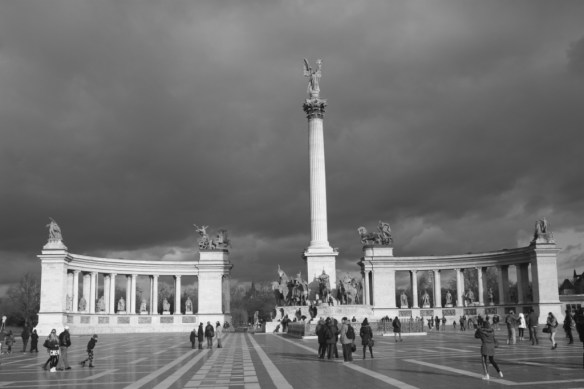
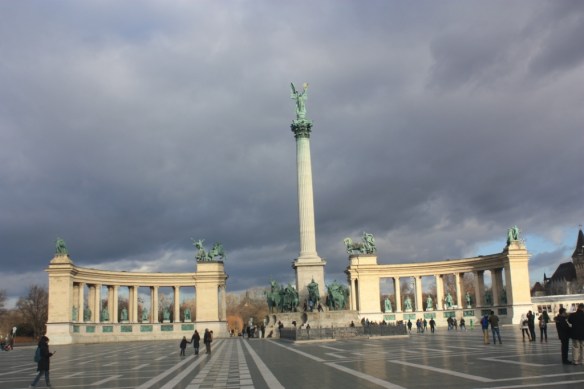
DAILY PHOTO: Heroes’ Square; Monochrome & Color

Taken in December of 2016 in Budapest