
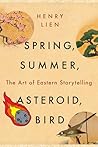
 Spring, Summer, Asteroid, Bird: The Art of Eastern Storytelling by Henry Lien
My rating: 4 of 5 stars
Publisher Site
I enjoyed, and was stimulated in thought, by the first half of this book, as well as by sections of the latter half, especially in the fourth chapter. (It’s arranged into four chapters, echoing the book’s central idea of a unique four-act approach to storytelling prevalent in Eastern societies. I’ll get to why I was not so fond of Ch. 3 later.) The book employs exemplary works of literature, film, and even video games to support the claim that there’s not just one approach to sound story crafting — but, rather, that Eastern societies developed distinct modes of storytelling reflecting their values and worldview. (A note on the use of the word “Eastern”: while the book draws heavily on East Asian sources, it tries to make a broader case suggesting not only South Asia but also the Middle East [i.e. everyplace not big-W “Western”] fit this mold. The book might have made a stronger case sticking to East Asia, as – for example – it might be argued that Arabia / Persia of the time of One Thousand and One Nights, being Abrahamic, was closer to Europe than East Asia in values and worldview. To be fair, the author does argue that some parts of that book are believed to have come from farther East (India and, possibly, beyond.))
The book proposes that there are two (arguably three) styles of story construction that are distinctly Eastern. The first is a four-act structure that is far from just a rejiggering of the three and five act forms with which English Literature students will be familiar. Incidentally, the book’s rather unusual title maps to the elements of this four-act structure. The second involves circular and nested story structure. I don’t know that the author succeeds in (or even seeks to) convince the reader that this is a uniquely Eastern approach, but -rather – makes an argument as to why it is prominent in Eastern storytelling.
The author picked an excellent set of works to illustrate his points. Generally, the works are both well-known and well-received among diverse audiences. The films he employs as cases include Parasite, Everything Everywhere All at Once, and Rashomon (the latter also being a literary work.) Lien uses one of my favorite Haruki Murakami novels Hard-Boiled Wonderland and the End of the World as a critical example. I was not at all familiar with the video games he describes (beyond name,) but – given that I’d at least heard of them – I assume they are pretty popular (though I can’t speak to whether they have any discernable stories and will have to take that on faith.) [I’m not sure whether One Thousand and One Nights was a good choice for Eastern literature, though it is an excellent choice as of nested structure.]
As for why I didn’t care for the book’s third part. I should point out that is the most philosophical (and the least explicitly concerned with story) part of the book, and it aims to show how values and worldview vary across cultures such that there are differences in story structure and crafting between different parts of the world. That could be a laudable objective and germane to the book’s point and it’s not why I found this section to be muddled and ineffective. The problem is that the chapter oversimplifies the issue in a way that seems to undercut a broader central argument (that Eastern modes of storytelling are underrepresented outside of the East.) Instead of suggesting that people experience conflicts along continuums (e.g. individual to group identity) and that Easterners tend come to different conclusions than Westerners do based on differing values and cultural perspectives, it engages in an elaboration of the distinctions that seems to suggest there’s some unbridgeable gulf of understanding between cultures (and, quite frankly, kind of feels like it’s shifted from making the aforementioned point to just being a thinly veiled critique of Western culture — which is fine, but probably belongs in a different book — or maybe a manifesto.) But if there were no basis for stories to resonate across this gulf, then not only wouldn’t Parasite and Everything Everywhere All at Once have killed it at both the Oscars and American box office, there’d be no reason for artists to attempt to branch out and tells stories across tribal lines. Without establishing a basis for story resonance, it’s ridiculous to argue that Hollywood should use Eastern modes of storytelling and Eastern worldviews to a greater extent. (A profit pursuing entity is always going to seek the largest possible customer base.) I’m not attempting to negate the argument that there are different approaches to storytelling among different peoples nor that more diversity of approaches shouldn’t be seen across cultures. I’m saying that this chapter doesn’t well support the argument for greater representation of Eastern modes of storytelling outside of Eastern outlets (publishers, film studios, etc.) because it spends so much time arguing the cultural differences that it doesn’t indicate how cross-cultural story resonance is possible.
Overall, I found this to be an interesting and thought-provoking read, though it was – for me – a bit muddled in the middle.
View all my reviews



 Tiger Riding for Beginners