BOOK REVIEW: 30 Days of Night, Vol. 2 by Steve Niles

30 Days of Night Volume 230 Days of Night Volume 2 by Steve Niles
My rating: 3 of 5 stars

Amazon.in page

[Note: this isn’t the Vol. 2 that follows immediately from the original book.]

I enjoyed the original three-issue “30 Days of Night” series. That book imagines a vampire attack on Barrow, Alaska during the winter when the sun does not rise for weeks. That concept of eliminating one of the vampires’ greatest vulnerabilities while putting the survivors in the demoralizing state of being hunted in the darkness and brutal cold makes for a visceral story.

While I thought this volume was written and drawn well (and quite similarly to the original – same writer, different artist) I have two gripes. First of all, I guess owing to the immense success of the franchise which resulted in many series and sub-series, it’s quite confusing to pick up the order of storytelling at this point. After reading the original book, I read Volumes 2 and 3 (sometimes labeled “Ongoing”,) thinking they would follow up on the Vol. 1 [the original] that I’d read. However, while I could follow the story, there was clearly a substantial gap in time and events. It seems like the Vol. 2 and Vol. 3 that I read (labeled “Ongoing”) were fitted together, but at least one series must fit between this Vol. 2 and the Vol. 1 that I read. Even scanning through a Wiki-page on the overall series didn’t really lend me clarity — though I had no desire or inclination to read through 30 summaries to figure out where this Vol. 2 and 3 belongs. [Especially as I don’t intend to read further as the series seems to have devolved from that gripping and unique Barrow, Alaska plot to being just another modern-day vampire story.]

So, the story of the Vol. 2 that I read is essentially Sheriff Eben Olemaun first feeding his way through a rebuilt [security super-maxed] Barrow before going to Los Angeles to do both more recruiting and turning, and then attacking the LA FBI offices in order to retrieve the remains of his wife, Stella. [My first clue of discontinuity was that at the end of the first [first] volume, Eben is dead and Stella was alive, and in this book those tables were inexplicably turned.] The other “half” of the story revolves around an FBI agent, Alice Blood, who is apparently the FBI’s star Vampire-slayer. We find out that she is the one who killed Stella, though she seems a bit broken up about it. Being the virtuous hero, Alice is also fed up with the bureaucratic moral ambiguity of her employer.

Getting around to my second gripe, it’s that this isn’t really a satisfying story arc as a standalone entity, it’s just carrying a story through. To clarify, I’m not saying it doesn’t stand alone because I’d missed who knows how much of the preceding story and didn’t understand. In that sense, I thought they actually did a great job of making clear what was going on without getting bound up in a lot of “as-you-know-Bob” exposition. What I’m saying is that this book gives one a chain of action without providing much understanding of motivation. I will grant that my not understanding the motivation in the first chapter is probably the result of not reading the immediately prior issue. However, I didn’t see much convincing motivation for anything in this volume. I saw that Eben wanted his wife’s head and torso back, but as he seems to have zero of the devoted husband and law enforcement professional left at this point and is just monstrous killing machine, it’s hard to know why he would care.

Long story short, I thought this book was alright, but not particularly satisfying and that the ordering is quite confusing. I picked up all three volumes I’ve read on Amazon Prime, so no great loss there. However, I mention that so no one else expects the Volume 1, 2, and 3 presented on Prime to present a contiguous story. Continuity issues aside, I don’t think the story still distinguishes itself from the massive number of modern-day vampire tales available today.

View all my reviews

BOOK REVIEW: 30 Days of Night, Vol. 1 by Steve Niles

30 Days of Night, Vol. 130 Days of Night, Vol. 1 by Steve Niles
My rating: 5 of 5 stars

Amazon.in page


This story takes the run-of-the-mill vampire tale into more chilling territory by setting it in Barrow (a town on the northern end of Alaska that sits within the Arctic Circle) in the dead of winter when weeks pass without sunlight. The vampires, thus, figure they have a month to feed without having to hide from the light, or risk being staked to death in their sleep.

On the day of Barrow’s final sunset of the year, the Vampires send in a scout to destroy all communications – starting by stealing and burning all of the residents’ cell phones. As I thought about this after reading, it was one of several points that strained credulity, but I have to say the visceral setup these people being trapped in darkness while being hunted kept me from being too skeptical at first reading. (I don’t know what cell service is like in Barrow but it seems like eliminating a tower would be more probable means of success than steeling a huge number of individual phones. To be fair, the scout does knock out the central communication hub as well, and maybe the reader psychology of being without personal communication (a cell phone) in the world we’ve grown accustomed to makes this course more intense – if absurd.)

The vampires, literally, chew through most of the population in short order. We do get some sense of the futile resistance put up by locals – particularly the protagonist and sheriff. [I would assume in a town like Barrow everyone over six-months-old possesses at least one firearm, and that likelihood is not disregarded, which makes the inconsequential resistance more chilling.] While the pacing feels slightly fast, it does get the scenario down to a manageable few to be hiding out together in a single building. (There is another major vein of strained credulity with regards to the people hiding out while maintaining core temperature, but – again – it was engrossing enough that I wasn’t much distracted at the time.)

I give the resolution high marks for being clever and gripping, but I will say that it felt to me like it unfolded too quickly and was too easy. I suspect that that may have to do with this being a serialized story. While I will say that the story is successfully wrapped up as a stand-alone arc (no mean feat as this is often a fail in serialized graphic novels or comic books,) the one eye toward setting up the continuing story arc may have contributed to this ending’s rushed feel. (Or maybe it was too much story for the allotted pages.)

I found this to be an intense and riveting read. If you like vampire horror, you’ll probably enjoy it.

View all my reviews

BOOK REVIEW: American Vampire, Vol. 1 by Scott Snyder and Stephen King

American Vampire, Vol. 1American Vampire, Vol. 1 by Scott Snyder
My rating: 5 of 5 stars

Amazon.in page


This graphic novel includes two distinct, but interconnected, stories presented in an interspersed fashion (i.e. each chapter presents a piece of each story.) The first story, written by Scott Snyder, is set in flapper era Hollywood, and revolves around a hardworking aspiring actress, Pearl, who is lured into a den of vampires by a big-name actor who she has a celebrity crush on.

The second story, by Stephen King, is set in the wild west and tells the story of a violent bandit named Skinner Sweet. Sweet is also turned vampire when he is “killed” by a vampire whose business activities are disrupted by Skinner’s rogue ways. The connective tissue between the two stories is the character of Sweet, who is a background character in Snyder’s story – playing a sort of mentor / guide who Pearl is only reluctantly and skeptically willing to accept.

Like Blade, character from Marvel Comics and the movies of the same name, Pearl and Sweet have enhanced capabilities in comparison to the old “European” vampires. These enhancements are similar to Blade’s, as well. The American Vampires don’t instantaneously fry in sunlight, and they are stronger and faster than their old-world counterparts. I suspect that in both cases, these enhancements are meant to make things interesting, given that – in both cases — these characters are at a disadvantage in every other way (i.e. they are outnumbered, they have many fewer resources, and they are far less experienced.) Unlike Blade, the “American Vampires” morph into nastier and more monster-like versions of themselves when they go on the attack.

The stories are straightforward, though skillfully crafted. In the first, Pearl is turned and then goes out for some payback, her best friend getting caught up in the action as well. In the second, Sweet plays out his vendetta against a lawman who was his nemesis. We get additional insight from a man who wrote up Skinner’s story as a work of fiction, but then came out as having really been writing the truth – much to the amusement of a skeptical audience. Flashbacks throughout this author’s talk layout the Skinner Sweet story. One does get the sense that immortality has had a tempering effect on Sweet, who doesn’t seem so prone to be mean for meanness sake. Although, this might be deceptive as we don’t see much action by him in the Snyder story.

I found the artwork to be well-done. While I don’t have expertise on the subject, I could follow the panels with no problem, and that’s about all I need out of them.

I was engrossed by this book. It can’t be claimed to being original, but it is an adept execution. If you are interested in vampire stories, this is an interesting take on them.

View all my reviews

POEM: The Vampire Rule

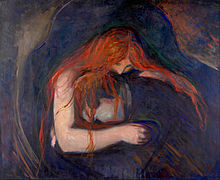
Edvard Munch; “Vampire”

They say a Vampire can’t enter your house unless you invite them inside.

I don’t know whether it’s true, on account of I don’t know if Vampires are a thing.

But I recognize a rule that is good and true when I hear one.

I always hear this or that person complaining about how such-and-such is,

“…living in my head, rent free.”

Well, who invited them?

BOOK REVIEW: The Strain, Vol. 1 by David Lapham et. al.

The Strain Volume 1The Strain Volume 1 by David Lapham

My rating: 3 of 5 stars

Amazon page

I sometimes wonder what Bram Stoker would think about the fact that his work spurred an entire industry of copy-cats. Everybody thinks that they can make an interesting and novel contribution to this vampiric genre. In very few cases, see: Richard Matheson’s I am Legend, they are correct. However, even though most of these works don’t take us into uncharted territory, they can still be entertaining. In fact, some of the versions that stay true to the concept seem more entertaining than others that moved into new territory but are patently stupid. I’m speaking, of course, of Twilight and other vampire-as-romance books that feed a widespread malady of the age afflicting teenage girls and, sadly, middle-aged women. I think The Strain, Volume 1 makes for an interesting and entertaining modern-day vampire story, without being particularly brilliant or groundbreaking.

The Strain, Volume 1 is the first installment of a graphic novel adaptation of the novel written by Guillermo del Toro and Chuck Hogan. The Introduction states that the graphic novel isn’t meant to precisely mirror del Toro and Hogan’s prose novel. I haven’t read the del Toro / Hogan book, but the synopsis indicates that at least the beginning and the characters are largely the same. I can’t comment as to how much the two works differ in detail, and whether the authors of the first book emphasized the difference so as to encourage readers to pick up both books (instead of cannibalizing each other), versus because the works are truly substantively different.

The inciting incident, apparently for the novel as well as the comic, occurs when a commercial jet liner lands in New York, coming to a stop and going out of contact with the tower. It turns out that all but three of the individuals on the plane are dead.

The graphic novel weaves together the story from two perspectives. First, the lead in the story is Dr. Ephraim Goodweather, a Center for Disease Control (CDC) employee who heads a rapid response team. As circumstances somehow indicate that this event involves a biological or toxic substance—though they have no ability to see into the plane, Goodweather’s team is called to investigate. (How they concluded with such high certainty that it was a substance in CDC’s bailiwick and not smoke inhalation or a terrorist hijacking is beyond me. But the CDC team enters on the heels of SWAT, and with operational control.) However, it’s a graphic novel with limited page constraints, so I didn’t grade too harshly on this particular type of credulity stretcher.

Second, the graphic novel begins with a vignette from the point of view of Abraham Setrakian who is a holocaust survivor and former Vampire hunter. Setrakian knows what is going on from his experience in the old world. It’s this odd couple pairing of an old man who knows an unbelievable truth and a scientist who doesn’t believe in the supernatural that makes this work interesting. The latter anchors the work in the world as we know it, but the former adds an element of mystery and charm. These mixed atmospherics are where this work really excels. The two men end up teaming up to fight a threat that will spread with unchecked fury unless they do something about it.

Unlike the hunky Vampires of Twilight fame, the vampires in Lapham’s work are meant to be as repulsive as possible. They have six-foot tongues with stingers by which they take their blood meals, and the giant slobbery maws necessary to accommodate such an appendage. Instead of having a new twist on the Vampire story, this work attempts to create value added in part by putting the horror back into Vampires in a big way (also, through skillful atmospherics.)

It should also be noted that this isn’t a work for young kids. That should go without saying, I know. Freak-show parents who reason that it’s only violence, and who have no problem with their child seeing someone take a shotgun blast to the chest, but who’ll write a death threat to networks, publishers, or congressmen if said shotgun blast exposes a nipple should be forewarned that the work has a short but sexually graphic section in it—in addition to all the stakings and proboscis stabbings.

This was an entertaining enough horror-genre take on the Vampire. Scientists may find it a bit ridiculous that their comic book counterparts go about their jobs sticking their hands in unknown substances found at the site of the mysterious deaths of almost 200 people. However, despite some credulity challenges, the book creates an interesting atmosphere for a vampire story.

View all my reviews

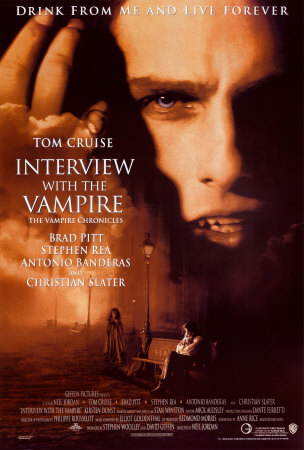
Interview with the Vampire: The Real Deal

InterviewwithaVampireMoviePosteI saw a review of Anne Rice’s book recently, and it got me thinking about how an actual interview with a vampire would go.

Interviewer (I): So, about this whole turning into a bat thing. It seems to me that a man is much bigger than a bat. Therefore, my first question is do you conserve mass? In other words, do you get really dense as a bat, and, if so, how do you even get off the ground? If not, you must shed mass, but then how do you get it back?

Vampire (V): I am the prince of darkness. I rule the night. I take whatever form suits my needs.

I: Well, that’s not really a proper answer, now is it? That’s sort of a politician on the Sunday morning talk shows answer.

V: [Bares fangs and growls]

I: Well then, moving on. Are you at all concerned about the many blood-borne illness out there: HIV, Hepatitis, Ebola, Rift Valley Fever, etc.?

V: I’m immortal. I can’t be killed by your puny germs.

I: So, that’s a… no?

V: Hrrumph!

I: Moving on. Have you ever had anyone put Vaseline on their neck or something else really gross–you know to prank you?

V: You suck!

I: One could say the same of you, my friend. Ha!… You know… because you suck on people’s necks… Well, then, moving on. Which would you rather have: a wooden stake to the heart or a silver bullet in the chest?

V: Silver bullets are for werewolves, you imbecile.

I: Yeah, but it’s still got to be quite unpleasant, wouldn’t you say?

V: [Sighs loudly] OK, I’d have to take the silver bullet, but the longer this interview goes on, the more fond I grow of the stake.

I: I love steak, too, but that’s besides the point. Any way, who would you rather have as an enemy: Bram Stoker’s  Van Helsing, who’s very smart but has no kung fu; or the  Hugh Jackman Van Helsing who’s all buff and studly but not the sharpest tool in the shed?

V: It matters not. They are both humans and, as such, no match for me.

I: Really, because in both the book and the movie…

V: [hisses like a rabid cat,  fangs out] Human propaganda. Are we done yet?

I: Not quite. What’s the hurry? Got a hot rendezvous with a Victorian wench on the docket?… Anywho. What would you say are the pros and cons of working the night-shift? I’d think it would be rather easy to get a parking space, but, then again, you don’t really need one if you turn into a bat. But, then again, all that flapping must get tiring…

V: I’m out of here!


BOOK REVIEW: Dracula by Bram Stoker

DraculaDracula by Bram Stoker

My rating: 4 of 5 stars

Dracula leaves Transylvania to find a new pool of victims, and the only thing standing between him and the people of London is Dr. Van Helsing and his cast of allies.

The novel begins with the arrival in Transylvania of Jonathan Harker, a real estate agent from England. Both Harker and his beloved wife, Mina, play an important role in unraveling the mystery of Dracula. Soon after a ghost ship rams into port, Lucy Westenra (a friend of Mina’s) begins to suffer an unusual illness. A Dr. Seward brings in Dr. Van Helsing who has a rare expertise in her particular ailment. Professor Van Helsing’s knowledge is essential to driving Dracula out of London and back to Transylvania. They pursue the vampire– resulting an a final show down.

Bram Stoker uses a series of journal entries, letters, and memos to convey the story. This is an interesting approach, and popular at that time, but it does have its limitations.

Dracula was written early in the age of science and reason. While it was an age of superstition, there is an attempt to elevate vampirism from a strictly supernatural phenomena to one in which science has something to say.

The 19th century language and approach to tension makes for a less gripping tale than one would likely see today, but it is still a very readable book.

View all my reviews

BOOK REVIEW: You Suck by Christopher Moore

You Suck (A Love Story, #2)You Suck by Christopher Moore

My rating: 4 of 5 stars

I haven’t read Twilight or any of the many YA vampire books that have glutted the market in recent years, but You Suck perfectly captures what real teenage vampires would be like. Tommy Flood is not a confident, suave, sexy vampire. He’s an awkward, if likable, dumb-ass. Christopher Moore’s characters are hilarious and, sadly, true to life.

Moore tickles the funny-bone as he tells a love story of a young couple up against an elder vampire, a group of other young idiots, and the cops. The fact that the couple isn’t pitted against each other– despite the fact that the female, Jody, turned Flood into a vampire– is testament to the strength of the relationship. If anything can sour a relationship, it’s one half of the couple turning the other into a vampire (or a Zombie for that matter.)

While the tension is not intense, the humor is ubiquitous. More importantly, one gets food for thought on such mundane vampire questions as:
– how does one recruit a good minion? (Abby Normal holds her own as a font of humor.)
– do cats make suitable substitutes for a blood meal?
– what happens when you bronze a vampire?

I enjoyed this book, and suspect you will too.

View all my reviews