BOOK REVIEW: Shamans, Mystics and Doctors by Sudhir Kakar

Shamans, Mystics and Doctors: A Psychological Inquiry into India and its Healing TraditionsShamans, Mystics and Doctors: A Psychological Inquiry into India and its Healing Traditions by Sudhir Kakar
My rating: 5 of 5 stars

Amazon.in Page

In this book, Freudian psychoanalyst Sudhir Kakar examines a range of alternatives to mainstream psychiatry / psychotherapy that are pursued across India. They are largely traditions that predate psychiatry, and which weren’t developed primarily as a path to mental health, but rather as methods to develop mind and spirit – but which came to fill a void. Included in this exploration are a Sufi Muslim Pir, a Balaji Temple exorcist, an Oraon bhagat, Tibetan Buddhist / Bon healers, cultists, tantrics, and Ayurvedic doctors. The chapters are organized by the type of healer, and the ten chapters are split between shamans (Pt. I,) mystics (Pt. II,) and Ayurvedic healers (Pt. III.)

This book is at its best and most interesting when it’s describing the author’s visits to various temples, shaman huts, and other places where healers reside. He tells what he learned and experienced at these places, which ranges from reassuring (shamans and healers getting at least as good a result as their mainstream psychotherapeutic counterparts) to mildly horrifying (people chained to cots, or being blamed for their condition — i.e. being told their faith is inadequate.) I found many of the cases under discussion to be fascinating, and learned a lot about how mental illness is perceived by different religious and spiritual traditions.

While Kakar is trained in a Western therapeutic system, he maintains a diplomatic tone about these indigenous forms of therapy – some of which are quite pragmatic but others of which are elaborately pseudo-scientific. I found this book to be insightful about various modes of treating the mind that are practiced in India

View all my reviews

BOOK REVIEW: The Shaman’s Apprentice by Zacharias Kunuk

The Shaman's ApprenticeThe Shaman’s Apprentice by Zacharias Kunuk
My rating: 4 of 5 stars

Amazon.in page

Out: May 11, 2021

This is an illustrated children’s book that takes the reader on a journey with an Inuit Shaman and her apprentice. The pair make a house call to diagnose and treat a man who is laid up in his sickbed. That diagnosis and treatment involves “visiting” a kind of spirit guide who provides them the information needed to understand the man’s ailment.

The pictures are beautiful, detailed, and rich in insight into the Inuit way of life.  They are full-page illustrations rendered in a painting-like style. The artist is Megan Kyak-Montieth.

The text consists of, at most, a paragraph on each page that opposes the respective illustration, thus making this a book that could easily be read as a bedtime story. It’s a simple and straightforward story.

The book explores the interesting issue of how our behaviors and mindset can influence our physical health. Some parents may be more comfortable than others with the supernatural way in which the patient’s ailment comes to be understood – i.e. through consultation with a spirit. However, if one is at all prone to buy a book featuring “Shaman” in the title, you’re probably not going to be disturbed by the material or the questions that might arise as a result of said material.

I found this book to be interesting and beautifully illustrated. If you’re looking for some diversity in what your children are exposed to, you may want to look into it.

View all my reviews

Medicine Man [Prose Poem]

He was unkempt and disheveled, even by the standards of those primitive living people of the tribe. If you could find a translator to speak with his tribes-folk, they’d not be offended to hear you refer to him as a madman. They’d find it surprising that you considered that some sort of insightful revelation.

They would part company on two points. First, you believe the fact that he thinks he speaks to spirits and devils is evidence of his insanity. They believe the fact that he has to speak with spirits and devils has made him coo-coo. Who wouldn’t lose a few screws? Second, where you think his insanity makes him fit for nothing — incapable of a worthy contribution. They think his insanity makes him uniquely fit to do a task no sane person would ever do.

He lives by himself, outside the tribe’s clearing, and people only have the nerve to visit when they must. But he’s never for lack of a conversational companion. Though only occasionally does he speak in the tribe’s language. He’s just as likely to caw like a crow. He fears nothing, even those things sensible people would agree are rightly feared. The tribespeople fear him, but they value him for the fear he inspires — in those unseen things that bump in the night and in their souls.

With one foot in this world and the other in another, his world bears only a passing resemblance to yours.


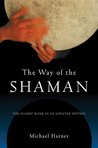
BOOK REVIEW: The Way of the Shaman by Michael Harner

The Way of the ShamanThe Way of the Shaman by Michael Harner
My rating: 4 of 5 stars

Amazon page


From tripping on ayuhuasca in Peru to sucking the evil spirits out of patients, Harner offers an overview of shamanic methods and practices. While it would seem like such an undertaking would be a thick tome given the wide variety of cultures in which Shaman are a fixture, Harner suggest that there is a remarkable similarity of methods used by these “medicine men” be they in the Americas, Central Asia, or the South Pacific. Of course, at a tight level of granularity there are differences, and Harner gives examples of such differences here and there – usually using examples of the Shamanic practices he has studied in South and Central America. However, this book is more the high altitude over pass of the landscape.

There are seven chapters. The first couple of chapters both set up the book and hook the reader with a detailed discussion of Harner’s ayuhuasca — and other mind / mood altering substance – experience. It should be pointed out that not all Shaman use psychedelics and Harner describes in detail alternative approaches to achieve altered states of conscious that involve a combination of drumming and meditative practices.

Chapter three discusses altered states of consciousness, and what Harner calls the “Shamanic State of Consciousness” (SSC) which is the altered state that is pursued by medicine men in their practice. Chapter four describes the concept of power animals and the role that they have in health and illness. (i.e. from the Shaman’s view, an illness might be seen as the result of lacking such a “spirit animal.”) The final three chapters discuss practices such as how the Shaman can acquire a power animal for the patient or how he / she might extract a malevolent influence.

I found an interesting corner being turned in this book. In the opening chapters it reads much like an anthropologist’s scholarly account. Even talking about tripping on psychedelic substances, it’s all with the grounded feel of a scientific mind. However, in the latter half of the book, it reads as though Harner truly believes that the altered state of consciousness is actually a sort of parallel dimension with an intrinsic reality unto itself. I don’t know whether this is a tactic to feather it in for skeptical readers or if it reflects Harner’s own internal journey. (It’s definitely a hard line to walk when writing a book that one hopes to be read by both scientific rational skeptics and religious true believers.) At any rate, the book gets a bit wilder as it goes along. In the beginning, the reader might think the book a discussion of how a powerful placebo effect is achieved, but by the latter chapters it seems one is considering how malevolent spirits can be trapped or extracted from a patient.

As for ancillary material, there are line-drawn illustrations, annotations, a bibliography, and two appendices. The first appendix is about drumming and gives details about what kind of drums and rattles the would-be Shaman should seek. (Drumming plays a major role in achieving the proper state of mind.) The second is a detailed description of a game played by the Flathead Indians. I should note that I read the 3rd edition of this book. The original was published in 1980.

I found the book intriguing as one interested in how people of various cultures achieve altered states of consciousness, how they experience such states, and why they pursue them in the first place. I’d recommend it for a reader who is curious about Shamanic practices – even one who, like me, is a complete neophyte to the subject.

View all my reviews