Are Action Movies Dazzling Us Stupid?

AvengersJust like everyone else, when I first watched The Avengers, I was awed. As I digested the experience, however, I realized how appallingly flawed the story was. Can a film that is visually impressive enough dance over the hard parts of story?

Alright, it’s not just being visually impressive. If it were, then the Transformers movies (I’m thinking particularly of the second one) wouldn’t be so sucktacular. No. Filmmakers also need clever quips. This feeds an inexplicable urge of young people to repeat the witty remarks of movie characters ad infinitum. (Confession: I’ve always longed for an excuse to say, “I’m your Huckleberry,” as per Doc Holliday’s words to Johnny Ringo in Tombstone.) It’s not just that the Hulk bashes a marble floor to dust using Loki’s lanky frame, but that he delivers that witty, two-word rejoinder. Together the CGI and the quip seal the scene in one’s mind.

[Spoilers ahead] If one looks up deus ex machina in the dictionary, one learns that it means: “someone or something that solves a situation that seemed impossible to solve in a sudden and unlikely way, especially in a book, play, movie, etc.” If one’s dictionary is online, one would then probably be treated to a video clip of the scene in which Professor Selvig is knocked on the head, becomes unenslaved, and consciously realizes that his subconscious built a backdoor that will allow him to shut down the portal that were previously told can’t be shut. The clip could then continue through the end of the movie (minus the post-credit shawarma scene.)  The following are key incidents of deus ex machina in this film:

-a bump on the noggin releases one from the mind-control of a god (A “puny god,” indeed.)
-a conscious mind (in a waking and non-meditative state) knows in great detail what happened in the subconscious
-an attack on the mothership disables all troops on the ground, Independence Day style (worst command and control ever.)

One may be thinking that I’m just one of those douches who picks nits, but I’m really not. These flaws are fundamental to how the story is resolved. They are cheats that make everything that happened leading up to the climax irrelevant. Think about it; if the Professor had gotten knocked on the head 20 minutes earlier, the massive Avengers battle through Manhattan would never have been necessary. They could have called the movie “Professor Selvig’s Magical Mind” and left the Avengers out of it all together.

I’m willing to sustain disbelief about the small things. There are plenty of critics who get into the minutiae of continuity gaffes and the like. A couple of my favorites are below.

Lest one think that I’m picking on The Avengers, that’s only because it’s the third highest grossing film ever and first in the superhero genre. If you’re spending hundreds of millions on a film, you’d think you could throw some chump change into good story-building.  I realize that filmmakers have a jaded audience to contend with, and that they have to ramp up the peril to impossible heights to impress. Maybe they are forced to then throw away the resolution of story. Those who read my recent review of The Wolverine, will know that my criticism isn’t restricted to The Avengers.

Well, I’ve got nits to pick.

BOOK REVIEW: World War Z by Max Brooks

World War Z: An Oral History of the Zombie WarWorld War Z: An Oral History of the Zombie War by Max Brooks

My rating: 4 of 5 stars

Amazon page

World War Z, as the subtitle suggests, is written as a series of interviews of key (or in some cases typical) people involved in the Zombie War. The viewpoints addressed include various political leaders, military service members of various branches and nations, strategic planners, doctors, and even civilians caught up in the diaspora that resulted from the plague.

The approach of the novel is unusual. To the degree there is a lead character, it’s the UN employee who conducts all the interviews. However, we don’t experience the interviewer’s story arc and are left with very little insight into this individual. Rather, the story is a global arc of mankind’s experience of zombies from “patient zero” through the clean up in the years following the war. And, it is a global tale. The stories of these individuals take one to places like Chongquing, Meteora, the Amazon, Barbados, Johannesburg, the Alang ship breaking yard (an excellent choice for a post-apocalyptic setting, I must say), Denver, and even onto a ballistic-missile-toting submarine sitting on the ocean floor.

Where Brooks’s book excels is in making one think, and in that regard it does an excellent job. This isn’t about edge-of-the-seat adrenaline injections to which most Zombie book authors aspire. I don’t deny that there are emotional parts to the book, but the tension is reduced by virtue of being a collection of survivors’ tales. That is, we know the story-tellers survived more-or-less intact. Also, because of the intrusions of the interviewer and the authenticity of responses (some are more skilled and open story tellers than others), we never lose sight of the fact that this is a couple of people talking war stories.

That being said, we take a cook’s tour of gut-wrenching food for thought over the course of the novel. Consider a government that abandons its citizenry, and even uses some as bait to help save others. Brooks tugs at the readers’ heartstrings through an interview with a K-9 soldier who describes the role of man’s best friend. Brooks portrays the best and worst that mankind has to offer–as one would surely expect to experience them in such a world gone wrong.

I must admit, some of the topics may be more interesting to me as a social scientist than they will be to others. One interviewee discusses the mismatch between job skills needed and job skills available in a rapidly evolving post-apocalyptic landscape. This speaks to present-day society as much as it does to a dystopian future. The author devotes an interview to questioning the man responsible for reestablishing trust in the dollar in an economy that has by necessity reverted to barter. There is also discussion of revolutions in governance that find their catalyst in the Zombie War. There are intriguing turns of events such as the makeshift flotillas of U.S. citizens converging on Cuba because Fidel’s authoritarian regime was uniquely prepared to close itself off during the earliest days of the outbreak.

With the movie coming out this Friday (June 21), I will say that I can’t see much in common between the book and the trailers for the movie that I’ve seen to date. However, I can imagine the movie being an extension or outgrowth of one of the many vignettes expressed in the book. This is not to say that the movie will be bad (or that it won’t be), but if one sees the movie one will still be left with impetus to read the book.

I enjoyed World War Z because it makes one think–a feat that isn’t the strong suit of Zombie literature.

View all my reviews

Your Post-Apocalyptic Guidance Counselor Is In

I’ve been reading World War Z because I had heard it’s an interesting book and because it went on sale–presumably in anticipation of the movie that comes out next week that shares a name (but probably little else besides Zombies) with the novel. I don’t usually read zombie or vampire literature because there’s so much of it and rarely does it offer anything new or intriguing. (Once one’s read Bramstoker and Matheson, what more is there to be said on the undead.) Brooks’ book is an exception. Told as a series of oral histories collected by a UN employee who serves as a quasi-protagonist–but not necessarily a central character–of the book, World War Z  chronicles the human dimension of the Zombie War.

The book tells a series of personal vignettes from the earliest sign of the pandemic through the cleanup afterward. One of the issues that is discussed is the mismatch between the skill sets the survivors had and the skill sets that were needed to survive in a post-apocalyptic world. In one of the interviews, a bureaucrat discusses the need for job retraining because they had all these information age analysts, managers, coordinators, etc. but few people who knew how to make new things, grow food, or repair damaged infrastructure. They had all these mid-level white-collar people and they needed blue collars.

This got me thinking. To be honest, I haven’t had a job that would be useful in a post-apocalyptic wasteland since I was a 22-year-old infantry-trained law enforcement officer. Everything since then has involved life in a cubicle or small office uncovering, creating, evaluating, analyzing, describing, modifying, and disseminating information. Then there has been writing, which I love, but which isn’t exactly going to pull humanity back from extinction. (Let’s not kid ourselves that “reading is fundamental” when society has to be rebuilt from the ground up–fed, clothed, etc.)

This isn’t to say that I would be altogether useless in a post-Zombie Apocalypse world. I lived years 0 through 18 on a working farm. That was a long time ago, but I’m sure I could remember something about how to engage in activities that are actually directly related to keeping people alive (as opposed to keeping them informed.)

So will you be useful post zombie apocalypse? What would you be interested in doing if your current Dilbert-esque work life became irrelevant?

BOOK REVIEW: Watchmen by Moore & Gibbons

WatchmenWatchmen by Alan Moore

My rating: 4 of 5 stars

Amazon page

When one sees lists of must-read books, if there is a graphic novel on the list, it’s probably this one. Watchmen represents both the graphic novel and the super-hero tale at their best. It forgoes the unrealistic and hackneyed dialogue and internal monologue that usually plague this genre. While the “tough” style (see: Tough Sweet Stuffy by Walker Gibson)is used liberally–particularly for the voice of Rorschach–it has a natural ring to it.

At its heart, Watchmen is a morality tale that pits absolutist morality against the utilitarian approach. Rorschach (a.k.a. Walter Kovacs) represents the absolutist extreme. For Rorschach, the lesser of two evils is nothing more than an evil to be punished. On the other hand, Ozymandias (a.k.a. Adrian Veidt) represents the utilitarian view that to save the many one may have to sacrifice the few. The rest of the cast is in between, showing varying degrees of comfort with utilitarianism, but none willing to accept the absolutist extreme.

While my preceding paragraph may have made this sound dreadfully boring, in fact it’s anything but. The morality tale plays out inside a well-developed mystery plot. It begins with an inciting incident best described by a quote from Rorschach’s journal, “Tonight, a comedian died in New York.” That comedian was “The Comedian” one of the book’s cast of costumed heroes. As other heroes begin to be eliminated–not all by death, some by imprisonment or apparently self-imposed exile–the intrigue builds. Events pull individuals–such as Nite Owl and Silk Spectre–back into the game after many years out.

For those who have seen the movie, I will say that it follows the book far more than do most film adaptations. The movie borrows many of the exact words of dialogue. It even borrows a lot of the imagery almost exactly (e.g. the Comedian flying out the window enveloped by glass shards.) However, if you’re wondering whether it’s still worth reading, I’ll say two things. First, the book does cover a lot more detail than the movie. Besides the usual comic book style graphic panels, there are excerpts from fictitious novels, correspondence, magazine interviews, and another graphic novels that support the story line. Second, the biggest deviation between the book and the film is in the details of the devious plan that is revealed at the book’s end. In other words, there are a few surprises.

I would agree with the widespread notion that if you only read one graphic novel, make it this one.

View all my reviews

BOOK REVIEW: Ubik by Philip K. Dick

UbikUbik by Philip K. Dick

My rating: 4 of 5 stars

Amazon page

Philip K. Dick was one of the most imaginative writers and skilled storytellers of the 20th century. There’s a reason that so many of his stories and novels have been made into movies (e.g. Minority Report, Total Recall, Scanner Darkly, and–most famously–Do Androids Dream of Electric Sheep? [which was adapted into a less quirky and darker film called Blade Runner.])Dick’s works lend themselves to the screen because they lay out novel plots in engaging stories.

Ubik isn’t among the Dick works that have been made into movies, but it’s not for lack of trying. Dick wrote his own screenplay for a film adaptation of the novel, but the project fell through. Over the years, a few directors have talked of Ubik: the Movie, so don’t be surprised if you see it someday.

Ubik deals with the afterlife. It’s set in 1992 (Dick’s future–our past.) (You can’t blame a man who lived from 1928 to 1982 for over anticipating the futuristicness of the 90’s. In the year of his birth Amelia Earhart was making the first solo transatlantic flight by a woman–only a year after Lindbergh became the first ever to do it. The year Ubik was published (1969) the Concorde was making its first supersonic transatlantic flight.)

In the world of Ubik, the moon is being developed for human use, and there are many people with psychic abilities. The protagonist, Glen Runciter, runs a business offering services blocking psychic activity to prevent industrial espionage. He is working for a company that’s building a moon base.

Runciter’s wife is deceased; however, he often consults with her as the dividing line between life and death isn’t so clear in Runciter’s world as our own. There exists a state of “half-life” between life and being fully dead.

The inciting incident is a nefarious explosion on the moon base of which Runciter and his team are victims. At first it appears that Runciter is dead and that his team is alive and trying to rush him back to Earth to get him into a state of half-life (just like his wife.)However, as the novel goes on it becomes less clear who is alive and who is dead. All that is clear is that Runciter exists in a different world from his team members. As the story proceeds there are clues–most notably coins with faces on them that aren’t dead Presidents. Joe Chip (a team member) sees coins with Runciter’s face on them, and later Runciter sees coins with Chip’s face on them.

Ubik is a product that Chip and the others begin to see advertised in their world–which they have come to believe is the afterlife. (Some versions of the book have a spray can on the cover that represents this mysterious product that comes in many forms.) They begin to believe that Ubik is their only hope. There has been a great deal of discussion about the symbolism of Ubik. Its name comes from the word for “everywhere”– as in “ubiquitous”– but what (or who)it’s supposed to be is never clearly revealed. Some have said that Ubik is meant to be God. If so, Dick made an interesting statement because the product is always marketed like some cheesy consumer good.

One test for whether you’ll like this book is whether you enjoy ambiguity in endings. Some readers really enjoy the thought-provocation of an ambiguous ending and the process of thinking out their own conclusions. (I am among this type of reader.) However, there are other readers who feel ripped off if the writer doesn’t tie all the answers up with a neat little ribbon at the end of the book. If you are this type of reader, you will likely hate this book. In other words, if you felt good leaving the theater when you saw Inception you’ll like this book, but if you left shaking your head and saying, “WTF, Chris Nolan?” then don’t bother.

View all my reviews

BOOK REVIEW: Wolverine by Claremont & Miller

WolverineWolverine by Chris Claremont

My rating: 3 of 5 stars

Amazon page

I got this as the Kindle “Daily Deal” about a week ago. It’s really a bundling of six comic book editions: Wolverine No. 1 through 4, and Uncanny X-Men No. 172 & 173.

The story begins as Wolverine travels to Japan to check on his beloved Mariko only to discover she is married to another man. Her abusive husband is a man owed a debt by Shingen Yashida, Mariko’s father, and a Yakuza crime lord. Mariko is the repayment of debt. Over the course of the six books, Wolverine battles Shingen Yashida and–having defeated him–must take on Mariko’s half-brother, the Silver Samurai. In the process, while Wolverine loves Mariko, Yukio (Shingen’s assassin sent to kill Wolverine) falls for Wolverine’s animal charm. The final two editions involve the X-men coming to Wolverine’s wedding to Mariko, but only Storm plays a significant role in the action.

I will admit that comic books are not my bag. As a writer, I generally find the dialogue and internal monologues contrived and filled with jarring “as you know, Bob” style references. This is nails-on-chalkboard grating to me, and it was no less true for this book than others. However, I accept that some of this is an inevitable result of the serialized nature of story lines (often across different series), the space limitations, and the fact that boys are a targeted audience.  The Watchmen is one of the few exceptions to this problem.

Having said that, I thought the story line was intriguing and it obviously kept my interest through to the end (albeit without much of a significant time investment.) There are lots of battles with ninja, so how cool is that?

It’s the first graphic-intensive book that I’ve read on my Kindle–which is the basic model, and I was surprised how well it worked. Each page contained several frames, usually in mice type that was hard on the eyes, but one could double-tap the screen to call up a single frame in very legible type.

I think this is worth a read if you’re interested in the Wolverine story. The upcoming Wolverine movie seems to share many of the same characters, but apparently with a different story line. Of course, as I understand it, the X-men series of movies are legendary for scrambling the mythology and timelines of the comics without much concern for being internally consistent, let alone consistent with the comics.

View all my reviews

DAILY PHOTO: Gregarious Darth Vader on a Sunny Day

Taken at the 2011 DragonCon Parade in Atlanta

Taken at the 2011 DragonCon Parade in Atlanta

BOOK REVIEW: So Long, and Thanks for All the Fish by Douglas Adams

So Long, and Thanks for All the Fish (Hitchhiker's Guide, #4)So Long, and Thanks for All the Fish by Douglas Adams

My rating: 4 of 5 stars

Amazon page

My reviews of the previous books in the series are linked below:

Hitchhiker’s Guide to the Galaxy

Restaurant at the End of the Universe

Life, the Universe, and Everything

This, the fourth book in the H2G2 trilogy, feels different from the others. First, it’s not so much about the ensemble cast featured in the other books. This is a book about Arthur, plain and simple. Arthur is reunited with Ford Prefect only in chapter 36 of 40, though there are Ford chapters interspersed preceding that reunion. Marvin the depressive robot makes it into the final chapter, but his appearance seems random and purposeless (except that it interjects a Marvin’s typical humor to nice effect.) Zaphod and Trillian are only mentioned in passing.

Second, romance plays a significant part in the story line, answering the previously perennial question, “Will Arthur ever get laid?”

It will be no surprise to readers of the earlier books that the title, So Long, and Thanks for All the Fish, was the final message of the dolphins before they jetted from the Earth–they being the only ones on the planet who knew the Vogons were about to destroy Earth to make way for a hyperspace bypass.

The story begins with Arthur being dropped on a planet that looks suspiciously like the Earth that he knows was destroyed. He hitches a ride with a young man and his delirious sister, Fenchurch. He develops an inexplicable connection with Fenchurch, and their burgeoning romance makes up a considerable part of the story. Fenchurch had had an epiphany right before what she can’t help feeling was the destruction of the world, and she is traumatized by her inability to remember.

The only difference between this planet and the one Arthur knows is that–he later finds out–this one is entirely devoid of dolphins. His house is even where he left it with a couple of months of dust and dirt accumulated. The only thing out-of-place is a new fishbowl engraved with “So long, and thanks for all the fish.”

The couple, once united, go to meet an eccentric scientist who claims to know what happened to the dolphins. The eccentric, who goes by the name Wonko the Sane, has a house built inside-out to symbolize that he is outside the asylum–the asylum being the rest of the world. Wonko shows the couple his engraved fishbowl, and they then realize that all three of them (including Fenchurch) received such bowls. Wonko tells them that they should have put their ear to the bowl’s mouth. They do so, and hear a message from the “Save the Humans” organization, which is a dolphin charity group whose name says it all.

Fenchurch wants to see the universe, and so when Ford lands back on Earth–having come to investigate why the Hitchhiker’s Guide entry for Earth has been expanded from “mostly harmless”–they go off together. Their first stop is to read God’s final message to His created. I’ll not tell you the message. So ends the book–well there’s a little epilogue which is nearly meaningless in isolation.

While it’s off-kilter from the other books, this one shares Adams’ usual absurdist humor. However, in keeping with the different feel, one of the best laughs I had in this book was not absurdist humor at all. That laugh resulted from a story told by Arthur to Fenchurch as an icebreaker. He had once bought a packet of crisps and a beverage and sat down at a table to work the crossword at a train station. The station cafe was crowded and so a stranger ended up sitting across the table from him. The man opened the package of crisps and ate one. Taken aback, Arthur didn’t know what to do. Being non-confrontational in a reserved British fashion, all he could manage to do was to ignore the man’s encroachment and take his own crisp to eat. The man, not to be out done, took another. They proceeded like this until the entire pack had been consumed. To Arthur’s mortification, when he got up to go to his train, he found that his packet of crisps was under his newspaper, untouched. Something about that struck me as hilarious.

View all my reviews

Here is the song from the movie of the same name.

CLASSIC WORKS: Slaughterhouse-Five by Kurt Vonnegut

Slaughterhouse-FiveSlaughterhouse-Five by Kurt Vonnegut

My rating: 4 of 5 stars

Amazon page

If you’re like me, you had to read this in high school. I reread it as an adult because the first time its awesomeness was tarnished by the fact that it was mandatory. Being a pessimistic youth, my thought was, “How good could it be if they are making me read it?” They don’t make you read Batman; they make you read Moby Dick. I’m glad I reread it as an adult. Little did I realize, my knee-jerk rejection of the book as something forced upon me, beyond my control, was mirrored by the theme of the book.

Slaughterhouse-Five tells the story of Billy Pilgrim, an optometrist who survived the Dresden fire-bombings was abducted by an alien race and became “unstuck in time.” If you didn’t get this impression, the book is strange. As the term “unstuck in time” suggests, there isn’t a chronological sequencing of events. Instead, the story leaps around from Pilgrim’s adult life as an optometrist to his time as a young soldier in the military to his time as an exhibit in a Tralfamadorian Zoo.

While the novel covers a lot of life, many of the important themes are seen in protagonist’s war experience. It should be noted that there is an autobiographical component to this book. Vonnegut was a prisoner of war who was ordered to help dig for survivors in the wake of the fire-bombing of Dresden. This gave Vonnegut a unique perspective of war and how similarly it is experienced by the enemy. An important line of tension in the book is between Pilgrim’s character and that of the jingoistic Roland Weary.

The Tralfamadorian subplot has a lot to do with being out of control, and learning that perceptions of control are illusory. This is exemplified by the time jumps, which leave Pilgrim completely unable to predict what will happen next. Then there is Pilgrim’s experience being exhibited in an alien zoo, what  could be less in control than that.

Like most of Vonnegut’s work, Slaughterhouse-Five is a dark comedy. There is humor throughout, but humor wrapped in the macabre. For example, whenever anyone dies there is a chorus of “So it goes.”

Everyone should read this, and reread it if necessary.

View all my reviews

MICRO-FICTION: Julia Doesn’t Know How Lucky She Is

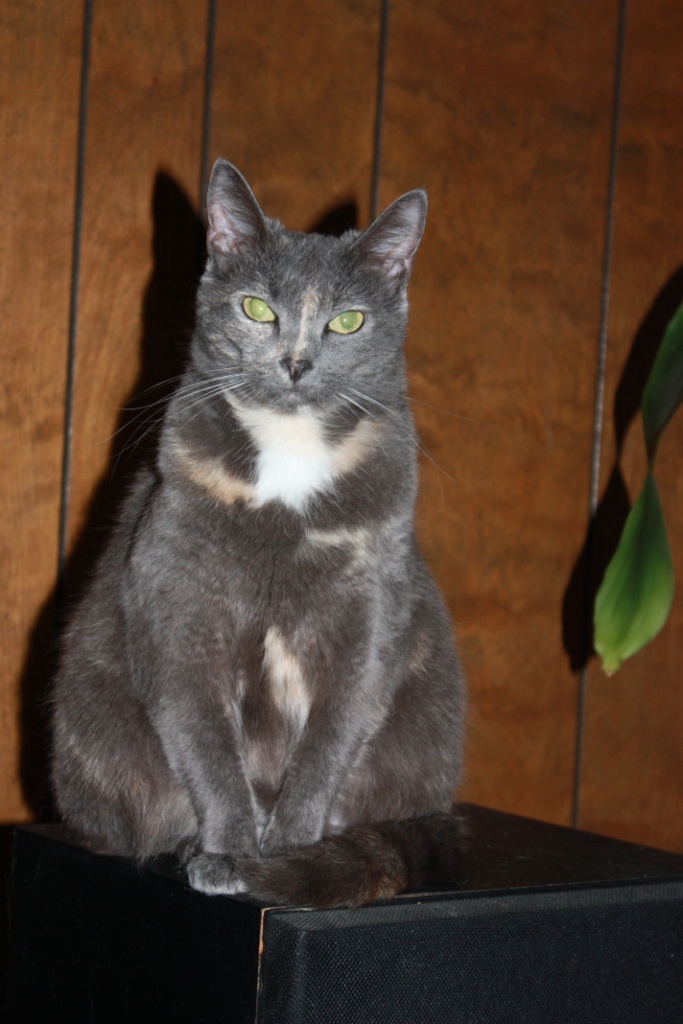
IMG_2555“Have you completed your mission? The Council grows impatient,” The thought occurred in Safrom’s mind as if he had a split personality rather than an angry disembodied consciousness in his head.

“No, we were very close to planting it last night, but the cat came in squawking and making racket. It woke her up just before we could get it set. Those damn cats will be the death of me.  The preceding night we managed to keep one out all night, but the other slept on the subject maintaining constant vigilance,”  Safrom said aloud as he paced around the sterile white space of his station.

“The subject travels, why don’t you just do it then?” The thought formed.

“Believe me, I would love to, and we make great efforts to do so. But it is not as easy to track a person through thought-space as it is in the physical world. If we can ever get the damn implant installed, that will, of course, change immediately. Most of the time she is not gone long enough for us to find her, and on the few occasions she has been, or we’ve been lucky, she hasn’t slept deeply.”


“RRRrrrarr-eeeow …  RRRARRrrr-eeeow… RRArrra-eeeow,” the noise came from floor level.

Julia pushed herself upright groggily and swept a shock of black hair out of her face. She stared at the gray cat illuminated by a shaft of streetlamp glow that slanted in through her bedroom window, and said, “Really! You’re really waking me up from a sound sleep in the middle of the night?”

The cat stopped its bellowing and sat back on its haunches, looking at Julia indifferently. Then the shorthair trotted out of the room and down the hall.

Julia lay back down melting into a down pillow and drifted back to sleep while wondering what made her cat do that. What makes a cat that has been fed and is never let out at night, repetitively caterwaul until its owner wakes up, and then it just goes back to its indifferent self?


Julia yawned aloud. “Excuse me. My cat woke me up in the middle of the night three times for no apparent reason.”

“Does it do that a lot?” Erma asked.

“It comes in waves, but, it seems to have it down to a science. It always seems to do it when I’m in the deepest sleep, usually in the middle of a weird dream.” Julia elaborated.

“What was your dream about?” Erma asked.

“Ah, you know, it was a dream. It didn’t make much sense. I was being chased?

“Being chased by whom?”

“I don’t know. I never see them, but it always feels as though they are just about to catch me.”

“Maybe the cat is doing you a favor.”  Erma said in a completely somber tone.

“Yeah, right, maybe.” Julia replied with a grin. She assumed Erma was joking, although there was nothing in the older woman’s expression to indicate that she might be.

Erma changed the subject, “So how is your research coming?”

Julia shrugged and said, “I don’t know. I’m feeling a little overwhelmed as of late. I keep pulling up new material, but, as I do analysis, I don’t seem to be converging on an explanation.”

“It’ll come, you’ve just got to keep at it, and never up. If you never give up, a solution will always present itself.” Erma said with a smile.

“I suppose.”

“You know the thing about cats is…” Erma began.

“What’s that?” Julia inquired.

“Aww, never mind.” Erma said.