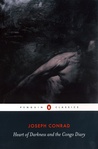
 Heart of Darkness by Joseph Conrad
My rating: 4 of 5 stars
Amazon page
Heart of Darkness is a story within a story (i.e. a frame narrative) in which the protagonist, Marlow, tells a group of men on a ship on the Thames about his adventures captaining a boat on the Congo River. The use of a frame narrative both gives this novella/ novel a confessional feel, but also imagines Marlow’s audience feeling his tale particularly viscerally as some of them might be caught up in similar intrigues themselves.
Marlow’s job in the Congo is transporting ivory. However, the core of the story revolves around a trip to extract an agent of the ivory trade named Kurtz, and to transport the ill man to medical care. Kurtz is an intriguing character. This isn’t a man one can feel indifferently towards. Some love his intellect, charisma, or even his ruthlessness. Others despise him as the face of villainy. Kurtz represents imperialism at its most vile. Some natives are at war with him. Others respect and fear him. However, he’s willing to destroy them all on a whim to make the flow of ivory come more swiftly.
Marlow isn’t a member of Kurtz’s fan club initially and thinks the agent is completely insane, but he becomes intrigued with him as their journey progresses. In a way, Marlow is the moderate face of Imperialism. He doesn’t like the way the natives are treated, or the power plays and bureaucracy of the trade. However, he’s an active and willing participant, and, ultimately, when given a choice to work against the system or in support of it he chooses the latter. He hands over Kurtz’s report on the “Suppression of Savage Customs.” He also shows his sympathy towards Kurtz through his interaction with the dead man’s fiance.
This is definitely 19th century literature. While the book is very short, it’s readability isn’t high by today’s standards. It’s organized into just three parts or chapters, and the prose isn’t built for speed. Also, while it turns out to be a gripping tale, it’s slow off the blocks. It must also be put in the context of 19th century literature because the themes of imperialism and suppression of “savagery” have long since been settled. Viewed through today’s lens, the story might not ring true. Though I suppose there’s still a heart of darkness in urban environments today, behind walls rather than across seas.
What are the book’s strengths? While it may seem silly, the title is pure-D awesomeness. Also, while it’s not organized or written for readability by today’s standards, by 19th century standards it’s a page-turner. It’s certainly a compact tale. As I indicated, I’m not sure whether to call it a novel or a novella. Reading this book isn’t a major time investment, and it does pay off. Conrad’s use of descriptive language is often beautiful. Conrad’s characters all ring true and serve to sit one in a world of darkness beyond the imaginings of the London elite, where sad and terrible things happen to make their world possible.
Lastly, the book makes one think. Like Kurtz, one is likely to love it or hate it.
View all my reviews
Share on Facebook, Twitter, Email, etc.