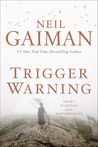
 Trigger Warning: Short Fictions and Disturbances by Neil Gaiman
My rating: 5 of 5 stars
Amazon page
“Trigger Warning” is a collection of 24 pieces of short fiction and poetry written by Neil Gaiman. If you know what a trigger warning is (I had to look it up) you may be thinking this collection is darker, edgier, and/or more risque than it really is. (For those who don’t want to look it up, a “trigger warning” is a blurb that intimates that a work has words or images that may induce a traumatic reaction.) However, these stories are Gaiman to the core, which means they are humorous, clever, and often quirky; but they are unlikely to throw one into catatonia or an apoplectic fit. The pieces include Sherlock Holmes and Doctor Who stories, spin-offs from Sleeping Beauty and American Gods, as well as a few homages to other authors, including Ray Bradbury, Gene Wolfe, and William Blake.
Without further ado, I’ll give a rundown of the included works:
1.) “Making a Chair”: This is a poem about writer’s block.
2.) “A Lunar Labyrinth”: An homage to Gene Wolfe’s work, “Solar Labyrinth.” This short story is about a maze that was destroyed, and that wasn’t to be walked on full moon nights.
3.) “The Thing About Cassandra”: This is among my favorite stories in the collection. What happens when your friends and family start bumping into the girl who you made up as a girlfriend back in school?
4.) “Down to a Sunless Sea”: This was written for a water-themed event. It’s about a person riding in a lifeboat down the Thames toward the sea.
5.) “The Truth is a Cave in the Black Mountains”: This one was inspired by an island off Scotland called Skye, but the story is fantasy with magic elements. A man strikes out in search of revenge and closing, regarding a daughter who he thought had run away. This is one of the most engaging pieces in the collection.
6.) “My Last Landlady”: This is a story, conveyed in poetic form, about a mean landlady.
7.) “Adventure Story”: In the Introduction, Gaiman calls this a companion piece to his novella “The Ocean at the End of the Lane.” However, I didn’t make that connection, (and I’ve read that story.) At any rate, it’s a great story about an intriguing artifact left behind by a [deceased] father whose stories were always painfully dull. It’s told by a mother to a son who is incredulous that his, seemingly milquetoast, father lived through such a fascinating event.
8.) “Orange”: Like several of the pieces in this book, this one is unconventional / experimental. However, it’s creative, and it works. It consists of answers to a questionnaire, from which the reader pieces together the story. One doesn’t have the questions, but most of them are fairly clear from the context of the answer.
9.) “Calendar of Tales”: This is what it sounds like, 12 stories each matched to a month. It’s another of the unconventional and unusual pieces. Each story was spun from a tweet response to a question about a given month of the year.
10.) “The Case of Death and Honey”: Few characters in the public domain have spurred as many offshoot stories as Sherlock Holmes, and this is Gaiman’s entry in the pool. Holmes’s interest in bee-keeping is central to the story.
11.) “The Man Who Forgot Ray Bradbury”: An homage to Bradbury. If one forgets a person, did they ever exist?
12.) “Jerusalem”: This work was influenced both by a poem by William Blake and a trip the author took to said city. The story is about a couple of tourists and the unique mental illness associated with this locale.
13.) “Click-Clack the Rattlebag”: A scary bedtime story told by a child about a different kind of monster.
14.) “An Invocation of Incuriosity”: A story about one of the strange and colorful people one might meet at a flea market.
15.) “’And Weep, Like Alexander’”: A lighthearted story about an “un-inventor,” one who keeps you from having flying cars and all the other promised technology from sci-fi.
16.) “Nothing O’Clock”: This is a “Doctor Who” story. It’s not necessary to be familiar with the series (necessary backstory is provided), but it could make it more appealing—i.e. the inside joke effect.
17.) “Diamonds and Pearls: A Fairy Tale”: This is from “Who Killed Amanda Palmer?” Palmer is a cabaret-punk singer/songwriter and Gaiman’s wife, and the aforementioned booklet consists of a series of photos of Palmer looking deceased with brief stories to go along. This is one of the stories that could stand alone. It’s a fairy tale of the adults-only variety.
18.) “The Return of the Thin White Duke”: Another fairy tale, this one about a Duke that strikes out on a quest for adventure in order to rescue a Queen who doesn’t need rescuing.
19.) “Feminine Endings”: A story about a human statue—by that I mean one of those people who deck themselves out and stand on a box in the town square in touristy places in many parts of the world.
20.) “Observing the Formalities”: A poem about one who doesn’t get invited.
21.) “The Sleeper and the Spindle”: A take on the story of “Sleeping Beauty,” but from a different point of view.
22.) “Witch Work”: This is another poem. I believe it’s the only one that’s not free verse. It’s about the life of a witch.
23.) “In Relig Odhrain”: This is a true story about a saint, written in free verse.
24.) “Black Dog”: This is a spin-off from the novel “American Gods” and it features that book’s protagonist, Shadow. You don’t need to have read that book, but you might have a greater affinity for the story if you have. It should also be noted that this is the one piece that is original to this collection, and it’s one of the most substantial pieces in the collection. i.e. it gives fans a reason to pick up the book even if they’ve read a lot of it from the original source.
I enjoyed this book. Gaiman is a masterful story-teller. Whether it’s one of conventional pieces based in established worlds (e.g. “Doctor Who” or that of Sherlock Holmes) or one of the off-the-wall, experimental pieces, these stories and poems are a pleasure to read.
View all my reviews
Share on Facebook, Twitter, Email, etc.