
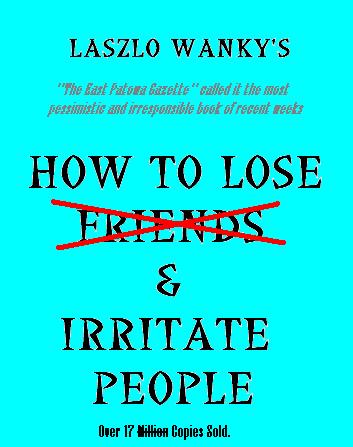
BOOK REVIEW: How to Lose Friends & Irritate People by Laszlo Wanky

Cover_How_to_Lose_Friends


How to Lose Friends and Irritate People by Laszlo Wanky

My Rating: 5 out of 5 Stars

Amazon Page


Wanky pays an homage to Dale Carnegie’s seminal self-help book by calling it, “a book for its time–that time being one in which people were lonely, pathetic, and didn’t understand social networking.” The author’s central premise is that we live in very different times, and today people are inundated by Facebook friends they neither like nor find interesting. Furthermore, Wanky goes on to argue, gone are the days when likable people are  liked. We live in an era in which douche-bags and drug-addled celebrities are gods among men. The book offers many headline examples, such as how Miley Cyrus’s career crashed as the sweet and admirable Hannah Montana, but then she caught her second wind by adopting the persona of a meth-addicted prostitute.


Roughly half of the book is dedicated to how to find success in defriending unwanted virtual amigos. Wanky suggests that the usual tactic of subtly “un-adding” people almost always fails because people are too “wussified” to make it stick. The only effective strategy, according to the author, is to trick others into removing you from their list of pseudo-friends. Be forewarned, however, being uninteresting and annoying is not enough–one must be spectacularly despicable. This is hard for most people–whom Wanky calls “the sychophantic masses”–because they slobber over being liked. Wanky devotes three chapters to helping people get over their love of being liked. The most cogent of these chapters is, “Kim Jong Un or Gandhi: Who Ya Wanna Party With?


The aforementioned chapters also help set up Part II of the book, which explains how one can put a skyrocket on one’s career by borrowing the techniques of the likes of Howard Stern, Rush Limbaugh, and Piers Morgan. Wanky shows how, like these individuals, one can be thoroughly unlikable while having people hang on your every word.  Again, three chapters form the core of this part of the book. They are: “Loud = True”, “Bombastic Fact Picking for Beginners”, and “Your Hairstyle Makes You Sound Stupid.”


I’m not going to pretend that Mr. Wanky’s language is fluid or graceful.  The author’s prose is colloquial… at best. A typical sentence–seen in chapter 8–is, “If ya wanna get with the boom-chiggy-booms, you gotta shout those fart-monkeys down, cause if they hear ’em they’ll all be like, ‘who’s the fart-monkey now, bitch, who’s the fart-monkey now?'”


The book’s strengths include its incredible brevity. Weighing in at only 26 pages, four chapters consist entirely of 27-syllable haiku. It also features fine graphics such as a picture of a “fart-monkey” that any grandmother would be proud to stick on their refrigerator. (The color choices were bit odd, but Wanky was clearly limited to the 16-color box of Crayolas.)


I’d recommend this book for anyone who doesn’t like friends and who really despises people’s indifference toward them. I have no doubt that by following Mr. Wanky’s recommendations, one can become a thoroughly loathsome individual in a matter of days.


Lastly, Happy April Fool’s Day.


BOOK REVIEW: 250 Things… by Chuck Wendig

250 Things You Should Know About Writing250 Things You Should Know About Writing by Chuck Wendig

My rating: 3 of 5 stars

Amazon page

You’re not going to get any visionary insight from Wendig’s book. What you will get is a lot of practical advice on writing salable commercial fiction delivered in a concise and humorous package. However, be forewarned, Wendig’s humor isn’t for everyone. It’ll appeal most to frat boys and others who enjoy the gratuitously bawdy.

The book really is arranged as a list of 250 pieces of advice on writing commercial fiction. These items are arranged logically into chapters covering topics such as character, setting, plot, description, screenwriting, and marketing your manuscript. The book offers a good way to review a lot of information if you enjoy the author’s sense of humor.

Rather than recommend the book without reservation, it may make more sense to make a couple lists of my own.

List I: People who will love this book.
-If you watch Robot Chicken and Archer, you’ll love this book.
-If you want to be the next Chuck Palahniuk,…
-If you send freakish porn to co-workers and are shocked by their stunned silence,…

List II: People who will hate this book.
-If you watch Downton Abbey and The MacNeil Lehrer Newshour, you’ll hate this book.
-If you want to be the next Chaucer,…
-If you are a deacon or lay minister in your church,…

Wendig’s language doesn’t leave a lot of room for middle-of-the-road views. His attempts to entertain as he informs will make the book quite readable for some and unpalatable for others. However, I suppose if you’re in the Venn intersect of those who watch both Downton Abbey and Robot Chicken you might have middling views on the book.

View all my reviews

BOOK REVIEW: Pocket Guide to Hatha Yoga by Michele Picozzi

Pocket Guide to Hatha Yoga (The Crossing Press Pocket Series) (The Crossing Press Pocket Series)Pocket Guide to Hatha Yoga (The Crossing Press Pocket Series) by Michele Picozzi

My rating: 4 of 5 stars

Amazon page

Having moved to India, I’ve been wanting to take advantage of the wealth of expertise in yoga. However, part of the problem is that there is such a wealth of knowledge. There are many different schools, each with different approaches and focal points, and each of those with separate branches. So I began, as I often do, among the shelves of one of my local bookstores. (Yes, here in India, we still have local bookstores [plural emphasis intended.])

That is where I picked up Michele Picozzi’s Pocket Guide to Hatha Yoga. A slight book of only about 100 pages, this guide serves as a sort of “Yoga for Dummies.” (I’m aware that there is a book by that title, but it’s probably not as concise.) Despite a mild bias against learning about yoga from Westerners (what’s the point of being in India–yes, I realize it’s irrational), I picked up this thin guide because it was only 70 rupees (less than $1 US), and I like the way it was organized.

It begins with a quick overview of the many schools of yoga. Next, it does the same for the many branches of Hatha yoga–which by all accounts seems to be the most popular school. I found this very helpful. The book doesn’t get bogged down in the minutiae, but rather presents a short paragraph hitting the highlights that differentiate one sect from another.

Then the book gets to the meat of the subject (my apologies to vegetarians for that analogy.) It gives helpful tips for one who has never been in a yoga studio before. Then it has chapters on postures (asana), breathing exercises (pranayama), and meditation (dhyana.)We learn that these are but three of yoga’s 8-fold path (not to be confused with Buddhism’s 8-fold path.) For the neophyte, it may be news to learn that there is more to yoga than just bendy poses.

The last chapter deals with basics of a yogic/ayurvedic diet. Here I learned that the Dalai Lama isn’t a vegetarian, among many more important advice about how and what yogis and yoginis should eat.

There are appendices containing line drawings of about 45 of the most fundamental asanas (all of the graphics in the book are line drawings), a glossary, and a list of references.

If you are brand new to yoga, I would recommend this book. You can get it through Amazon for only a little more that 70 Rupees.

View all my reviews

BOOK REVIEW: Blue Zones by Dan Buettner

The Blue Zones: Lessons for Living Longer From the People Who've Lived the LongestThe Blue Zones: Lessons for Living Longer From the People Who’ve Lived the Longest by Dan Buettner

My rating: 4 of 5 stars

Blue Zones are places with disproportionately large numbers of 100+ year old folks. Buettner’s book contains case studies on four of these blue zones: Sardinia, Okinawa, Loma Linda (California), and Hojancha (Costa Rica), and provides interesting insights on living from the places that produce lots of centenarians.

Even those who aren’t particularly interested in longevity will find a great deal of valuable information in the book. Not unexpectedly, nutrition is at the fore in this book. However, there are other factors such as family and social life, sleep, and being active that correlate strongly with longevity.

A few things I picked up:
– As in Okinawa, one should say hara hachi bu before each meal as a reminder to stop when one is 80% full– rather than 100% or 180% full.
– Most nuts make a good snack even if they’re roasted in an oil that isn’t particularly healthy (the density means limited saturation.)
– Despite our species’ history, which presumably involved gorging on meat when it was available,vegetarians (and near-vegetarians) live longer.
– When you eat is as important as what you eat.

View all my reviews