
My First Tibetan Buddhist Meditation & Lecture

Having settled into life in India over the past month, I’m now getting around to some of the self-enrichment activities I’ve planned on taking advantage of here in Bangalore. Today I attended a meditation session and discussion/lecture at the Thubten Lekshey Ling Tibetan Buddhist Meditation Center. I’ve read a few books on Buddhism and even one or two specific to Tibetan Buddhism, but this was my first time attending such a session. Also, while I’ve done several kinds of secular meditation, both in a group and individually, this was my first exposure to guided meditation in the Tibetan Buddhist tradition.

The title of the session was As the Clouds Drift by… The first hour was the meditation portion and the following two hours were the lecture / discussion portion. The session opened with a few prayers that were chanted in what I believe was Sanskrit, but there was an English translation for newbies such as myself to follow along with the meaning. Then we did a few short meditations that were much like others that I’ve done: meditation on breath and meditation on bodily awareness. Then there was a visualization as we read a sutra in English.

Transitioning into the discussion and lecture portion, we first discussed the meaning of life. No, I’m not making that up. While it might seem like a hackneyed question, some intriguing points were raised. We were directed to think of the question as having two alternative meanings. First, why am I here? Second, what is my purpose? The conversation gravitated to the latter topic. I’m not sure if this was because there was a consensus that the question “why am I here?” is meaningless, or if the question of purpose was just more intriguing. There were various opinions about whether there was a purpose, and–if so–whether it is universal or individual-specific.

After a brief tea break, the remainder of the session involved readings from The Way of Bodhisattva followed by analysis and prompted discussion. Much of the discussion revolved around the issue of how compassion is expressed and the difficulty (or ease) of being a Bodhisattva. (A Bodhisattva is one who seeks enlightenment out of compassion for all sentient beings.)

I found the session to be thought-provoking and beneficial, and thought the atmosphere was conducive to growth. Emphasis was placed on discussion rather than straight lecturing. I will no doubt be back to visit in the future.

I did learn something interesting about myself through the process of the class, and that’s that I need to learn to be still for more than two hours. While there was no prohibition on moving around–particularly beyond the meditation portion– in an effort to not be a distraction, I tried to keep fairly still. I practically ran home afterwords. I had all this pent-up energy. I would have thought myself better than average at sitting in a contemplative state. I’m a writer for goodness sake. I spend entire days at my computer. However, in truth, I rarely sit more than an hour without getting up and stretching or doing some sort of movement to limber up my body and get the blood flowing. I was raised Catholic, and so I’m not new to sitting quietly for long periods of time. Though that was a long time ago. I also have three college degrees and have spent more than my fair share of time in classrooms, but the wandering mind is not discouraged in that environment–in a way it’s encouraged.

Transmigration of Blog

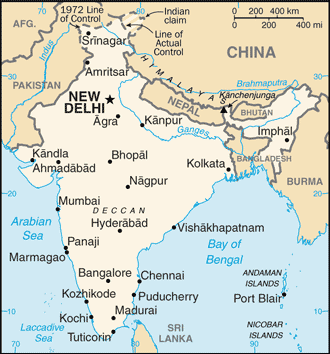
india_sm_2012We’re down to about a month until our move to India.

The house is largely in order with only a few odds and ends remaining.

Most of our worldly possessions are in storage, and I haven’t really missed any of it. (A lot of “moss” collects when your stone stops rolling for a few years.) The house now echoes. Movers will be coming to get the small amount of stuff we’ll ship to India in the next couple weeks. Then we’ll really be living minimalist.

We’ve got all our shots with the exception of the final doses for Hepatitis. We’ll get those in country. With respect to shots, when moving to India, one has to get… well,  all of them.

Visas are in the works though we’ve had some delay on that front. However, fortuitously, the local Indian Consulate is beginning to take applications, and so I won’t have to send my application off to another city and can eliminate the time and risk of postal transit.

My list of things to do consists of fewer large, all-consuming tasks and more quick and easy jobs.

All of this means that I’m getting back to writing.  This is a bit like getting a corroded junk-yard jalopy running again. It’s remarkable how much the creative juices curdle when one spends a few months focusing on home repairs, monitoring contractors, getting shots, and other mundane tasks of international relocation. I worked almost exclusively on drafting two novels for a period of a little over a year, and now–as I resume writing and revisions–I’m having to re-read just to figure out what they’re about. On the bright side, I sometime surprise myself with what I wrote. For me, there’s definitely economy of scale in long writing  projects. Writing eight hours a day yields a lot more than eight times writing for one hour a day. I lose voices, character idiosyncrasies, and plot detail so easily unless I’m immersed in them.

As for this blog, I think a rebirth is in order. Since I’m moving to India, I’ve invoked the concept of transmigration of soul. In Hinduism, some sects of Buddhism, as well as a few lesser known religions, there’s a belief in reincarnation in which the soul may be reborn into an altogether different type of container. For example, if you were good in your last life, you might come back as a lama or a lap cat. If you were bad in your last life, you might come back as a slug or a Congressman. So the question of the moment is what this blog will be reborn as when  it sputters up from out of the ashes.

I would like the site to remain (or, perhaps, become)  humorous, but I’d like the humor to be less curmudgeonly. This presents a challenge because I’m not sure that I know how to be funny without being a curmudgeon. In point of fact, I’m not sure I know how to not be a curmudgeon–funny or otherwise.

I want this site to be reflective of my new life. I’ll continue posting photos, though after the move they will be disproportionately from Bangalore, India, and a few adjacent countries to which I will be traveling. So it’ll remain part travel site. I’m sure I’ll have plenty of lessons learned about travel in India to share.

When I’m not writing or sleeping, I’ll be engaged in a quest of self-improvement. The development of mind and body have been raised to high art in India, and I hope to  find some of those individuals with that knowledge.

Expanding my abilities and understanding of martial arts is one of my goals for this period. It’ll be a challenge to keep from becoming rusty in the jissen kobudō (Japanese old school martial arts that emphasize pragmatic skills) that I have been studying my entire adult life. However, in addition to working on what I know, there are other activities that I think will help expand my understanding while keeping me suitable limber and conditioned. I would like to learn  a little about indigenous Indian martial arts such as kalaripayattu, silambam, and–if time permits–gatka. Furthermore, I would like find a place to train in Bangalore where I can do some training in what I’d call general jissen (practical fighting) skills.

However, my attempts to improve myself will not be limited to martial arts alone. India might be cursed with plagues of poverty, pollution, and–well–plague, but they have no shortage of gurus–whether I can find one that’s reputable and willing is another matter. The older I’ve gotten, the more I’ve realized that I don’t have a firm grasp of my mind. My mind runs and I don’t pay enough attention to what it is telling me; I don’t put enough effort into fixing what is broken. I read a quote recently about people who put great effort into studying the external world, but who remain ignorant of themselves.  This struck close to home, but it’s not just me–it’s widespread. People study psychology in school and learn about cognitive biases, but they don’t put the information to use in becoming more virtuous people. For example, a person might learn about the “self-serving bias” –whereby people claim responsibility for successes but place blame for failures on external factors–and say, “yeah, it’s funny that other people totally do that.”

Part of practicing martial arts is keeping one’s self healthy, against all odds. While I’ve never practiced yoga, I appreciate the belief that mind and body are inseparable. I would like to work on building a body that is less likely to be crippled by the practice of martial arts as I age. I intend to study Thai yoga massage, which incorporates stretching and pressure point massage. There’s an interesting connection between India and Thailand with respect to this form of bodywork. While it’s most closely associated with Thailand, some claim that its roots are in Northern India with a master called Guru Jivaka. While visiting Thailand, I developed an appreciation for the health benefits of this type of massage–particularly for one prone to have things out of whack. However, I didn’t have the time to study it during that visit. There is also the more distinctly indigenous holistic healing system of India, Ayurveda, and I would like to learn more about it as well.

In short, I intend to have a pretty full agenda while living in India, and I hope readers will find my posts about these experiences interesting and worthwhile.

BOOK REVIEW: Zen Mind, Beginner’s Mind by Shunryu Suzuki

Zen Mind, Beginner's MindZen Mind, Beginner’s Mind by Shunryu Suzuki

My rating: 5 of 5 stars

Amazon page

This thin volume packs a great deal of knowledge about the Zen approach to the mind. It’s divided into three parts: right practice, right attitude, and right understanding. The first section is technical (e.g. posture, breathing, etc.); the second section is inspirational; and the third section is philosophical. This is consistent with the Zen priority of putting practice first and being cautious about philosophizing.

The core concept is captured by the book’s topic sentence, “In the beginner’s mind there are many possibilities, but in the expert’s there are few.” This sentence contains a valuable truth, but I can’t help but think that the related title probably hurt the book’s sales. Sadly, many people would rather read a book entitled “How to be a Zen Master in 90 Days.” Everybody wants to be an expert, and few are open to the lesson that they must look at the world through the eyes of a novice. I’ve noticed this in the martial arts. Most individuals seem to be much happier as mediocre black belts with only a few years of practice than they would be as a highly competent white belt. This, of course, is the lure of external validation, which is a weak salve for one’s private demons.

At any rate, the value of cultivating shoshin (i.e. beginner’s mind)is to avoid have one’s experience jaded or tarnished by one’s past. It’s about avoiding attachment to what one believes one knows, such that one is incapable of learning something new. It’s like that old, but popular, tale that is told in both the Zen Buddhist and Taoist traditions about a cocky, young student who comes to learn from a master and proceeds to tell the master all he has already learned. The master pours tea for the youth, and when the cup is full he continues to pour until the scalding liquid spills over into the kid’s lap. When the student angrily asks why the teacher did that, he is told, “Your cup is already full. In order to take in more you must first empty your cup.”

I enjoyed this book. It’s very readable. The chapters are concise and not the least bit arcane. The bits on practice are not bogged down in minutiae. As I indicated, this book covers a lot of ground. I would dare say that if you are only going to read one book on Zen in your lifetime, this is a suitable candidate.

View all my reviews