
Taken in October of 2014 at Angkor

Taken in October of 2014 at Angkor

Taken in October 2013 at Angkor, Cambodia.

Taken in October of 2012 at Angkor.
At Angkor, trees swallow temples, both breaking them up and holding them together, giving us a glimpse of the world after us.
 A Record of Cambodia: The Land and Its People by Zhou Daguan
My rating: 4 of 5 stars
Traveling to an archaeological site as grand as Angkor, it’s natural to wonder what the city must have been like in its heyday. Angkor’s population was estimated to be as much as 1 million people, making it one of the world’s biggest urban centers in its day. One can get a feel for how vast and impressive Angkor was by way of the restorations, its artwork, and even the lay of its rubble fields. However, today’s Angkor is in large part a testament to the power of Mother Nature to swallow once proud temples and palaces with strangler figs and to shatter stout walls with white silk cotton trees. It’s hard to fathom what it was like when it was occupied by kings and concubines, slaves and shamans.
A Record of Cambodia offers a rare glimpse into life at Angkor at the tail end of the 13th century—near the city’s peak. It was written by Zhou Daguan, a Chinese diplomat sent by Yuan China [Mongolian era] as part of a delegation. Zhou spent almost a year at Angkor during 1296-1297. His report was translated into French during the 19th century, and all the English translations in existence had been based on the French not the original Chinese (i.e. twice translated.) This 2007 edition, however, was translated directly from Classical Chinese by Peter Harris.
The thin volume weighs in at only about 150 pages, but fewer than 40 pages are Zhou Daguan’s report. The other 110 pages include front matter, graphics, appendices, and notes. The Introduction, at 30 pages, is almost as long as Zhou’s document. However, this should not be taken as criticism. There’s a lot of useful expansion upon, and explication of, the information in Zhou’s report in both the Introduction and the end-notes. While it’s written by the translator, Peter Harris, it’s probably best to think of the Introduction as an Editor’s Introduction rather than a Translator’s Introduction–the latter creating an impression of a discussion of the minutiae of ancient grammars. (There is a little of that in a separate “Notes on the Translation.”) Harris’s introduction sets the background, elaborates on certain mistakes that Zhou seems to have made, and contrasts Zhou’s report with the accounts of other famous travelers such as Marco Polo, Ibn Buttata, and Xuanzang
Zhou’s report is divided into 40 chapters; though the word “chapter” seems more fitting for some than others, as many are no more than a single short paragraph. Each chapter is themed by some element of Khmeri life during the era. They include coverage of how people dressed, the nature of slavery at Angkor, what the buildings looked like in their glory days, sexual practices, agriculture, trade, local flora and fauna, and eating practices.
While short, Zhou’s book gives us a great deal of information that we wouldn’t have had otherwise. I learned a number of intriguing facts such as that fireworks displays were a regular event, runaway slaves had their faces tattooed blue, and the only ones not all allowed in Angkor Thom were those who were missing a toe(s) (removal of digits was a punishment back in the day.) Zhou has a great curiosity with the sexuality of the Khmeris, which was a great deal more liberal than that of China. Even the practice of toplessness among both men and women of all classes drew Zhou’s attention.
As when one reads the accounts of European explorers and adventurers, there’s a certain bigotry and conceit that comes across in Zhou’s writing—though it doesn’t come across as jarringly as in the works of, say, Francis Galton. Zhou does report on matters where the Khmeris looked down on Chinese practices as uncivilized (e.g. using human waste as fertilizer or using toilet paper / not reserving their right hand for sanitary endeavors.) On some cultural differences, Zhou comes across as mocking the Khmeri ways (e.g. communal bathing practices), and he goes as far as to refer to them as “Barbarians.”
If you’ve been to (or plan on going to) Angkor, I’d highly recommend giving this thin volume a read. It won’t take much time, and it’ll allow you to see the ruins in a new light.
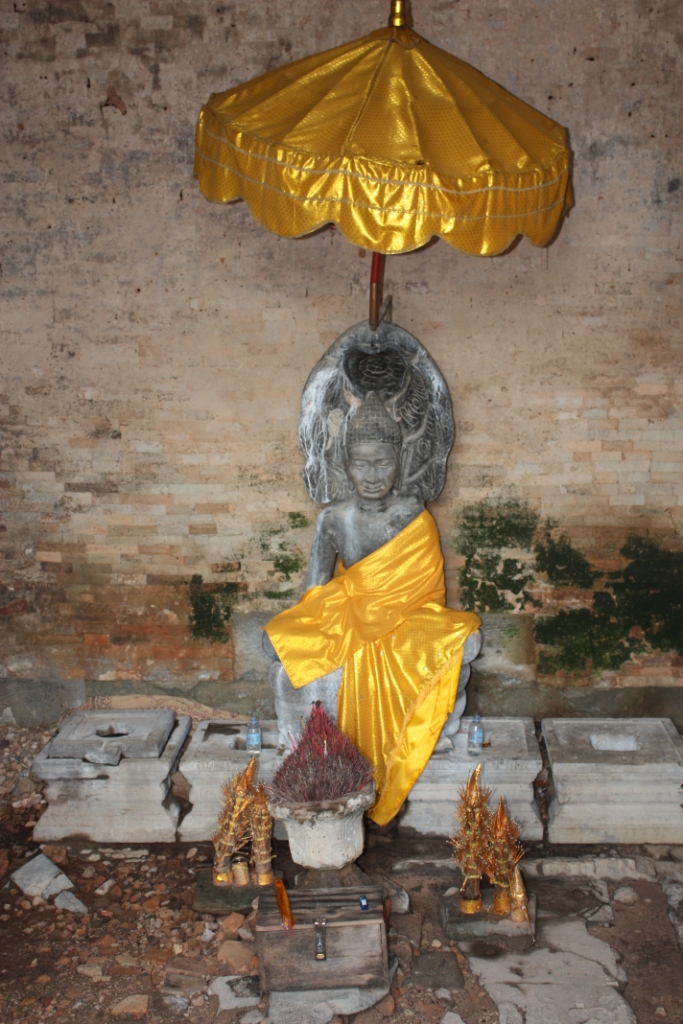
Taken in October of 2012 at Angkor, Cambodia.
I was just doing some research on 13th century Angkor, and so I figured I’d dig back to 2012 for a photo from my visit there.
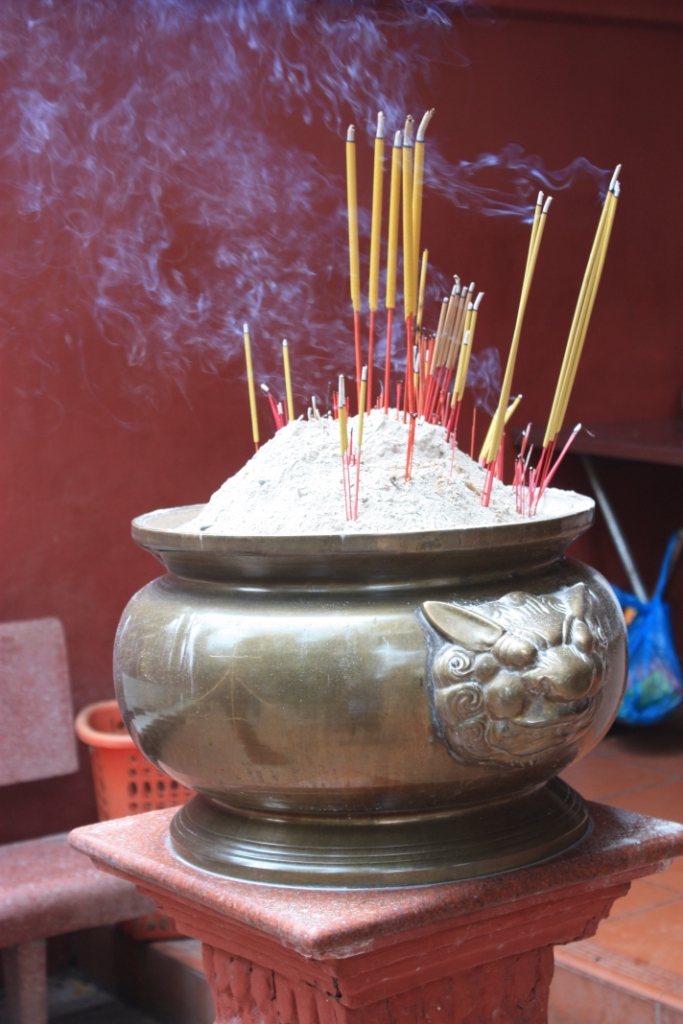
Taken October 2012 at Wat Phnom in Phnom Penh.
How come the noun “incense” means “a substance that releases a strong fragrance when burned,” but in its adjectival or verbal form it means to be, or make someone, extremely angry.
It’s not a rhetorical question, people. If you’ve got an answer, let me know.
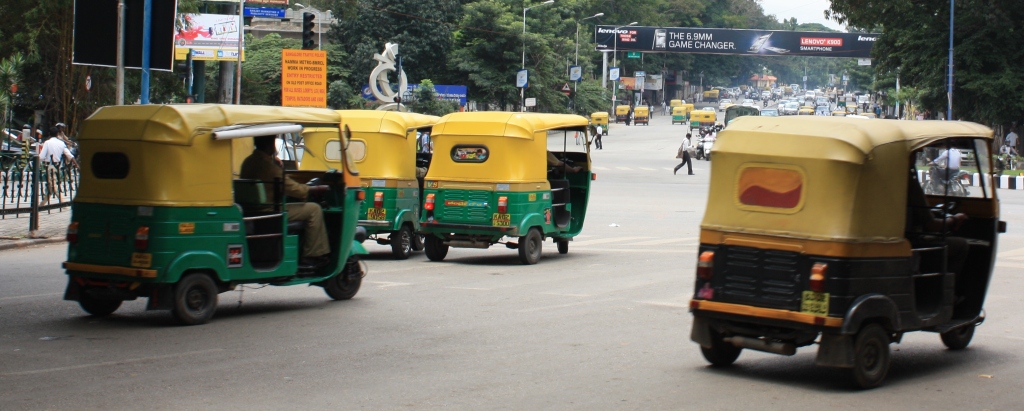
Taken Sept 5, 2013 in Bangalore, India
Tuk-tuks or Autorickshaws are the ubiquitous three-wheeled vehicles-for-hire seen throughout South and Southeast Asia. (Note: Owing to their evolution from walking or pedal rickshaws, they’re sometimes just called “rickshaw” for short, or even “pedicab” or “petty cab”–the latter likely a corruption of the former.) They’re an essential way to get around in the big cities of Mega-Asia, but almost everyone has a bad experience with one at some point.
Let me point out that I’m not suggesting that most tuk-tuk drivers are amoral liars, but as a tourist (or someone who looks like one) the drivers that approach you probably will be. The vast majority of drivers are honest, hard-working men (and the elusive woman) just trying to put food on the table. That’s why my key advice to people on the subject is, “Pick your driver, and don’t ride with the ones who pick you. Then always negotiate your fare–or make sure they will use the meter– before you get in.” The drivers who pick you often have rationalized that it’s alright to treat foreigners like crap. And I’m not so much talking about charging you a little more money (which I personally don’t mind), but more that it’s alright to waste your time or take you places you didn’t ask to go [and potentially much worse.]
Well, without further ado, I’ll share some of my interactions with drivers. This is inspired by a whooper I was told yesterday.
1.) Driver: “The Temple is closed.”
Me: “But there’s a line of Caucasians and Japanese people with cameras going into the place right this moment. I can see them as we speak.”
Driver: “Uhh, monks and nuns.”
2.) Driver: “That road closed. Big protests. Throwing stones. Very dangerous!”
Me: “But I can see all the way to the corner where we need to turn, there’s nobody there.”
Driver: “They hide. [Pantomiming popping up over a wall] Throw rocks.”
3.) Driver: “Meter[ed fare is] 200 Rupee, but I’ll take– only 150 Rupee.”
Me: “I just took a trip yesterday that was 50% farther and took twice as long, and the metered fare was 50 Rupee.”
4.) Driver: “But traffic very bad, VERY BAD. Premium rate time.”
Me: “But it’s Sunday morning at 8:00am. I haven’t heard a horn for half an hour, and I happen to know that there’s no such thing as ‘premium rate time.'”
Driver: “It’s new.”
5.) Driver: “You can’t get from here to there, except go past travel office.”
Me: “Sure you can. It’s one block over and then a straight shot of five kilometers. The travel office is four kilometers out-of-the-way.”
Driver: See lie #2

Taken in the fall of 2012 in Phnom Penh

Taken October 2012 in Phnom Penh.
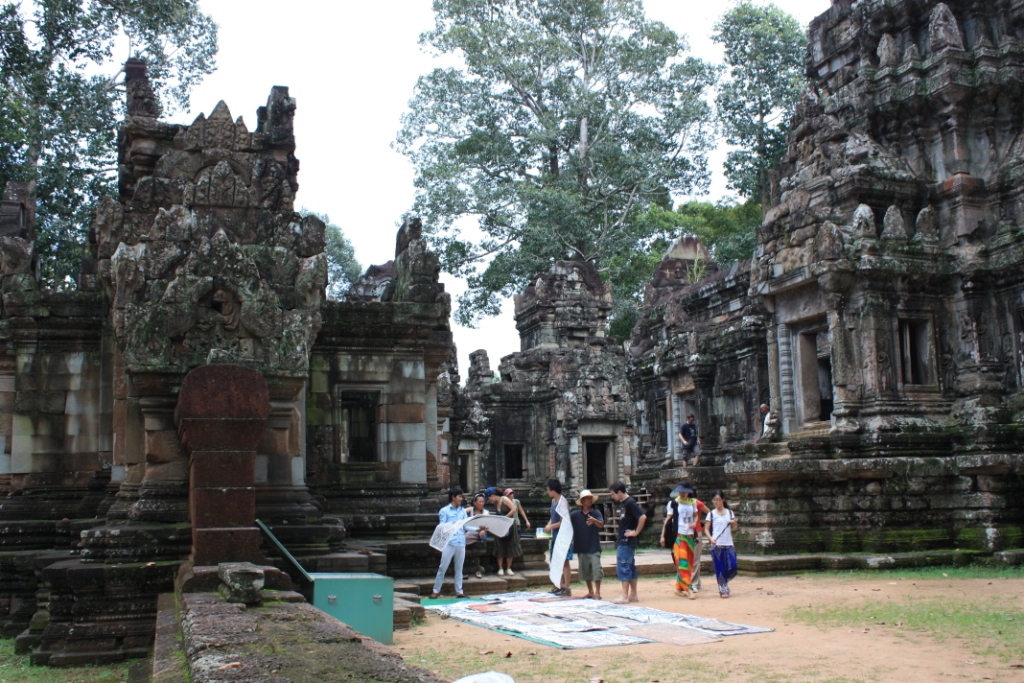
Taken in October of 2012 in Angkor, Cambodia


 Tiger Riding for Beginners