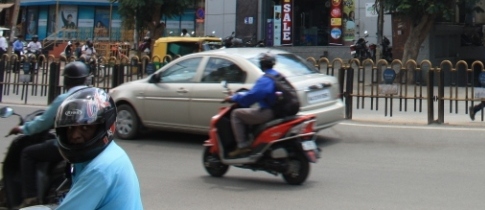
Taken Sept 5, 2013 in Bangalore, India
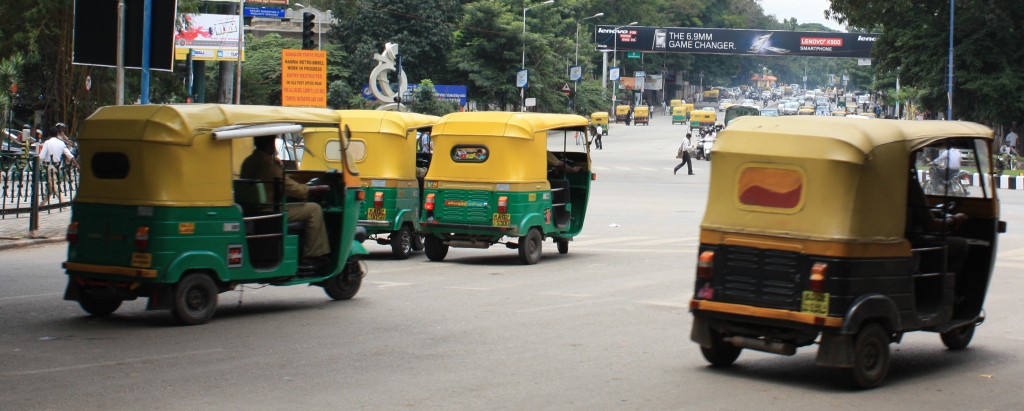
Tuk-tuks or Autorickshaws are the ubiquitous three-wheeled vehicles-for-hire seen throughout South and Southeast Asia. (Note: Owing to their evolution from walking or pedal rickshaws, they’re sometimes just called “rickshaw” for short, or even “pedicab” or “petty cab”–the latter likely a corruption of the former.) They’re an essential way to get around in the big cities of Mega-Asia, but almost everyone has a bad experience with one at some point.
Let me point out that I’m not suggesting that most tuk-tuk drivers are amoral liars, but as a tourist (or someone who looks like one) the drivers that approach you probably will be. The vast majority of drivers are honest, hard-working men (and the elusive woman) just trying to put food on the table. That’s why my key advice to people on the subject is, “Pick your driver, and don’t ride with the ones who pick you. Then always negotiate your fare–or make sure they will use the meter– before you get in.” The drivers who pick you often have rationalized that it’s alright to treat foreigners like crap. And I’m not so much talking about charging you a little more money (which I personally don’t mind), but more that it’s alright to waste your time or take you places you didn’t ask to go [and potentially much worse.]
Well, without further ado, I’ll share some of my interactions with drivers. This is inspired by a whooper I was told yesterday.
1.) Driver: “The Temple is closed.”
Me: “But there’s a line of Caucasians and Japanese people with cameras going into the place right this moment. I can see them as we speak.”
Driver: “Uhh, monks and nuns.”
2.) Driver: “That road closed. Big protests. Throwing stones. Very dangerous!”
Me: “But I can see all the way to the corner where we need to turn, there’s nobody there.”
Driver: “They hide. [Pantomiming popping up over a wall] Throw rocks.”
3.) Driver: “Meter[ed fare is] 200 Rupee, but I’ll take– only 150 Rupee.”
Me: “I just took a trip yesterday that was 50% farther and took twice as long, and the metered fare was 50 Rupee.”
4.) Driver: “But traffic very bad, VERY BAD. Premium rate time.”
Me: “But it’s Sunday morning at 8:00am. I haven’t heard a horn for half an hour, and I happen to know that there’s no such thing as ‘premium rate time.'”
Driver: “It’s new.”
5.) Driver: “You can’t get from here to there, except go past travel office.”
Me: “Sure you can. It’s one block over and then a straight shot of five kilometers. The travel office is four kilometers out-of-the-way.”
Driver: See lie #2
Share on Facebook, Twitter, Email, etc.