BOOK REVIEW: The Secrets of Judo by Jiichi Watanabe and Lindy Avakian

The Secrets of Judo: A Text for Instructors and StudentsThe Secrets of Judo: A Text for Instructors and Students by Jiichi Watanabe
My rating: 5 of 5 stars

Amazon page

Every once in a while, one stumbles onto a book that one feels desperately needed writing but which one thought didn’t yet exist. In the case of The Secrets of Judo, the book has been around for almost 60 years. First off, a more telling title for this book would be “The Science of Judo” or “The Physics of Judo.” It’s not a book that deals in arcane knowledge, as its title might suggest, but rather applies science to the skills of throwing, pinning, and submitting seen in judo.

While there’s a brief discussion of the nervous system as it pertains to reaction times, the bulk of the book is classic mechanics applied to judo techniques. The first six chapters (which constitute a little over half the book) provide a background of the relevant principles of both physics (e.g. force, momentum, and center of gravity) and judo (e.g. kuzushi [unbalancing], seiryoken zenyo [maximum efficiency], and ukemi [breakfalls].) The last two chapters provide explanations of how forces are applied to achieve successful throws (ch. 7) and grappling techniques—i.e. pins, chokes, and locks (ch. 8.)

I found this book to be invaluable and would recommend it for anyone who’s interested in grappling arts generally (whether judo or not) or even the science of human movement. The writing is clear. There are some mathematical equations, but just the algebraic formulas seen in basic physics. The graphics (mostly line drawings with a few photos) are useful, especially the drawings of the sequences of techniques which have letter labeled arrows to clarify the lines of force.

I should note that I read the original (1960) edition. Tuttle put out a 2011 edition that is probably what you will get–unless you stumble onto a copy in the used bookstore as I did. From a quick glance at the table of contents of the new edition, it doesn’t look like a major change and I suspect the new edition is at least as good.

View all my reviews

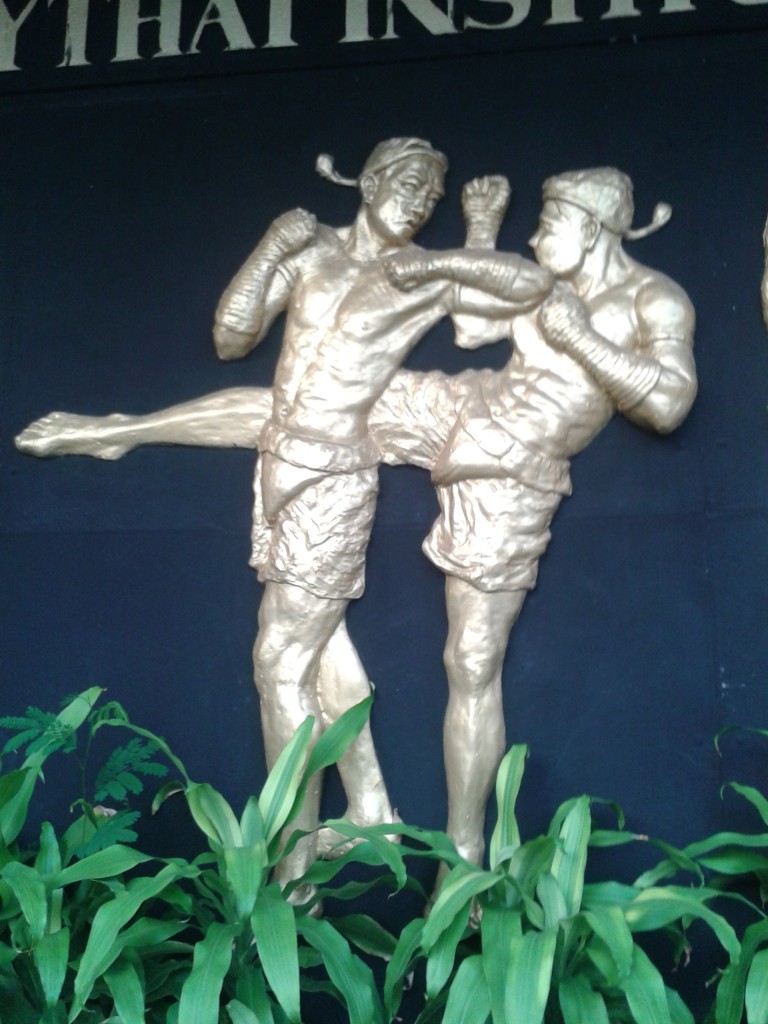
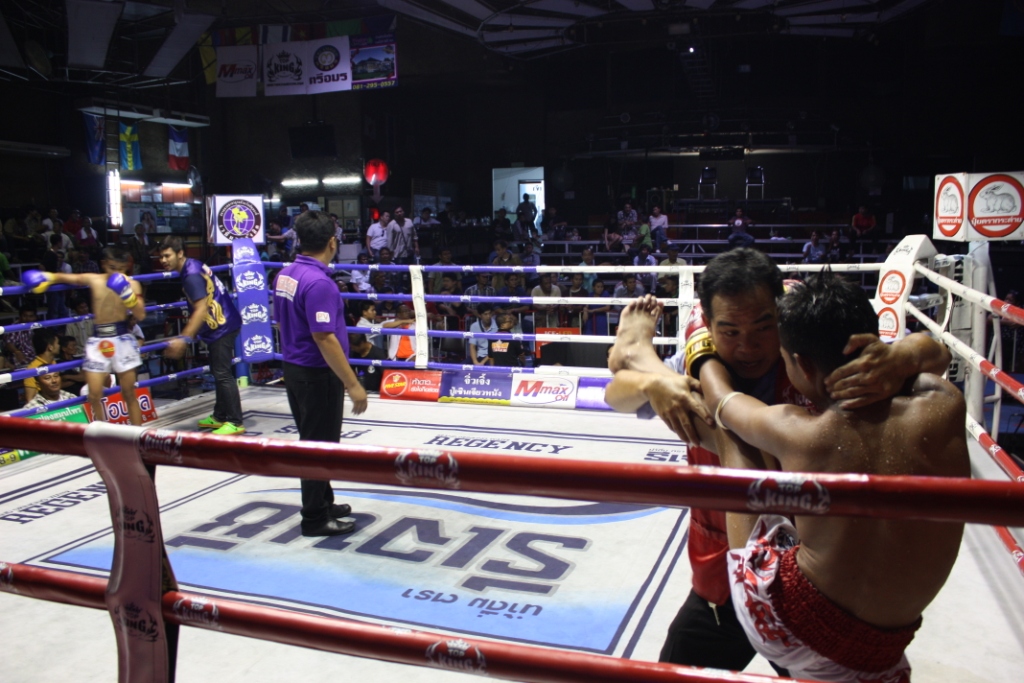
DAILY PHOTO: Spinning Elbow

Taken at the Muay Thai Institute in Rangsit, Thailand.

Taken at the Muay Thai Institute in Rangsit, Thailand.

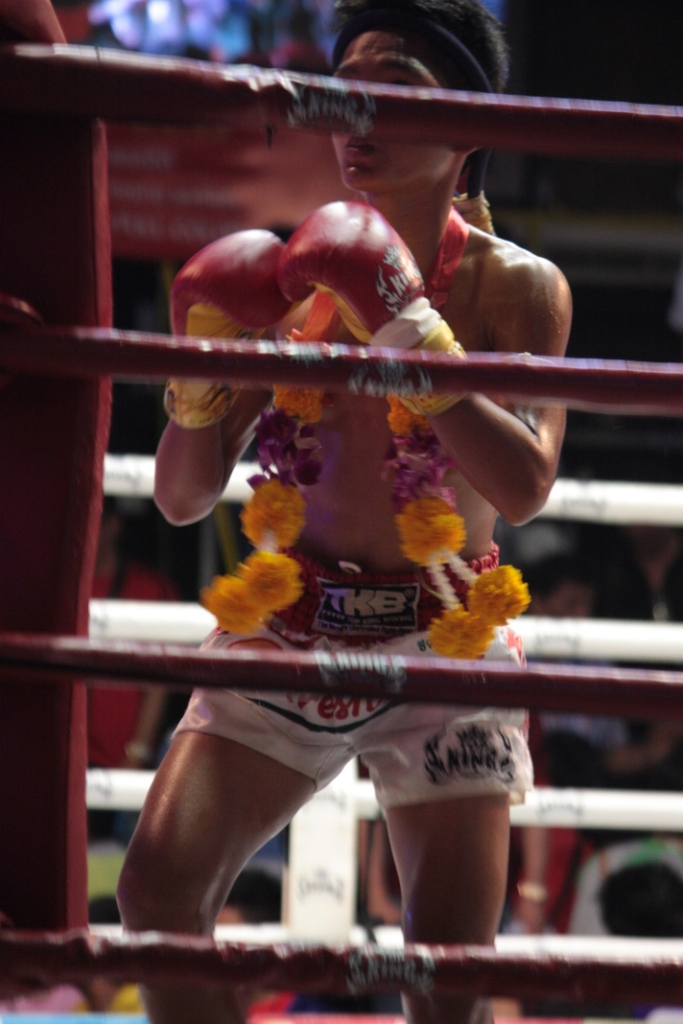
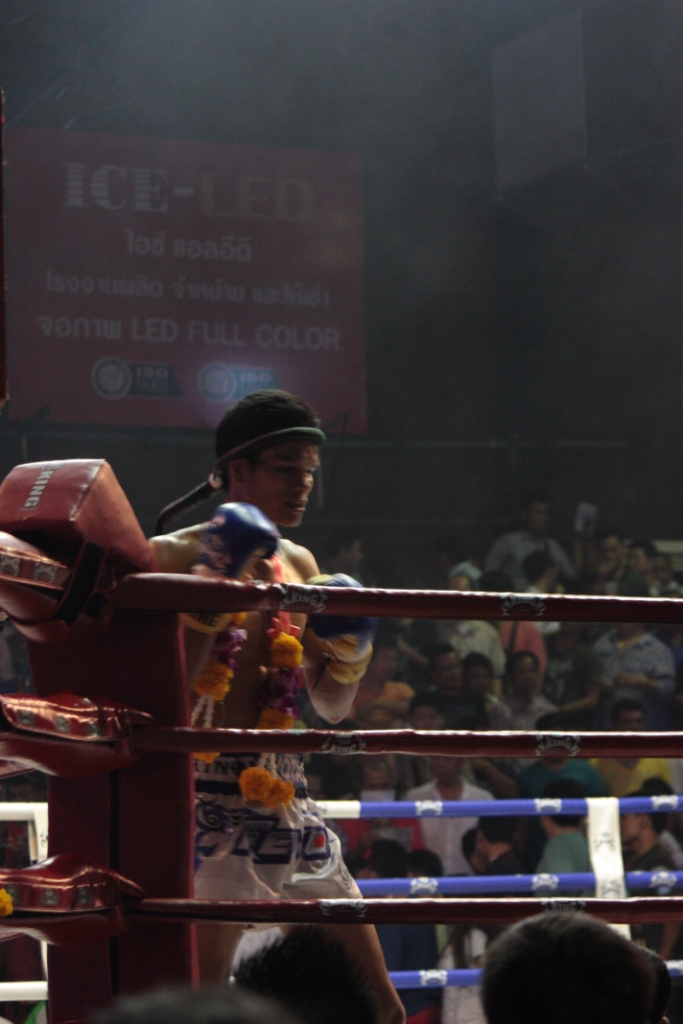
DAILY PHOTO: Pre-Fight Ritual

Taken on September 13, 2015 at Rangsit International Boxing Stadium

Taken on September 13, 2015 at Rangsit International Boxing Stadium

IMG_1742

DAILY PHOTO: Trainer Stretches Fighter

Taken September 6, 2015 at Rangsit International Boxing Stadium

Taken September 6, 2015 at Rangsit International Boxing Stadium

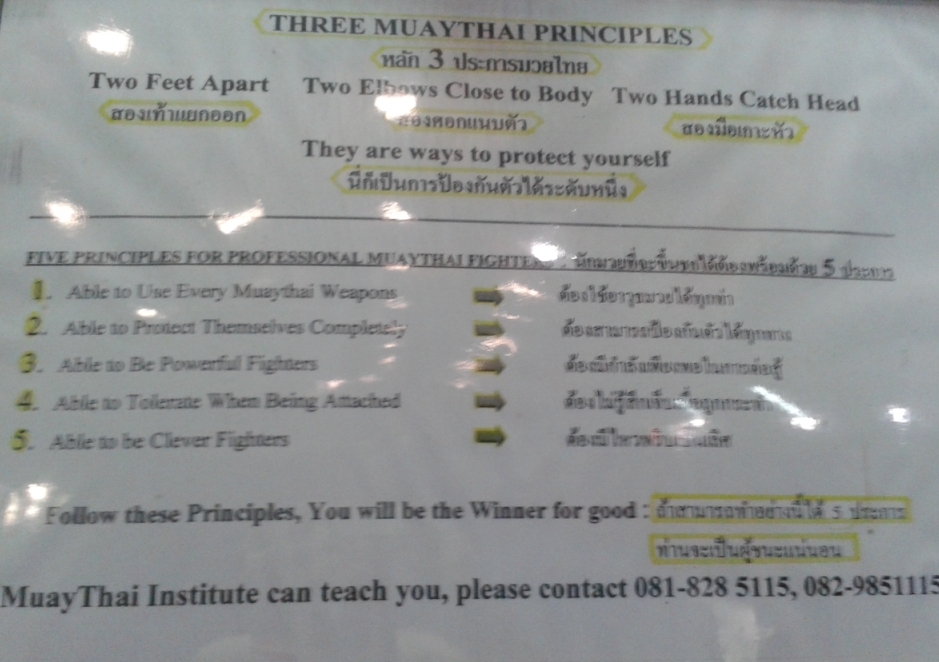
Principles of Muay Thai

Source: Muay Thai Institute of Rangsit, Thailand

Source: Muaythai Institute of Rangsit, Thailand


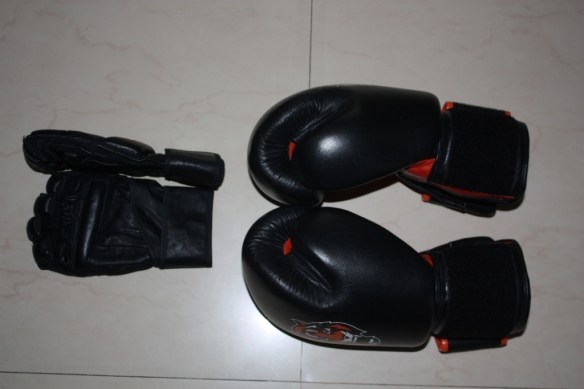
Walking around the lobby of the Muaythai Institute [MTI]  is an education unto itself. There are many photos, articles, and memorabilia–as well as a few educational placards. Over the office and weight room there are a series of old photos from an earlier era in the development of this martial art. Of course, Muaythai already had a long history before there were cameras around to document it. (As witnessed by the presence of boxing gloves in the photo above [and most of the other photos here.] Gloves were probably a relatively new addition from the previous rope hand-wraps at the time of many of these photographs.)


Yesterday, I noticed the following poster describing the principles of Muaythai:

?????????????

Poster in the gym at the Muaythai Institute


As it’s difficult to read, I’ll paraphrase the contents:

First, the three principles of Muaythai:

1.) Feet apart

2.) Elbows close to the body

3.) Hands guard the head


Second, there are the five principles for professional Muaythai fighters:

1.) Use all Muaythai weapons [i.e. fists, feet, elbows, and knees.]

2.) Protect oneself completely.

3.) Be powerful.

4.) Tolerate (persevere) attacks.

5.) Be clever.


I started to think of these guidelines in terms of the concept of budō-kun, which are the guiding principles of a given school of martial arts or even a specific teacher. The budō-kun concept is seen in Japanese martial arts, and at first blush it seems quite different from the muaythai principles stated above. While budō-kun typically have a philosophical / moral bent, the Muaythai principles seem quite pragmatic.


However, one can see broader meanings in these simple statements.


1.) The admonition to use all Muaythai weapons can be seen as a suggestion to be flexible and adaptable, and not to latch onto a single approach. I find the talk in judō about “favorite” or “match-winning” techniques (tokui waza) to be intriguing. Historically,  martial artists seem to have avoided giving the impression that they had a favorite techniques. The logic behind this secretiveness can be described by Ralph Waldo Emerson’s quote: “If I know your sect, I anticipate your argument.” Or, expanding further, if I know your feelings on a subject I can respond to them to my advantage.


2.) “Protecting oneself completely” can be seen as valuing one’s body over one’s ego. In Thaiboxing, as in almost all combative sports, one sees instances in which a fighter drops his guard to either encourage an attack or just to showboat for the audience. Sometimes this works out as desired, but often it results in the fighter waking up on his back.


3.) Be powerful seems self-evident, but incumbent in the statement is the need to train hard. One doesn’t become powerful without working hard to develop both form and fitness.


4.) Being able to tolerate being under attack is another point that may seem less than profound, but it speaks to the realization that both fitness and capacity to “take a licking and keep on ticking” matter. Sometimes the outcome hinges on the durability and resilience of a given fighter–much as we might like to think that technique always and everywhere trumps all.


5.) Being clever speaks to the creative element. One must be able to adjust to changing circumstances, and sometimes victory hinges on actions that are unconventional.


I’m curious about the interpretations of others on this subject.


What Are Your Thoughts on “Dick Move Mondays” in a Dojo?

Going rogue with attacks

Gone rogue

So, the whole “dick move Mondays” concept may require clarification. First of all, some readers may be saying, “Every day is dick move Monday at our dojo.” However, readers who train at more orthodox schools may be wondering how such an apparently ludicrous idea would even come up. The idea’s origins are the result of seeking a martial art’s correlate to the “bad pass Fridays” that have been instituted in many basketball practices in recent years. On “bad pass Fridays” coaches give players passes that are catchable–but just barely. I’ll get into the scientific argument for this kind of training below, but for now suffice it to say that the idea is to have regularly scheduled instances in which the individual is taxed to his or her limits and forced to try to cope with worst case scenarios. While there needs to be some limitations for safety’s sake, I’ll argue that there’s some advantage to applying this concept from the sports science and motor learning literature to martial arts training. [Note: if your objective in practicing martial arts has nothing to do with being able to succeed in the context of a sporting match, an actual combat situation, or both (i.e. a situation in which an opponent is trying to clobber you and vice versa) then this isn’t really relevant to you. But feel free to read it any way.]


Here’s some low-down on the science. Historically, it’s been popular to teach / coach sports (and non-sport martial arts) using a “partial and blocked” approach. This method is extremely popular because: a.) it’s simple to organize and conduct practice sessions, b.) short-term growth is rapidly visible, and c.) it looks neat and tidy. “Partial” means that a particular skill (or even sub-skill) is extracted from the overall skill set of the activity at hand and practiced in isolation. This could be a throw, a strike, or a means of receiving or defending. “Blocked” practice means that one skill or sub-skill is practiced over and over again under the exact same conditions until it’s deemed time to move onto the next. “Whole and random” practice represents the opposites of “partial and blocked.” “Random” means that one drills a skill under an ever-changing situational context (e.g. one may still be drilling hip throws repetitively, but not against a static partner who’s standing in the same place–there’s movement and pushing and pulling, and possibly a few dick moves.) “Whole” practice simulates the actual event that one is practicing for–whether it’s a Muay Thai match or a parking deck brawl.


For a good explanation of the problems associated with blocked practice, watch the video by Trevor Ragan of “Train Ugly” that’s linked below. (fyi: “Train Ugly” is an apropos name for an approach that involves more “whole and random” practice because there will be more short-term failure and one won’t look masterful at what one is doing by the end of a practice session. However, long-term skill retention and the ability to integrate those skills and sub-skills into a more realistic environment is higher.)

As Ragan points out, the random approach requires one read the situation and environment and respond in a way that won’t leave one worse off. (I don’t like the word “planning” applied to martial arts because there’s never time to do any planning in the sense of using one’s conscious mind. However, I’d say reading is a very apropos concept, and there is a need to adjust to one’s context.)

So what would “whole and random” training look like in a martial art? First of all, one should realize that one doesn’t need to make every training session “whole and random” from the very beginning. In the beginning a lot of “partial and / or blocked” practice is necessary. The problem is that if one doesn’t ever move beyond that, one’s performance will be hindered. Second, all practice doesn’t have to be both whole and random; one can spend a lot of time with random drilling of a particular skill. One can drill a particular skill while moving around freely, applying counters, making timing more random, and making the approach less regimented. “Whole and random” practice in the martial arts involve sparring or randori. Jigoro Kano did a brilliant thing in making the techniques and practice environment safe enough that randori (free form) training became possible. For many years, I would have said that Kano Sensei made a system that was less “realistic” by paring out the dangerous elements of jujutsu. However, today I don’t see it that way. I’ve come to realize that the ability to train randori keiko actually added back in a great deal of realism. Who’s to say what the net effect on realism is. I certainly see the advantage over the old way in which one trained in a regimented fashion devoid free form components for years and then one day one went out on musha shugyō (warrior’s errantry) and may be the day you learned of a deficiency in your technique was the day you died.

So “dick move Mondays” is really a way to add randomness into training. One can’t ignore the reading portion of the attack because one never knows what whacky ass attack one’s opponent is going to come up with.

If you do implement “dick move Mondays” in your school or gym, you may want to review this instructional video by Master Ken because the “bitch slap” is sure to enter into your training.

[Disclaimer: Master Ken video included as farce. Readers are advised not perform any techniques suggested by Master Ken or his Amer-i-do-te practitioners.]

BOOK REVIEW: Faster, Higher, Stronger by Mark McClusky

Faster, Higher, Stronger: How Sports Science Is Creating a New Generation of Superathletes—and What We Can Learn from ThemFaster, Higher, Stronger: How Sports Science Is Creating a New Generation of Superathletes—and What We Can Learn from Them by Mark McClusky

My rating: 4 of 5 stars

Amazon page

McClusky’s book tells us how advances in sports science and technology are producing a new class of elite athlete. More usefully, it discusses which practices of high-level athletes can reasonably be emulated by amateurs. One may think that what’s good for the goose is good for the gander. In this case, not so much. If shaving a hundredth of a second off your time isn’t going to affect your life’s course, there are many activities of elite athletes that simply aren’t worth the cost (in whatever terms.) For example, the loss of friendships due to rampant flatulence resulting from consuming large quantities of baking soda isn’t worth it if you just want a little bit stronger Sunday cycling ride. (Baking soda [sodium bicarbonate] counteracts blood and muscle acidification during exercise and makes it possible to keep moving strongly when fatigued would normally degrade performance. Incidentally, this practice has been shown to be effective only for events that last between one and seven minutes.) On the other hand, some of the lessons of sports science are relatively low-cost and high benefit, and might be just what one is looking for to improve one’s performance. (e.g. Replacing a pre-workout stretching routine with one of rolling out the muscles.)

Faster, Higher, Stronger consists of twelve chapters, each addressing a different aspect of the application of science and technology to sport, including: training methods, genetics, nutrition, recruitment, practice, performance enhancing substances (legal and illegal), elevation training, and the limits of performance.

One question that has always been of great interest is how much of a top athlete comes from his or her genes? In other words, can anyone can do it–given a willingness to work like a maniac of course. As with many other questions about heredity, it was once thought that there would be a precise answer to this question in the wake of the decoding of the human genome. However, the success of the human genome project showed only that the situation was vastly more complex than we’d imagined. It turns out that having certain genes isn’t the end of the story because there are many factors that influence which genes are expressed. Attempts have been made to put numbers to the influence of genetics. For example, one scientist is quoted as claiming that 50% of oxygen processing capability (i.e. VO2 max) is heritable. This translates to the fact that, while the average Joe has a reasonable chance of engaging in athletics at some level, only a 0.1 to 0.3 % can summit the pinnacle of elite level athletics.

In many ways, science has encouraged coaches, trainers, and recruiters to think outside the box—and to look beyond the traditionally engrained approaches. One fascinating story was that of how the British national rowing team held tryouts based only on height, with experience with the sport being not required. They ended up with a champion rower who’d first entered a boat only four years before. This is part of the evidence that controverts the once popular 10,000 hour rule that was popularized by Malcolm Gladwell–though Anders Ericsson is more properly considered the father of the idea. It turns out that 10,000 hours of practice aren’t required for most activities if one goes about it right.

McClusky spends a considerable amount of space on the questions of what athletes should and shouldn’t consume. In emulating elite athletes many amateurs are working at cross purposes. This is readily seen with the issue of sports drinks. If you’re guzzling down a Gatorade or snacking on Cliff Bars after your run, you may only be ensuring that you continue to gain weight despite working out. On the other hand, you may decide that chocolate milk or beet juice are good choices for you.

I’d recommend this book for those interested in the heights of human performance.

View all my reviews

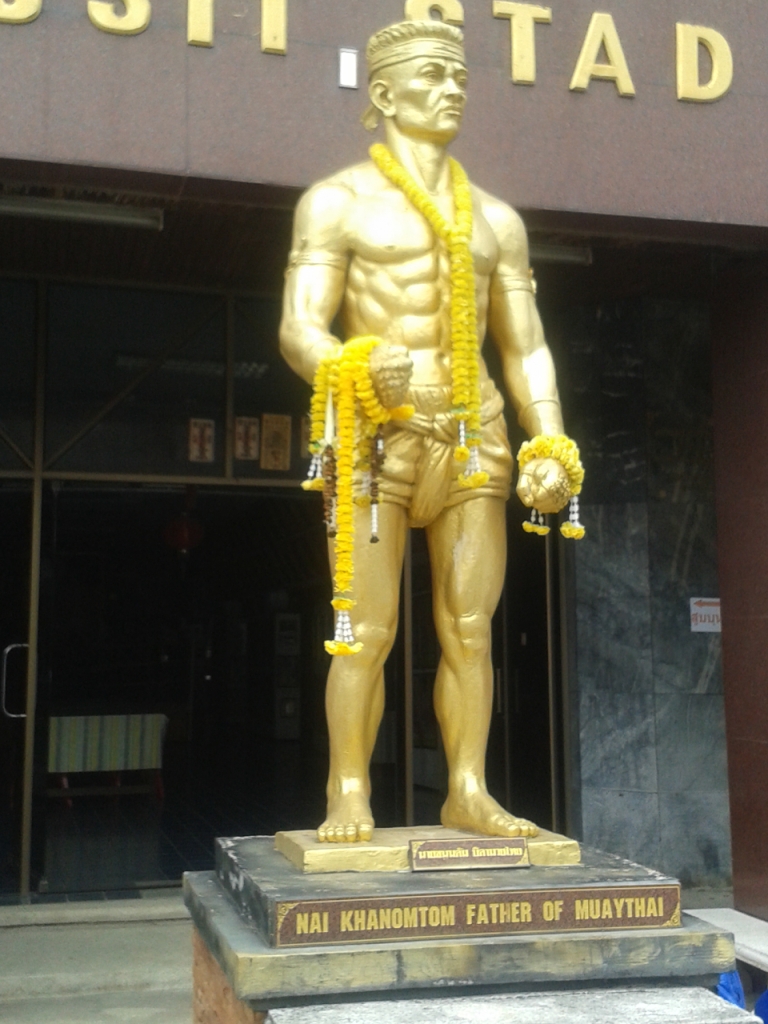
The Legend of Nai Khanomtom: Hero of Muay Thai

?????????????

Muay Thai Institute in Rangsit, Thailand

In 1767 the Ayutthaya Kingdom of Siam fell to the Burmese. Burma occupied Siam only briefly because Burma’s king, King Hsinbyushin (a.k.a. King Mangra), was forced to withdraw his troops to combat a Chinese invasion to his homeland. The Thais were fabled to be valiant fighters and even had a numeric advantage, but they were easily put into disarray by Burmese forces. Even King Mangra was said to have declared that he couldn’t have taken Ayutthaya had the leadership of the opposition been more effective. [Keep in mind that even if he did say this, it might have been more a dig at his Thai counterpart than an expression of his true feelings.]

The Burmese captured a many prisoners during their Thai campaign and true warriors were particularly coveted as prisoners. One such fighter was Nai Khanomtom (fyi: it’s also written Nai Khanom Tom.) Nai Khonomtom was renowned for his skill in Muay Boran, an early Thai fighting style related to Muay Thai. This made him a logical choice to headline for the Thais in a tournament that would pit Muay Boran against Thiang–i.e. the indigenous martial arts of Burma (e.g. Lethwei and Bando.) The tournament would be part of King Mangra’s seven day festival in honor of Buddhist relics, the festivities of which would also include plays, comedians, and sword fights.

Nai Khanomtom was pitted against a Burmese champion, a man who was clearly the audience favorite. Timed rounds didn’t exist in those days. Fights stopped when one of the fighters was physically unable to continue, and not before. The Burmese fighter wore a kind of sarong that was the usual attire for the men of Burma, and Nai Khanomtom wore a loin cloth tied up in the traditional Thai style (see the statue pic above.) Each fighter wrapped only ropes on their forearms and hands, and each may have had some padding over the groin–though not as insurance against an accident, but because crotch kicks were fair game.

Nai Khanomtom began with a Wai Kru, which perplexed the Burmese. Wai Kru is a pre-fight ritual that has several purposes, the most important of which is to show respect for one’s teachers, deities, and the audience. The practice can take several minutes and some variants of it can be physically demanding.

When the fight started, Nai Khanomtom charged over the fight space taking the fight to his opponent and laying down a barrage of kicks, knees, elbows, and punches. By some accounts, his victory was declared invalid by a judge, who’d been distracted by other festival events (and who–no doubt–wasn’t pleased by the swift defeat of the Burmese champion.) The decision was made despite the fact that the Burmese fighter had been knocked unconscious.

The King was thrilled by the fight and offered Nai Khanomtom his freedom if he could fight nine more Burmese fighters. Nai Khanomtom didn’t get breaks between these fights, and as soon as an opponent went down the next was queued up to come after the Thai fighter. And so it was that Nai Khanomtom took on the Burmese fighters in an ironman fashion. The last of his opponents was a famous martial arts master teacher from Rakhine, a coastal region in Burma’s southwest. Nai Khanomtom went after the Rakhine master with flurry of kicks. It’s worth noting that in those days Burmese fighters were said to have relied much more heavily on hand strikes than kicks, and so the kicks may have given Nai Khanomtom a range advantage while presenting his opponent with attacks that the Burmese fighter was less practiced at defeating.

At the fight’s end, King Mangra honored his agreement, and Nai Khanomtom was granted his freedom and provided safe-conduct back to Siam. There are varying accounts that say that Nai Khonomtom returned home with either two Burmese wives or a number of his fellow prisoners as an additional payment for providing a spectacle that the Burmese king found gripping. In these accounts, Nai Khanomtom is usually said to have turned down a cash payment.

There’s a quote that’s often attributed to King Mangra that goes, “Every part of the Thai is blessed with venom, even with his bare hands he can fell ten opponents.” [FYI-It should be noted that seeing the same words quoted by several sources isn’t proof of truth, because the quotes could have a common (and false) point of origin.  So take it all with a grain of salt.]

[Note: The details of this story vary. So you may hear–or have heard–a slightly different version of events. The exact details are likely lost to history and–when that happens–embellishment may creep in. That said, the variations that I’ve heard are neither great nor particularly significant. It’s also worth noting that these events are celebrated in Thailand every March 17th on what is called Boxer’s Day or National Muay Boran Day.]

The 4% Rule, Yerkes-Dodson, and Finding the Sweet Spot in Martial Arts Training

I was watching one of Michio Kaku’s Big Think videos recently that addressed American science education. The question of interest was how America continues to do so well in science and technology given that the American (primary and secondary) educational system isn’t up to par in science and mathematics with its technological competitors. The bulk of his talk (re: the H-1B visa and importation of brain power) isn’t germane to this post. It’s Kaku’s mention of a second secret weapon that caught my attention, and that’s how America is able to do a better job than many of its competitors in identifying and nurturing top talent. While math and science education is better in many Asian countries, those countries (e.g. Japan, Korea, or China) don’t excel at skimming off the cream of the crop. Dr. Kaku explains that this is because Confucian values teach students to conform, and students are loathe to stand out–even for exceptional performance. Even if a student wanted to show their talent in hopes of having it fostered, the large classes, lecture-centric teaching, and testing of memorization and standardized processes doesn’t offer much opportunity to grow one’s individual strengths.


Kaku’s statement resonated with me because I’ve been thinking about the pros and cons of traditional approaches to martial arts instruction. I’m particularly interested in the gulf between the traditional approach and what martial arts teaching would look like if one took advantage of the wealth of scientific knowledge about mind and body development. Most of the martial arts instruction I’ve received over the years is consistent with Confucian thinking. All the students are doing the same practice (or faking it to the best of each’s abilities if it’s beyond one’s current capacities), and each is trying to closely emulate the teacher-presented ideal as much as possible. There’s not much consideration of the individual student’s weaknesses or strengths. Emphasis is on trying to convey as high-fidelity a replica of the techniques that have been handed down through the ages. (While this may be a laudable goal, I’ll later offer explanations as to why I think it’s both death for retention of students and ultimately counterproductive.)


Let me first say that there are a number of advantages to the traditional approach to martial arts instruction. First, it’s easy to teach many students at once. This was probably a huge advantage when there were armies of men having to learn these skills. Second, [theoretically] it helps students reduce their egotism through discipline and conformity. The highly hierarchical nature of this approach means students spend years in a lowly position, with the hope that some humility may stick. (NOTE: I’m not certain that this works out in practice.) Third, it creates a disciplined learning environment that is conducive to helping a student keep his or her head in the game.


What the traditional approach isn’t so good at is producing students who all perform at the best of their abilities. I suspect that the traditional approach doesn’t do so well for student retention either. It’s a system in which new students are forced to drink through the fire-hose; while students who’ve been around for a while often feel like they’re stagnating.  As I’ll get to below, there’s good reason to believe that a proper match between the challenge of a task and the performer’s skill level is critical to creating an intrinsically rewarding activity and to helping students perform at their best.


My thoughts on this topic have been heavily influenced by learning and teaching yoga. While one’s vision of a yoga class may be rows of students doing the exact same posture (and huge classes and / or poor instructors may result in that condition),  but there’s often a degree of variation in a class. This variation results from two concepts that I’ve been thinking about quite a bit lately, namely modifications and capacity building.


Modifications are a two-way street. If the task at hand is beyond the student’s current abilities, he or she may be given an easier variant that allows him or her to work toward the fundamental form. On the other hand, if the task of the moment is old hat, a student might be offered a more challenging version on occasion. I’m not suggesting that one shouldn’t drill the basics throughout one’s martial arts career. Repetition of fundamentals is key to drilling them down into one’s nervous system. However, the brain loves novelty and hates drudgery, and it will become harder and harder to remain engaged if the overall challenge level doesn’t rise. The science suggests that one needs to keep upping one’s game if one wants to perform at one’s best.


The nature of modifications in martial arts may not seem as clear as it is with respect to yoga postures. For randori, sparring, and other free-form training, it’s easy to envision how one can adapt the practice to reduce or increase the challenge to a level more apropos of the student’s skill level. One can practice a restricted form. For example, one may work only on sparring with boxing rules to kicks or grappling out of the equation until a student builds up his or her confidence and abilities with recognizing and responding to punches. Alternatively, an advanced student might be presented with armed or multiple attackers. There are some practices, such as specific techniques, for which modifications may not be an option, but that doesn’t necessarily let a teacher off the hook for helping a student who’s challenged by the technique. That may be where capacity building exercises come into play.


Capacity building goes beyond offering an easier modification to suggesting exercises to help the student build the physical capacity to do the technique repetitively WITHOUT INJURY. I emphasized those last two words for a reason. In some martial arts, the need for capacity building exercises maybe clear because of the acrobatic insanity involved. However, practitioners of more pragmatic martial arts may say, “We don’t do all those fancy spinning back kicks, so we don’t need capacity building. Anybody can do our techniques because they’re simple and direct.” Maybe that’s true, but if multiple members of your school have the same (or similar) repetitive stress injuries, it’s not true at all.


What kind of capacity building are we talking about?  If the technique involves jumping or leaping and the individual is gravitationally-challenged, then plyometrics might be the prescription. On the other hand, if the problem is the inability of the student’s joints to withstand the technique, there might be need for exercises that build up stabilizing muscles, help him / her to cut weight, or both. If a student can’t do a throw without risk of injury, maybe that individual needs to spend time practicing with elastic bands or inner tubes or working on their balance.


RiseOfSupermanWhat is this 4% rule? I read about it in Steven Kotler’s The Rise of Superman. As background, there’s a state of mind called “Flow” that’s associated with performing at one’s best. In this state of mind, which some call “the zone” and others probably once called satori or samadhi, one’s concentration on the task at hand is at its greatest, unnecessary features like sense of time and sense of self fall away, one’s inner critic shuts the hell up, and–at least afterwards–there’s a blissful state. Flow can be described as the shutting down of specific elements of the pre-frontal cortex (PFC)–largely involved with the consciousness mind. It can also be defined neuro-chemically by the hormones released (i.e. Serotonin, Endorphins, Dopamine, Anandamide, and Norepinephrine) and neuro-electrically in terms of one’s brainwaves (around 8 Hz.)


There are conditions that favor achievement of Flow, notably: 1.) clear goals, 2.) immediate feedback, and 3.) a good match between the level of the challenge and the level of one’s skill. Flow is a key factor in why some activities are intrinsically rewarding (whether or not they are rewarding in other ways) and why almost any activity can be intrinsically rewarding if it’s sufficiently challenging relative to one’s abilities. What’s sufficiently challenging? That’s where 4% comes into the picture. While it’s by no means an exact or universal value, it turns out that when a task presents a challenge that is roughly 4% above one’s present skill-level is when this state of mind is most accessible. This is why one may see students drop out if they find the level of challenge stagnant. On the other hand, one may not keep new students either if the challenge is constantly beyond their abilities.


How about that Yerkes-Dodson? The two early 20th century scientists for whom the Yerkes-Dodson Law are named discovered that performance increases with arousal (one might do best to think of this as anxiety level rather than the colloquial use of that word) up to a certain point, beyond which performance either levels off or plummets–depending upon the nature of the objective.  The point is that keeping the training environment too sterile has it’s disadvantages. In free-form practices like sparring, a little nerves can be a good thing, but being overwhelmed can be detrimental.

Yerkes-Dodson Curves. Source: Wikipedia

Yerkes-Dodson Curves. Source: Wikipedia

Adjusting one’s instruction to the abilities of one’s students is challenging. Traditionalists may hold that it’s far more important to keep the tradition intact than it is to cater to the individual needs of students.  That is, said teachers may prefer to focus on the aforementioned high-fidelity transmission of the teachings of the lineage. There was a time during which I probably would have echoed that sentiment. However, it increasingly occurs to me that producing the best and most engaged students is the best way to keep a tradition alive.

6 Science Books That Martial Artists Should Read

When one has a passion for an activity,  it’s easy to get tunnel vision and miss out on the many avenues of information by which one might improve oneself.  I’ve done many posts on martial arts books, but I thought it might be useful to do one about books that aren’t about martial arts per se, but which have none-the-less contributed to my thinking as a martial artist.


1.) On Killing: The Psychological Cost of Learning to Kill in War and Society by LTC Dave Grossman

OnKillingWhat it’s about? Psychologically, it’s a lot harder to kill another human being than one might think. Even when one is a combatant in a just war, the reluctance to kill–even one’s sworn enemy–is intense. Grossman examines the roots of this reluctance, what methods have been employed to get soldiers over it, and what the cost of doing so is.

The book also goes into a topic one might find surprising: video games. Not to give too much away, but military researchers discovered that getting infantrymen to kill required conditioning them to shoot targets that look human. This resulted in moving from bulls-eye targets to silhouettes, pictures of humans, and even Firearms Training Simulators (i.e. FATS, systems that run shoot / no-shoot scenarios on a screen, like an interactive movie.) It turns out that shoot-em-up video games may contribute to a child’s conditioning to be willing to shoot another human being.

Why it’s a good read for martial artists? Martial arts vary radically in realism and relevance to combative situations, but it’s easy for students of the martial arts–even martial arts that seem “hardcore” and self-defense oriented–to have unrealistic notions about the realities of combat. As François de La Rodefoucauld said, “One cannot answer for his courage when he has never been in danger.” By reading this book one might, perhaps, begin to rethink one’s assumptions, and change how one prepares to defend oneself and others.

Further reading on related topics:  I’ve heard good things about the works of Rory Miller–particularly Facing Violence and Meditations on Violence, but I haven’t gotten around to reading his books yet. If you have, please feel free to comment with your thoughts.


2.) The Rise of Superman: Decoding the Science of Ultimate Human Performance by Steven Kotler

RiseOfSupermanWhat it’s about? Kotler examines a state of mind that is widely call “flow,” and how extreme athletes are tapping into flow to achieve unprecedented advances in performance. There are a number of ways by which this state of mind can be defined, e.g. neurochemically (i.e. a neuro-cocktail of serotonin, anandamide, endorphins, dopamine, and norepinephrine), neuroanatomically (transient hypofrontality), neuroelectrically (high theta / low alpha wave–i.e. between meditation and resting wakefulness), or psychologically (intense concentration on a challenge that’s just beyond one’s present skill level.)

Kotler proposes that risk is an important trigger for entering a deep state of flow, and that this is why extreme athletes are proving so much better at achieving these states (and translating them into radically increased performance) than many other groups who seek to master flow.

Why it’s a good read for martial artists? It should be noted that not only is flow not a newly discovered state of mind, but it sounds a lot like the state of mind that martial artists have sought for centuries in the practice of their arts–often in conjunction with disciplines such as Zen or Vajrayana Buddhism. What is new, which makes this book worth reading, is an understanding of the science behind flow states. By moving beyond the hazy mix of truth and falsehood embodied in systems of spirituality, one may be able to find a way to more reliably increase one’s performance.

Further reading on related topics:  Flow in Sports: The Keys to Optimal Experiences and Performances is a book that is co-authored by the granddaddy of flow research Dr. Mihaly Csikszentmihalyi.


3.) Becoming Batman: The Possibility of a Superhero by E. Paul Zehr

Becomingbatman

What it’s about? (Arguably, this is a martial arts book, but I’m including it because one wouldn’t get that from the title or blurb.) This book’s central question is whether a real life person could achieve the level of crime-fighting bad-assery that is the Batman, and–if so–what combination of genetics, training, and conditioning would be required. It also addresses what would be the cost in terms of wear and tear on one’s body and how long one could be expected to maintain said abilities. (Also, for the martial artists of feminine persuasion, how Batgirl or Catwoman might fair in combat against Batman.)

Why it’s a good read for martial artists?   There is tons of great information relevant to martial artists about the toll of extreme practice and regular fighting on one’s body (e.g. concussions, broken bones, etc.), what the limits of human performance are, by what means those limits are approached, and how realistic it is to have an unreciprocated policy prohibiting lethal weapons.

Further reading on related topics: Actually, if you know of any books on related topics, I’d love to hear about them. There are a number of such books, but they’re on textbook pricing (i.e. insanely expensive.)


4.) Extreme Fear: The Science of Your Mind in Danger by Jeff Wise

ExtremeFear

What it’s about? This book is about the mental and physical effects of mortal peril, and why some people’s performance excels under dire threats while other people just let themselves die while cowering in a fetal ball. The book asks what we can all learn from those people who manage to keep their heads about them when death seems certain.

In the interest of full-disclosure, as of this writing I’ve not completed this book. I just started it and am only in the second chapter. However, so far it’s been both informative and interesting.


Why it’s a good read for martial artists? Much like On Killing, I think this book may be valuable because there are many martial artists with daydream-induced misconceptions about how they will perform in dangerous situations. This book may help one evaluate one’s true state of preparedness, and discover how to go about making changes to improve one’s level of preparedness for a worst-case scenario.

Further reading on related topics:  If you want a scholar’s account, the book Anxious by Joseph E. Ledoux may be more your style. (Wise is a popular science writer.) I see that Ledoux is cited a lot in books I’ve been reading as of late, but I can’t say I’ve read any of his books yet. However,  I know he’s widely regarded as one of the foremost experts on fear. It looks like his book isn’t so much on mortal peril as Wise’s book, and covers all kinds of anxiety and fear.


5.) Faster, Higher, Stronger: How Sports Science is Creating a New Generation of Superathletes–and What We Can Learn from Them by Mark McClusky

FasterHigherStrongerWhat it’s about? The super-long subtitle says it all. It’s about how athletic performance is being improved by bringing scientific methods to the study of sports, and–as the second half of the freakish subtitle suggests–it explains how amateurs can put this information to good use. There are some methods used by elite athletes that aren’t at all suitable to the run-of-the-mill martial artists (e.g. don’t consume mass quantities of baking soda.) However, there are other approaches to nutrition and training that are readily translated to amateurs without much downside.

Why it’s a good read for martial artists? You may or may not think of yourself as an athlete. I can hear some martial artists saying, “I don’t practice a sport, I’m a martial artist. I deal in lethal combat, not games. yada, yada, yada…” Maybe so, but fitness, nutrition, and conditioning matter. If you want to be able to hold your own against more skilled opponents, you need to improve your capabilities and capacities. Fitness matters. If you think technical proficiency will get you through any situation, you haven’t run up against someone who is both technically skilled and highly fit–and when you come up against said person, your disillusionment will be swift.

Further reading on related topics:  As with the Becoming Batman book, most of the books on this subject are textbooks and are outrageously priced. If you know of other books in this vein, I’d love to hear about them.


6.) Buddha’s Brain: The Practical Neuroscience of Happiness, Love, and Wisdom by Rick Hanson et. al.

BuddhaBrainWhat it’s about? This book turns the lens of modern science on the serene, immovable state of mind that martial artists have historically sought out through Buddhist and yogic systems. It discusses how Buddhist practices help people to be more cognitively effective and less prone to emotional manipulation or disturbance.

Why it’s a good read for martial artists?  If one reads the works of warriors–ancient and modern, one will discover that the greatest warriors place a premium on the importance of the mind.

Consider the famous swordsman Miyamoto Musashi. Musashi was exceedingly successful in defeating his enemies by making them angry. He would show up late and behave disrespectfully, and he would make his own mind imperturbable. This allowed him to easily defeat warriors who were considered at least his equal in terms of technique.

Further reading on related topics: There are many books that look at similar questions.  Zen and the Brain is probably a better book in terms of the amount of information / insight provided, but it’s a much more daunting read. I wouldn’t put the latter in the category of “pop science” as much as just “science.”  (Zen and the Brain is also a much older book.)


These are my recommendations, I’d love to hear about yours in the comments section.