BOOK REVIEW: Hallucinations by Oliver Sacks

HallucinationsHallucinations by Oliver Sacks
My rating: 5 of 5 stars

Amazon page


Hallucinations are among the most captivating, yet misunderstood, phenomena of the mind. In the popular imagination, they are synonymous with losing one’s grip on reality and are considered evidence of a full-blown psychosis. However, there are a great variety of causes and forms of hallucination, many of which occur among the sane. What Sacks provides in this book is a survey of the forms of hallucination through exploration of cases and anecdotes. To emphasize the point that hallucinations aren’t just for the insane, Sacks doesn’t arrange the book around the idea sanity and insanity. Cases of mental illness are peppered throughout, but there are even more cases of people who fully realize that their hallucinated sensory experiences aren’t real. In fact, he starts with Charles Bonnet Syndrome, hallucinations among blind individuals who are often scared to discuss the phenomena for fear they will be labeled insane even though they know they aren’t really seeing anything. (The brain’s abhorrence of under-stimulation is a recurring theme in the book.)

As mentioned, the approach of the book is to discuss cases of hallucination, and not so much to delve into the research on causes and treatments. This anecdotal approach makes the book readable and offers a unique and intimate insight into hallucination, but it doesn’t drill down into the brain science as much as some might like. This will no doubt be a positive for many, and a negative for others. The author describes several of his own hallucinatory experiences related to drug use, drug withdrawal, and migraine headaches. As I understand it, that level of candor was par for the course for Sacks (though this is the first of his books that I’ve read.) At any rate, his personal experience offers a particularly vivid portrait, and moves the book beyond the sterile feel often found in scientific works.

The book consists of 15 chapters, organized by types / causes of hallucination. After an introduction and the aforementioned chapter on Charles Bonnet Syndrome, there’s a chapter on sensory deprivation hallucinations that’s aptly entitled “the prisoner’s cinema.” Chapters three and four are on olfactory and auditory hallucinations, respectively. The fifth chapter focuses on cases of hallucination experienced by those with Parkinson’s Disease. Chapter six is entitled “Altered States,” but it deals largely with drug-induced hallucinations (it should be pointed out other “altered states” of consciousness, notably sleep, are dealt with in other places), and it’s where Sacks’ personal story begins to be detailed. The next chapter deals with migraine headache related phenomena, and—as the author suffered from such headaches—his story is also imprinted on this chapter.

Chapter eight deals with epilepsy, and, like the Sam Kean book that I reviewed yesterday, is entitled “The Sacred Disease.” That name derives from the fact that those who develop temporal lobe epilepsy are sometimes known to become spontaneously hyper-spiritual in the process. In fact, many scientists now believe that Joan of Arc, Saint Paul (the Apostle), and [for my Indian readers] Ramakrishna were afflicted by this ailment. (Not based on their high degree of spirituality, but rather on accounts of sensory phenomena they were said to have experienced.)

Chapter nine examines cases related to hemianopia—a situation in which one occipital lobe is damaged resulting in a kind of “blindness” in half one’s visual field. While people think of blindness as being a problem with the eyes, it’s possible to have perfectly good eyes and optic nerves and be blind (on a conscious level) due to brain’s incapacity to process the input it is receiving. (Incidentally, in his book “Subliminal” Leonard Mlodinow describes engrossing cases of people who were blind due to brain damage, but–owing to a redundant subconscious systems–they could walk around without running into obstacles.)

Chapter ten describes cases associated with delirium, a common cause of hallucinations that can be the side-effect of any number of physical problems including fever, blood sugar imbalance, and liver failure.

The next two chapters are about sleep-related sensory imaginings. Chapter eleven details cases of hypnagogic and hypnopompic imagery, which are what we see as we are on the edge of falling asleep or awaking, respectively. Hypnagogic hallucinations may be as simple as shifting shapes, or more elaborate. If you’ve gotten this far in the book without any experience that corresponds to what Sack’s is describing, you’ll almost certainly have some experience with hypnagogic images. If not, you should stop consciously counting sheep (or whatever other daydreaming you do as you fall asleep) and just watch what your mind projects. You’ll know it when you see it because you won’t be able to control the imagery (though you can distract over it with conscious thought) and—as in dreams—it probably won’t make a lick of sense. Hypnopompic images are quite different, less widely experienced, and often more disconcerting. Chapter twelve presents cases dealing with narcolepsy (random spontaneous falling asleep) and sleep paralysis, a common experience on the trailing edge of sleep in which one can’t move and which often comes with imagined sensations of a more nefarious variety—hence the widespread lore of night hags and the like.

Chapter thirteen scrutinizes cases that are associated with traumatic events from one’s past. These can involve sightings of ghosts of departed loved ones or replays (flashbacks) of the traumatizing event. This chapter, in a discussion of dissociation, also foreshadows the phenomena of out-of-body (OOB) experience that’s dealt with in more detail in chapter 14. The theme of that penultimate chapter is seeing oneself. Beyond OOB, it deals with a variety of hallucinations of oneself, including those in which one’s body appears distorted (i.e. so-called “Alice in Wonderland” Syndrome.)

The last chapter discusses hallucinations in the tactile domain, and, specifically, the most widely investigated form of these phenomena—the phantom limb. Phantom limb syndrome is experienced by amputees, many of whom can still feel the lost limb. This has resulted in nightmarish scenarios in which an awaking patient complains of an itch on the sole of his or her foot only to be shown that they have no legs from the knee down.

There are no graphics in the book, but, because it’s based around cases, it doesn’t need them for clarification of complex ideas. There are footnotes, as well as a bibliography.

I found this book to be absorbing, and I learned a great deal from it. I’d recommend it for anyone who seeks greater insight into hallucinations or unusual mental phenomena more generally.

View all my reviews

BOOK REVIEW: The Tale of the Dueling Neurosurgeons by Sam Kean

The Tale of the Dueling Neurosurgeons: The History of the Human Brain as Revealed by True Stories of Trauma, Madness, and RecoveryThe Tale of the Dueling Neurosurgeons: The History of the Human Brain as Revealed by True Stories of Trauma, Madness, and Recovery by Sam Kean
My rating: 5 of 5 stars

Amazon page


Once upon a time, our knowledge of what the brain did, how it worked, and the degree to which its parts were specialized came from observing people who had brain injuries or a disease of the brain. Kean’s book examines the evolution of our understanding of the brain by way of investigations of historic cases. Looking at damaged brains is obvious not the ideal way to study the most complex system in the known universe—accidents and brain-eating diseases aren’t discriminating. Still, over time, a few conscientious [and sometimes warped] doctors and scientists pieced together important clues. From the rudimentary observation that people conked on the head often pass out temporarily, doctors began to learn about the degree to which brain parts were specialized and how changes in the brain effected beliefs, memories, and behavior.

Kean’s book is in part a history and in part a work of popular science, and the cases selected are often of interest both as history and as science. We learn about the damaged brains of kings, assassins, soldiers, adventurers, and those with more mundane jobs but no less fascinating brain trauma (e.g. Phineas Gage, one of the most well-known cases in the book, a construction foreman who had a steel tamping rod rocketed through his skull.)

It’s this historical approach that builds a niche for Kean. There have been a massive number of popular science books on the brain in recent years. (You’ll note that I’ve reviewed many of them.) While other books discuss many of the same intriguing neuroscientific phenomena (e.g. synesthesia [mixing of sense and / or mental data, e.g. people who see colors with musical notes or even with numbers], phantom limbs, epilepsy’s effect on beliefs, and the brain’s role in aberrant behavior) most of them are rooted in the mother-lode of discoveries that have come out of functional Magnetic Resonance Imaging (fMRI) and other modern technologies. Even the works of V.S. Ramachandran, which largely deal in discoveries rooted in low-tech but exceedingly clever science, are placed in the context of present-day science. (You should read Ramachandran’s book “The Tell Tale Brain” also.)

Kean’s book is complementary to the body of works on popular neuroscience. While some of those books mention the same (or similar) cases as Kean, they do so to illustrate the Dark Age origins of many of these questions. Kean delves into the intriguing details of such cases. On the other hand, while Kean is dealing in the historic, he brings in modern science on occasion to give the reader insight into what ideas have been confirmed and which overturned. That’s important as Kean is often telling the reader about the opposing theories of the day—as the title suggests.

The book contains an Introduction and twelve chapters that are arranged into five parts. The book’s organization is by brain structure and key (interesting) functions tied to those various parts. It’s logically arranged, starting with a question as crude as the skull’s role in brain injury and ending on a topic so challenging that there remains a great deal of mystery (and controversy among scientists) about it, i.e. consciousness. In between, we learn about neurotransmitters, neuroplasticity, and the brains role in sensory processing / presentation, bodily awareness / movement, emotion, belief, delusion, and memory—as well as the degree to which the two halves of our brain are independent and what severing the connection does.

The book is end-noted and has a works cited section, but it has a couple other noteworthy features. A fun feature of note is that each chapter begins with a rebus, a kind of word puzzle that relates to an anatomical part relevant to that chapter. There are also graphics in the form of both diagrams and black-and-white photos, and they are interspersed throughout the book with the relevant text (as opposed to in special sections.)

I’d recommend this book for individuals not only interested in neuroscience, but in the history of science generally. Even history buffs who don’t think much about science will likely learn a thing or two from Kean’s presentation of the cases—e.g. there is much discussion of Civil War wounds.

View all my reviews

BOOK REVIEW: Fooling Houdini by Alex Stone

Fooling Houdini: Magicians, Mentalists, Math Geeks, and the Hidden Powers of the MindFooling Houdini: Magicians, Mentalists, Math Geeks, and the Hidden Powers of the Mind by Alex Stone
My rating: 4 of 5 stars

Amazon page


This book operates on two levels. The first is the autobiography of a magician, telling a tale from being gonged off stage at the “Magic Olympics” through a rising obsession with the craft before rolling into his redemption. On a second level, it’s a history of magic in the modern age (although there are occasional forays into more ancient history.) The author tells of the magicians that inspired him, some of whom he learned from personally and some were from the preceding generation, such as Dai Vernon—the magician who actually fooled Houdini. However, the book’s title doesn’t come from Vernon’s feat with the Ambitious Card Trick, but is instead a more general statement about the challenge of tricking magicians—an accomplishment a great deal more prestigious than fooling a pod of eight year olds at little Timmy’s birthday party.

Stone was a science writer turned Physics graduate student, and so the science of magic and mentalism comes out frequently. However, this book is distinct from one such as “Sleights of Mind” by Macknik & Martinez-Conde, which is focused entirely upon conveying the science of how magic tricks work (primarily neuroscience with a focus on how the sense organs and brain interact to a magician’s advantage.) In truth, I expected this book to more along the lines of “Sleights of Mind.” However, in a way, it’s a good thing that it wasn’t. Stone reviews the science that Macknik and Martinez-Conde drill down into enough so that it’s a good review if one has read that book (I had) or an introduction if one hasn’t. What Stone does a great deal more of is describing the perfection one’s craft. Along the way he shows us a blind card handler with a preternatural capacity for tactile control of the deck, he takes us to clown college to improve showmanship, and he meets up with some street hustlers of the 3-card monte variety.

Throughout the course of the book are ups and downs that maintain the tension. In fact, one chapter is actually entitled “It’s Annoying and I Asked You to Stop,” about the inevitable point at which a magician’s obsession with improving his/her skills stops being cute to loved ones. There is also a chapter about Stone’s [almost] being blackballed from the magic community for revealing secrets in a general readership magazine (I guess that’s a muggle-mag?) An important part of the story is Stone’s search for a Yoda, a wizened member of the magic community who can give him the deeper insight needed to fool a room of experts. He eventually finds said individual, but is not quickly adopted. (It has a hero’s journey feel through this part.)

I thought that the author did a good job of building an interesting story arc within a work of nonfiction. This increases the book’s readability, particular if one has no particular interest in magic. One need not be knowledgeable about the discipline to find the story interesting and to learn some fascinating tidbits. If nothing else, one will learn how con men cull marks, so one can avoid falling prey to their potent psychology (though I expect the subset of readers of books and those tricked into gambling 3-card monte is probably not huge.)

One area in which a reader might be dissatisfied is in the coverage given to mentalism and math-based tricks. The alliterative subtitle makes reference to “magicians, mentalists, and math geeks…” but the bulk of the book is about close-up magic; mentalism and mathematical methods don’t come in until the last few chapters. If you’re expecting that the coverage of those topics will be on par with that of close-up magic, this may not be the book for you. Still, while this was different from I expected, it didn’t hurt my impression of the book.

I enjoyed this book, and received some intriguing insights from it. I’d recommend it for those interested in magic and in particular the craft and science of it. Even if you aren’t that interested in magic, you might find the story of one man’s development of his discipline to be worth reading.

View all my reviews

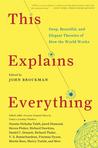
BOOK REVIEW: This Explains Everything ed. by John Brockman

This Explains Everything: Deep, Beautiful, and Elegant Theories of How the World WorksThis Explains Everything: Deep, Beautiful, and Elegant Theories of How the World Works by John Brockman
My rating: 4 of 5 stars

Amazon page


A theory that explains a lot with a clear and simple set of ideas is much beloved by scientists and social scientists alike. In this book, about 150 renowned thinkers were asked what theory they thought explained the most with the least. Every year, Edge.org (the online face of an Algonquin Round Table-like group called “The Reality Club”) produces a question to direct toward members, and this book resulted from the 2012 question. The editor, John Brockman, had his work cut out for him given limited space and the fact that a few theories (e.g. Darwinian Evolution) would be rehashed ad nauseam without coordination. (Many authors sited Darwin, even if they weren’t discussing evolution because they knew it’d already been addressed from many angles.)

The contributors are a veritable who’s who of science, and include: Matt Ridley, Richard Dawkins, Leonard Susskind, Frank Wilczek, Steven Pinker, Martin J. Rees, Max Tegmark, Freeman Dyson, V.S. Ramachandran, David Eagleman, Robert Sapolsky, Richard Thaler, Daniel Dennett, Howard Gardener, Lisa Randall, Eric R. Kandel, Alison Gopnik, Lee Smolin, Nassim Nicholas Taleb, Mihaly Csikszentmihalyi, Jared Diamond, and Michael Shermer. One may note that not all of the authors are, strictly-speaking, scientists. The book even ventures into the arts and humanities, including contributors such as Alan Alda and Brian Eno. Of course, this means that the book sometimes veers away from theories that have explanatory power on the scale of natural selection or the neat offerings of physics and chemistry, but these entries often provide some intriguing food-for-thought.

All of the entries are short; some are less than a page and most are less than three. Given the range of authors, the approaches and the degree of colorfulness employed in entries varies greatly. There are few graphics and no ancillary matter (notations or bibliography) except for an editor’s introduction. It’s good bathroom reading, or for any other time when one has a couple free minutes to take in an idea.

I enjoyed this book, and found it thought-provoking. Often it wasn’t the expected theories (i.e. the most parsimonious) that provided the greatest revelatory insights. There were even responses that challenged the nature of the question. One won’t necessarily find all the responses present elegant theories, or that all of them even are theories, but that’s not the point. They are all ideas that have merit in some regard. One will see old standards (e.g. the 2nd law of thermodynamics) from new angles and will be exposed to ideas that might be entirely new (e.g. the Faurie-Raymond hypothesis that suggests the advantage of lefties in fighting.) I found essays on swarm intelligence and frames of reference taking my thinking in new directions.

I’d recommend this book for those looking for some interesting thinking on elegant ideas.

View all my reviews

BOOK REVIEW: Astrobiology by David C. Catling

Astrobiology: A Very Short IntroductionAstrobiology: A Very Short Introduction by David C. Catling
My rating: 4 of 5 stars

Amazon page


This book explains how life came about on Earth and what that might mean for life elsewhere in the universe. It may seem odd that life’s origins on Earth is relevant to this otherwise extraterrestrial sub-discipline, but that bit of biology offers insight into what is necessary for life—at least life as we know it. There is also the question of whether life originated entirely within Earth’s primordial soup, or whether there was an extraterrestrial ingredient necessary.” [Note: we aren’t talking about an advanced civilization placing creatures here so much as raw materials frozen in space dust or a meteorite. This is the idea of panspermia that once had a substantial following.]

If you’re interested in whether there might be life beyond our planet, this little introduction will give you the basic insights into where it might be found and what it might be like. Though the book deals with a highly technical subject, it’s written with the non-expert in mind.

The book consists of eight chapters. The first chapter defines the subject of “astrobiology,” which is important as it’s not exactly a household term—and is arguably an ill-chosen term to boot. However, chapter one also defines life and outlines what are the necessities for the development of life. The second chapter explores what type of celestial body life might reside upon–or in. We tend to think narrowly of other planets like ours, but what about moons or meteorites, or even space dust? More broadly, this chapter gives the reader a primer on cosmology and astronomy as is relevant to the development of life. Chapter three evaluates the conditions which proved conducive to spawning life on Earth. This is followed by a chapter that looks at how the Earth provided an environment in which life could flourish, even allowing for the evolution of intelligent lifeforms. Chapter five explains how genes and the chemistry of life contribute to the perpetuation of life.

Chapters six and seven both answer the question of where we might expect to find extraterrestrial life. The former discusses promising locales for life within our solar system and the latter is about the space beyond. Needless to say, chapter six is a great deal more specific; it actually proposes nine celestial bodies in the solar system that could theoretically harbor life, and expounds upon which are most and least promising and why. Chapter seven is more about what kinds of places we might expect to find life, and where we might direct our investigations. While scientists are finding new planets all the time, it is a relatively new capability and these distant bodies are only discovered through indirect evidence. The last chapter is a brief one that discusses “controversies and prospects.” With respect to controversies the primary contender is the Rare Earth hypothesis that suggests that life may not be so common as we expect by virtue of the massive number of solar systems out there. As for prospects, that is just a couple of pages on the most likely contenders at the time the book was written.

The book has about a dozen illustrations, mostly explanatory diagrams and all in black-and-white. It also has a two-page further reading section. However, that’s it as far as ancillary matter is concerned.

I found this book to be interesting and a good way to get up to speed on the basic concepts necessary to understand the search for extraterrestrial life. I’d recommend it for others who’d like to do the same.

View all my reviews

BOOK REVIEW: The Grand Design by Stephen Hawking w/ Leonard Mlodinow

The Grand DesignThe Grand Design by Stephen Hawking
My rating: 4 of 5 stars

Amazon page


Why is there a universe, and why is it as it is? This is the question addressed by “The Grand Design.” These questions have been taken up in many ways by many disciplines in addition to science (e.g. mythology, religion, and philosophy), and science, itself, is continuously attempting to hone in on an explanation that is consistent with observed reality. Hawking and Mlodinow suggest that, for now, the leading contender is M-theory.

The authors advocate for M-theory, but also for the [relevant] notion of model-dependent realism. M-theory predicts that quantum fluctuations are causing a continuous spawning of new universes—each with its own laws of nature (or lack thereof.) Most of the bubble universes in this frothy multiverse don’t have staying power, but a few—like ours—are governed by laws that not only allow them to blossom, but also to spawn life. Besides the existence of a multiverse of universes governed by differing sets of laws, there are some other predictions of the M-theory model that remain to be proven. These include the existence of eleven dimensions, most of which are curled up and must be curled up in a certain way according to a set of laws and conditions. The theory also predicts that there will exist “objects” of various dimensionality up to nine. [Whether we will ever be able to test any of these predictions remains unclear.]

What’s this model-dependent realism bit? This is the idea that what we know of reality exists through models that connect observations to a set of rules. Within the limited space for which we have observations, there is no requirement that there be a solitary model or mapping between rules and observations. Because of this, there may be multiple theories. Physics has been long looking for a grand unified theory (GUT) or a Theory of Everything (TOE) that explains all the laws of the universe in one fell swoop. Hawking suggests that such a solitary theory may not be found given our limitations, and that we may have to exploit different theories for different situations. This belief is important because M-theory isn’t a unified theory but a grouping of theories that each work well in certain domains. Needless to say, this isn’t a particularly satisfying notion for the many physicists who are hoping for a more satisfying level of elegance.

The book consists of eight chapters. The first, entitled “The Mystery of Being,” is a brief description of the central question and an outline of why M-theory is proposed as the answer. Chapter two gives an overview of our evolving understanding of the laws that govern the universe, and sets up the important idea that the configuration of the universe is contingent upon the form of the laws governing it. The third chapter is where the authors argue for model-dependent realism, while discussing the arguments of realists and anti-realists as well. Chapter four describes alternate histories and the idea that the probability of an observation is dependent upon all possible histories that could have led to said observations. This bit of quantum strangeness is crucial to reconciling the central question. The next chapter describes the forces seen in our universe and considers attempts to unify the four forces (i.e. gravity, electromagnetism, the weak nuclear force, and the strong nuclear force) in a single theory that explains it all—a ToE. Chapter six discusses our universe with particular respect to its steady expansion that has allowed galaxies and solar systems to form. Chapter seven goes further, exploring the nature of a universe that could support the development and evolution of life. There are a wide variety of precise conditions needed to produce intelligent life. We live in a narrow band with respect to our distance from our star in which our type of life could be created. If the orbit of the sun was more elliptical or our axis wasn’t stabilized by a moon, we couldn’t be—and those features require laws that support them. The authors also examine how the chemistry of our universe is conducive to the development of complex life. The final chapter uses a discussion of a primitive computer game called “the game of life” to show how a model shapes reality as we know it. This grid-based game has only a few rules, and yet if there are more than a few pixels at the beginning, it becomes impossible for us to predict an outcome. With the complexity we see in our universe, this situation is vastly greater.

The book contains many graphics, mostly color, to clarify ideas that are difficult to comprehend via verbal description, or sometimes just to add levity. The only ancillary matter is a brief glossary of terms that come up in the book. There are no notes and no bibliography.

I found this book to be thought-provoking. However, I don’t know why it had the feel of a sales pitch. It repeats the theme of “M-theory is the best game in town” ad nauseam. This repetition draws attention to itself because the book fails to directly challenge those who critique M-theory in any depth or detail. It also fails to take on the question of how it is that M-theory might be taken from a purely theoretical construct to one that can be tested. (It makes falsifiable claims, but does that matter if we may never have a capacity to test those claims?) Those aspects wouldn’t be necessary if the book wasn’t making a pitch. [It felt like the book may have wanted to convince its pop-sci readers that–while they would only have a foggy idea of the why M-theory might have merit at the end of the book–they should remember that it’s the best–so that no funding gets cut from M-theory research and delivered to other lines of inquiry. In other words, the take-away sometimes feels like: “Stephen Hawking is super-smart, and he says ‘vote M-theory.’”]

I would recommend this book for those interested in the big picture of our universe’s existence, but as a neophyte it has made me want to read Woit’s “Not Even Wrong” or Smolin’s “The Trouble with Physics” just so that I’ll know what the critics are saying.

View all my reviews

BOOK REVIEW: Remember When by Scientific American

Remember When?Remember When? by Scientific American
My rating: 3 of 5 stars

Amazon page


This book is part of a series put out by Scientific American magazine that collects articles on a specific topic of interest, in this case memory.

I’ll get straight to the point:

Pros: The style is readable and concise, and the book is well-organized and full of fascinating tidbits [Note: when I say “well-organized,” it’s clearly a collection of past articles of various types, and so there are a mix of short pieces, long-ish pieces, and an interview or two. However, these inconsistent “chapters” are placed in sections in a logical fashion. Furthermore, I expected much more repetitiveness from this type of collection than there was.]

Cons: First, the Kindle version that I read had lots of typos, and they were systematic typos. [Fun fact, considering this is a book on memory. My memory was that this book had typos throughout, but when I looked back through to review it, I noticed it was only some chapters, but—influentially—including the last.] By “systematic typos” I mean the same characters were replaced throughout with the wrong character(s.) While this isn’t the kind of typo that leads to confusion, it’s the kind that makes one say, “Did you really not have anyone look this over after it was machine-converted, you lazy …?” Second, because it’s a collection of magazine articles, one might see a piece from recent years right next to one from the 1990’s. This wouldn’t necessarily be anything to concern one, and might even be a positive. However, once one has seen the aforementioned laziness, it makes one wonder whether half the information isn’t outdated.

The 30 pieces that make up this collection are divided among seven sections to provide a logical organization and progression of the material.

Section 1 explains what memory is and why it seems to work so well in some cases but so poorly in others.

The second section explores the neuroscience of memory and how the brain turns experiences into memories.

Section 3 offers insight into the connection between learning and memory. This describes some fascinating discoveries on the importance of white matter (not the cells that store the memories, but the ones that connect those that do) and the role of sleep.

Section 4 is where it really gets interesting. This section investigates amnesia, hypnosis, and déjà vu.

The fifth section considers a few of the many ways that memory can fail. Besides discussing how false memories are created and attempts to erase traumatic memories, the section also explores the connection between emotion and memory.

Section 6 answers why memory gets worse with age, with discussion of a few of the methods for reducing this tendency.

The last section describes some of the methods used to improve memory. Here, I will offer the same warning as I did for the last review I did on a book of this topic (i.e. “Memory: A Very Short Introduction”), which is to say that if this is your primary purpose for buying the book, you probably want to look for a more specialized book. (Where the AVSI book was a cursory summation of proven techniques, this one focuses on the science of the moment [e.g. experimental medicines and blueberries] and not well-established techniques.)

The graphics are those from the magazine, and, therefore, tend to be detailed and “slick.” This can be a disadvantage when reading on a base model Kindle, such as mine. Even with the graphics expanded, the font is tiny and hard to read. Also, the color graphics on a black-and-white device would likely be clearer as simple line diagrams rather than complex computer renderings. However, most of the articles have little to no graphics, and so it’s not a problem that comes up with great frequency.

I’ll compare this book with the Oxford University Press “A Very Short Introduction” on the same topic that I just reviewed because they are clear competitors. This book covers a broader range of topics, including some intriguing ones such as: hypnosis and memory, déjà vu, the role of fitness on memory, and more detailed information about the connection between sleep and memory. In other words, this book is full of the latest (at the time) research of a nature intended to attract popular science magazine readers. However, the AVSI book is more concisely arranged to get a neophyte up to speed on memory without offering extraneous information. I suspect the AVSI book will age better. The Scientific American book has a fair amount of current events reporting that may be overturned (if some of it hasn’t already been) by subsequent research. The AVSI book was much more easily readable on my Kindle.

I found this book to be interesting and informative—though not without significant flaws. Overall, I’d recommend it for those wanting to learn about the research of recent decades on memory.

View all my reviews

BOOK REVIEW: Memory: A Very Short Introduction by Jonathan K. Foster

Memory: A Very Short IntroductionMemory: A Very Short Introduction by Jonathan K. Foster
My rating: 4 of 5 stars

Amazon page


Everything we think, do, or say relies upon–or is influenced by–memory, and yet our memories offer a much lower fidelity and more highly corruptible recording than we tend to think. Even those events that lead to “flashbulb” memory (i.e. JFK’s assassination, 9-11 terror attacks, or the 3-11 tsunami in Japan) aren’t remembered particularly well. You may remember where you were and what you were doing in broad brushstrokes, but you probably wouldn’t test well on the actual details of the event. Old memories are constantly over-lain with a corresponding loss of accuracy. This brief introduction explains the basics of how memory works, and—as importantly—how it doesn’t.

The book is part of Oxford University Press’s “A Very Short Introduction” [AVSI] series, and it follows that approach. It’s under 150 pages, and written for someone looking for a “ground-up” explanation of the subject. It has minimal ancillary material, just a couple of pages of “Further Reading” after the book’s seven chapters. There are a few black-and-white graphics throughout the book, a combination of photos and diagrams.

Chapter 1 introduces the reader to what memory is and what it isn’t. One learns about the three-part process of memory (encoding, storage, and retrieval), an idea which will be important throughout the rest of the book because these stages mirror the structure of memory failures and the means to build a better memory.

Chapter 2 explores the landscape of memory, which is a great deal more complex than the short-term v long-term dichotomy that we all learned in school. There’s working memory, procedural memory, semantic memory, and episodic memory.

In chapter 3, the reader learns about how memories are retrieved or recalled and the immense power of context in the process.

Chapter 4 explains the many ways in which memory fails us from simple forgetting to false or corrupted memories. We learn how being knowledgeable improves our memory, but also how it can lead us into error.

The next chapter advances the same theme by looking at amnesia. While amnesia is one of Hollywood’s favorite plot devices, the subject is generally poorly understood because of the simplified and myth-filled nature of the entertainment form of the affliction. Here you’ll learn what one isn’t seeing in the soap operas.

Chapter 6 is entitled the “The Seven Ages of Man” and it looks at memory over the lifespan, with particular attention to the ends of the spectrum. On one end, why do most of us remember nothing from our first few years—and what we do remember is often quiet suspect (false memories from hearing stories about one’s infancy?) At the other end of the spectrum, we are all well aware of how memory degrades with age—particularly those of us buying and reading books on memory. However, one learns that it’s a great oversimplification. While our episodic (event) memory degrades, some elements of memory are quite robust to aging.

The last chapter discusses what does (and to a small degree, what doesn’t) work with respect to improving one’s memory. As it’s a short chapter in a short book, this should be taken as an outline of the subject. If this is one’s main purpose for seeking out a book on memory, one may want to keep looking.

At this point, I’ve read and reviewed many books in the AVSI series, and I found this one to be typical. It’s not among the most engaging of the titles in the series, but it gets the central concepts across in a way that is readable and soundly organized. Because there’s a lot of definitional and conceptual material to cover, there’s not a lot of room for the narrative approach, which isn’t to say that there aren’t brief descriptions of key cases here and there.

I’d recommend this book for someone wanting an overview of the subject of memory.

View all my reviews

BOOK REVIEW: Consciousness by Susan Blackmore

Consciousness: A Very Short IntroductionConsciousness: A Very Short Introduction by Susan Blackmore
My rating: 4 of 5 stars

Amazon page


Consciousness remains one of the least understood phenomena of our world. It’s also one of the most intriguing subjects, and fascination with it has spurred debate both between science and religion and within science. While science has been moving toward the belief that consciousness is rooted in the brain, there remain many important questions to be answered. Of course, historically, it wasn’t at all common to think of consciousness as arising from the action of a material object (e.g. the human brain), it was beyond humanity’s intellectual capacity to comprehend how something as grand as consciousness could arise from a 1.2kg (<3lb) organ. Consciousness was intertwined with ideas of “the soul”—a non-material self-ness.

So it is that Blackmore takes on a shadowy subject in which questions are as likely to lead to more questions as they are answers. She lays out the arguments between scholars of science and philosophy as to what exactly consciousness is, how it operates, and how important it is or isn’t.

The book consists of eight chapters. The first chapter attempts to define consciousness and discusses the degree to which there is a lack of consensus on the subject. In doing so, it outlines why consciousness is such an elusive subject.

Chapter two describes the attempt to find correlates of consciousness in the brain, and it describes some of the case of brain damage that support the notion that consciousness is a product of the brain. Many beliefs of duality (i.e. the idea that body and mind are separate) have been in decline because of cases in which brain damage is specifically linked to changes in consciousness. Consider life-long love being uprooted by a scalpel.

Chapter three deals with a number of topics related to time and space, such as whether consciousness lags behind reality. That sounds ridiculous. However, remember that we experience the world from inside the frame of reference of consciousness.

Chapter four examines a number of illusions to which our conscious minds are systematically subject. We have a number of blind spots, many of which result from the fact that a great deal of what the brain does, it does without letting the conscious mind in on events.

In the fifth chapter, the author presents the link between consciousness and perception of self. It has long been taken for granted by most of the world that there is some soul that exists beyond the body, and it’s in this chapter that the author reflects upon whether this is an illusion or not.

Chapter six covers a topic that is integrally linked to consciousness and the idea of self, and that is free will. Free will is another notion that humanity historically took for granted that is coming under fire in the face of our increasing understanding of the brain. Current scientific evidence suggests that free will as we perceive it (i.e. thinking things through consciously and then making a decision at a conscious level) is an illusion.

Chapter seven is about the many altered states of consciousness, including: dreaming, drug-induced effects, meditation, and some of the widely reported experiences that seem to involve separation of consciousness from body (e.g. out-of-body and near-death experiences.)

Chapter eight ponders the evolutionary advantage offered by consciousness (especially if a major part of what we think we use our conscious minds for is an illusion.) One thing is clear; evolution doesn’t hand out vast and complex advances in capability if they don’t serve to make one more likely to survive to procreate. However, could consciousness—majestic as it may seem—be a mere side-effect of a big brain developed to facilitate survival in a world in which we weren’t the strongest, fastest, or most athletic creatures by a long shot?

The book uses a wide variety of black-and-white graphics including cartoons, technical diagrams, and photographs. These graphics help to communicate important ideas and are more likely to do so with levity than technical complexity. The book is readable, considering the challenging topic.

I’d recommend this book for those interested in an overview of the state of understanding and debate about what consciousness is.

View all my reviews

BOOK REVIEW: The Brain: A Very Short Introduction by Michael O’Shea

The Brain: A Very Short IntroductionThe Brain: A Very Short Introduction by Michael O’Shea
My rating: 4 of 5 stars

Amazon page


The human brain in 120-ish pages, it’s an ambitious goal considering that the brain is widely considered to be the most complex object in the known universe. Still, this is one of Oxford University Press’s “A Very Short Introduction” (AVSI) series, so the only promise is to give one a concise overview of the subject for beginners. In that task, the book succeeds. In fact, the book takes on some subjects that one might think beyond its scope, such as the historical progression of our understanding of the brain and how technology might be used to repair damaged brains.

The book consists of seven chapters and an epilogue. The first chapter introduces the brain, and it makes this monumental subject manageable by considering reading—a skill that we take for granted but for which the brain conducts miraculous feats from rapid accurate eye movement to turning abstract symbols into meaning. The second chapter takes the reader on a tour of the changing understanding of the brain leading up to the discovery of the neuron—the brain’s basic unit. Chapter three explores how those neurons transmit signals, the fundamental action of the brain. Chapter four examines the evolution of the human brain, both from the perspective of how it could become so complex, and of why it needed to become so. Chapter five is about how the brain receives information and uses this information to conduct activities. A majority of this chapter is devoted to how patterns of light are recognized and turned into the meaningful basis upon which to make decisions or perform actions. Chapter six offers a basic understanding of memory, one of the roles we most closely associate with the brain. Chapter seven considers whether we’ll be able to fix damaged brains, and, if so, using what technologies. A brief epilogue tells us where the future of brain research will go–having gained much understanding since the invention of functional Magnetic Resonance Imaging (fMRI), neuroscience must find new approaches to take itself into the future.

The book uses line drawings to depict concepts that are hard to convey via text. While the graphics are simple black-and-white drawings, they are immensely beneficial. Like other AVSI books, there are no citations or notes, just a couple of pages of “further readings.” That’s not a criticism; it’s perfectly acceptable for this type of book.

I found “The Brain: AVSI” to be informative and interesting. The author uses some illuminating examples and cases to cover a lot of ground in a small package. I’d recommend the book for anyone who wants a neophyte’s introduction into the human brain.

View all my reviews