DAILY PHOTO: Thai Yoga Bodywork Percussion


Taken Friday the 13th of June in 2014 in Bangalore.

Taken Friday the 13th of June in 2014 in Bangalore.

I haven’t been traveling much lately (or even getting far beyond commutes to the yoga studio, kalari, etc.)  so I’m resorting to posting pics of what I’m doing in my day-to-day life as Daily Photos. The past few days I’ve been refreshing my training in the side, prone, and seated sequences of Thai Yoga Bodywork (Nuad Bo Rarn) at the Inner Mountain School of Healing Arts.

This photo is taken at the end of the seated sequence as a series of percussive actions are applied to the back.

Paleo-Stressing: Acute v. Chronic Stress

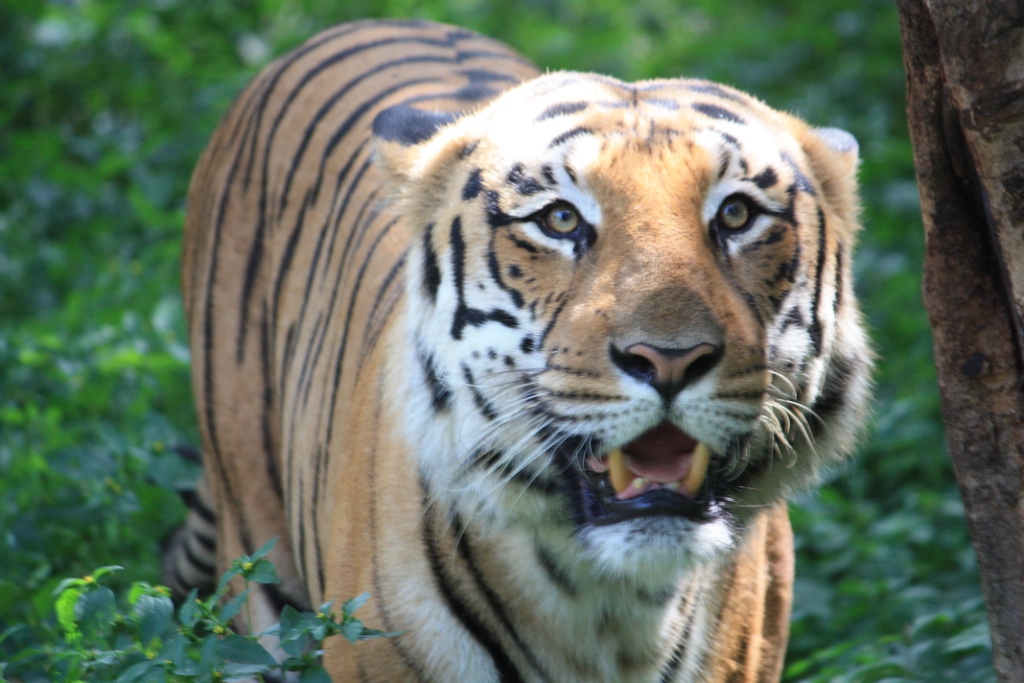
"What happened to the good ole days when I ate you people--not lived in your cages?"

“What happened to the good ole days when I ate you people–not lived in your cages?”

Paleolithic dieting is all the rage these days. I’m no expert on the paleo-diet, but–as I understand it–this refers to the practice of eating the foods consumed by our pre-agrarian ancestors. The idea is that if one consumes the foods that our species is evolutionarily-optimized to eating, one will be healthier.  Whether one believes in the merits of the paleo-diet or not on the whole, it’s hard to argue that one wouldn’t be better off eating less highly-processed and highly-refined foods and more things that look like food at a glance.


Our diet isn’t all that has changed since the days of our pre-agrarian ancestors. Modernity has brought with it an entirely new way of experiencing stress. Eliminating or reducing stress is a common topic of discussion, but not all stress is created equal. There’s a necessary form of stress, a stress that makes one better, stronger, faster, and smarter. We don’t want to willy-nilly eliminate stress; we want to reduce the wrong type of stress.


Our ancestors—like animals–experienced brief periods of intense stress (e.g. saber-tooth tiger attacks), followed by longer periods in which they were free of deadlines, carpools, and after-school activities. Now, no one likes to have a saber-tooth tiger stalking them. It’s unpleasant. Modern humanity has gone to great lengths to eliminate those short bursts of terror, but not without cost. (If you don’t believe me read Robert Sapolsky’s Why Zebras Don’t Get Ulcers.)


Whether or not you believe that eliminating acute instances of terrifying stress is bad for mankind, it’s hard to argue that modernity’s leveling process didn’t eliminate stress, but instead resulted in a chronic stress on a smaller scale. People today have impossibly long daily to-do lists, and they have to accept trade-offs between work, family, and personal development.


It’s true that you don’t get eaten by a giant cat when you drop the ball, but life is so packed diverse events that one may feel like one is dropping some ball constantly. If your boss thinks you’re a model employee, then your kids are probably going to need therapy. If you have a contented home life, your boss may have his or her eyes open for someone who can give the firm consistently 70+ hour work weeks. If you feel you’re doing alright on both the work and family front, your body and / or mind is probably a train wreck.


Chronic [mini] stress may feel better than acute [catastrophic] stress, but it takes its tolls in various ways. First, with our sympathetic nervous system (fight-or-flight reaction) constantly engaged our body’s power to heal itself is reduced. When the parasympathetic nervous system is engaged, the body devotes resources to long-term goals like getting healthier, but in stress mode activities not relevant to immediate survival shut down. This is a great system if you have periodic life and death stress, but is not so good if you’re under constant stress.


Second, chronic stress reduces sleep, and sleep is essential to one’s mental and physical well-being. There are a wide variety of symptoms associated with sleep deprivation such as forgetfulness, decreased concentration, decreased alertness, reduced reasoning ability, diminished problem-solving capacity, and depression—all of which can diminish our physical health through accidents, ailments, suicide attempts, and lack of energy for exercise.


Third, chronic stress can make one fat, with all the health issues that result. Some people use food as a coping mechanism. Other people eat too fast or choose their food poorly because of time constraints or because they are not mindful of eating as their monkey minds churn at a mile a minute. Then there is the more convoluted and complex issue of cortisol–a hormone released under stress that is linked to weight gain in at least some cases. Even if you don’t have a problem on the calorie intake side, the stressed individual may not do so well on the calorie burning side—either because of a lack of time to exercise or a lack of energy.


Modern humans are uniquely suited to chronic stress because we are the only species that achieves the same physiological stress response by remembering and obsessing about a stressful event as experiencing it. Abandoning the modern approach to living isn’t an option most are willing to entertain; but there are ways to combat chronic stress.


Move – Meditate – Mindfully Breath: The bad news is you’ve got to shoehorn these activities into your schedule daily (or at least several times a week.) The good news is that they don’t need to take up a lot of your day. There are a number of systems that address all three components in one handy package such as Qi Gong, Yoga, and some martial arts. I don’t think it matters so much which one chooses as how one goes about one’s practice.


Movement strengthens and strategically stresses the body, but it also increases one’s bodily awareness so that one becomes aware of how stress is manifesting itself in one’s body. Meditation teaches one how to live in the present moment, and it trains one to recognize the seeds of negative thought and emotion earlier so that one can counter-act them. Obviously, breathing is essential to life, but learning to be aware of one’s breathing patterns and to “manually override” the breath patterns associated with harmful emotional states is a beneficial skill.


Massage / Bodywork: Whether self-administered or other-administered (the latter allowing greater distressing–particularly if the masseuse is skilled) massage is an activity, like movement, that can help one become aware of where one is physically holding one’s stress. These physical manifestations of stress can exacerbate the whole experience of stress. One should take time periodically to have bodywork done. A day rarely goes by in which I don’t work on my own neck, shoulders, head, or face, and I occasionally get professional Thai Yoga Bodywork done.


The Places that Scare You: Force yourself to go someplace (not necessarily literally a “place”) that scares you once in a while. This needn’t be skydiving or hand-gliding—but it could be. It may be a martial arts class in which one has to put on the gloves occasionally and go at it. It may be joining Tostmasters and having to give a speech in front of a crowd. It may be traveling to some backwater where you don’t know the language, but you want to learn. This is a very personal issue. (i.e. A Type-A personality he-man may not find that skydiving is outside his comfort zone. If so, sorry, skydiving doesn’t count, he may need to learn ballroom dancing, or something else that truly takes him outside being comfortable.) KEY POINT: The problem with hiding from all stressors is that it doesn’t result in a stress-free life, what happens is that smaller and smaller stressors loom bigger and bigger in one’s mind. Which brings us to…


Perspective:  One must put life’s challenges in perspective. Each person’s problems are important to them, and I don’t want to diminish anyone’s problems, but—come on—you’re not going to be eaten by a freaking saber-tooth tiger.

BOOK REVIEW: The Book of Massage by Lucinda Lidell

The Book of Massage: The Complete Step-By-Step Guide to Eastern and Western TechniquesThe Book of Massage: The Complete Step-By-Step Guide to Eastern and Western Techniques by Lucy Lidell

My rating: 4 of 5 stars

Amazon page

I picked up this book because I recently began studying Thai Yoga Bodywork (TYB.) While The Book of Massage doesn’t specifically deal with Thai massage, as a neophyte, I figured some general reading was in order, and there aren’t a lot of widely available books that deal with Thai massage specifically (at least not where I currently reside.)My first testimonial of this book is that I looked through over a dozen books on massage at my local bookstore, and this is the one with which I walked home.

I found Lidell’s book to be a valuable resource. The book covers three approaches to massage: oil massage, shiatsu, and reflexology. As the subtitle suggests, this book addresses both Eastern and Western approaches to massage. The section labeled simply “Massage” is one that deals largely in the Western approach, as it’s suggestive of the Swedish style of massage. This involves oil, no / few clothes on the recipient, and a variety of strokes that are delivered over relatively broad areas (as opposed to the deeper acupressure approach of the latter methods.) The oil massage chapter begins with an overview including what type of oil to use and the basic strokes, and then provides a sequence before delving into specific techniques for various body parts or groups of body parts.

Shiatsu is a Japanese form of massage that is based on the concepts of Traditional Chinese Medicine (TCM.) I found this style to be much closer to what I’ve learned in TYB. Like TYB, both patient and recipient are clothed, there is no oil, acupressure is the norm, it requires no table, and there is a match up between what are called “energy lines” in TYB and “meridians” in Shiatsu. Shiatsu even employs similar stretching techniques to those that are the hallmark of TYB. I can imagine these systems having a common ancestral art.

The order of the shiatsu chapter is basically the same as the chapter on Massage. First, there’s necessary background information. This consists of a couple of pages on the basic Taoist concepts on which TCM is based (e.g. Chi, Yin & Yang, and the five elements) and related vocabulary like “tsubo” (pressure points) and meridians. The section then goes on to address basics of posture and bodily tools (palms, thumbs, elbows, knees, etc.), the sequence of the massage, and then the specifics of various body parts.

Reflexology massages only the feet and hands in the belief that points on these appendages map to other parts of the body. In other words, practitioners believe one can increase wellness throughout the body by working points on only the feet or hands. It’s said that the roots of reflexology may be ancient and that it may have been practiced in Egypt in 2300BC, but the modern school was developed by an American physician in the early 20th century. TYB does borrow from reflexology (though not necessarily the modern form of it), so some of this was also similar to what I learned in TYB. Again, the order of this section went from the generic information one needs toward the specifics of how to apply a given technique on a particular part of the foot or hand.

In addition to the three core sections, there were chapters before and after that provide the reader with useful information. Some of this was banal but obligatory (e.g. a brief history of massage and a discussion of the importance of touch among the human species), but some of it was essential practical information such as how to create the proper environment and how to center oneself before delivering a massage. There was also information that will be useful for some about massages involving babies, expectant mothers, the elderly, athletes, and oneself.

Perhaps the most beneficial of the “supplementary” chapters was one that dealt with the subject of how to read bodies. This may seem like an odd topic. However, it’s useful to be able to recognize where an individual holds his tension or where her posture is off–a problem that can create many muscular difficulties. There’s a short overview of anatomy, which I found useful, and a shorter overview of “chakras and auras,” which I personally didn’t find useful but can see where others might.

There are several strengths and relatively few weaknesses to this book. I found the organization to be logical. The graphics are a combination of photos and line drawings, and they work well together. I thought it was great that the author explained that Shiatsu is to be done in comfortable, loose-fitting clothing and that the only reason the graphics display the masseuse in a skin-tight body suit was so that the baggy clothing wouldn’t inhibit the reader’s view. Also, I found the written descriptions worked well with the graphics. One often needs a written cue as to where to find a certain point or line, and just showing it in a picture can be misleading given the wide variety of body types as well as the granularity of the graphic in contrast to the specificity of a point one may need to hit.

I suppose I should warn the easily mortified and / or very religious that there are full and partial frontal nude photographs in the section on oil massage. [I doubt such people are a major demographic for giving or receiving massage, but one never knows.]

I don’t have a lot of complaints. As it’s set up like a workbook, a spiral binding might have been nice, but I recognize the huge challenges of that. Plus, I’m not certain that one can or should learn massage from a book. Rather one should look at it as information to support study with a skilled teacher–or to experiment with once one has already developed some skill. The sections early and late in the book that talk about the importance of human touch didn’t add much, but they were also brief.

If you’re looking for a book on massage that covers a broad set of bases, but yet gives adequate detail for learning, I think this book is a good choice. I’d say it piqued my interest in learning Shiatsu.

View all my reviews

Indonesian Snake Massage

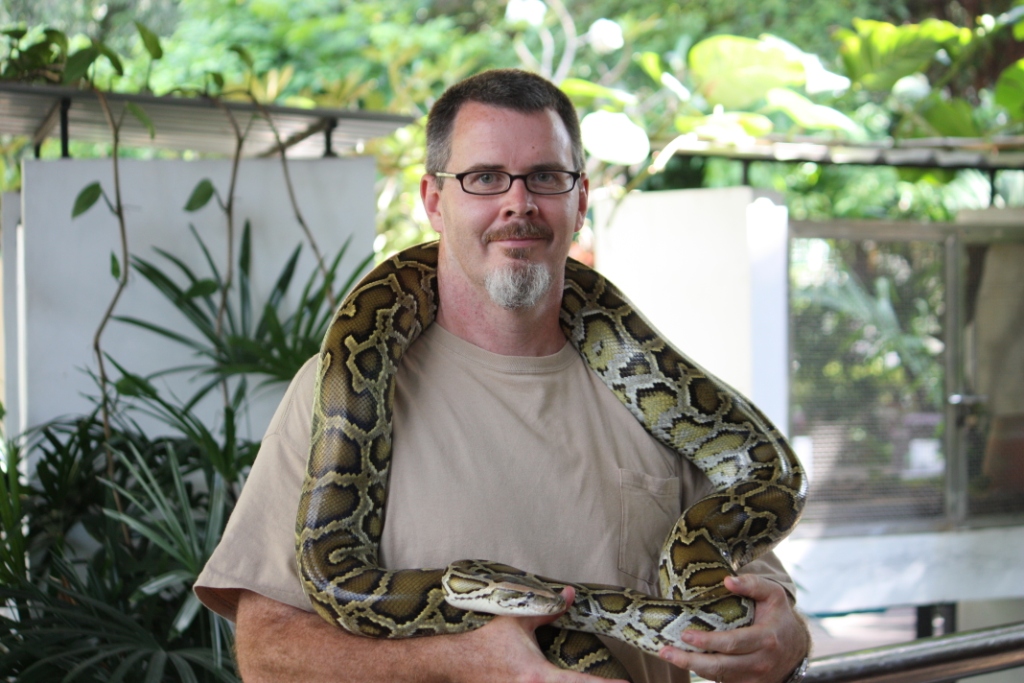
A Python, but no massage

A Python, but no massage

What could be more relaxing and luxuriating than laying on a massage table and having pythons heaped upon one to slither and writhe their way around one’s body? Many people might answer that question with replies like, “being set on fire”, “a prostate exam”, or “a pop math quiz.” Yet, some people dig this unusual form of therapy, and are willing to pay big bucks for it.

If you’ve traveled in the third world, you know that there are ever new and innovative attempts to bilk tourists out of cash. However, there has to be something to a weird idea for it to really take hold. Consider the ubiquitous Southeast Asian “fish massage.” I’ve tried it. It isn’t really a massage, but it does involve fish–namely little fish that eat away one’s dead skin cells to exfoliate and tickle at the same time. I don’t know if the fish massage does much good, but it feels weird, has some novelty to it, and is a good way to both get off one’s feet and experience ten minutes without someone trying to sell one something else odd and questionable.

Will the python massage (no, that is not a euphemism, innuendo, or a phrase from bad erotica) survive? I believe it will. Why? Because behind every insane idea there are drunk backpackers with Type-A personalities challenging one another to “go for it.”