Publisher’s Site
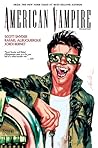
The American Vampire saga enters the 1950’s, at least with two of the three storylines presented in this volume. The central arc takes place in Glendale, California in 1954 and features Fonzi-like vampire hunter, Travis Kidd, against the series’ central villain — Skinner Sweat. But the main story is bookended by two shorter stories. The opener is a cowboys v. indians tale, set in New Mexico Territory in 1871, that provides backstory on Skinner Sweat and James Book. The closing story is also set in 1954 but takes place in Alabama and features a black vampire hunter in the Deep South.
I found all three stories to be compelling and have greatly enjoyed this series.
DC Site
If you love a good story, you really can’t go wrong with Gaiman. This volume consists of four standalone pieces of short fiction set in the Sandman universe.
“Calliope,” like Greek Mythology, envisions an anthropomorphized muse, but takes the idea into a dark and modern twist as said muse is held captive and violated.
“A Dream of a Thousand Cats” imagines dreams do shape the real world and asks what if animals dreamt as big as humans.
“A Midsummer Night’s Dream” is built around the premise that Shakespeare had a patron, none other than Morpheus, a.k.a. Dream, himself.
“Facade” is about a supernatural woman who can only go out in public by taking risky measures to look “normal,” and explores her lonely existence.
All of these stories are clever and compelling, and I’d highly recommend this collection for readers of speculative fiction.
Publisher’s Site
In this opening volume in a series that pits a set of the DC pantheon of superheroes against a shadowy vampire cabal, we learn that the vampires are preparing for attack and that they’ve infiltrated all levels of society to degrees unknown — even the Justice League. This volume focuses heavily on the extended “Bat-Family” along with Oliver Queen’s smaller Green Arrow team, but includes many more superpowered characters in varied roles. Though it also ignores some of the most powerful characters, a big risk for such a huge ensemble cast. (One wants to save some big guns, but it begs the question of whether Superman is fiddling while the world burns.)
I like how tension was built in this story, and how information is revealed to the reader, allowing one to be gripped by questions of how the characters will learn what one already knows and with what consequences. The volume ends with a big reveal, though not with any kind of resolution. So, it’s not a standalone story in my view.
I found the volume engaging, but feel it suffers from the unavoidable problems of having too many characters, particularly characters of the god-tier variety.
Publisher’s Website
This is an anthology of stories of the supernatural set in India or built around characters and contexts of India. About half of the stories are by writers of non-Indian ancestry, though some were born or lived extensively in India (e.g. Rudyard Kipling and C.A. Kincaid.) Not all of the pieces are “ghost stories” in a technical sense, but they all revolve around the supernatural or surreal experience.
I enjoyed all the stories in this collection, but among my favorites were: “The Brown Hand” by Arthur Conan Doyle; “The Strange Ride of the Morrowbie Jukes” by Rudyard Kipling; “The Fire-Jogi” by A.C. Renny; “Fritz” by Satyajit Ray; “Anath Babu’s Terror” by Satyajit Ray; “The Yellow-Legged Man” by Sudhir Thapliyal, and “Topaz” by Ruskin Bond.
If you enjoy scary stories, I’d highly recommend this book.
Publisher site
The third volume of the American Vampire series advances the story into the 1940’s — World War II to be precise. The book contains two distinct storylines, both involving missions behind enemy lines. The first, “Strange Frontier,” is set in the Pacific theater and centers on the character of Henry Preston (the non-vampire husband of benevolent American Vampire, Pearl Jones.) In it, Preston is assigned to an elite fighting squad dispatched to investigate an island that turns out to be infested with a new strain of vampire.
The second story, “Survival of the Fittest,” takes vampiric vampire-hunter Felicia Book as its lead as she is dispatched (in partnership with agent “Cash” McCogan) to Nazi-occupied Romania to investigate claims of a “mad” scientist’s vampire-related research, only to find herself in a completely unexpected and daunting scenario.
I’m enjoying this series. The stories are satisfying and well-crafted, and the books somehow manage to not be just another set of vampire stories. Moving through time allows the stories to be self-contained while making it possible to continue with ever fresh material. (A tactic that works owing to the long lifespans of vampires.) The books also use genre mixing brilliantly, be it detective noir or — in the case of this volume — the war story. Snyder has breathed new life into the vampire story, and I’d highly recommend this series for comic book readers.
Publisher site
This six-issue volume, just like the first, intersperses the story of two American vampires, Skinner Sweet and Pearl Jones. For those who haven’t read Vol. 1, the American Vampire is mutated to have advantages of strength, speed, and UV resistance, but in vampire mode they are much more monstrous. The first four issues focus on a detective noir story set in 1930’s Las Vegas. Skinner Sweet could be said to be central to events in that arc, though not to be the lead character. (That would be the police detective trying to solve a string of gruesome murders.) The last two issues put the Pearl Jones story front and center. That arc is set during the same timeframe, but in Northern California. The first arc is tied up more successfully, but I suspect this has to do with the challenges of interspersing stories (the first arc also has twice as much space with which to work.)
There’s an interesting contrast between the stories. Skinner Sweet is villainous, was villainous before he became a vampire, and is even more so afterwards. The Pearl Jones story is more of a love story between Pearl and her human husband, Henry Preston — albeit a love story in which the couple is being hunted by nefarious forces and must fight to survive. She is trying to be free of the monster life as best she can.
I am enjoying this series. The journey through time and landscapes of America makes this not just another vampire story. If you enjoy comics that mix genres, I’d highly recommend this volume.
Amazon.in Page
This volume presents two separate and complete story arcs. The first features the Floronic Man (Jason Woodrue) as the main villain, and it deals heavily in the origins of Swamp Thing and the creature’s struggles to come to grips with who it is and why it experiences the world as it does. The second story makes a shift to a more supernatural threat and shows a Swamp Thing who is more comfortable in its… roots? twigs? foliage? — whatever Swamp Thing has in lieu of skin.
Alan Moore does his usual superb job of creating a clever and satisfying set of tales. Swamp Thing was groundbreaking in its cross-genre mélange of horror, supernatural, eco-fiction, and sci-fi. There is also a certain smartness about the comic. One is led to consider questions of consciousness and humanity’s role in nature through these stories. And solutions are rarely achieved by punching the villain into a stupor. This won’t be for everyone. In some ways, the comic elevates the wise old mentor to the role of hero.
I enjoyed reading this book and would highly recommend it for readers of comic books and graphic novels.
Once upon a midnight dreary, while I pondered, weak and weary,
 Over many a quaint and curious volume of forgotten lore --
 While I nodded, nearly napping, suddenly there came a tapping,
 As of some one gently rapping, rapping at my chamber door.
 "'Tis some visitor," I muttered, "tapping at my chamber door --
  Only this and nothing more."

 Ah, distinctly I remember, it was in the bleak December;
 And each separate dying ember wrought its ghost upon the floor.
 Eagerly I wished the morrow; -- vainly I had sought to borrow
 From my books surcease of sorrow -- sorrow for the lost Lenore --
 For the rare and radiant maiden whom the angels name Lenore --
  Nameless here for evermore.

 And the silken sad uncertain rustling of each purple curtain
 Thrilled me -- filled me with fantastic terrors never felt before;
 So that now, to still the beating of my heart, I stood repeating
 "'Tis some visitor entreating entrance at my chamber door --
 Some late visitor entreating entrance at my chamber door; --
  This it is and nothing more."

 Presently my soul grew stronger; hesitating then no longer,
 "Sir," said I, "or Madam, truly your forgiveness I implore;
 But the fact is I was napping, and so gently you came rapping,
 And so faintly you came tapping, tapping at my chamber door,
 That I scarce was sure I heard you" -- here I opened wide the door; --
  Darkness there and nothing more.

 Deep into that darkness peering, long I stood there wondering, fearing,
 Doubting, dreaming dreams no mortal ever dared to dream before:
 But the silence was unbroken, and the darkness gave no token,
 And the only word there spoken was the whispered word, "Lenore?"
 This I whispered, and an echo murmured back the word, "Lenore!" --
  Merely this and nothing more.

 Back into the chamber turning, all my soul within me burning,
 Soon I heard again a tapping, somewhat louder than before.
 "Surely," said I, "surely that is something at my window lattice;
 Let me see, then, what thereat is, and this mystery explore --
 Let my heart be still a moment, and this mystery explore; --
  'Tis the wind and nothing more."

  Open here I flung the shutter, when, with many a flirt and flutter,
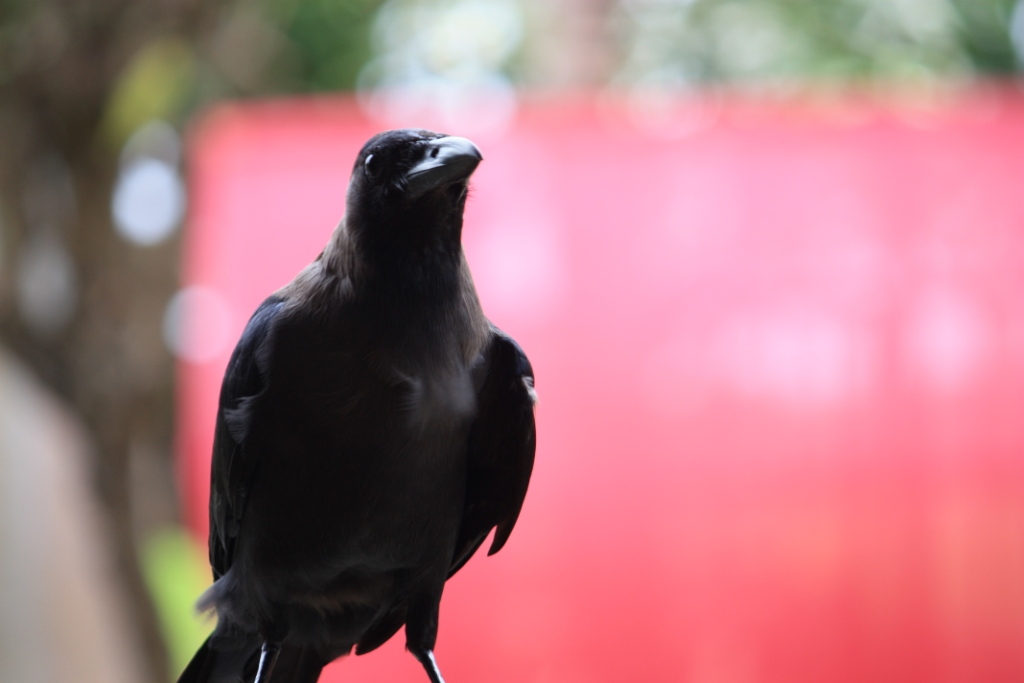
 In there stepped a stately Raven of the saintly days of yore;
 Not the least obeisance made he: not an instant stopped or stayed he;
 But, with mien of lord or lady, perched above my chamber door --
 Perched upon a bust of Pallas just above my chamber door --
  Perched, and sat, and nothing more.

 Then this ebony bird beguiling my sad fancy into smiling,
 By the grave and stern decorum of the countenance it wore,
 "Though thy crest be shorn and shaven, thou," I said, "art sure no craven,
 Ghastly grim and ancient Raven wandering from the Nightly shore --
 Tell me what thy lordly name is on the Night's Plutonian shore!"
  Quoth the Raven, "Nevermore."

 Much I marvelled this ungainly fowl to hear discourse so plainly,
 Though its answer little meaning -- little relevancy bore;
 For we cannot help agreeing that no living human being
 Ever yet was blessed with seeing bird above his chamber door --
 Bird or beast upon the sculptured bust above his chamber door,
  With such name as "Nevermore."

 But the Raven, sitting lonely on that placid bust, spoke only
 That one word, as if his soul in that one word he did outpour.
 Nothing further then he uttered -- not a feather then he fluttered --
 Till I scarcely more than muttered, "Other friends have flown before --
 On the morrow he will leave me, as my hopes have flown before."
  Then the bird said, "Nevermore."

 Startled at the stillness broken by reply so aptly spoken,
 "Doubtless," said I, "what it utters is its only stock and store,
 Caught from some unhappy master whom unmerciful Disaster
 Followed fast and followed faster till his songs one burden bore --
 Till the dirges of this Hope the melancholy burden bore
  Of 'Never -- nevermore."

 But the Raven still beguiling all my sad soul into smiling,
 Straight I wheeled a cushioned seat in front of bird and bust and door;
 Then, upon the velvet sinking, I betook myself to linking
 Fancy unto fancy, thinking what this ominous bird of yore --
 What this grim, ungainly, ghastly, gaunt, and ominous bird of yore
  Meant in croaking "Nevermore."

 This I sat engaged in guessing, but no syllable expressing
 To the fowl whose fiery eyes now burned into my bosom's core;
 This and more I sat divining, with my head at ease reclining
 On the cushion's velvet lining that the lamp-light gloated o'er,
 But whose velvet violet lining with the lamp-light gloating o'er,
  She shall press, ah, nevermore!

 Then, methought, the air grew denser, perfumed from an unseen censer
 Swung by Seraphim whose foot-falls tinkled on the tufted floor.
 "Wretch," I cried, "thy God hath lent thee -- by these angels he hath sent thee
 Respite -- respite and nepenthe from thy memories of Lenore;
 Quaff, oh quaff this kind nepenthe, and forget this lost Lenore!"
  Quoth the Raven "Nevermore."

 "Prophet!" said I, "thing of evil! -- prophet still, if bird or devil! --
 Whether Tempter sent, or whether tempest tossed thee here ashore,
 Desolate yet all undaunted, on this desert land enchanted --
 On this home by Horror haunted -- tell me truly, I implore --
 Is there -- is there balm in Gilead? -- tell me -- tell me, I implore!"
  Quoth the Raven, "Nevermore."

 "Prophet!" said I, "thing of evil! -- prophet still, if bird or devil!
 By that Heaven that bends above us -- by that God we both adore --
 Tell this soul with sorrow laden if, within the distant Aidenn,
 It shall clasp a sainted maiden whom the angels name Lenore --
 Clasp a rare and radiant maiden whom the angels name Lenore."
 Quoth the Raven, "Nevermore."

 "Be that word our sign of parting, bird or fiend!" I shrieked, upstarting --
 "Get thee back into the tempest and the Night's Plutonian shore!
 Leave no black plume as a token of that lie thy soul hath spoken!
 Leave my loneliness unbroken! -- quit the bust above my door!
 Take thy beak from out my heart, and take thy form from off my door!"
  Quoth the Raven, "Nevermore."

 And the Raven, never flitting, still is sitting, still is sitting
 On the pallid bust of Pallas just above my chamber door;
 And his eyes have all the seeming of a demon's that is dreaming,
 And the lamp-light o'er him streaming throws his shadow on the floor;
 And my soul from out that shadow that lies floating on the floor
  Shall be lifted -- nevermore!
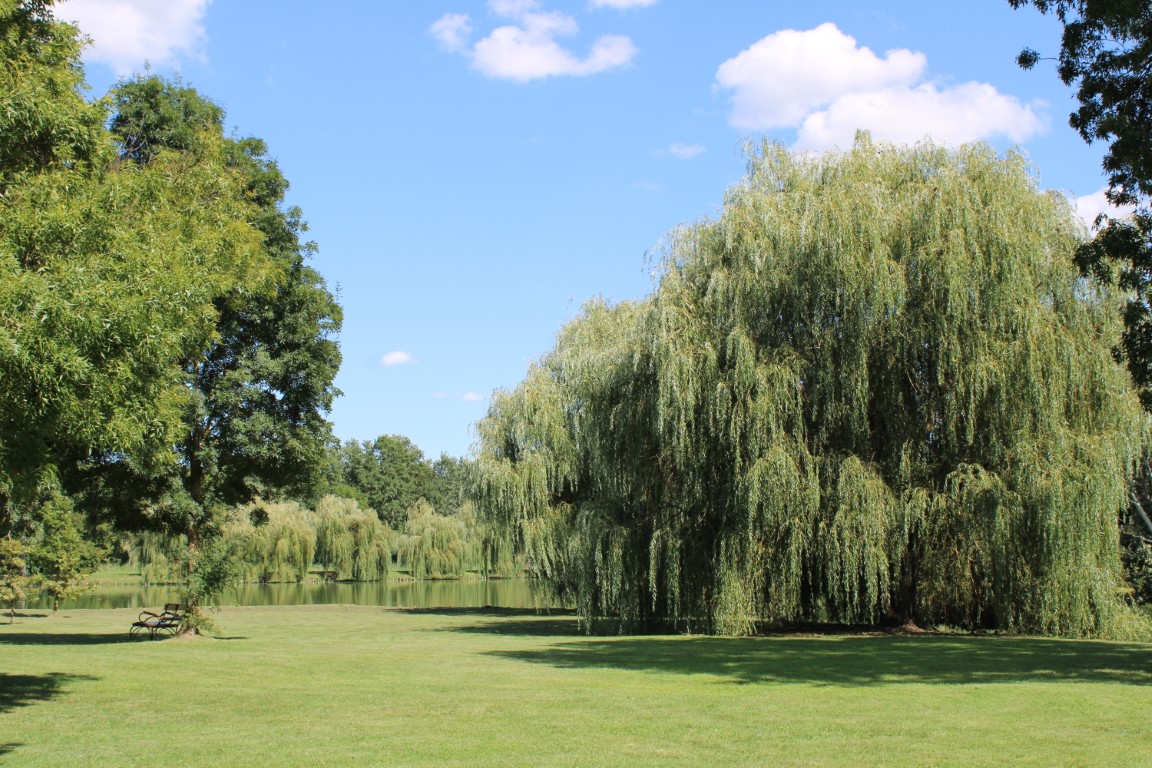
When I see some willows -
 down by water's edge,
  drooping in the moonlight,
 or swaying in the breeze -

I think of Blackwood's tale
 of Danube canoers
  who land upon an isle
  to camp among the willows.

And will the willows that
 I see, mark wicked ground,
  and what will they become
 when darkness makes its stand?

It's such a pretty tree...
 now all but ruined for me,
  and that is story's power
 to sweeten or to sour.
For those interested in reading the referenced story:
flow on, Dark River;
  slip through the night.

midnight's thick clouds
  block the moonlight.

your voice drowned out
  by insect chirr.

a Huck Finn raft
  drifts by at a blur:

the rafters unseen;
  their secret stays hush...

but for those red eyes
  in the underbrush.

 American Vampire, Vol. 4 by Scott Snyder







 Tiger Riding for Beginners