BOOK REVIEW: Boxing Fitness by Ian Oliver

Boxing Fitness: A Guide to Get Fighting Fit (Fitness Series)Boxing Fitness: A Guide to Get Fighting Fit by Ian Oliver
My rating: 4 of 5 stars

Amazon page

How does one skip rope, work the pads, or avoid nipple rash? If you think that boxing would be a fun way to get fit, this would probably be a useful book for you. Oliver shows a range of fitness practices—many specific to boxing, but others that are used in a number of sports and fitness activities—that will help one improve one’s fitness.

The reader will gain insight into bagwork, padwork, and boxing drills–from beginner to advanced. While the book’s emphasis isn’t on boxing technique, there’s a minimal discussion of the basics of footwork and punching designed to allow a reader to safely begin practice of bagwork and padwork. One also learns about roadwork, the basics of weightlifting as it’s useful for boxers, calisthenics, and other exercise routines that boxers use. It’s a small book and, therefore, doesn’t go into great detail on any particular subject. However, it does offer useful tips in a concise form.

There’s a chapter on equipment, but throughout the book the author gives advice on equipment as it’s relevant to the discussion at hand. The same is true of safety tips. There’s a chapter on injury and illness, but you’ll find insights into how to avoid injuries woven throughout.

I liked the approach of this book. While it shows one the age-old practices of fighters, it also describes more recent developments. In other words, it’s neither crusty and obsolete, nor does it try to re-invent every wheel in order to prove itself cutting edge. I also appreciated the author’s pragmatism—e.g. emphasizing the benefit of a strong core over that of six-pack building and suggesting dietary practices that are sound and simple rather than fads and fables.

Graphics include black and white photographs throughout a few diagrams. Most chapters have photographs, and they are generally sufficient to convey the necessary information without being overwhelming.

While this is a book of the basics, I found it to be a beneficial read and I appreciated the way it was arranged and the way information was conveyed. I’d recommend it for anyone interested in fitness for combative sports or who thinks boxing would be a good way for them to stay motivated to get fitter.

View all my reviews

BOOK REVIEW: The Harvard Medical School Guide to Tai Chi by Peter M. Wayne & Mark Fuerst

The Harvard Medical School Guide to Tai Chi: 12 Weeks to a Healthy Body, Strong Heart, and Sharp MindThe Harvard Medical School Guide to Tai Chi: 12 Weeks to a Healthy Body, Strong Heart, and Sharp Mind by Peter Wayne
My rating: 5 of 5 stars

Amazon page

This book provides an overview (and a laymen-friendly literature review) of the scientific findings about tai chi, and it helps a beginner get started in his / her own practice. (Tai chi, short for tai chi chuan, is a Chinese martial art that is called an internal–or soft–style.)

The authors achieve an impressive tightrope act. And they manage to do it in a way that reads sincerely, while at the same time providing useful information for all readers. Often books on the science of Eastern health-enhancing activities (e.g. tai chi, chi gong, or yoga)–even if they are positive on the results of such activities—take digs at people’s beliefs about ideas like chi, prana, meridians, or chakra as the authors attempt to distance themselves from such beliefs. On the other hand, books that cater to the spiritually inclined—even when they are couched in scientific terms—may resort to third-hand anecdotes about the supernatural powers of some ancient master or report methodological train wrecks that support their views alongside sound studies, as long as the latter don’t present any evidence contrary to their belief system. In short, such books often talk in scientific lingo while showing a complete lack of understanding of the scientific method. In this book, Wayne manages to navigate these rocky shores because he’s both a scientist and a longtime tai chi practitioner who genuinely accepts that there may be more at work in the practice than science fully understands. Thus, he knows the importance of testable hypotheses and when a study needs to be validated by more a robust follow-up study, but he also reports on the traditional beliefs and isn’t adverse to writing about studies evaluating the benefits of spirituality (note: showing that being spiritual has benefits doesn’t mean that the benefits result from anything spiritual or supernatural.)

The book has 14 chapters divided into three parts. The first part introduces the reader to tai chi, describes the dimensions along which tai chi has been shown to offer benefits (the authors call these “the 8 active ingredients of Tai Chi,” relating them to pharmacological medicines), and explains how tai chi can be simplified for beginners (even the short form sequences take a while to be memorized—let alone building any grasp of the intricacies of said forms.) The second part consists of six chapters that report the findings of studies on the health effects of tai chi, as well as discussing the possible mechanisms of those benefits. The topics discussed in this section include: increased balance, bone density, pain mitigation, cardiovascular health, mental performance, psychological well-being, and sleep quality. The book’s last part suggests ways in which the reader can build a tai chi practice. The five chapters in this section deal with the interactive practices of tai chi (tai chi isn’t just the solo forms that you’ve seen elderly people do in the park), integrating tai chi with other health and fitness practices, the potential for practicing tai chi at work, the role of tai chi in creative practices, and tai chi as a practice of lifelong learning (this last chapter gives beginners tips about how to start a practice.) There is also an afterword about how tai chi might play a part in building improved health and well-being in the present era.

I found the book to be well-organized to achieve its objective. It’s packed with food for thought. Neophytes will find a lot of benefit in this book, but I suspect even advanced practitioners can glean insights—particularly if said advanced practitioner hasn’t been reading up on the scientific findings. Humor, quotes, and stories are used to lighten the tone and illustrate key points. There are some photos and other graphics where needed (mostly in chapter 3), but they are relatively sparse for a book on a practice like tai chi. (That’s not a complaint. I think there are far too many attempts to teach movement arts through books—an impossible task—and not enough effort put into conveying the kind of ancillary information that is transmissible in book form.)

I’d recommend this book for anyone who’s interested in knowing more about the health benefits of tai chi, and moving beyond the platitudes often heard but seldom evaluated.

View all my reviews

Flexibility & Power in Kalaripayattu: Confessions of a Gravitationally-Challenged Student

IMG_4269Learning third level material was when Kalaripayattu became daunting. Until then, it was just exhausting.


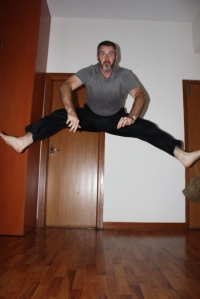
I’d been doing a lap of the kalari consisting of high kicks flowing into Hanumanasana (a scissors split.) Each split is on the opposite side from the last. By yoga standards, my split alignment was off. My hips weren’t perpendicular to my legs, but I’d allowed them to twist open to make the split easier. However, that was probably the least of my errors, and–unlike in yoga practice during which one might take minutes to ease into this intense split–the cadence in kalari was kick – split – struggle to one’s feet. [Okay, the “struggle” shouldn’t have been, but it’s an accurate description of my rendition.]


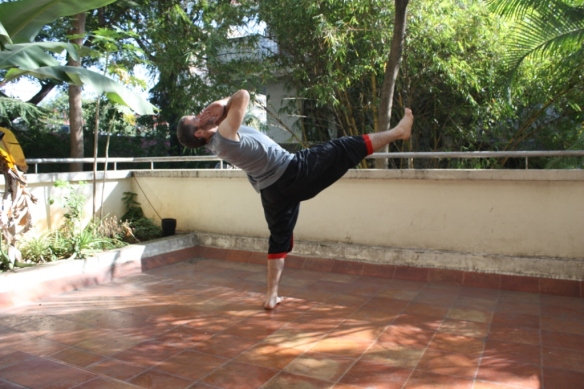
This wasn’t the hard part, by the way. I’ll get to that. The structure of the class up to that point was logically arranged to facilitate those splits. The practice started with warm ups of rapid repetitive motions that got the muscles and core warm. Then there were a series of kicking exercises that also served as dynamic stretches. Next, there was a vertical version of the splits done in a static form. With the inner edge of one’s bottom foot posted along the base board, the heel of one’s upper foot is slid up a piece of wood lathe worn smooth that has been tied vertically–perpendicularly to the steel burglar bars that one uses to pull oneself into the stretch. (This is an inner city kalari, and not the traditional version dug into the ground.) Then one revisits a high kick, swinging the leg with greater intensity. Only then does one do the lap of splits.

A traditional kalari looks like this. This is the Kalari Gurukulam in Chikkagubbi (parent school to the one at which I train.)

A traditional kalari looks like this. This is the Kalari Gurukulam in Chikkagubbi (parent school to the one at which I train.)


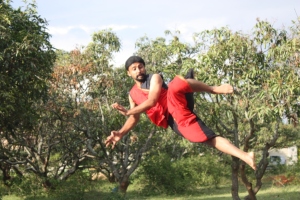
The next piece is where the third level kicked my butt. One’s hamstrings and quads stretched to the max, feeling more like limp noodles than coiled springs, one is now expected to work through a series of leaping maneuvers. There are seven leaping exercises (besides some basic warm-up leaps): a leaping circle kick, a spinning kick that takes one 360-degrees, a split kick in which one leaps up and kicks out laterally in both directions simultaneously, a split kick in which one leaps up spinning 360 degrees [theoretically] and does the same split kick in the middle, a flip kick in which one kicks up and forward and flips one’s body over in mid-air to come down on one’s hands and feet (in a lunged position with palms down next to the feet), and then there are two versions of leaping/spinning kicks that proceed down the length of the kalari.


IMG_1661Why does one do these plyometric techniques in the wake of such intense stretching? I suspect that experts in exercise science would tell me this isn’t the best way to improve my leaps. One should do the leaps when one’s muscles are more like rubber bands than al dente linguine. Still, I dutifully comply. Maybe there’s an ancient wisdom at work here. Maybe there’s not. There’s no way to find out without giving it a try. I fall down a number of times that first day, and on all subsequent sessions. As I write this, I’m now learning level five material, but I continue to revisit the leaps every session for two reasons. First, I’m not happy with my abilities. Second, I want to find out whether I can improve my balance of flexibility and power, and whether the kalari approach does the trick. (Note: I’m using the word “power” in the specific sense of work performed per unit time. In other words, it’s not synonymous with strength. It’s a function of both speed and strength.) At any rate, I still fall down.


IMG_2278However, looking beyond my own limited capacity to have my cake and eat it too (i.e. retain flexibility as I gain power), I see evidence of the success of this approach. There are a number of advanced people who’ve been using this approach for many years and have a preternatural balance of flexibility and jet propulsion. Said individuals seem to go from deep stretches to phenomenal vertical leaps without difficulty.


If nothing else, I’ve learned a great deal about my muscular composition. While I’m challenged by ballistic movements, my stamina is quite respectable. Type I (slow twitch) musculature seems to be disproportionately common in comparison to type II (fast twitch) in my body. While I’m including more power building training in my workouts, my progress is glacial. If I was smart, I’d take up long-distance running or some other endurance activity. But I tend to find such activities tedious, while I love the martial arts. And so I struggle.

IMG_4275


BOOK REVIEW: Obstacle Race Training by Margaret Schlachter

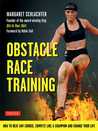
Obstacle Race Training: How to Beat Any Course, Compete Like a Champion and Change Your LifeObstacle Race Training: How to Beat Any Course, Compete Like a Champion and Change Your Life by Margaret Schlachter
My rating: 4 of 5 stars

Amazon page

If you’re a neophyte to the obstacle racing scene, as I am, this is the book for you. That’s not to say that it wouldn’t be useful for someone with some experience, but if you’re a competitive racer looking to shave time off your runs to boost your standings, I suspect you might want more detail on some topics (e.g. details on various approaches for getting over/under/through/around particular obstacles and more explanations of variations on obstacles.) That said, this book hits the Goldilocks zone for someone who has no idea what they are doing, but would like to give some form of obstacle race a try. (i.e. Not so much information as to be overwhelming, but not so little that you’ll be unprepared to have a good run.)

It’s a short book, less than 200 pages, arranged into 18 chapters that are in turn divided into five sections. The first section introduces one to obstacle course racing. While this sport / social event (there are both competitive and non-competitive participants involved in most races and some events are more about comradery than competition) has been growing wildly in popularity in recent years, there will be many readers who are completely unaware of it. However, by the end of these first three chapters you’ll have a thorough sketch of the scene. The rest of the book goes through what one needs to do long before the race (e.g. picking a race, training [general fitness as well as obstacle-specific], and dieting), immediately before the race (e.g. dressing for the race and eating / hydrating for the race), during the race, and after the race (e.g. recovery, choosing a next race, and moving forward with your participation.)

I found this book to be packed with valuable information (e.g. The mantra DON’T WEAR COTTON ON RACE DAY will be forever etched into your brain.) I found Schlachter’s practical, no-nonsense approach to be a breath of fresh air. For example, with respect to diet, her advice is sparse but invaluable. Basically, it boils down to “eat good food in the portions needed for your body.” It may sound like I’m being dismissive, but I’m not. I appreciate her making sense on the subject and not drawing it out with fad baloney diet (figuratively or literally) quackery. (Pet peeve: I really don’t like hearing about people’s ludicrous ideas about how one can eat a pound of bacon a day, but you’ll die if a slice of wheat bread or a wedge of orange goes in your mouth.)

There are several nice features of this guide that I’ll mention specifically. One is that it has a chapter that shares insights from other high performing obstacle course racers. This gives one some useful and varied advice. Second, it actually shows one how to make a couple of obstacles, e.g. walls and spear targets, that are either common or challenging. Finally, it gives one tips for making this an affordable hobby. (If you’re at the stage of reading this book, you’ll probably have to pay the entry fee out of pocket—no sponsors– and have little to no chance of running well enough to earn winnings.)

If you’re considering running an obstacle race, whether a mud run or an obstacle course race, I’d recommend you give this book a read.

View all my reviews

BOOK REVIEW: Why We Run by Bernd Heinrich

Why We Run: A Natural HistoryWhy We Run: A Natural History by Bernd Heinrich
My rating: 5 of 5 stars

Amazon page

This book is actually several different books woven together. It’s part autobiography of the author’s running life, it’s part a study of comparative biology between various creatures with an endurance bent and humans, it’s part an examination of the evolutionary biology of humanity’s proclivity to run, and it’s part guide to preparing to engage in ultramarathons. Often I pan such books as being unfocused, ill-planned, and—most often—attempts to whip an article’s worth of material into a book length piece. However, Heinrich keeps it interesting enough that I don’t feel it necessary to level these criticisms. Still, my first warning to readers is that one has to read on for quite a while before one gets to the book that one thought one bought—i.e. one that answers the title question of “why WE (i.e. people in general and not the author specifically) run.” In short, you’ll need to have an eclectic set of interests to get through the whole book, but some may find reading only part of it gives them all they wanted from the book.

It should be noted that the book is on its second title. The original title was: “Racing the Antelope: What Animals Can Teach Us about Running and Ourselves.” The author explains in the front matter why the original name was changed (apparently some loud and obnoxious writer had a similarly titled book on a different subject and whined about it.) Changing the title wasn’t required because: a.) titles cannot be copyrighted, and b.) it wasn’t exactly the same title anyway. Still the new, more succinct, title may lead one to expect a succinct book, which this isn’t so much.

Some readers will enjoy Heinrich’s writing style; others will find that it ventures too far into flowery territory on occasion. I did enjoy it. However, I can see how a reader might find some of the descriptive sequences to be excessive–particularly toward the beginning of the book.

While there’s some overlapping and interweaving, one can think of the book in three sections. It’s written in twenty chapters. The first six tell the author’s story of getting into running and his youth. The next eight chapters deal in comparative and evolutionary biology. In general, these chapters look at the biology of other creatures as they pertain to said animals’ ability to engage in running (or activities that are like running in that they involve endurance of muscles and the cardiovascular system.) Also included in this section is the evolutionary biology of humans as it relates to becoming a species of runners. This is the core of the book and was the most interesting section for me. In it, Heinrich considers the endurance activities of insects, birds, antelopes, camels, and frogs. Each of these has a particular relevance. For example, camels are masters of endurance under harsh conditions. Frogs tell the story of the difference between fast and slow twitch musculature (relevant to sprinters versus distance runners.) Antelopes are, of course, the exemplars running in the animal kingdom, but the nature of their running is so different from that of humans (i.e. making quick escapes versus pursuing wounded prey.) The last six chapters can be seen as a guide to preparing for ultramarathon races, but it’s also a continuation of the author’s self-examination of his running life from the time he began ultramarathoning.

I’d recommend this book for readers who are interested in the science of human performance. It’s well written, and the insights it offers into the biology of other animals are fascinating. Whether you read the whole book or just the part that pertains to your interests, you’ll take something away from this book.

View all my reviews

BOOK REVIEW: Embrace the Suck by Stephen Madden

Embrace the Suck: A Crossfit MemoirEmbrace the Suck: A Crossfit Memoir by Stephen Madden
My rating: 3 of 5 stars

Amazon page

Embrace the Suck is one man’s account of his experience with Cross-fit and other high intensity fitness regimens, including SEALFIT 20X. While Madden comes across as a regular Joe, i.e. not one of those crazed individuals who wreck their bodies through lack of rest, failure to heed the body’s warnings, or by way of starvation diets pursued to get that perfect cut, he’s a cheerleader for Cross-fit. If one is looking for an unbiased account of the strengths and weaknesses of Cross-fit, there are probably more objective accounts of the system’s pros and cons. This book is for someone who’s trying to psych themselves up for high intensity interval training. In that regard, the book does a good job because Madden always portrays himself as a human with the unique set of strengths, weaknesses, and limitations that condition entails. He succeeds because he guts it out in the company of the people around him who are portrayed as being more fit (at least in some dimensions) and driven than he.

Still, Madden’s account does give one a taste of the ugly side of the notoriously cult-like fitness system. For example, there is the trainer who refers to orange juice as poison–because it’s a high glycemic index carbohydrate. Even more disturbing is the wife who chastises him upon seeing a photo of him smiling as he crossed the finish line in a marathon–because it showed he hadn’t pushed hard enough. [Come on, it’s not as if, even if he’d died upon crossing the finish line from exhausting all bodily resources, that some Kenyan wouldn’t have been hours ahead of him.] Madden does include a chapter about pain and injuries, but it just suggests one should know what is run-of-the-mill fatigue and what is an actual injury. He mentions an example of a shoulder injury from his own body that he “should probably get checked out.” Furthermore, the final chapter seems to be a cautionary tale about packing too much training into too few days.

The book lays out the Cross-fit approach to exercise, and explains why it is so successful without getting deeply into the research. For those unfamiliar with high intensity interval training (HIIT), the general principle is that one constantly varies one’s workout, and that said workouts are done at maximum intensity with short and regimented rest breaks (though the core workout—i.e. the so-called WOD, workout of the day, is often quite short, i.e. 15 -20 minutes.) The track record for increasing fitness for this approach is good. Studies have indicated that one can get about the same level of cardiovascular benefit as one does from traditional cardiovascular exercise while building muscle (endurance activities like running pursued in isolation tend to result in muscle wastage) and reducing risk of repetitive stress injuries (because one is always changing one’s workout / movement.)

It sounds like there’s no down-side. The workouts are short (granted you may puke, but you’re out the door in an hour or less.) The benefits are high, and it doesn’t seem to be deficient in cardio—the one area in which one might think it would be. The jury is still out on the injury risk. Cross-fit puts out guidelines (which Madden explains) on how frequently one should take a rest day and on the need for perfect form. Those who follow the guidelines may not have any higher risk than other exercisers (the science remains insufficient.) However, the problem may be that it’s hard to maintain the aforementioned perfect form when a trainer is shouting, “faster, faster, faster” in one’s face. Furthermore, moderation and following rest suggestions has apparently not proven the strong suit for many Cross-fitters, some of whom come down with rhabdomyolysis (a deterioration of skeletal muscle from over-exertion / insufficient rest.)

Diet is, of course, an essential topic for any book on fitness, and Madden touches on the two diets that are popular with Cross-fitters. One of the diets, The Zone, is quickly dismissed as being of little use to him because it requires weighing out one’s food portions, and that level of anal retentiveness is beyond his capabilities. The other diet popular in Cross-fit is the one that Madden practices and addresses in the chapter on diet. It’s the so-called Paleo diet—in which one is supposed to eat like one’s pre-agrarian ancestors–except if it involves a high glycemic index food that our ancestors ate, in which case, no. Madden stresses the 80% rule that other Cross-fitter put him on to. That is, follow the diet in a strict way 80% of the time, but allow for a cheat here and there of no more than 20%. Madden’s approach to diet, like his workout drive, seems more moderate and approachable than that of other individuals one sees in the book.

The most fascinating chapter was his description of completing the SEALFIT 20X challenge. This is a one [long] day program in which one trains like a Navy SEAL. It’s part of a fitness and mental toughness conglomeration headed by former-SEAL Mark Divine. This training is a bit different from the Cross-fit workouts in that endurance is a major challenge, and the mind is challenged as much as the body. I don’t just mean that will is important, but the SEALFIT program tests one’s ability to use one’s brain under the pressure of intense physical training.

I’d recommend this book for those interested in learning about the Cross-fit and SEALFIT 20X experience. If one is trying to get an unvarnished view of Cross-fit, you may want to start with another book before getting to this one. It’s readable and thought-provoking.

View all my reviews

DAILY PHOTO: Fitness Trail

Taken September 20, 2015 in Jatujak Park

Taken September 20, 2015 in Jatujak Park


Thailand has some of the best parks in the world. They make the pursuit of fitness easy whether you’re an athlete or an elderly grandma.

IMG_3063 IMG_3079

IMG_3084

BOOK REVIEW: You Are Your Own Gym by Mark Lauren

You Are Your Own Gym: The bible of bodyweight exercisesYou Are Your Own Gym: The bible of bodyweight exercises by Mark Lauren
My rating: 4 of 5 stars

Amazon page

As the title suggests, this is a guide to bodyweight exercises, and—specifically—periodized callisthenic training without equipment. Periodization is an approach in which the volume and intensity of workouts is in constant flux, as opposed to the regular approach that used to be the norm. It’s with regard to coping with a lack of fixed equipment that this book really seeks to separate itself from the many high-intensity interval training (HIIT) books in bookstores today. Obviously, calisthenics require much less equipment than weight training. However, without at least a pull-up bar and dip bars, it’s hard to get a well-rounded bodyweight workout. You Are Your Own Gym shows the exercises done with makeshift apparatus where necessary. Some of the suggested substitutes look safer than others, and a few of them (e.g. door pull-ups) work muscles a little differently than the basic. However, the examples get one into the habit of considering how one can use one’s environment creatively to get a good workout. [I would recommend exercising caution and safety when using the demonstrated improvised methods.] Even if one has access to equipment in day-to-day life, frequent travelers often have trouble getting a good workout in on the road. This book can be helpful in assisting one in avoiding the dead spots in one’s training regimen due to inability to get to a fitness facility.

The author, Mark Lauren, is a former Combat Controller and Special Operations fitness instructor. For readers who aren’t familiar with the US Air Force, Combat Control is one of two special operations career fields in the Air Force (excepting pilots and crew who fly special operators around.) Combat Controllers usually serve with Army Special Forces, facilitating the provision of air support in the midst of combat operations. Lauren certainly has the bona fides to write intelligently on the subject.

The book consists of 12 chapters, but it’s the penultimate and final chapters that present the meat of the work. Chapter 11 presents a thorough collection of bodyweight exercises organized by the area of the body worked. In most cases, the exercise descriptions include a photo, as well as modifications to provide a more or less strenuous version of the exercise. The latter feature makes Lauren’s program nicely scalable. The reader can optimize exercises to his or her needs.

The last chapter lays out the program. Because varying the characteristics of the workout is the key to the periodization approach, varied workout structures are discussed. These include well-known approaches such as interval sets, super sets, and tabatas, as well as less familiar approaches such as stappers (cycling through a fixed number of repetitions of a few exercises for a set amount of time without rest periods—but with a low enough number of reps to avoid failure) and ladders (i.e. long sets in which one does on rep, rests for one, does two reps, rests for two, etc. up to just before the point of failure, and then working back down to one rep in a symmetric manner.) While one can certainly make up one’s own workout with the knowledge gained to this point in the book, there are 10-week sample programs at four different levels (starting with beginners and working toward advanced practitioners of calisthenics.) If you’re not sure which level is right for you, the author provides a set of exercises that one should be able to carry out as a minimum to begin work at a given level.

The first ten chapters deal with a range of subjects including: diet, strength training myths, motivation, intensity, and the nature of bodyweight exercise. These short chapters lay out basic concepts helpful to engage in the program. There are three appendices that discuss equipment issues, a summary of guiding principles, and a discussion of the science of the program. The latter is beneficial, given some claims by the author that old school fitness buffs might find hard to accept–such as the lack of need for high volume endurance activities for cardio (i.e. one doesn’t need go for a run to get cardio benefits.)

I found this book to be beneficial. I like the fact that Lauren addresses the science of the approach rather than just throwing his approach out there with all the fad workouts. I found the advice to be sound, and have become more creative when considering how I can get a good workout on the road as a result of reading the book. As I write this, I’m in the 10th (and final) week of one of the sample workout sequences. I believe I’ve gotten good strength workouts from the program. I enjoy the scalability of the program, and have taken advantage of both easier and harder variants of the exercises.

I’d recommend this book if you’re looking for a bodyweight exercise program—particularly if you travel a lot, don’t have access to fitness facilities, or just like to workout at home.

View all my reviews

Saving the Knees: Preventing Knee Injuries in the Martial Arts

Public Domain Image from Wikipedia

Public Domain Image from Wikipedia


The knee is a hinge joint. It’s designed to flex and extend with the thigh bone (femor) and the shin bone (tibia) in the same plane. A healthy joint can tolerate a certain amount of torquing or poor distribution of the body’s weight on occasion, but repetitive movements of that nature and /or severe uncontrolled movements can lead to permanent damage. Healthy knees are stable when straight (extended), but become slack when bent (flexed.)


Knee damage among martial artists is all too common, and the causes may or may not be self-evident. Martial artists whose practice includes kicks that require pivoting on a support leg or which involve landing leaping maneuvers may be intimately aware of the risks. However, the first martial art that I ever trained in had no twisting / pivoting kicks and few leaps (that were rarely practiced), but knee injuries were epidemic. The culprit in this case was low postures which required the thigh to be turned out (externally rotated and abducted) with the knee deeply flexed.


Well, I should say those postures were the culprit in conjunction with lack of flexibility and/or strength in all the right places. This isn’t to say that the individuals who developed knee problems weren’t strong or flexible, but the areas that needed work weren’t necessarily the big muscle groups that leap to mind when workout time comes around.   Emphasis on the big muscle groups (quadriceps and hamstrings) with neglect of the muscles involved with adduction, abduction, external rotation, internal rotation and stabilization can create some problems. If you’re a runner or a weightlifter (with good form) you may be able to get away with such a stretching and strengthening emphasis. [Note: I’m not advocating such an approach for anyone. What I’m saying is that if your knee is only worked with the knee straight below the hip and pointed forward in a hinge fashion, your risks are not the same as someone who works with a flexed knee with the thigh turned out. The likely injuries are different.]

Note: Knees pointing the same direction as the toes. (The back knee might be a little far back but that's an issue for the ankle health post.)

Note: Knees pointing the same direction as the toes. (The back knee might be a little far back but that’s an issue for the ankle health post.)

WRONG: Note: if one dropped a line down from the knee it would be well inside the foot. That means the ligaments are having to work too hard and your skeleton isn't doing enough

WRONG: Note: if one dropped a line down from the knee it would be well inside the foot. That means the ligaments are having to work too hard and your skeleton isn’t doing enough


To do a posture like the one above, one needs the flexibility to keep the knee wide enough so that it points the same direction as the toes.  The joint shouldn’t be wrenched or torqued with load on it. The four ligaments (Anterior Cruciate Ligament [ACL], Posterior Cruciate Ligament [PCL], Medial Collateral Ligament [MCL], and the Lateral Collateral Ligament [LCL]) and the surrounding musculature keep the joint snug during movements. And, as mentioned earlier, when the knee is deeply flexed it’s more sloppy than when extended.


-Increase flexibility in the muscles that internally rotate and adduct  the thigh: When one goes into a wide-legged stance, one’s thigh is pulled away from the body’s center-line (abducted) and the thigh externally rotates. If the muscles that act in the opposite direction (pulling the thigh back on center and rolling the thigh inward) are too tight to allow the knee to move into proper position, then the load of the body weight will be going into the ground through a kinked joint. Furthermore, one will end up torquing through the joint as one moves. Below are a few hip openers that will help one achieve the requisite range of motion.

Utkatakonasana (often called goddess pose) variations will show you whether you're getting your knees and toes in line.

Utkatakonasana (often called goddess pose) variations will show you whether you’re getting your knees and toes in line.

Badhakonasana (often called the butterfly stretch): Work on getting those knees down

Badhakonasana (often called the butterfly stretch): Work on getting those knees down

Place one foot on top of the opposite knee (and vice versa for the other side) carefully shift weight forward. This puts an intense stretch on the hip joint to help rotate the thigh sufficiently

Place one foot on top of the opposite knee (and vice versa for the other side) carefully shift weight forward. This puts an intense stretch on the hip-joint to help rotate the thigh sufficiently

Same as the last from the side

Same as the last from the side

Upavistakonasana: put legs at about 90 degrees relative to each other, and then lean forward with a flat back placing the stomach, chest, and chin on the floor (in that order.)

Upavistakonasana: put legs at about 90 degrees relative to each other, and then lean forward with a flat back placing the stomach, chest, and chin on the floor (in that order.)

Padmasana (lotus): If you meditate in padmasana, you probably already have the range of motion necessary. Note: if padmasana hurts your   knees, you need to go back to hip openers and discontinue the practice.

Padmasana (lotus): If you meditate in padmasana, you probably already have the range of motion necessary. Note: if padmasana hurts your knees, you need to go back to hip openers and discontinue the practice.


-Strengthen the muscles that stabilize the knee-joint. One begins this process with the usual suspects of leg exercise. One just needs to focus intently upon alignment. Here are a few of the exercises you may already be doing.


Wall squat: just like sitting on a chair with one's back  to the wall--sans the chair.

Wall squat: just like sitting on a chair with one’s back to the wall–sans the chair.

The classic squat

The classic squat

Side lunge: This one is  particularly important to get the knee aligned with the foot.

Side lunge: This one is particularly important to get the knee aligned with the foot.

The basic lunge: can be done stepping forward, backward, or both (the latter in an alternating fashion)

The basic lunge: can be done stepping forward, backward, or both (the latter in an alternating fashion)


As one needs more challenge, one can achieve it in the usual ways (single-legged, unstable surface, add weight, or combinations thereof.) Below are a couple of variations that combine single-limbed work with an unstable surface.


IMG_1537 IMG_1532


-Save static stretching for after the joint has warmed up. It used to be common to begin a workout with static stretching. While few do this anymore, it’s a practice that needs to be replaced. Stretch warm.


-Don’t neglect the opposing muscle groups: When I said that one needs to increase flexibility in adductors and internal rotators, that doesn’t mean to ignore the opposing muscles. Nothing  good comes of stretching or strengthening in an unbalanced fashion. Your musculature works as a team with agonists, antagonists, and stabilizers all working  in conjunction to produce effective movement.


-Don’t go overboard with stretching: If your aim is to be a contortionist, then by all means go ahead. However, highly flexible martial artists need to be concerned about joint laxity. Laxity is when the joint gets so loose that it’s vulnerable to popping out-of-place.  A martial artist needs a balanced style of fitness. Extreme flexibility results in weakness and lack of joint robustness, just like extreme strength training produces a body that lacks range of motion and stamina.


Most importantly, don’t ignore pain when it’s still at the minor twinge point. If you have knee pain you’re doing something that joint doesn’t like. One should reevaluate your movement and, if necessary, considering stepping back from your current practice to work on capacity building exercises.


What Are Your Thoughts on “Dick Move Mondays” in a Dojo?

Going rogue with attacks

Gone rogue

So, the whole “dick move Mondays” concept may require clarification. First of all, some readers may be saying, “Every day is dick move Monday at our dojo.” However, readers who train at more orthodox schools may be wondering how such an apparently ludicrous idea would even come up. The idea’s origins are the result of seeking a martial art’s correlate to the “bad pass Fridays” that have been instituted in many basketball practices in recent years. On “bad pass Fridays” coaches give players passes that are catchable–but just barely. I’ll get into the scientific argument for this kind of training below, but for now suffice it to say that the idea is to have regularly scheduled instances in which the individual is taxed to his or her limits and forced to try to cope with worst case scenarios. While there needs to be some limitations for safety’s sake, I’ll argue that there’s some advantage to applying this concept from the sports science and motor learning literature to martial arts training. [Note: if your objective in practicing martial arts has nothing to do with being able to succeed in the context of a sporting match, an actual combat situation, or both (i.e. a situation in which an opponent is trying to clobber you and vice versa) then this isn’t really relevant to you. But feel free to read it any way.]


Here’s some low-down on the science. Historically, it’s been popular to teach / coach sports (and non-sport martial arts) using a “partial and blocked” approach. This method is extremely popular because: a.) it’s simple to organize and conduct practice sessions, b.) short-term growth is rapidly visible, and c.) it looks neat and tidy. “Partial” means that a particular skill (or even sub-skill) is extracted from the overall skill set of the activity at hand and practiced in isolation. This could be a throw, a strike, or a means of receiving or defending. “Blocked” practice means that one skill or sub-skill is practiced over and over again under the exact same conditions until it’s deemed time to move onto the next. “Whole and random” practice represents the opposites of “partial and blocked.” “Random” means that one drills a skill under an ever-changing situational context (e.g. one may still be drilling hip throws repetitively, but not against a static partner who’s standing in the same place–there’s movement and pushing and pulling, and possibly a few dick moves.) “Whole” practice simulates the actual event that one is practicing for–whether it’s a Muay Thai match or a parking deck brawl.


For a good explanation of the problems associated with blocked practice, watch the video by Trevor Ragan of “Train Ugly” that’s linked below. (fyi: “Train Ugly” is an apropos name for an approach that involves more “whole and random” practice because there will be more short-term failure and one won’t look masterful at what one is doing by the end of a practice session. However, long-term skill retention and the ability to integrate those skills and sub-skills into a more realistic environment is higher.)

As Ragan points out, the random approach requires one read the situation and environment and respond in a way that won’t leave one worse off. (I don’t like the word “planning” applied to martial arts because there’s never time to do any planning in the sense of using one’s conscious mind. However, I’d say reading is a very apropos concept, and there is a need to adjust to one’s context.)

So what would “whole and random” training look like in a martial art? First of all, one should realize that one doesn’t need to make every training session “whole and random” from the very beginning. In the beginning a lot of “partial and / or blocked” practice is necessary. The problem is that if one doesn’t ever move beyond that, one’s performance will be hindered. Second, all practice doesn’t have to be both whole and random; one can spend a lot of time with random drilling of a particular skill. One can drill a particular skill while moving around freely, applying counters, making timing more random, and making the approach less regimented. “Whole and random” practice in the martial arts involve sparring or randori. Jigoro Kano did a brilliant thing in making the techniques and practice environment safe enough that randori (free form) training became possible. For many years, I would have said that Kano Sensei made a system that was less “realistic” by paring out the dangerous elements of jujutsu. However, today I don’t see it that way. I’ve come to realize that the ability to train randori keiko actually added back in a great deal of realism. Who’s to say what the net effect on realism is. I certainly see the advantage over the old way in which one trained in a regimented fashion devoid free form components for years and then one day one went out on musha shugyō (warrior’s errantry) and may be the day you learned of a deficiency in your technique was the day you died.

So “dick move Mondays” is really a way to add randomness into training. One can’t ignore the reading portion of the attack because one never knows what whacky ass attack one’s opponent is going to come up with.

If you do implement “dick move Mondays” in your school or gym, you may want to review this instructional video by Master Ken because the “bitch slap” is sure to enter into your training.

[Disclaimer: Master Ken video included as farce. Readers are advised not perform any techniques suggested by Master Ken or his Amer-i-do-te practitioners.]