BOOK REVIEW: Boxing Fitness by Ian Oliver

Boxing Fitness: A Guide to Get Fighting Fit (Fitness Series)Boxing Fitness: A Guide to Get Fighting Fit by Ian Oliver
My rating: 4 of 5 stars

Amazon page

How does one skip rope, work the pads, or avoid nipple rash? If you think that boxing would be a fun way to get fit, this would probably be a useful book for you. Oliver shows a range of fitness practices—many specific to boxing, but others that are used in a number of sports and fitness activities—that will help one improve one’s fitness.

The reader will gain insight into bagwork, padwork, and boxing drills–from beginner to advanced. While the book’s emphasis isn’t on boxing technique, there’s a minimal discussion of the basics of footwork and punching designed to allow a reader to safely begin practice of bagwork and padwork. One also learns about roadwork, the basics of weightlifting as it’s useful for boxers, calisthenics, and other exercise routines that boxers use. It’s a small book and, therefore, doesn’t go into great detail on any particular subject. However, it does offer useful tips in a concise form.

There’s a chapter on equipment, but throughout the book the author gives advice on equipment as it’s relevant to the discussion at hand. The same is true of safety tips. There’s a chapter on injury and illness, but you’ll find insights into how to avoid injuries woven throughout.

I liked the approach of this book. While it shows one the age-old practices of fighters, it also describes more recent developments. In other words, it’s neither crusty and obsolete, nor does it try to re-invent every wheel in order to prove itself cutting edge. I also appreciated the author’s pragmatism—e.g. emphasizing the benefit of a strong core over that of six-pack building and suggesting dietary practices that are sound and simple rather than fads and fables.

Graphics include black and white photographs throughout a few diagrams. Most chapters have photographs, and they are generally sufficient to convey the necessary information without being overwhelming.

While this is a book of the basics, I found it to be a beneficial read and I appreciated the way it was arranged and the way information was conveyed. I’d recommend it for anyone interested in fitness for combative sports or who thinks boxing would be a good way for them to stay motivated to get fitter.

View all my reviews

Flexibility & Power in Kalaripayattu: Confessions of a Gravitationally-Challenged Student

IMG_4269Learning third level material was when Kalaripayattu became daunting. Until then, it was just exhausting.


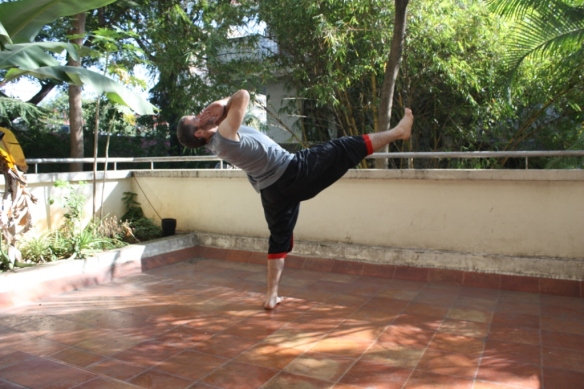
I’d been doing a lap of the kalari consisting of high kicks flowing into Hanumanasana (a scissors split.) Each split is on the opposite side from the last. By yoga standards, my split alignment was off. My hips weren’t perpendicular to my legs, but I’d allowed them to twist open to make the split easier. However, that was probably the least of my errors, and–unlike in yoga practice during which one might take minutes to ease into this intense split–the cadence in kalari was kick – split – struggle to one’s feet. [Okay, the “struggle” shouldn’t have been, but it’s an accurate description of my rendition.]


This wasn’t the hard part, by the way. I’ll get to that. The structure of the class up to that point was logically arranged to facilitate those splits. The practice started with warm ups of rapid repetitive motions that got the muscles and core warm. Then there were a series of kicking exercises that also served as dynamic stretches. Next, there was a vertical version of the splits done in a static form. With the inner edge of one’s bottom foot posted along the base board, the heel of one’s upper foot is slid up a piece of wood lathe worn smooth that has been tied vertically–perpendicularly to the steel burglar bars that one uses to pull oneself into the stretch. (This is an inner city kalari, and not the traditional version dug into the ground.) Then one revisits a high kick, swinging the leg with greater intensity. Only then does one do the lap of splits.

A traditional kalari looks like this. This is the Kalari Gurukulam in Chikkagubbi (parent school to the one at which I train.)

A traditional kalari looks like this. This is the Kalari Gurukulam in Chikkagubbi (parent school to the one at which I train.)


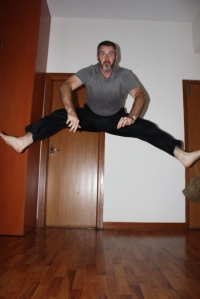
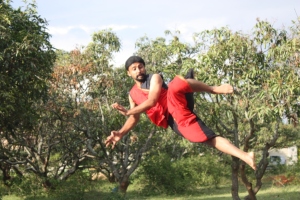
The next piece is where the third level kicked my butt. One’s hamstrings and quads stretched to the max, feeling more like limp noodles than coiled springs, one is now expected to work through a series of leaping maneuvers. There are seven leaping exercises (besides some basic warm-up leaps): a leaping circle kick, a spinning kick that takes one 360-degrees, a split kick in which one leaps up and kicks out laterally in both directions simultaneously, a split kick in which one leaps up spinning 360 degrees [theoretically] and does the same split kick in the middle, a flip kick in which one kicks up and forward and flips one’s body over in mid-air to come down on one’s hands and feet (in a lunged position with palms down next to the feet), and then there are two versions of leaping/spinning kicks that proceed down the length of the kalari.


IMG_1661Why does one do these plyometric techniques in the wake of such intense stretching? I suspect that experts in exercise science would tell me this isn’t the best way to improve my leaps. One should do the leaps when one’s muscles are more like rubber bands than al dente linguine. Still, I dutifully comply. Maybe there’s an ancient wisdom at work here. Maybe there’s not. There’s no way to find out without giving it a try. I fall down a number of times that first day, and on all subsequent sessions. As I write this, I’m now learning level five material, but I continue to revisit the leaps every session for two reasons. First, I’m not happy with my abilities. Second, I want to find out whether I can improve my balance of flexibility and power, and whether the kalari approach does the trick. (Note: I’m using the word “power” in the specific sense of work performed per unit time. In other words, it’s not synonymous with strength. It’s a function of both speed and strength.) At any rate, I still fall down.


IMG_2278However, looking beyond my own limited capacity to have my cake and eat it too (i.e. retain flexibility as I gain power), I see evidence of the success of this approach. There are a number of advanced people who’ve been using this approach for many years and have a preternatural balance of flexibility and jet propulsion. Said individuals seem to go from deep stretches to phenomenal vertical leaps without difficulty.


If nothing else, I’ve learned a great deal about my muscular composition. While I’m challenged by ballistic movements, my stamina is quite respectable. Type I (slow twitch) musculature seems to be disproportionately common in comparison to type II (fast twitch) in my body. While I’m including more power building training in my workouts, my progress is glacial. If I was smart, I’d take up long-distance running or some other endurance activity. But I tend to find such activities tedious, while I love the martial arts. And so I struggle.

IMG_4275


BOOK REVIEW: Obstacle Race Training by Margaret Schlachter

Obstacle Race Training: How to Beat Any Course, Compete Like a Champion and Change Your LifeObstacle Race Training: How to Beat Any Course, Compete Like a Champion and Change Your Life by Margaret Schlachter
My rating: 4 of 5 stars

Amazon page

If you’re a neophyte to the obstacle racing scene, as I am, this is the book for you. That’s not to say that it wouldn’t be useful for someone with some experience, but if you’re a competitive racer looking to shave time off your runs to boost your standings, I suspect you might want more detail on some topics (e.g. details on various approaches for getting over/under/through/around particular obstacles and more explanations of variations on obstacles.) That said, this book hits the Goldilocks zone for someone who has no idea what they are doing, but would like to give some form of obstacle race a try. (i.e. Not so much information as to be overwhelming, but not so little that you’ll be unprepared to have a good run.)

It’s a short book, less than 200 pages, arranged into 18 chapters that are in turn divided into five sections. The first section introduces one to obstacle course racing. While this sport / social event (there are both competitive and non-competitive participants involved in most races and some events are more about comradery than competition) has been growing wildly in popularity in recent years, there will be many readers who are completely unaware of it. However, by the end of these first three chapters you’ll have a thorough sketch of the scene. The rest of the book goes through what one needs to do long before the race (e.g. picking a race, training [general fitness as well as obstacle-specific], and dieting), immediately before the race (e.g. dressing for the race and eating / hydrating for the race), during the race, and after the race (e.g. recovery, choosing a next race, and moving forward with your participation.)

I found this book to be packed with valuable information (e.g. The mantra DON’T WEAR COTTON ON RACE DAY will be forever etched into your brain.) I found Schlachter’s practical, no-nonsense approach to be a breath of fresh air. For example, with respect to diet, her advice is sparse but invaluable. Basically, it boils down to “eat good food in the portions needed for your body.” It may sound like I’m being dismissive, but I’m not. I appreciate her making sense on the subject and not drawing it out with fad baloney diet (figuratively or literally) quackery. (Pet peeve: I really don’t like hearing about people’s ludicrous ideas about how one can eat a pound of bacon a day, but you’ll die if a slice of wheat bread or a wedge of orange goes in your mouth.)

There are several nice features of this guide that I’ll mention specifically. One is that it has a chapter that shares insights from other high performing obstacle course racers. This gives one some useful and varied advice. Second, it actually shows one how to make a couple of obstacles, e.g. walls and spear targets, that are either common or challenging. Finally, it gives one tips for making this an affordable hobby. (If you’re at the stage of reading this book, you’ll probably have to pay the entry fee out of pocket—no sponsors– and have little to no chance of running well enough to earn winnings.)

If you’re considering running an obstacle race, whether a mud run or an obstacle course race, I’d recommend you give this book a read.

View all my reviews

BOOK REVIEW: Embrace the Suck by Stephen Madden

Embrace the Suck: A Crossfit MemoirEmbrace the Suck: A Crossfit Memoir by Stephen Madden
My rating: 3 of 5 stars

Amazon page

Embrace the Suck is one man’s account of his experience with Cross-fit and other high intensity fitness regimens, including SEALFIT 20X. While Madden comes across as a regular Joe, i.e. not one of those crazed individuals who wreck their bodies through lack of rest, failure to heed the body’s warnings, or by way of starvation diets pursued to get that perfect cut, he’s a cheerleader for Cross-fit. If one is looking for an unbiased account of the strengths and weaknesses of Cross-fit, there are probably more objective accounts of the system’s pros and cons. This book is for someone who’s trying to psych themselves up for high intensity interval training. In that regard, the book does a good job because Madden always portrays himself as a human with the unique set of strengths, weaknesses, and limitations that condition entails. He succeeds because he guts it out in the company of the people around him who are portrayed as being more fit (at least in some dimensions) and driven than he.

Still, Madden’s account does give one a taste of the ugly side of the notoriously cult-like fitness system. For example, there is the trainer who refers to orange juice as poison–because it’s a high glycemic index carbohydrate. Even more disturbing is the wife who chastises him upon seeing a photo of him smiling as he crossed the finish line in a marathon–because it showed he hadn’t pushed hard enough. [Come on, it’s not as if, even if he’d died upon crossing the finish line from exhausting all bodily resources, that some Kenyan wouldn’t have been hours ahead of him.] Madden does include a chapter about pain and injuries, but it just suggests one should know what is run-of-the-mill fatigue and what is an actual injury. He mentions an example of a shoulder injury from his own body that he “should probably get checked out.” Furthermore, the final chapter seems to be a cautionary tale about packing too much training into too few days.

The book lays out the Cross-fit approach to exercise, and explains why it is so successful without getting deeply into the research. For those unfamiliar with high intensity interval training (HIIT), the general principle is that one constantly varies one’s workout, and that said workouts are done at maximum intensity with short and regimented rest breaks (though the core workout—i.e. the so-called WOD, workout of the day, is often quite short, i.e. 15 -20 minutes.) The track record for increasing fitness for this approach is good. Studies have indicated that one can get about the same level of cardiovascular benefit as one does from traditional cardiovascular exercise while building muscle (endurance activities like running pursued in isolation tend to result in muscle wastage) and reducing risk of repetitive stress injuries (because one is always changing one’s workout / movement.)

It sounds like there’s no down-side. The workouts are short (granted you may puke, but you’re out the door in an hour or less.) The benefits are high, and it doesn’t seem to be deficient in cardio—the one area in which one might think it would be. The jury is still out on the injury risk. Cross-fit puts out guidelines (which Madden explains) on how frequently one should take a rest day and on the need for perfect form. Those who follow the guidelines may not have any higher risk than other exercisers (the science remains insufficient.) However, the problem may be that it’s hard to maintain the aforementioned perfect form when a trainer is shouting, “faster, faster, faster” in one’s face. Furthermore, moderation and following rest suggestions has apparently not proven the strong suit for many Cross-fitters, some of whom come down with rhabdomyolysis (a deterioration of skeletal muscle from over-exertion / insufficient rest.)

Diet is, of course, an essential topic for any book on fitness, and Madden touches on the two diets that are popular with Cross-fitters. One of the diets, The Zone, is quickly dismissed as being of little use to him because it requires weighing out one’s food portions, and that level of anal retentiveness is beyond his capabilities. The other diet popular in Cross-fit is the one that Madden practices and addresses in the chapter on diet. It’s the so-called Paleo diet—in which one is supposed to eat like one’s pre-agrarian ancestors–except if it involves a high glycemic index food that our ancestors ate, in which case, no. Madden stresses the 80% rule that other Cross-fitter put him on to. That is, follow the diet in a strict way 80% of the time, but allow for a cheat here and there of no more than 20%. Madden’s approach to diet, like his workout drive, seems more moderate and approachable than that of other individuals one sees in the book.

The most fascinating chapter was his description of completing the SEALFIT 20X challenge. This is a one [long] day program in which one trains like a Navy SEAL. It’s part of a fitness and mental toughness conglomeration headed by former-SEAL Mark Divine. This training is a bit different from the Cross-fit workouts in that endurance is a major challenge, and the mind is challenged as much as the body. I don’t just mean that will is important, but the SEALFIT program tests one’s ability to use one’s brain under the pressure of intense physical training.

I’d recommend this book for those interested in learning about the Cross-fit and SEALFIT 20X experience. If one is trying to get an unvarnished view of Cross-fit, you may want to start with another book before getting to this one. It’s readable and thought-provoking.

View all my reviews

DAILY PHOTO: Fitness Trail

Taken September 20, 2015 in Jatujak Park

Taken September 20, 2015 in Jatujak Park


Thailand has some of the best parks in the world. They make the pursuit of fitness easy whether you’re an athlete or an elderly grandma.

IMG_3063 IMG_3079

IMG_3084

BOOK REVIEW: You Are Your Own Gym by Mark Lauren

You Are Your Own Gym: The bible of bodyweight exercisesYou Are Your Own Gym: The bible of bodyweight exercises by Mark Lauren
My rating: 4 of 5 stars

Amazon page

As the title suggests, this is a guide to bodyweight exercises, and—specifically—periodized callisthenic training without equipment. Periodization is an approach in which the volume and intensity of workouts is in constant flux, as opposed to the regular approach that used to be the norm. It’s with regard to coping with a lack of fixed equipment that this book really seeks to separate itself from the many high-intensity interval training (HIIT) books in bookstores today. Obviously, calisthenics require much less equipment than weight training. However, without at least a pull-up bar and dip bars, it’s hard to get a well-rounded bodyweight workout. You Are Your Own Gym shows the exercises done with makeshift apparatus where necessary. Some of the suggested substitutes look safer than others, and a few of them (e.g. door pull-ups) work muscles a little differently than the basic. However, the examples get one into the habit of considering how one can use one’s environment creatively to get a good workout. [I would recommend exercising caution and safety when using the demonstrated improvised methods.] Even if one has access to equipment in day-to-day life, frequent travelers often have trouble getting a good workout in on the road. This book can be helpful in assisting one in avoiding the dead spots in one’s training regimen due to inability to get to a fitness facility.

The author, Mark Lauren, is a former Combat Controller and Special Operations fitness instructor. For readers who aren’t familiar with the US Air Force, Combat Control is one of two special operations career fields in the Air Force (excepting pilots and crew who fly special operators around.) Combat Controllers usually serve with Army Special Forces, facilitating the provision of air support in the midst of combat operations. Lauren certainly has the bona fides to write intelligently on the subject.

The book consists of 12 chapters, but it’s the penultimate and final chapters that present the meat of the work. Chapter 11 presents a thorough collection of bodyweight exercises organized by the area of the body worked. In most cases, the exercise descriptions include a photo, as well as modifications to provide a more or less strenuous version of the exercise. The latter feature makes Lauren’s program nicely scalable. The reader can optimize exercises to his or her needs.

The last chapter lays out the program. Because varying the characteristics of the workout is the key to the periodization approach, varied workout structures are discussed. These include well-known approaches such as interval sets, super sets, and tabatas, as well as less familiar approaches such as stappers (cycling through a fixed number of repetitions of a few exercises for a set amount of time without rest periods—but with a low enough number of reps to avoid failure) and ladders (i.e. long sets in which one does on rep, rests for one, does two reps, rests for two, etc. up to just before the point of failure, and then working back down to one rep in a symmetric manner.) While one can certainly make up one’s own workout with the knowledge gained to this point in the book, there are 10-week sample programs at four different levels (starting with beginners and working toward advanced practitioners of calisthenics.) If you’re not sure which level is right for you, the author provides a set of exercises that one should be able to carry out as a minimum to begin work at a given level.

The first ten chapters deal with a range of subjects including: diet, strength training myths, motivation, intensity, and the nature of bodyweight exercise. These short chapters lay out basic concepts helpful to engage in the program. There are three appendices that discuss equipment issues, a summary of guiding principles, and a discussion of the science of the program. The latter is beneficial, given some claims by the author that old school fitness buffs might find hard to accept–such as the lack of need for high volume endurance activities for cardio (i.e. one doesn’t need go for a run to get cardio benefits.)

I found this book to be beneficial. I like the fact that Lauren addresses the science of the approach rather than just throwing his approach out there with all the fad workouts. I found the advice to be sound, and have become more creative when considering how I can get a good workout on the road as a result of reading the book. As I write this, I’m in the 10th (and final) week of one of the sample workout sequences. I believe I’ve gotten good strength workouts from the program. I enjoy the scalability of the program, and have taken advantage of both easier and harder variants of the exercises.

I’d recommend this book if you’re looking for a bodyweight exercise program—particularly if you travel a lot, don’t have access to fitness facilities, or just like to workout at home.

View all my reviews

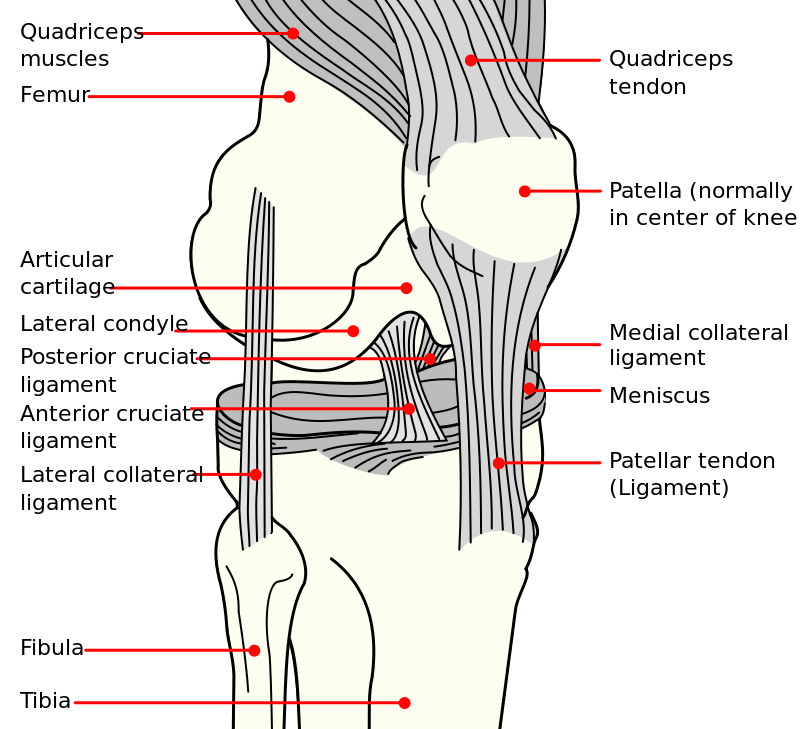
Saving the Knees: Preventing Knee Injuries in the Martial Arts

Public Domain Image from Wikipedia

Public Domain Image from Wikipedia


The knee is a hinge joint. It’s designed to flex and extend with the thigh bone (femor) and the shin bone (tibia) in the same plane. A healthy joint can tolerate a certain amount of torquing or poor distribution of the body’s weight on occasion, but repetitive movements of that nature and /or severe uncontrolled movements can lead to permanent damage. Healthy knees are stable when straight (extended), but become slack when bent (flexed.)


Knee damage among martial artists is all too common, and the causes may or may not be self-evident. Martial artists whose practice includes kicks that require pivoting on a support leg or which involve landing leaping maneuvers may be intimately aware of the risks. However, the first martial art that I ever trained in had no twisting / pivoting kicks and few leaps (that were rarely practiced), but knee injuries were epidemic. The culprit in this case was low postures which required the thigh to be turned out (externally rotated and abducted) with the knee deeply flexed.


Well, I should say those postures were the culprit in conjunction with lack of flexibility and/or strength in all the right places. This isn’t to say that the individuals who developed knee problems weren’t strong or flexible, but the areas that needed work weren’t necessarily the big muscle groups that leap to mind when workout time comes around.   Emphasis on the big muscle groups (quadriceps and hamstrings) with neglect of the muscles involved with adduction, abduction, external rotation, internal rotation and stabilization can create some problems. If you’re a runner or a weightlifter (with good form) you may be able to get away with such a stretching and strengthening emphasis. [Note: I’m not advocating such an approach for anyone. What I’m saying is that if your knee is only worked with the knee straight below the hip and pointed forward in a hinge fashion, your risks are not the same as someone who works with a flexed knee with the thigh turned out. The likely injuries are different.]

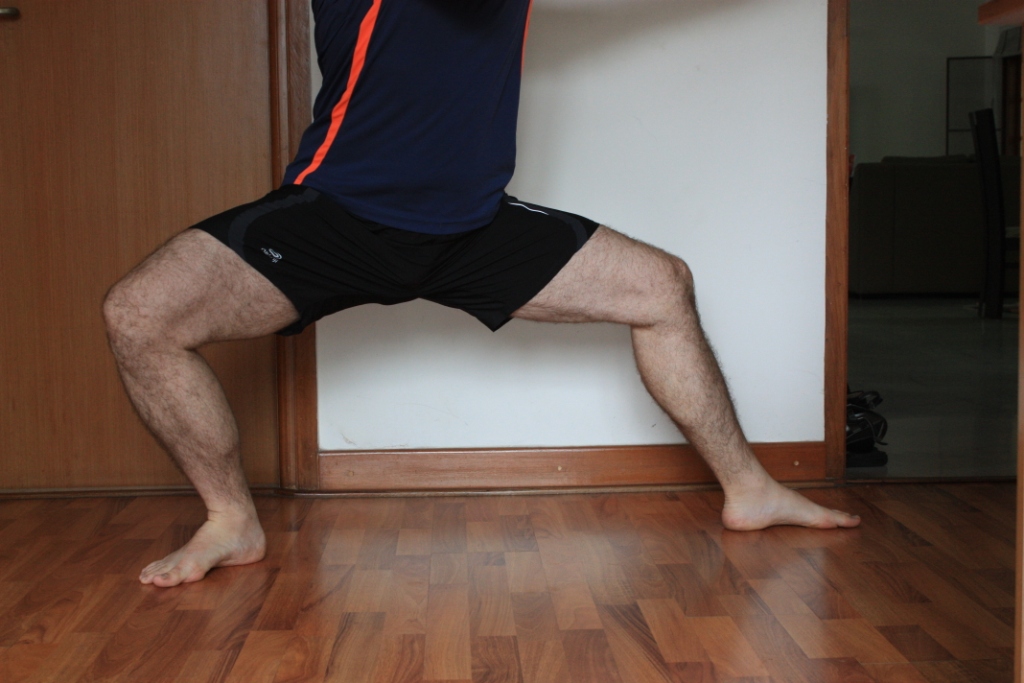
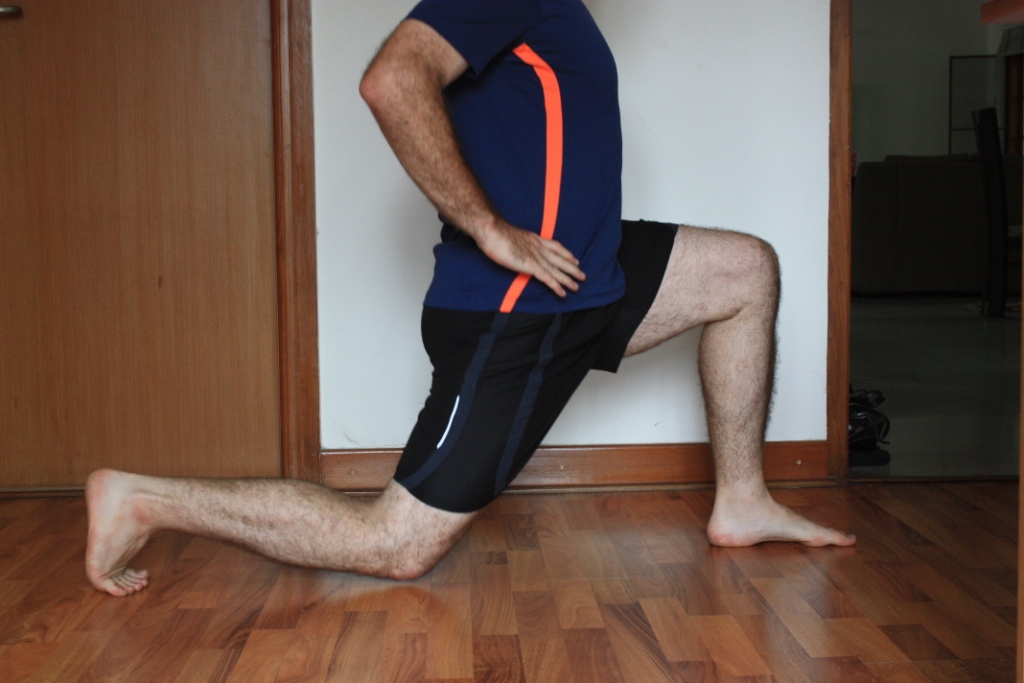
Note: Knees pointing the same direction as the toes. (The back knee might be a little far back but that's an issue for the ankle health post.)

Note: Knees pointing the same direction as the toes. (The back knee might be a little far back but that’s an issue for the ankle health post.)

WRONG: Note: if one dropped a line down from the knee it would be well inside the foot. That means the ligaments are having to work too hard and your skeleton isn't doing enough

WRONG: Note: if one dropped a line down from the knee it would be well inside the foot. That means the ligaments are having to work too hard and your skeleton isn’t doing enough


To do a posture like the one above, one needs the flexibility to keep the knee wide enough so that it points the same direction as the toes.  The joint shouldn’t be wrenched or torqued with load on it. The four ligaments (Anterior Cruciate Ligament [ACL], Posterior Cruciate Ligament [PCL], Medial Collateral Ligament [MCL], and the Lateral Collateral Ligament [LCL]) and the surrounding musculature keep the joint snug during movements. And, as mentioned earlier, when the knee is deeply flexed it’s more sloppy than when extended.


-Increase flexibility in the muscles that internally rotate and adduct  the thigh: When one goes into a wide-legged stance, one’s thigh is pulled away from the body’s center-line (abducted) and the thigh externally rotates. If the muscles that act in the opposite direction (pulling the thigh back on center and rolling the thigh inward) are too tight to allow the knee to move into proper position, then the load of the body weight will be going into the ground through a kinked joint. Furthermore, one will end up torquing through the joint as one moves. Below are a few hip openers that will help one achieve the requisite range of motion.

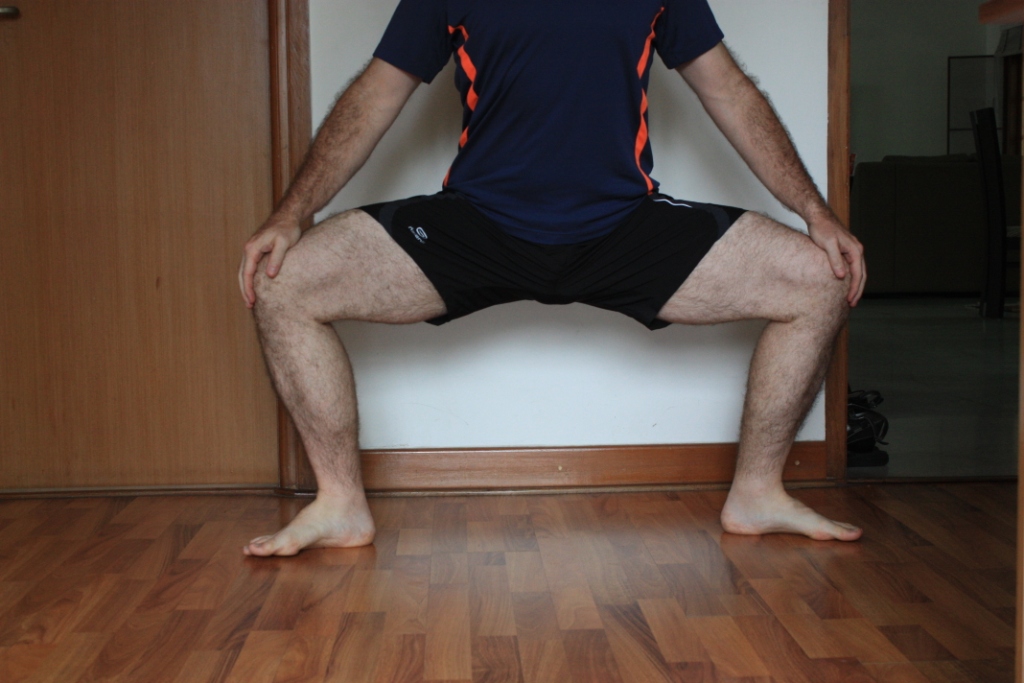
Utkatakonasana (often called goddess pose) variations will show you whether you're getting your knees and toes in line.

Utkatakonasana (often called goddess pose) variations will show you whether you’re getting your knees and toes in line.

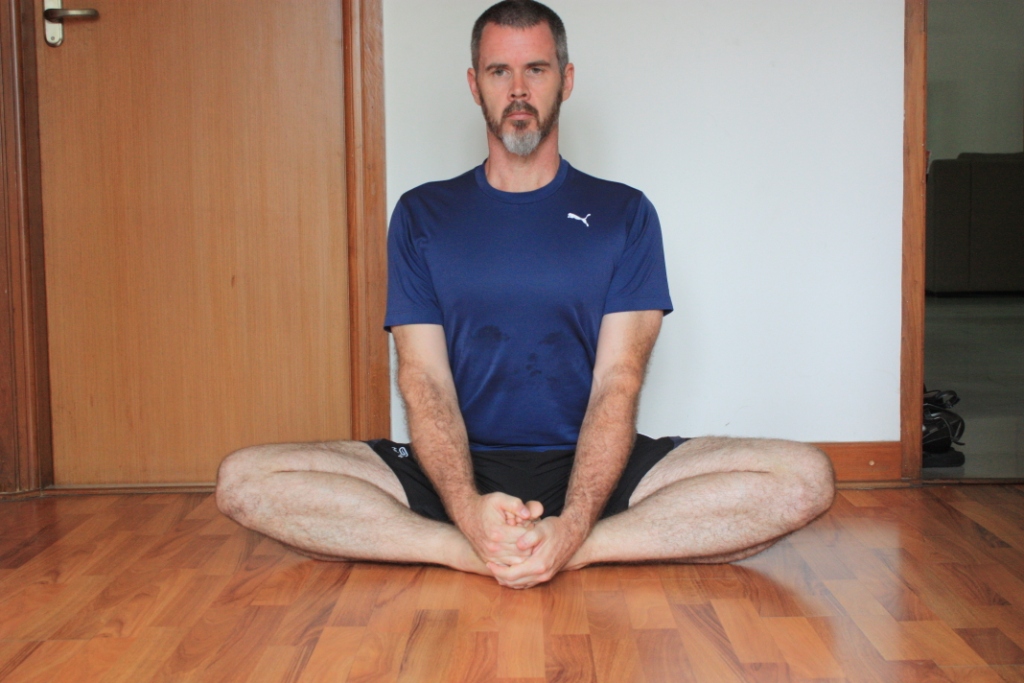
Badhakonasana (often called the butterfly stretch): Work on getting those knees down

Badhakonasana (often called the butterfly stretch): Work on getting those knees down

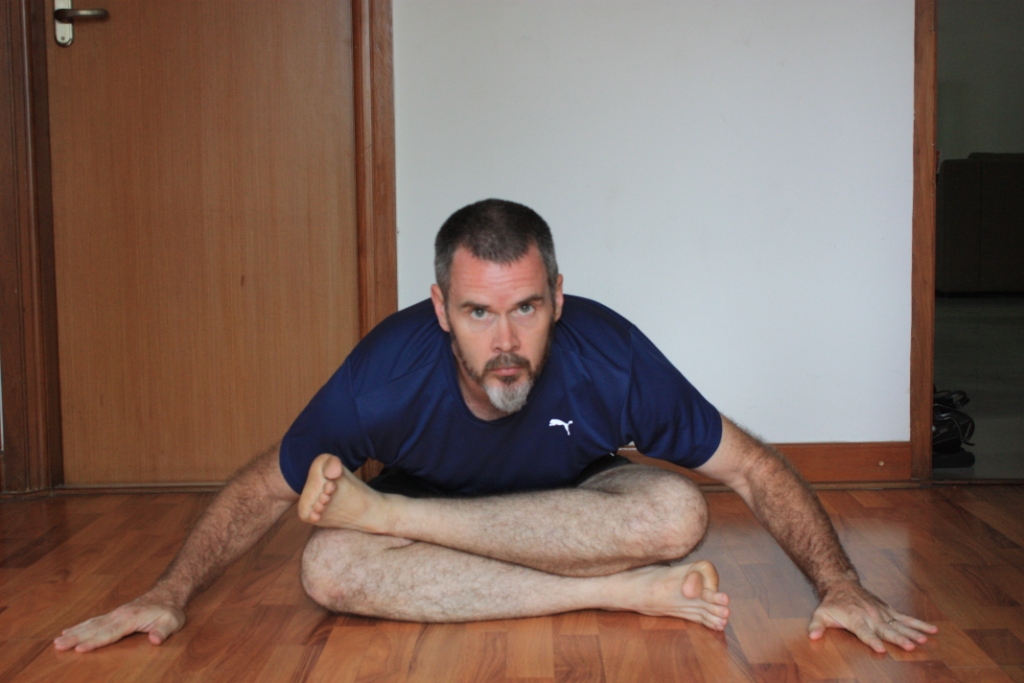
Place one foot on top of the opposite knee (and vice versa for the other side) carefully shift weight forward. This puts an intense stretch on the hip joint to help rotate the thigh sufficiently

Place one foot on top of the opposite knee (and vice versa for the other side) carefully shift weight forward. This puts an intense stretch on the hip-joint to help rotate the thigh sufficiently

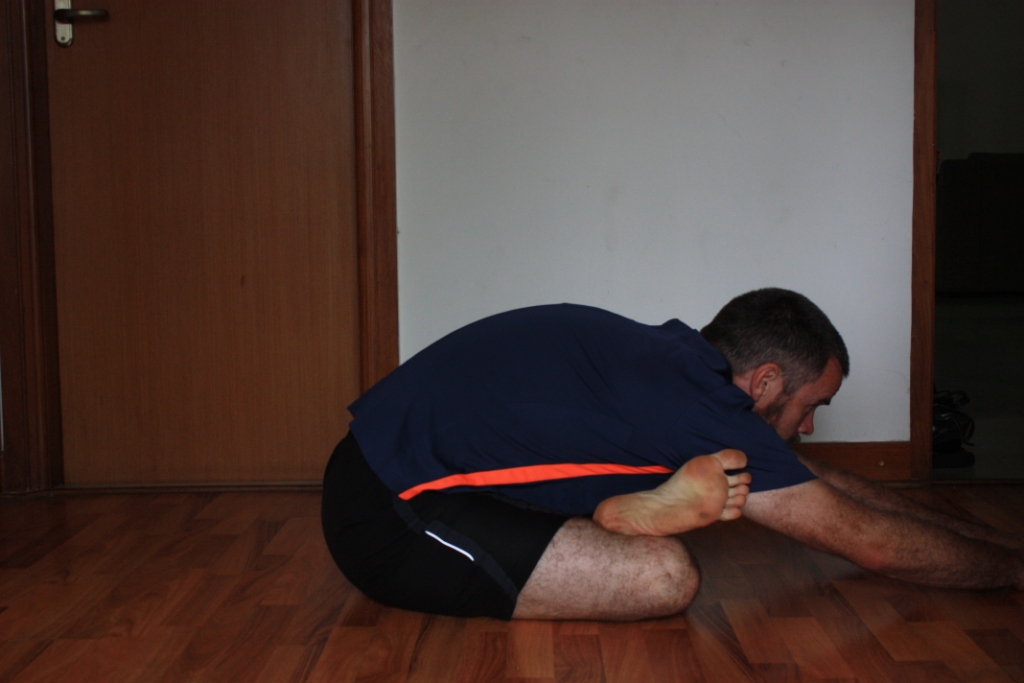
Same as the last from the side

Same as the last from the side

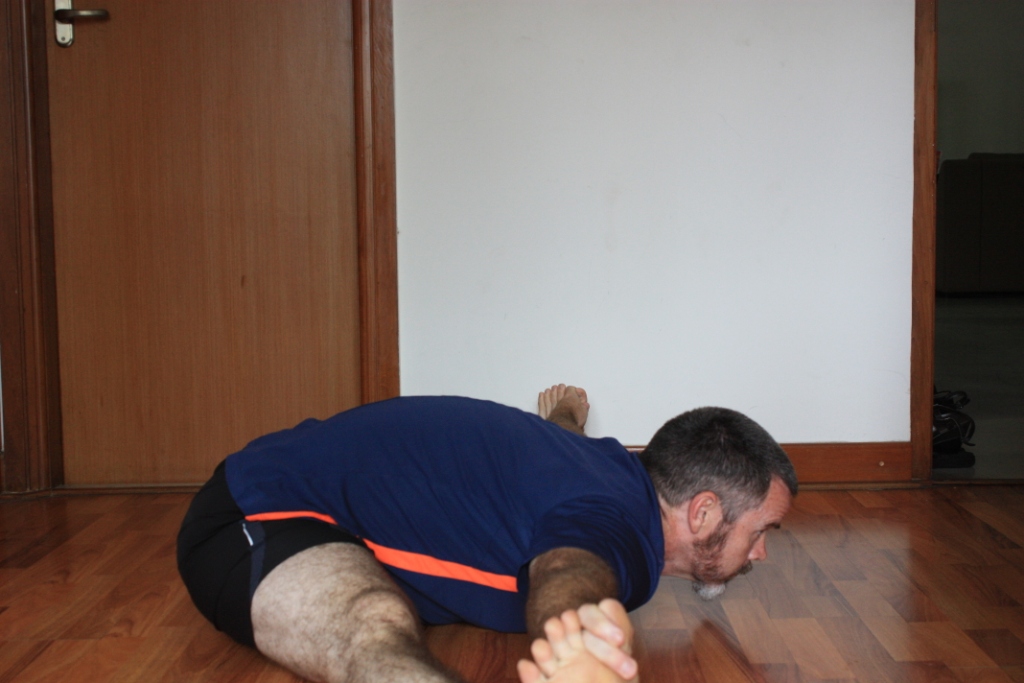
Upavistakonasana: put legs at about 90 degrees relative to each other, and then lean forward with a flat back placing the stomach, chest, and chin on the floor (in that order.)

Upavistakonasana: put legs at about 90 degrees relative to each other, and then lean forward with a flat back placing the stomach, chest, and chin on the floor (in that order.)

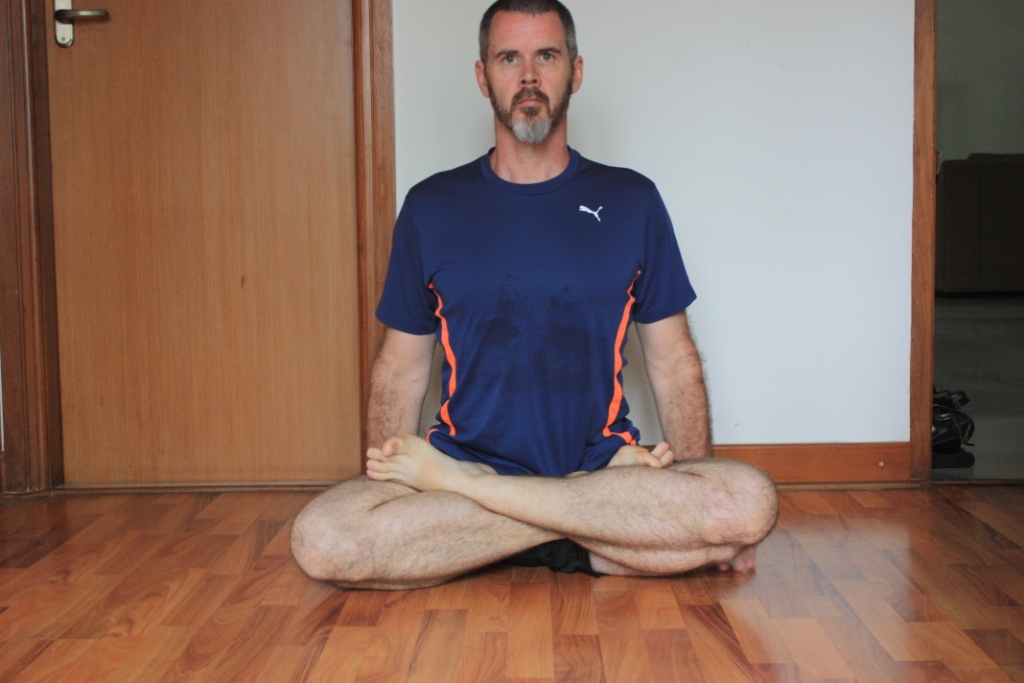
Padmasana (lotus): If you meditate in padmasana, you probably already have the range of motion necessary. Note: if padmasana hurts your   knees, you need to go back to hip openers and discontinue the practice.

Padmasana (lotus): If you meditate in padmasana, you probably already have the range of motion necessary. Note: if padmasana hurts your knees, you need to go back to hip openers and discontinue the practice.


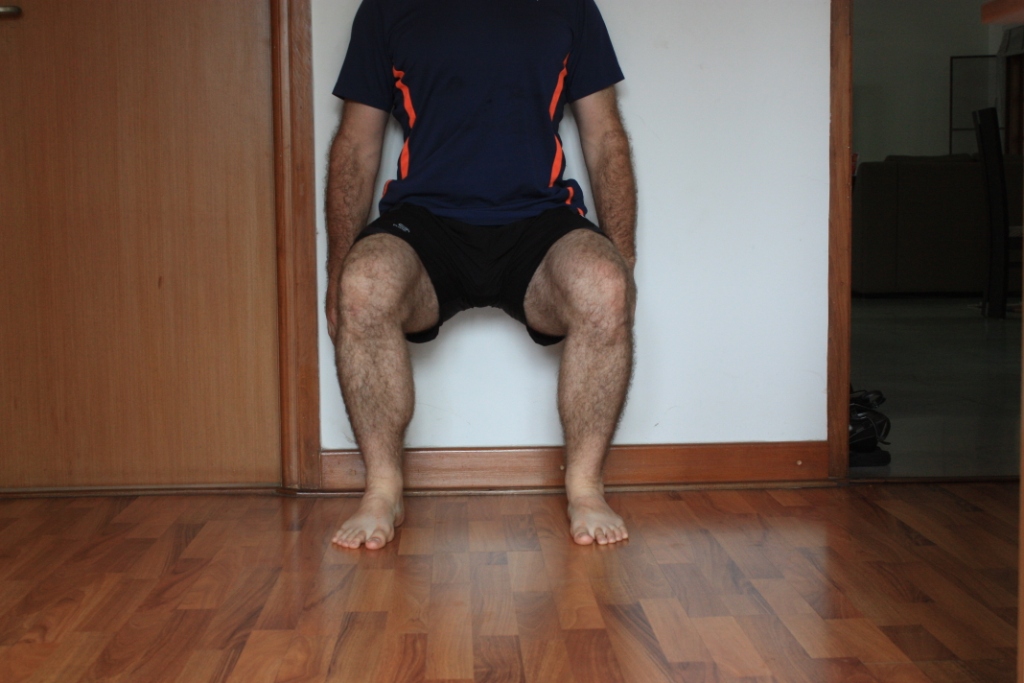
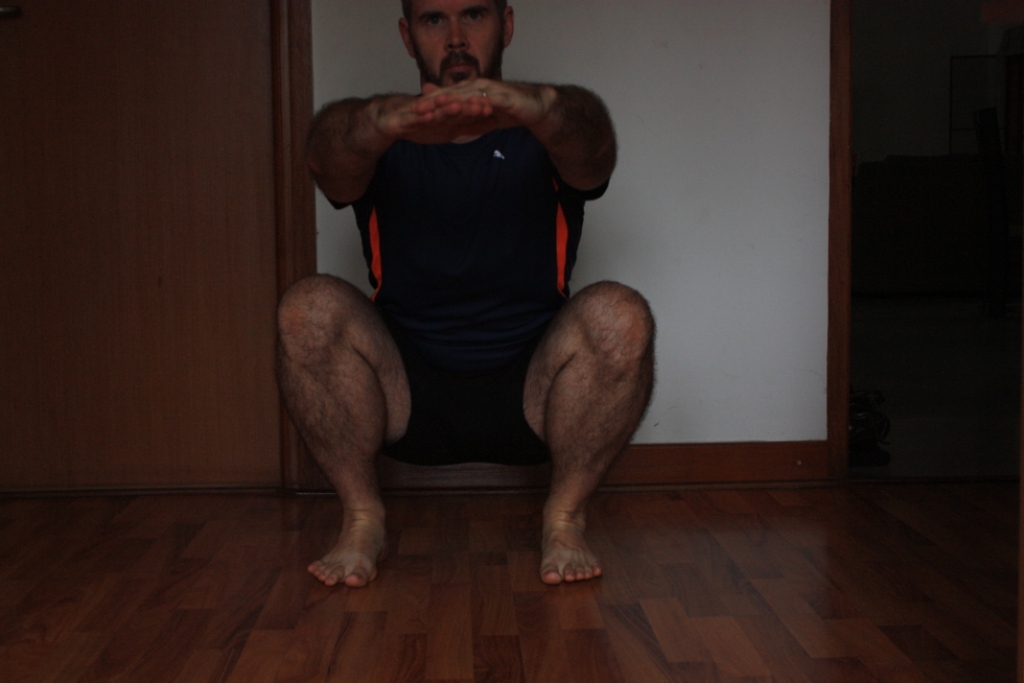
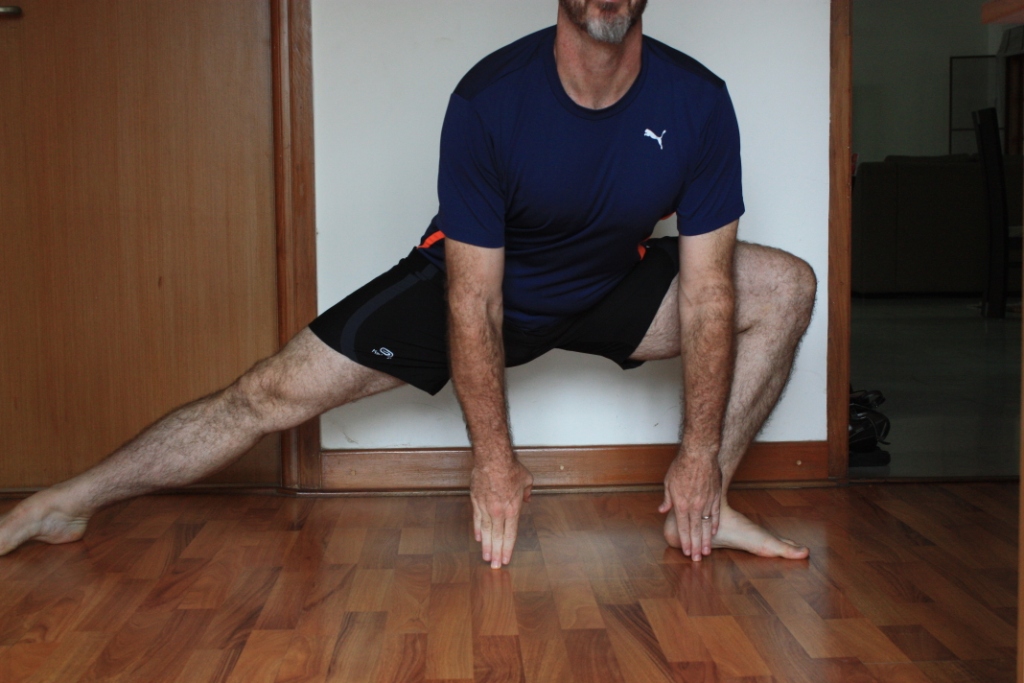
-Strengthen the muscles that stabilize the knee-joint. One begins this process with the usual suspects of leg exercise. One just needs to focus intently upon alignment. Here are a few of the exercises you may already be doing.


Wall squat: just like sitting on a chair with one's back  to the wall--sans the chair.

Wall squat: just like sitting on a chair with one’s back to the wall–sans the chair.

The classic squat

The classic squat

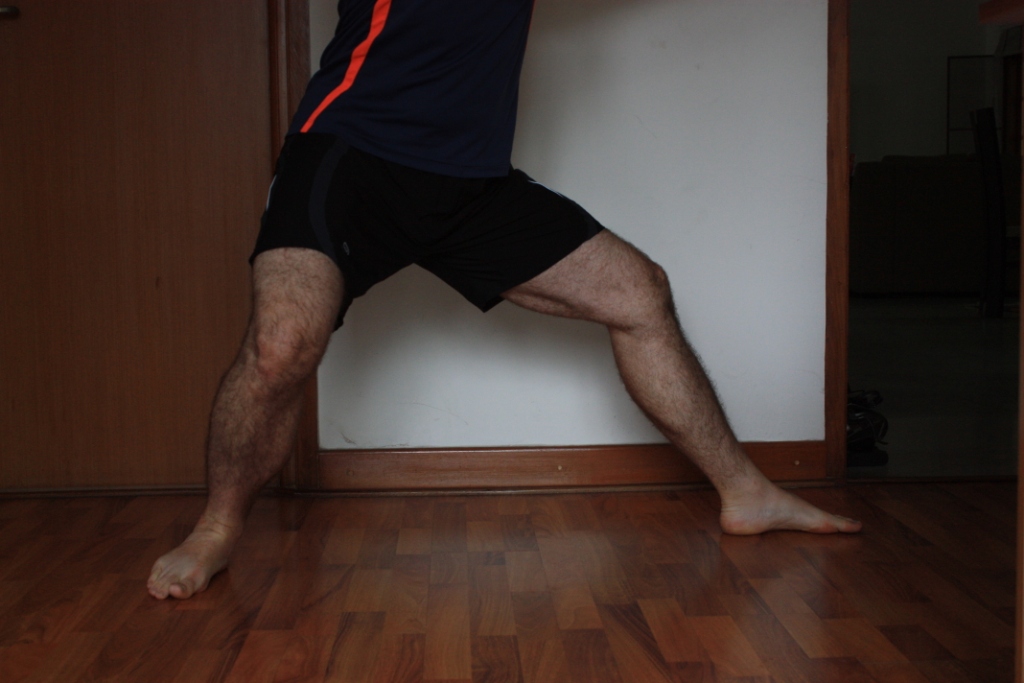
Side lunge: This one is  particularly important to get the knee aligned with the foot.

Side lunge: This one is particularly important to get the knee aligned with the foot.

The basic lunge: can be done stepping forward, backward, or both (the latter in an alternating fashion)

The basic lunge: can be done stepping forward, backward, or both (the latter in an alternating fashion)


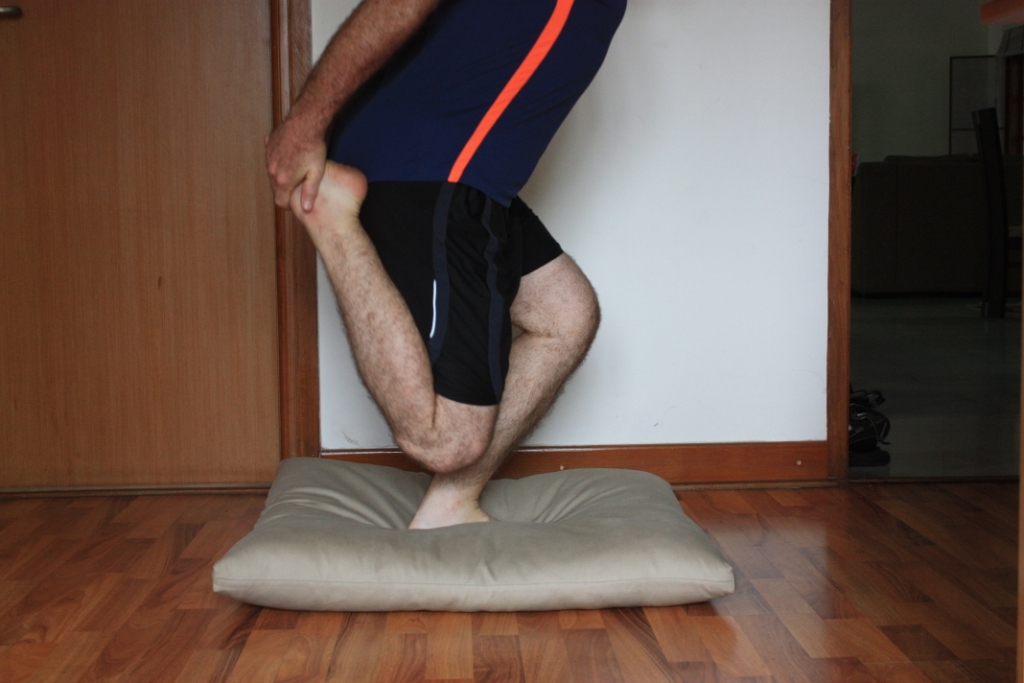
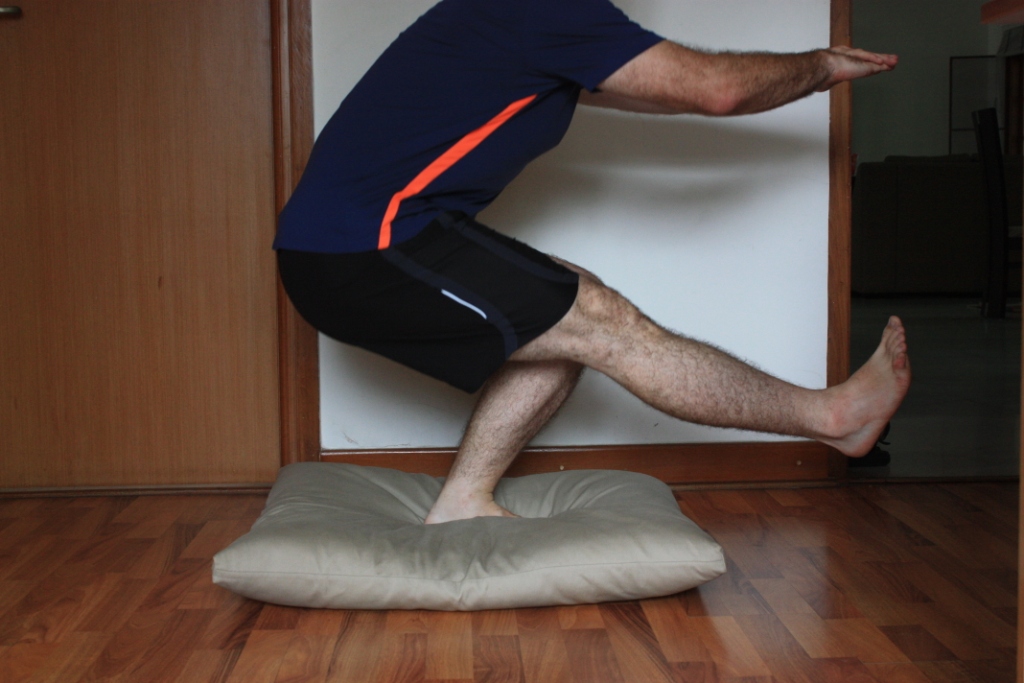
As one needs more challenge, one can achieve it in the usual ways (single-legged, unstable surface, add weight, or combinations thereof.) Below are a couple of variations that combine single-limbed work with an unstable surface.


IMG_1537 IMG_1532


-Save static stretching for after the joint has warmed up. It used to be common to begin a workout with static stretching. While few do this anymore, it’s a practice that needs to be replaced. Stretch warm.


-Don’t neglect the opposing muscle groups: When I said that one needs to increase flexibility in adductors and internal rotators, that doesn’t mean to ignore the opposing muscles. Nothing  good comes of stretching or strengthening in an unbalanced fashion. Your musculature works as a team with agonists, antagonists, and stabilizers all working  in conjunction to produce effective movement.


-Don’t go overboard with stretching: If your aim is to be a contortionist, then by all means go ahead. However, highly flexible martial artists need to be concerned about joint laxity. Laxity is when the joint gets so loose that it’s vulnerable to popping out-of-place.  A martial artist needs a balanced style of fitness. Extreme flexibility results in weakness and lack of joint robustness, just like extreme strength training produces a body that lacks range of motion and stamina.


Most importantly, don’t ignore pain when it’s still at the minor twinge point. If you have knee pain you’re doing something that joint doesn’t like. One should reevaluate your movement and, if necessary, considering stepping back from your current practice to work on capacity building exercises.


BOOK REVIEW: Faster, Higher, Stronger by Mark McClusky

Faster, Higher, Stronger: How Sports Science Is Creating a New Generation of Superathletes—and What We Can Learn from ThemFaster, Higher, Stronger: How Sports Science Is Creating a New Generation of Superathletes—and What We Can Learn from Them by Mark McClusky

My rating: 4 of 5 stars

Amazon page

McClusky’s book tells us how advances in sports science and technology are producing a new class of elite athlete. More usefully, it discusses which practices of high-level athletes can reasonably be emulated by amateurs. One may think that what’s good for the goose is good for the gander. In this case, not so much. If shaving a hundredth of a second off your time isn’t going to affect your life’s course, there are many activities of elite athletes that simply aren’t worth the cost (in whatever terms.) For example, the loss of friendships due to rampant flatulence resulting from consuming large quantities of baking soda isn’t worth it if you just want a little bit stronger Sunday cycling ride. (Baking soda [sodium bicarbonate] counteracts blood and muscle acidification during exercise and makes it possible to keep moving strongly when fatigued would normally degrade performance. Incidentally, this practice has been shown to be effective only for events that last between one and seven minutes.) On the other hand, some of the lessons of sports science are relatively low-cost and high benefit, and might be just what one is looking for to improve one’s performance. (e.g. Replacing a pre-workout stretching routine with one of rolling out the muscles.)

Faster, Higher, Stronger consists of twelve chapters, each addressing a different aspect of the application of science and technology to sport, including: training methods, genetics, nutrition, recruitment, practice, performance enhancing substances (legal and illegal), elevation training, and the limits of performance.

One question that has always been of great interest is how much of a top athlete comes from his or her genes? In other words, can anyone can do it–given a willingness to work like a maniac of course. As with many other questions about heredity, it was once thought that there would be a precise answer to this question in the wake of the decoding of the human genome. However, the success of the human genome project showed only that the situation was vastly more complex than we’d imagined. It turns out that having certain genes isn’t the end of the story because there are many factors that influence which genes are expressed. Attempts have been made to put numbers to the influence of genetics. For example, one scientist is quoted as claiming that 50% of oxygen processing capability (i.e. VO2 max) is heritable. This translates to the fact that, while the average Joe has a reasonable chance of engaging in athletics at some level, only a 0.1 to 0.3 % can summit the pinnacle of elite level athletics.

In many ways, science has encouraged coaches, trainers, and recruiters to think outside the box—and to look beyond the traditionally engrained approaches. One fascinating story was that of how the British national rowing team held tryouts based only on height, with experience with the sport being not required. They ended up with a champion rower who’d first entered a boat only four years before. This is part of the evidence that controverts the once popular 10,000 hour rule that was popularized by Malcolm Gladwell–though Anders Ericsson is more properly considered the father of the idea. It turns out that 10,000 hours of practice aren’t required for most activities if one goes about it right.

McClusky spends a considerable amount of space on the questions of what athletes should and shouldn’t consume. In emulating elite athletes many amateurs are working at cross purposes. This is readily seen with the issue of sports drinks. If you’re guzzling down a Gatorade or snacking on Cliff Bars after your run, you may only be ensuring that you continue to gain weight despite working out. On the other hand, you may decide that chocolate milk or beet juice are good choices for you.

I’d recommend this book for those interested in the heights of human performance.

View all my reviews

The 4% Rule, Yerkes-Dodson, and Finding the Sweet Spot in Martial Arts Training

I was watching one of Michio Kaku’s Big Think videos recently that addressed American science education. The question of interest was how America continues to do so well in science and technology given that the American (primary and secondary) educational system isn’t up to par in science and mathematics with its technological competitors. The bulk of his talk (re: the H-1B visa and importation of brain power) isn’t germane to this post. It’s Kaku’s mention of a second secret weapon that caught my attention, and that’s how America is able to do a better job than many of its competitors in identifying and nurturing top talent. While math and science education is better in many Asian countries, those countries (e.g. Japan, Korea, or China) don’t excel at skimming off the cream of the crop. Dr. Kaku explains that this is because Confucian values teach students to conform, and students are loathe to stand out–even for exceptional performance. Even if a student wanted to show their talent in hopes of having it fostered, the large classes, lecture-centric teaching, and testing of memorization and standardized processes doesn’t offer much opportunity to grow one’s individual strengths.


Kaku’s statement resonated with me because I’ve been thinking about the pros and cons of traditional approaches to martial arts instruction. I’m particularly interested in the gulf between the traditional approach and what martial arts teaching would look like if one took advantage of the wealth of scientific knowledge about mind and body development. Most of the martial arts instruction I’ve received over the years is consistent with Confucian thinking. All the students are doing the same practice (or faking it to the best of each’s abilities if it’s beyond one’s current capacities), and each is trying to closely emulate the teacher-presented ideal as much as possible. There’s not much consideration of the individual student’s weaknesses or strengths. Emphasis is on trying to convey as high-fidelity a replica of the techniques that have been handed down through the ages. (While this may be a laudable goal, I’ll later offer explanations as to why I think it’s both death for retention of students and ultimately counterproductive.)


Let me first say that there are a number of advantages to the traditional approach to martial arts instruction. First, it’s easy to teach many students at once. This was probably a huge advantage when there were armies of men having to learn these skills. Second, [theoretically] it helps students reduce their egotism through discipline and conformity. The highly hierarchical nature of this approach means students spend years in a lowly position, with the hope that some humility may stick. (NOTE: I’m not certain that this works out in practice.) Third, it creates a disciplined learning environment that is conducive to helping a student keep his or her head in the game.


What the traditional approach isn’t so good at is producing students who all perform at the best of their abilities. I suspect that the traditional approach doesn’t do so well for student retention either. It’s a system in which new students are forced to drink through the fire-hose; while students who’ve been around for a while often feel like they’re stagnating.  As I’ll get to below, there’s good reason to believe that a proper match between the challenge of a task and the performer’s skill level is critical to creating an intrinsically rewarding activity and to helping students perform at their best.


My thoughts on this topic have been heavily influenced by learning and teaching yoga. While one’s vision of a yoga class may be rows of students doing the exact same posture (and huge classes and / or poor instructors may result in that condition),  but there’s often a degree of variation in a class. This variation results from two concepts that I’ve been thinking about quite a bit lately, namely modifications and capacity building.


Modifications are a two-way street. If the task at hand is beyond the student’s current abilities, he or she may be given an easier variant that allows him or her to work toward the fundamental form. On the other hand, if the task of the moment is old hat, a student might be offered a more challenging version on occasion. I’m not suggesting that one shouldn’t drill the basics throughout one’s martial arts career. Repetition of fundamentals is key to drilling them down into one’s nervous system. However, the brain loves novelty and hates drudgery, and it will become harder and harder to remain engaged if the overall challenge level doesn’t rise. The science suggests that one needs to keep upping one’s game if one wants to perform at one’s best.


The nature of modifications in martial arts may not seem as clear as it is with respect to yoga postures. For randori, sparring, and other free-form training, it’s easy to envision how one can adapt the practice to reduce or increase the challenge to a level more apropos of the student’s skill level. One can practice a restricted form. For example, one may work only on sparring with boxing rules to kicks or grappling out of the equation until a student builds up his or her confidence and abilities with recognizing and responding to punches. Alternatively, an advanced student might be presented with armed or multiple attackers. There are some practices, such as specific techniques, for which modifications may not be an option, but that doesn’t necessarily let a teacher off the hook for helping a student who’s challenged by the technique. That may be where capacity building exercises come into play.


Capacity building goes beyond offering an easier modification to suggesting exercises to help the student build the physical capacity to do the technique repetitively WITHOUT INJURY. I emphasized those last two words for a reason. In some martial arts, the need for capacity building exercises maybe clear because of the acrobatic insanity involved. However, practitioners of more pragmatic martial arts may say, “We don’t do all those fancy spinning back kicks, so we don’t need capacity building. Anybody can do our techniques because they’re simple and direct.” Maybe that’s true, but if multiple members of your school have the same (or similar) repetitive stress injuries, it’s not true at all.


What kind of capacity building are we talking about?  If the technique involves jumping or leaping and the individual is gravitationally-challenged, then plyometrics might be the prescription. On the other hand, if the problem is the inability of the student’s joints to withstand the technique, there might be need for exercises that build up stabilizing muscles, help him / her to cut weight, or both. If a student can’t do a throw without risk of injury, maybe that individual needs to spend time practicing with elastic bands or inner tubes or working on their balance.


RiseOfSupermanWhat is this 4% rule? I read about it in Steven Kotler’s The Rise of Superman. As background, there’s a state of mind called “Flow” that’s associated with performing at one’s best. In this state of mind, which some call “the zone” and others probably once called satori or samadhi, one’s concentration on the task at hand is at its greatest, unnecessary features like sense of time and sense of self fall away, one’s inner critic shuts the hell up, and–at least afterwards–there’s a blissful state. Flow can be described as the shutting down of specific elements of the pre-frontal cortex (PFC)–largely involved with the consciousness mind. It can also be defined neuro-chemically by the hormones released (i.e. Serotonin, Endorphins, Dopamine, Anandamide, and Norepinephrine) and neuro-electrically in terms of one’s brainwaves (around 8 Hz.)


There are conditions that favor achievement of Flow, notably: 1.) clear goals, 2.) immediate feedback, and 3.) a good match between the level of the challenge and the level of one’s skill. Flow is a key factor in why some activities are intrinsically rewarding (whether or not they are rewarding in other ways) and why almost any activity can be intrinsically rewarding if it’s sufficiently challenging relative to one’s abilities. What’s sufficiently challenging? That’s where 4% comes into the picture. While it’s by no means an exact or universal value, it turns out that when a task presents a challenge that is roughly 4% above one’s present skill-level is when this state of mind is most accessible. This is why one may see students drop out if they find the level of challenge stagnant. On the other hand, one may not keep new students either if the challenge is constantly beyond their abilities.
 

How about that Yerkes-Dodson? The two early 20th century scientists for whom the Yerkes-Dodson Law are named discovered that performance increases with arousal (one might do best to think of this as anxiety level rather than the colloquial use of that word) up to a certain point, beyond which performance either levels off or plummets–depending upon the nature of the objective.  The point is that keeping the training environment too sterile has it’s disadvantages. In free-form practices like sparring, a little nerves can be a good thing, but being overwhelmed can be detrimental.

Yerkes-Dodson Curves. Source: Wikipedia

Yerkes-Dodson Curves. Source: Wikipedia

Adjusting one’s instruction to the abilities of one’s students is challenging. Traditionalists may hold that it’s far more important to keep the tradition intact than it is to cater to the individual needs of students.  That is, said teachers may prefer to focus on the aforementioned high-fidelity transmission of the teachings of the lineage. There was a time during which I probably would have echoed that sentiment. However, it increasingly occurs to me that producing the best and most engaged students is the best way to keep a tradition alive.

The Science of Inversions: or, Why and How to Get Off the Wall

IMG_0835Inversions are a class of postures (asana) in which part or all of the body / limbs are raised above the head. The classic inversions are: headstand [shirshasana], shoulder-stand [sarvangasana], plow pose [halasana], forearm-stand [pinchamayurasana], and handstand [adho mukha vrksasana], but there are many more–some of which are easier and others of which are more challenging than these basics. Other than a few partial inversions (e.g. down-dog [adho mukha svanasana] and leg-up-the-wall pose), inversions tend to be daunting for beginners (and even intermediate students) at a mental as well as a physical level.

In this post I’ll focus on headstands. Most students seem to achieve shoulder-stands and plow pose relatively easily because it feels more stable. I’ll note that those two asana require as much or more care and caution as any inversion given the flexed state of the neck. On the other hand, by the time one is perfecting one’s handstand, one will likely be over the issues that I’m addressing in this post. I’ll save those poses for a later post with a different thrust.

Let’s first consider the effect inversions are supposed to have (and then the effect they tend to have in reality.)

What inversions are supposed to do:  The story is supposed to go like this: 1.) The body inverts. 2.) Our body’s sensors recognize that the blood flow to the brain is far beyond its needs.  3.) The body quiets our vital signs.

What inversions (too often) actually do: It may surprise some readers that inversions are supposed to have a calming effect because the chain of events is often as follows: 1.) The body inverts. 2.) The amygdala fires, triggering the physiological responses associated with fear. 3.) One’s conscious mind imagines the pain and suffering of falling. 4.) The amygdala fires some more. One is in “fight or flight” mode, and the flight the body wants to make is to a right-side-up position.
While I’ve had to work hard to improve my inversions, I had a much easier time with this issue than many. Before you dismiss me as a narcissist, let me state unequivocally that I have no special gift for inversions . I’m not claiming to be a yoga prodigy by any stretch. Why was it easier for me? I’ve practiced a martial art for many years that required training in breakfalls (ukemi.) Therefore, I had no particular fear of falling over onto my back, because my body is trained to tuck and roll. [My only fear when I first started doing headstands in studio sessions was that someone, e.g. the teacher, would walk into my blind spot. Note to all: don’t walk behind someone’s back when they’re inverted unless you’re sure you’re out of the “timber” zone.]

Why are breakfalls so beneficial to the development of one’s inversions?  Because it allows one to get off the wall. A lot of practitioners get addicted to the wall. “Addicted” may sound like a harsh term, but like addicts they think they can quit anytime and that they will quit at some undesignated point in the future–sometimes they do, but often they don’t. Reliance on the wall is reinforced by the fact that one may find one can only spend a couple anxiety-filled seconds inverted without the wall, but one can spend minutes comfortably against the wall. There’s a reason for this great disparity, and understanding this reason is crucial for knowing why doing 2 or 3 seconds unsupported (at first) is better for one’s long-term development than staying for three minutes leaning on the wall.

Here’s the deal. When you invert, your body needs to make subtle corrections to keep you on balance–at least until you reach the level of yoga genius. If you stand up with your feet together, your eyes closed, and you pay attention to your feet and legs, you’ll see that this is true when you’re upright as well. It’s just that your body is used to being upright. It knows how to make all these micro-corrections without conscious thought. The good news is that one’s nervous system rapidly learns to do the same thing when one is upside-down. When I say “rapidly” I’m not talking about the first, second, or even the twelfth time you try to do an inversion. [Trust me, despite what your mother may have told you about her darling genius, you didn’t achieve stability upright on your first few tries either.] The first several times, you’ll fall down almost immediately. However, if you keep trying, your body will learn and you’ll achieve progressively longer inverted stays. You can’t make these corrections at the speed of conscious thought. But the beauty part is that your body will learn to achieve stability solely through practice without any intellectual activity whatsoever.

Why doesn’t your body learn this when you use the wall? The cornerstone biological principle for those interested in fitness, movement, and sports is: Your brain and body are lazy; they will not develop any capability that you don’t force them to by challenging activity. Your muscles don’t get bigger without overloading them and causing little micro-tears in them that they must heal up better than before. Your bones don’t get more dense unless you put more load on them (see: Wolff’s Law.) And your nervous system will not wire itself to keep you upright in an inversion if you’re propped up against a wall. You can invert against a wall for a thousand years and not get the same benefits as from an hour of struggling to get off the wall. This principle is reflected in nature from Darwinian evolution onward.  Gazelles don’t learn to run 500 miles an hour. Once it can accelerate (on average) fast enough to survive the cheetahs that prey on it, it passes on genetic material and the evolutionary pressure is off. Gazelles don’t keep getting increasingly faster than their predators for shits and giggles.
Incidentally, this is also why you should keep challenging yourself, and not rest with getting the basic form. There’s always somewhere new to take it. For example, one can look at moving between splits like so:


IMG_0834IMG_0836IMG_0837


Alternatively, one can work on a different form of the pose, such as the tripod headstand. Transitioning from crow pose [kakasana] to tripod headstand is a good way to start to learn the bodily control that will serve one well in intermediate and advanced practice.


IMG_0851IMG_0853IMG_0859


Yet another option is to practice a controlled descent. The inverted “L” is quite a challenge. Not as one might think because it requires tremendous core strength, but because it requires gradually leaning into the direction of falling backwards in order to counterbalance the weight of your legs.


IMG_0844IMG_0846IMG_0847IMG_0849


A few notes on headstand breakfalls:

– Make sure you have room in all directions to fall without crashing into anything or anyone. While it would be nice to always fall back onto one’s feet, it’s neither realistic nor beneficial to your development. Why not? If you’re always distributing your weight to fall onto your feet, you will be keeping muscles tense and will have trouble finding a relaxed state of balance. Furthermore, there is a tendency toward panicked motion if one starts to lose balance in the wrong direction, and speed is your enemy in inversions.  (One wants to do everything from entering the inversion to falling in as slow and controlled a manner as one can possibly manage.) If you get your feet up high enough to be on balance, you need to accept the fact that you’re as likely to roll onto your back as on to your feet.

– If one is doing the basic forearm-supported headstand, don’t tightly interlock one’s fingers. “Tightly” is the key word here. It’s alright to interlock your fingers, but one doesn’t want to create ridged hands such that one’s neck rolls over a 3 to 4 inch (7 to 10 cm) ledge if one falls backwards.  One wants the hands to collapse.

– Tuck and roll. Don’t reach back with your foot / feet and try to arrest your fall. If you have enough strength, flexibility, and timing to make that work you probably don’t need my advice and haven’t read this far. (i.e. you have advanced gymnastic skill.) If you’re the more typical yoga practitioner, you’re more likely to injure your back, toes, feet, or some combination thereof by arching into a back-bend to arrest your fall.

– Counter-intuitively, you probably don’t want to put anything behind you to soften your fall. You don’t want your spine rolling over surfaces that are at different levels–even if one them is relatively soft. It’s usually best to roll over a level surface, even if that surface may be a bit hard. Furthermore, if you think you’re going to save yourself by working entirely on a softer surface, you’ll probably find yourself falling more often and for a longer period. Softer surfaces are harder to maintain balance on. That’s why one of the primary ways that we make an exercise more challenging is to do it on a softer (more rolly) surface.

– Don’t let your neck crumple. On a related aside, never look around while you’re in a headstand. If you need to see something, e.g. the teacher’s demonstration, come out of the headstand.

– However you come out of an inversion, don’t neglect the counter-pose. For the headstand, child’s pose is a common counter posture, and you should spend some time there upon exiting the pose.

– It’s best to begin one’s practice of inversions under the supervision of a qualified teacher. As one develops confidence and one’s body begins to learn how to maintain stability, one can make these postures an increasing part of one’s practice.

It’s hard to get get a good sequence of pics to show how to breakfall–given my limited photography skills, that is. But here’s my attempt.

So it begins with crumpling balance

So it begins with crumpling balance

Get those fingers open so your neck doesn't flow over an interlocked fist

Get those fingers open so your neck doesn’t flow over an interlocked fist

Tuck and roll

Tuck and roll

Don't arrest your roll.  Let momentum carry you forward. Gradually dissipate the energy.

Don’t arrest your roll. Let momentum carry you forward. Gradually dissipate the energy.

Happy inverting.