BOOK REVIEW: The World’s Best Street Food by Lonely Planet

The World's Best Street Food: Where to find it and how to make it (General Pictorial)The World’s Best Street Food: Where to find it and how to make it by Lonely Planet
My rating: 4 of 5 stars

Amazon page


This is a combination guide to street food and cookbook. Each of the 100 entries consists of two pages. The first describes the food, how it’s eaten [that’s not always as self-evident to outsiders as one might think], its origins, where one can find a quintessential or famous example of the food, and whether there are any variants on the recipe. The second page is the cookbook entry, which lists the ingredients and describes the process by which they are combined to create the dish in question.

The foods are divided into broad categories of savory and sweet. The savory category is the larger by far, comprising 80 of the dishes—leaving 20 sweets. The dishes represent about 50 different countries of origin. A lot of these countries are well-known street food cultures such as Thailand, Vietnam, India, Mexico, and the US, but there are also a number of locales with which readers may be less familiar– such as Ghana, Malta, and French Polynesia. The dishes include a number of my favorites, such as Vietnamese Banh Mi, US Breakfast Burrito, Indian Masala Dosa, Thai Pad Thai, Hungarian Langos, and Singaporean Hainanese Chicken Rice. However, I also learned of new dishes that I’m eager to try, such as Croatian Cevapcici, Burmese Mohinga, and Chilean Sopaipilla.

WARNING: While I didn’t deduct stars for it, I will warn readers that this isn’t a good book to get as an e-book—at least unless you have a high-end tablet. It was a bit of a pain to read on my Kindle Touch, and the graphics (which I assume are beautiful in the print edition) were largely useless on my device. One could blow up the text easily enough (within limits, at least,) but the pages got grainy if one blew them up too much—and some of the text remained small when expanded.

There are photos. As I mentioned, on my device they were largely useless (grainy black-and-white) but your results may vary.

I found this book to be interesting and informative. While I wish the e-book had been easier to read, it was well-organized and offered a broad selection of dishes from a large number of countries.

I’d recommend this book for street food lovers and foodies.

View all my reviews

DAILY PHOTO: Bombay Vada Pav Stands

Taken in November of 2015 in Mumbai

Taken in November of 2015 in Mumbai


This row of street food stalls is located across the street from Flora Fountain in Mumbai. They don’t all sell Vada Pav, but the most popular one does. (Alternative spellings: wada pav, vada paav, or vada pao)

FYI: Vada Pav is a delicious deep-fried, spiced potato ball served as a sandwich on a fluffy dinner roll style bun. It’s a Maharashtra specialty. There’s a video below if you’d like to see how they’re made or to make your own.


Learning Indian Cooking in Bangalore

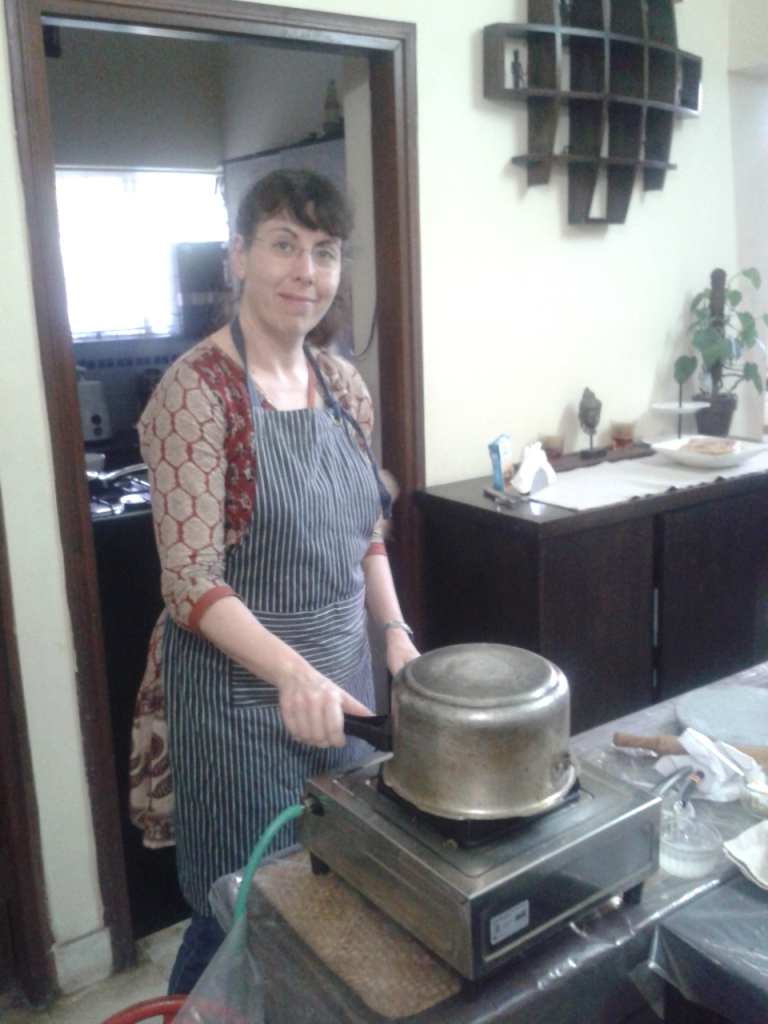
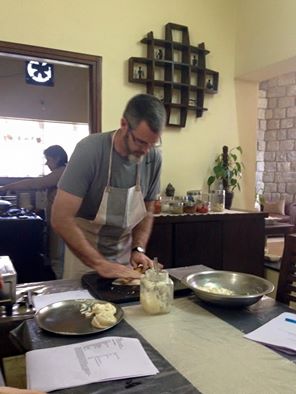
I'm stirring the pot.

I’m stirring the pot.

The thing about Indian food–with its penchant for pureed gravies–is that I find it delectable, but often have no idea what I’m eating or how it got to me looking, tasting, and smelling like it does.


That is until recently. A couple of weeks ago I attended a cooking class at Manju’s Cooking School in RT Nagar in an attempt to rectify (or at least reduce) my ignorance. Manju’s offers a wide variety of classes (Indian and non-Indian, veg and non-Veg, cooking and baking, etc.)


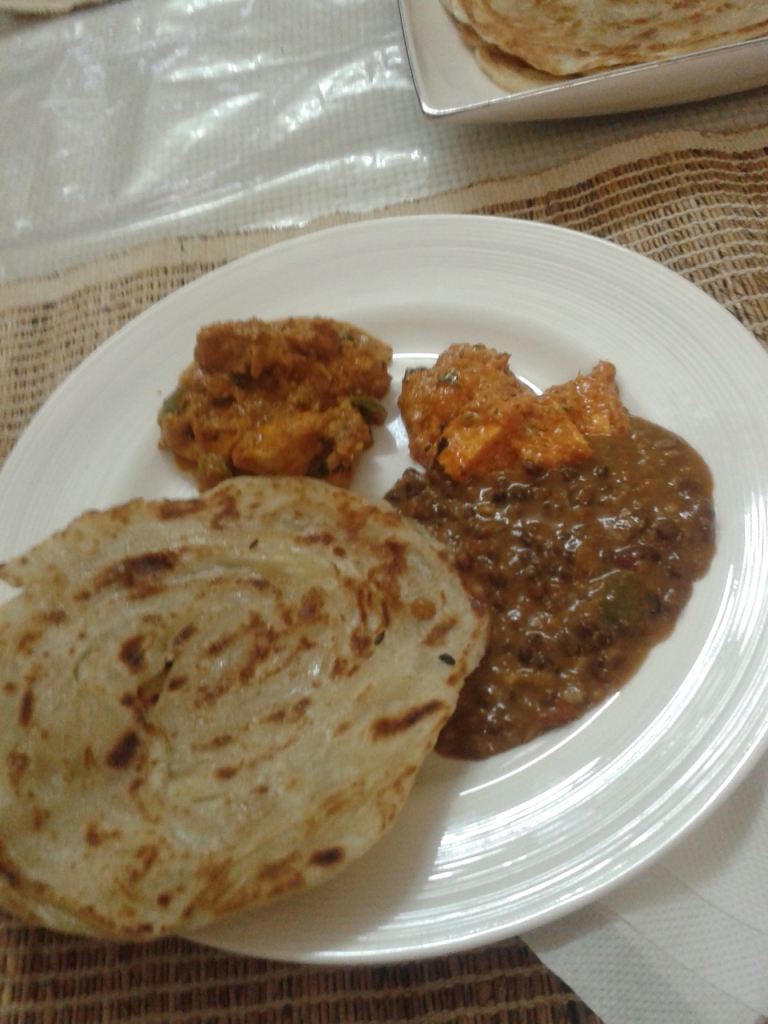
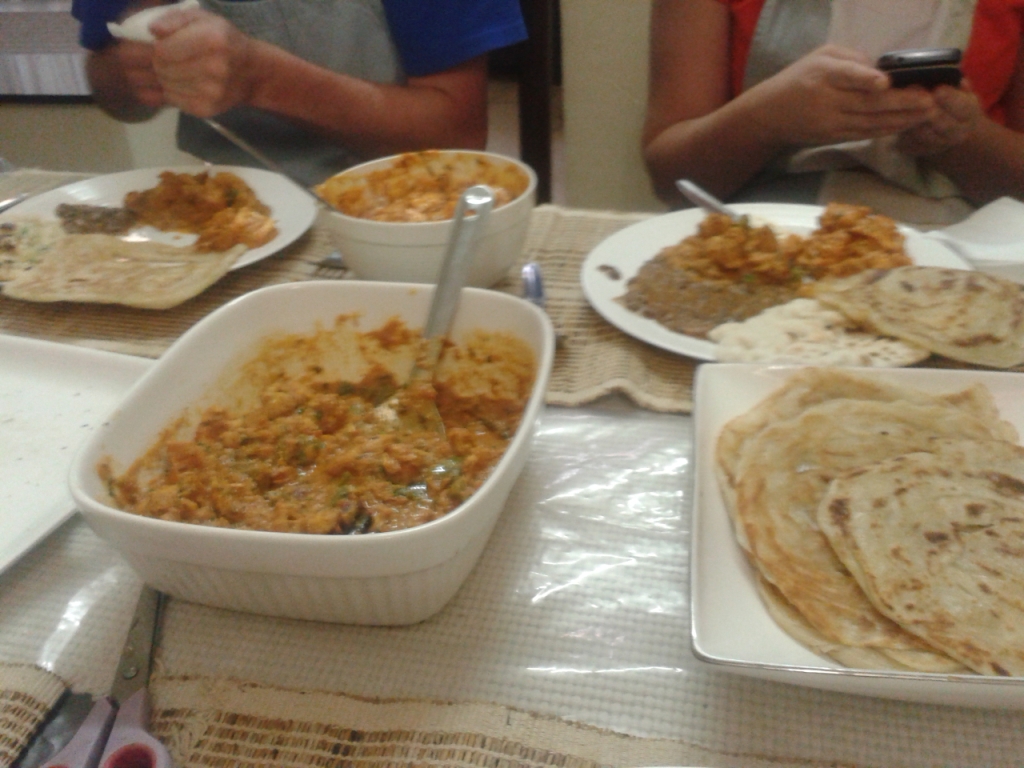
I attended with a group of friends, and we constituted a class unto ourselves. We, therefore, got a quick and dirty introduction to a number of common / typical Indian foods (veg and non-veg, and both North and South Indian.) The menu we prepared consisted of two breads (kulcha and Malabar parota), dal makhani, paneer butter masala, and kadai chicken.


The class took 2.5 or 3 hours, and ended in a banquet of the foods we hand prepared.

20150201_170142 20150201_170013


Some of the fun facts that I learned include:

-“Kadai” in the name of dish just means that it’s wok-cooked.

20150201_154859

-A Kulcha is essentially a naan of a different thickness.

-Dal makhani requires a lot of prep, even if you have access to a pressure cooker.

-There’s a lot of finely chopped onion in these gravies that often goes unnoticed.

-One can cook with the pot upside-down. This is how we cooked Kulcha. In a restaurant it would be cooked in a Tandoor oven, but at home you can cook it stuck to the bottom of a deep pot.

20150201_163717

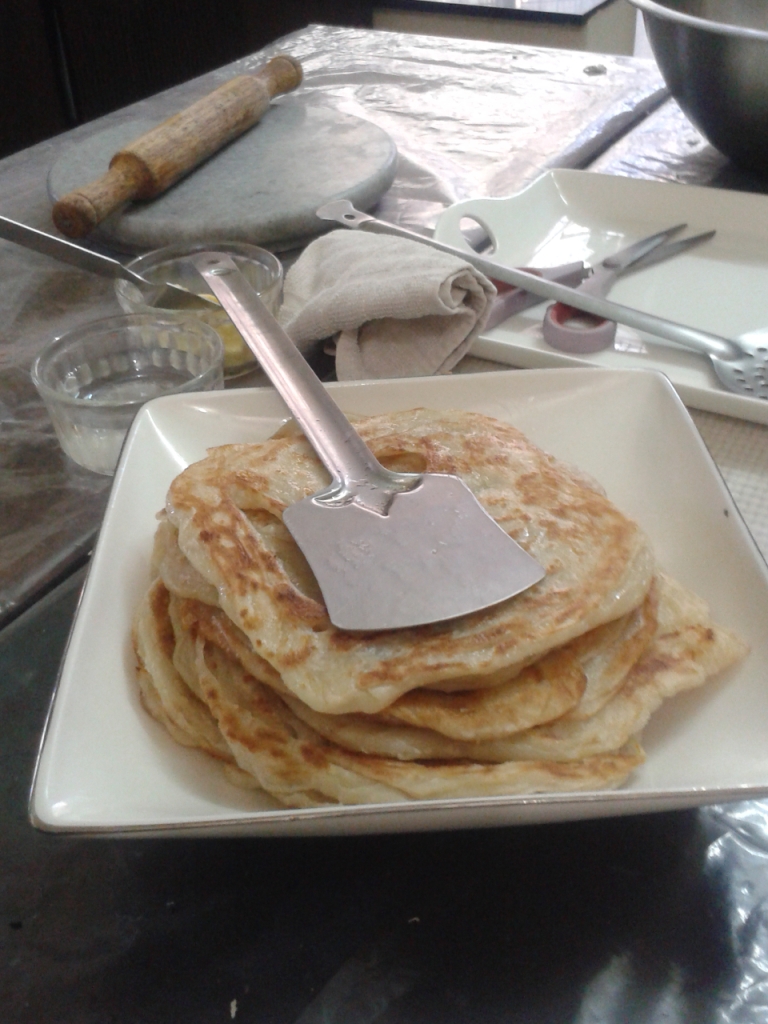
-Lastly, the key to a the flaky goodness of a Malabar parota is lots of fat… who’d have thought?

20150201_162915

Me&Parota


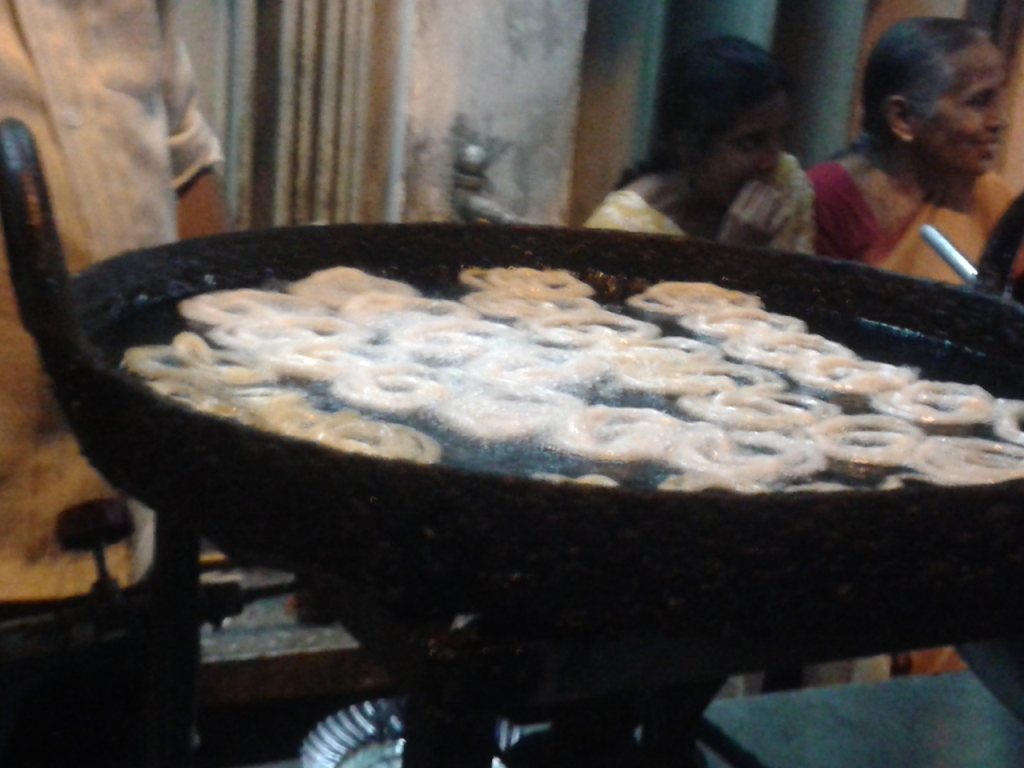
DAILY PHOTO: Frying Jelabi

Taken in April of 2014 in Bangalore.

Taken in April of 2014 in Bangalore.

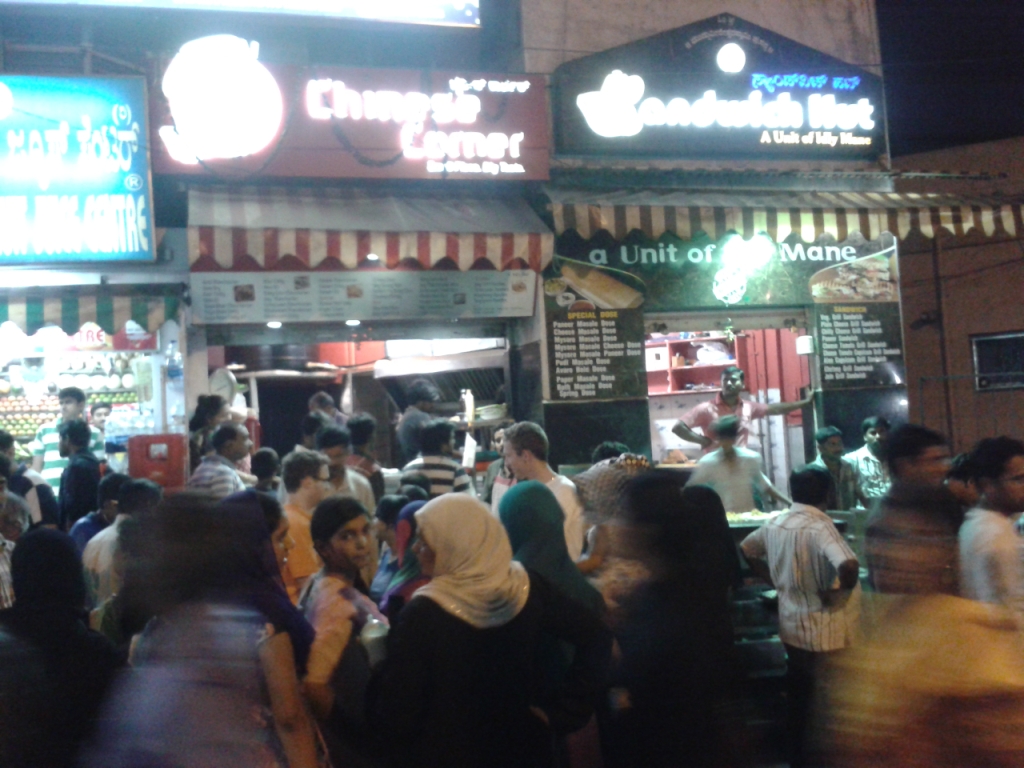
DAILY PHOTO: Food Street Bangalore

Taken on April 12, 2014 in VVpuram, Bangalore.

Taken on April 12, 2014 in VVpuram, Bangalore.

Made another trip to Bangalore’s Food Street in VVpuram (near Sajjan Rao Circle) for Rumali Roti and Mysore Masala  Paneer Dosa. Both were excellent, and the street was packed with humans, bovines, canines, and felines all living harmoniously.

20140412_195918

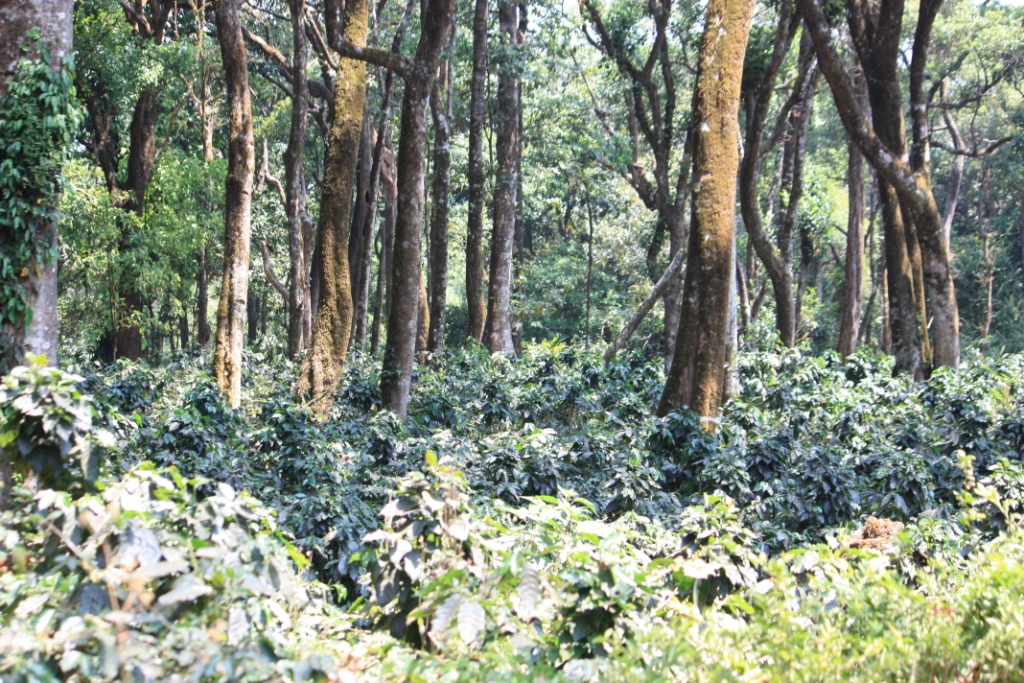
DAILY PHOTO: Coffee Plantation

Taken on March 29, 2014 near Madikeri

Taken on March 29, 2014 near Madikeri

This was taken at the Golden Mist coffee and tea plantation near Madikeri in Coorg. There are two kinds of coffee, arabica and robusta.  Arabica is the tastier variety, and the arabica tree requires more shade. Robusta is hardier, but is rarely consumed without being blended with arabica–unless one wants chest-hairs to grow on one’s chest hair. So wherein most agricultural pursuits eschew competing plants, coffee plantations need shade.

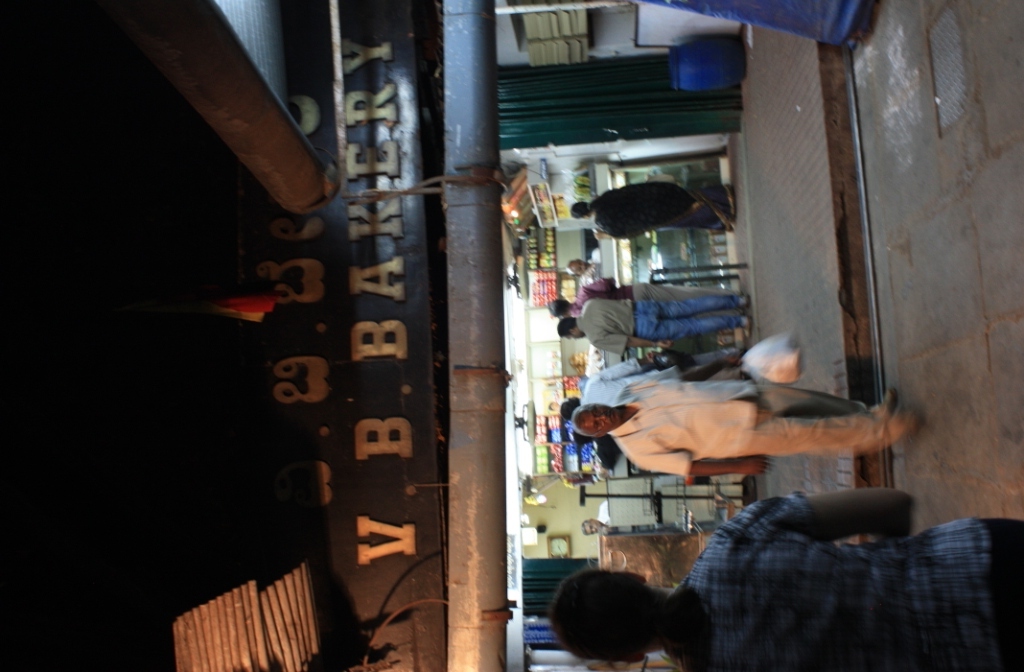
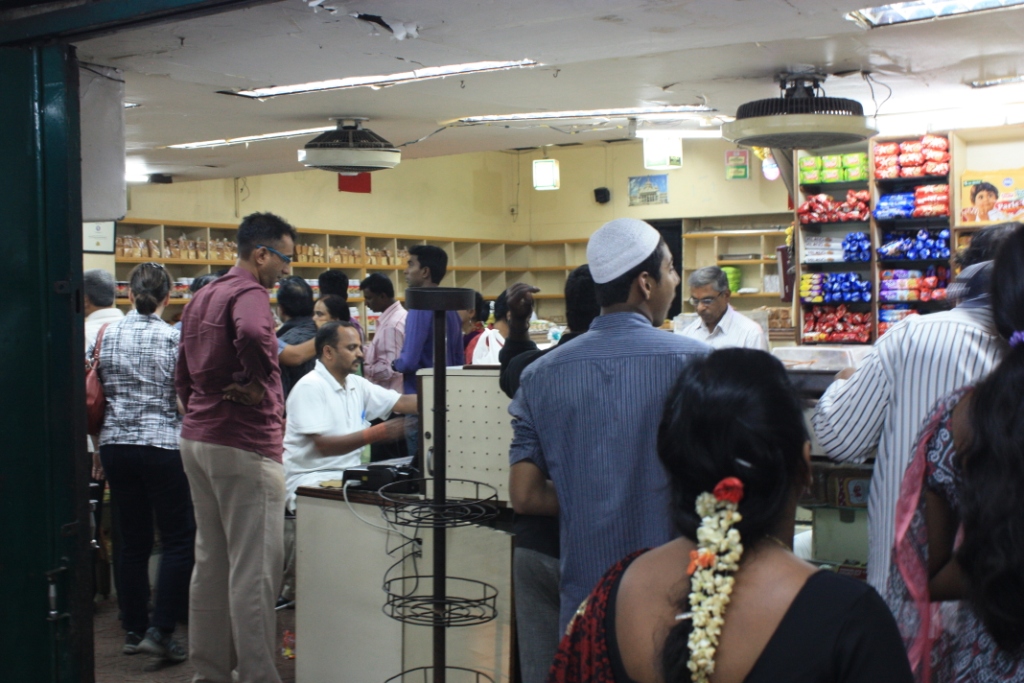
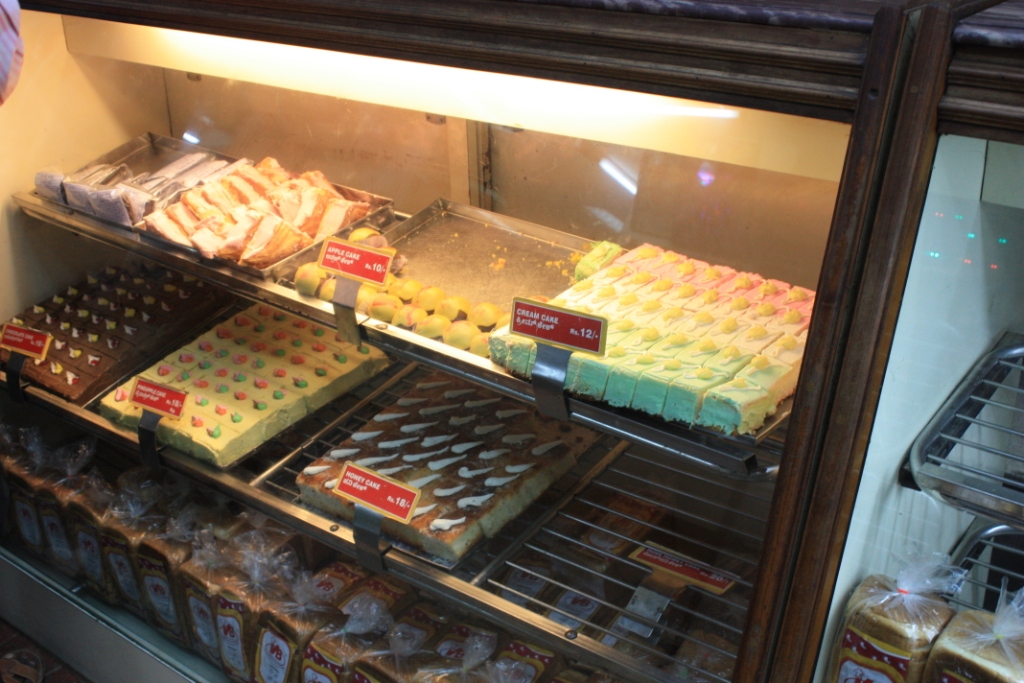
DAILY PHOTO: V.B. Bakery in VVpuram

Taken March 22, 2014 in Bangalore.

Taken March 22, 2014 in Bangalore.


IMG_1269

V.B. Bakery is a 60-year-old Bangalore institution located on Food Street (proper name: Old Market Road) in Visveswarapuram (a.k.a. VVpuram.) As you can see from the middle shot, it was thronged on Saturday night.


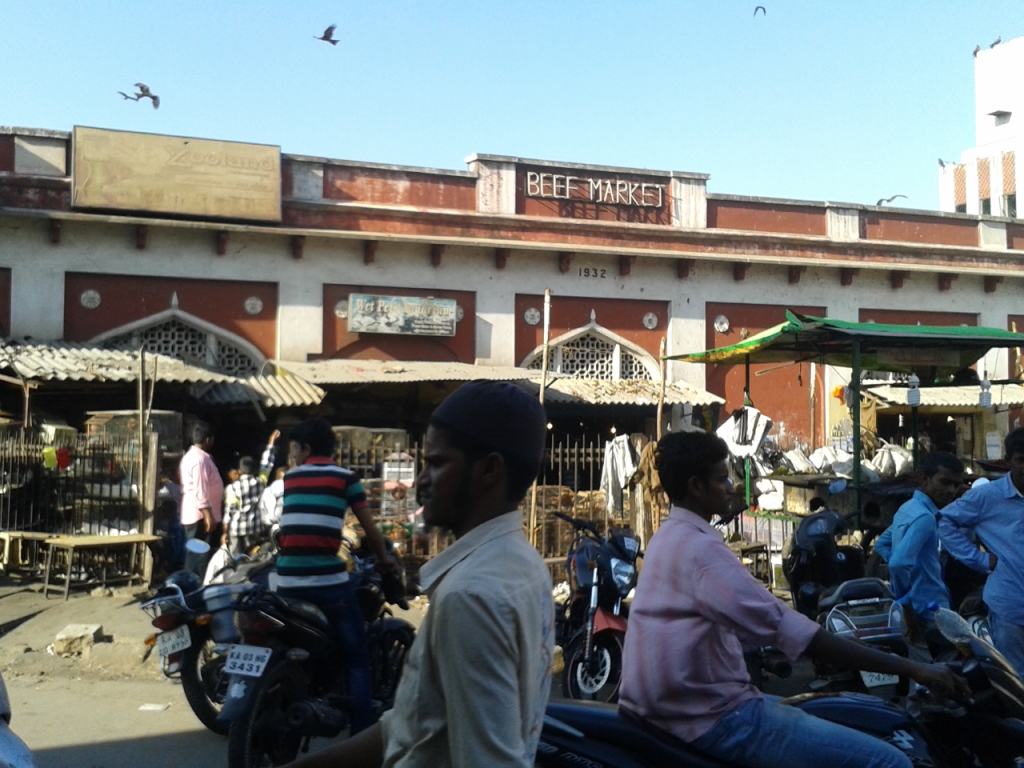
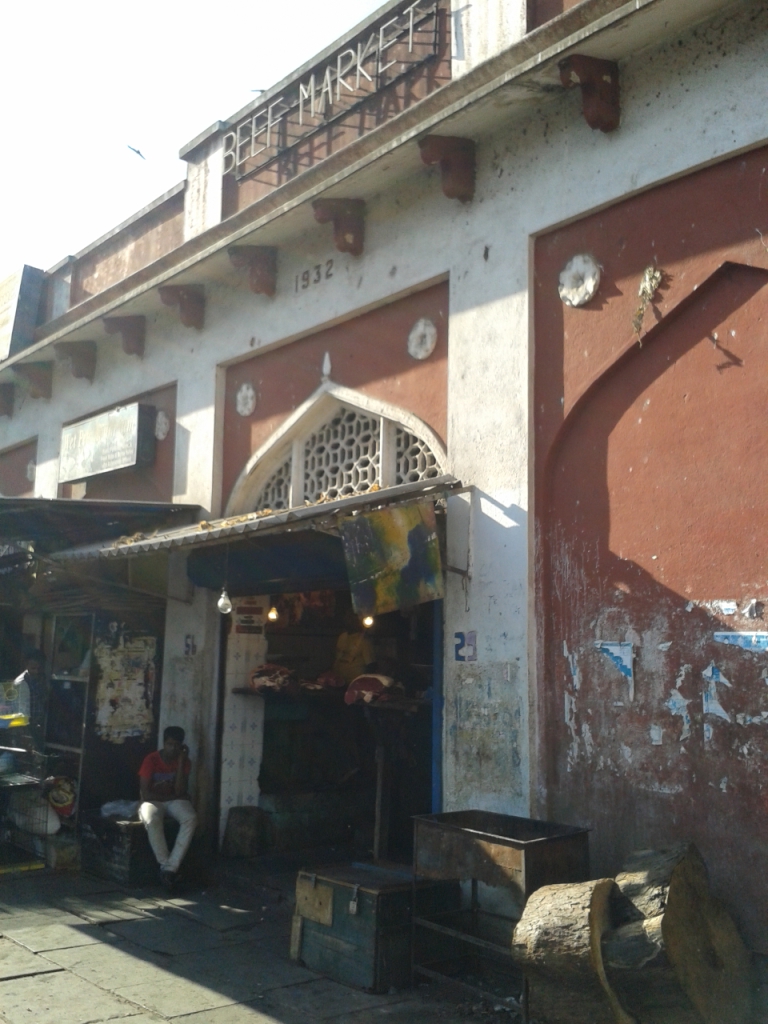
DAILY PHOTO: Bangalore Beef Market

Taken on March 16, 2014 in Bangalore.

Taken on March 16, 2014 in Bangalore.

Taken on March 16, 2014 in Bangalore.

Taken on March 16, 2014 in Bangalore.

You may be curious about whether one can get a steak or a burger in the land in which McDonald’s restaurants substitutes [chicken] Maharaja Macs for the iconic beef Big Mac. Indeed one can, and it’s not that hard to find, nor that expensive–though it does often involve going a little out of one’s way. A typical supermarket–if they sell meat–sells only chicken and mutton (the two globally non-offending meats–except among the vegetarian/vegan crowd.)

As one might expect, the beef trade is dominated by Muslim merchants.

I couldn’t recommend this particular place. (I have a robust digestive system by Western standards, but eating a steak acquired here would probably kill me instantly.) While you could probably get an animal butchered right there–insuring the ultimate freshness–I suspect these are mostly the garbage-eating cows seen around the city. The fact that there is a pet store attached to the beef market and that carrion eaters are constantly circling overhead is enough for me to shop elsewhere.

The Beef Market is located quite near the Russell Martket, near Commercial Street.


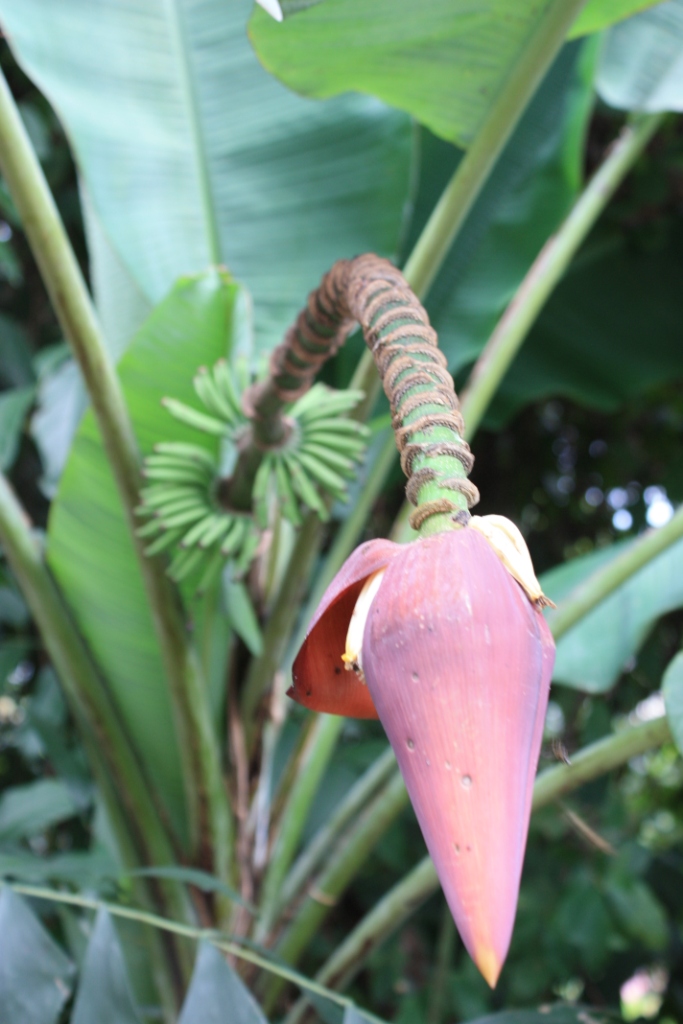
DAILY PHOTO: Banana Flower

Taken in December of 2013 in Kuala Lumpur.

Taken in December of 2013 in Kuala Lumpur.

The other night, I ate banana flower for the first time–that I know of / remember–in two separate dishes. My wife and I were eating at the Oh! Calcutta on St. Mark’s Road in Bangalore, and we sampled banana flower croquettes as part of an assorted starter platter, and then I tasted some of my wife’s entrée, which was “dry cooked banana flower with coconut slivers.” The former was tasty, but so spicy that my undiscerning palate was incapable of learning anything about the flavor of this flower. The latter, much milder, dish tasted like a tasty take on mashed potatoes (again, to my unrefined palate.)

The picture above was taken in Malaysia, but banana flowers are present everywhere bananas grow (throughout much of tropics.)

Deceptively, the flower looks like it could be a deadly weapon–with its pointy, conical bloom.

Hae Kum Gang: Korean Food in Bangalore

Jeyuk-Chulpan with assorted sides.

Jeyuk-Chulpan with assorted sides.

I’ve been eating a lot at restaurants since we moved to Bangalore, both because it’s (usually) cheap and for the experience of it. I’ve eaten at enough places to have developed some favorites, but I try to keep broadening my experience by eating at as many new places as  I can.

Today, I had a lunch experience that was new on two fronts. For one thing, it was a restaurant that’s new to me, but–for another–it was my first experience with Korean food as prepared in India. I’ve eaten at several Chinese restaurants in India, and, while the places I’ve tried were all pretty good, they were all distinctively Indo-Chinese. In other words, the dishes didn’t taste like they did in other places at which I’ve had Chinese food, e.g. China. On the other hand, the Bangalorean Thai restaurant, Lan Thai, seems pretty authentic to me, except perhaps the diminished use of fish sauce (which is incredibly popular in Thailand and almost non-existent in India.) I was, therefore, uncertain what to expect from Hae Kum Gang–other than that it had a pretty high rating on Zomato and so it likely had decent food.

I can’t say what Korean food tastes like in Korea, as I’ve not yet gotten outside of Inchon airport, but Atlanta had a pretty huge Koreatown and I ate at a variety of Korean restaurants there. (A Korean man once told me that Korean food in Korea tasted very different because of the taste of the vegetables–given the spice palette of Korean food, I wasn’t sure whether to dismiss this as nostalgia–e.g. tasting the difference between American cabbage and Korean cabbage through the kim chi chili seasoning and fermentation seems a bit of a challenge.)

At any rate, what I found at Hae Kum Gang was on par with what I’ve had in Duluth, Georgia.  This was a pleasant surprise because their menu states Korean, Chinese, and Japanese cuisine. While these cuisines have some overlap–particularly with Korea in the middle–they are each distinct. My concern was based on bad experience with “multi-cuisine” restaurants in India that try to do everything and end up doing everything in a mediocre fashion.  (Hampi was loaded with such places.) What I ordered was pretty typically Korean, I imagine if you had a Chinese or Japanese dish off the menu you might not find it authentic, but rather like a Korean interpretation of the dish. (Although, Duluth has some fine sushi places with Japanese names and advertising themselves as Japanese food, but clearly owned, run, and staffed by Koreans.)  

I ordered the Jeyuk-Chulpan, which was described as: “Stir-fried pork with vegetables, served in spicy chili sauce on a sizzler plate.” The description was spot on. The platter sizzled for about 15 minutes after it got to the table. The dish had a pleasant level of heat (spice) and was tasty.  This isn’t a dish for those watching their cholesterol. The pork was quite fatty, which, of course, made it sumptuous and delicious but higher in fat content than many might desire. For lunch it suited me. It’s not something that I would eat for dinner, both because I don’t sleep well if I have red meat immediately before bedtime and because one needs some active time to burn off some of those calories  before going to bed. 

I was told a bowl of steamed rice came with this dish, but was pleasantly surprised to find seven other sides were brought out as well. Getting a load of side dishes along with your main is not uncommon with Korean food and I’ve had similar experiences elsewhere. The first small plate to arrive was Yukhoe,–a spicy Korean answer to steak tartare. I was a little reluctant about eating a raw beef dish in India, but I forged ahead and found it delectable. It was spicy, and warmed through–though not enough to cook the meat. While it was tasty and I’m none the worse for wear, I don’t know if I’d recommend you partake of this dish unless you know your constitution to be caste-iron and you like to live a little on the wild side. In the US, where there are all sorts of regulations and health inspections in restaurants, there is still invariably a warning to consume at your own risk. The same could be said of Japan, where 4 people died (35 hospitalized) in 2011 from eating a batch of the Japanese version of this dish that was tainted with E. Coli.  The standard for raw beef dishes is less than a day between slaughter and freezing and less than a day between thawing and use. I can’t say what this restaurant’s practice is. It tasted clean and fresh, but exercise care.

There was also a soup and a salad. The soup actually tasted more like something I’ve had on occasion in India than anything I’ve had in a Korean restaurant, except the vegetables were typically Korean. I believe the salad was a seaweed. There was also braised tofu, boiled baby potatoes in a teriyaki-esque sauce, and the Korean mainstay kim chi.  If you eat the Yukhoe, I’d recommend you eat your kim chi. Kim chi isn’t a personal favorite of mine, but its fermentation may offer you some assistance in digestion.

I’d recommend Hae Kum Gang.  My food was 480 Rs. (plus tax, tip, and a mineral water), which is pricey by Indian standards–but, as I always say, sushi and brain surgery are two things you don’t want a great deal on.

No, I don’t know if the name is supposed to register as “Hey, Come Gang!”

HaeKumGang2 HaeKumGang3 HaeKumGang4 HaeKumGang5 HaeKumGang6 HaeKumGang7