Flour, water, salt, and yeast. The epitome of simplicity.
Category Archives: Cuisine
PROMPT: Expensive Meal
I can’t remember, but it’s never been worth it. Seems like the more one pays for a meal, the hungrier one leaves it. Enjoy your “foam reductions” if you like, but it’s not for me. I’ll take street food any day — cheap, filling, flavorful street food. It’s got character and doesn’t try too hard.
My palate may be unrefined, but — also — I’m no sucker.
PROMPT: Comfort Food
It depends on where I am. I recently discovered that my Busan comfort food is “Hotteok with seeds.” In Central Asia, it’s tandoor bread — by whatever name it’s called in the local tongue. In Tblisi, it’s khinkali. In Peru, a lomo saltado is a beautiful thing. Chicago is the only place I’ll eat a hotdog, but I do love one there.
As a traveler, I find it’s important to not get attached to any one thing. If you crave a bagel, you’re great if you’re in New York or Tel Aviv, but if you insist on one in Hyderabad, it will be a sad experience. But, by the same token, if you order Chicken Biryani in Des Moines, expect to be underwhelmed (or — if not — to pay an exorbitant amount, either way it’s depressing.)
Probably the single most widespread comfort food would be whatever the local dumpling is, be it called mo-mo, khinkali, pierogi, dim sum, etc. All quite unique, but with an underlying familiarity.
So, in the immortal words of (the apparently quite slutty) Crosby, Stills, Nash, and Young, “If you can’t be with the one you love… love the one you’re with.”
BOOK: “Masala Lab” by Krish Ashok
Masala Lab : The Science of Indian Cooking by Krish AshokMy rating: 4 of 5 stars
Publisher Site – Penguin
Many books have come out in recent years that explore the intersection of science and cooking, but this is one of the few that I’ve seen take on the sub-theme of science’s role in a particular cuisine — in this case Indian. Indian food, while broad and diverse itself, does present a unique palette of considerations. Few cuisines can make claims to the same level of complexity as Indian with all its spices and such. Also, Indian food tends to use heat to a different extent / in different ways than other cuisines, which is partly why, while Indian food is as tasty as food gets, aesthetically it tends toward a visually unappealing gloopy-gloppyness.
Ashok examines what applied heat does to food and why, how flavors are balanced and enhanced and why, what acids do and why they are essential, what value added is gained by pressure cookers and other specialty equipment, and how an experimental approach can be taken in lieu of a recipe book? The book takes a few controversial stances, such as in favor of sodium bicarbonate and MSG, but to a large extent is a straightforward discussion of how science informs culinary technique and ingredients.
The author maintains a light and readable tone throughout the book. I’d recommend this book for readers interested in the intersect of science and food, doubly so if one has a particular interest in Indian food.
View all my reviews
PROMPT: Meal Price
What’s the most money you’ve ever spent on a meal? Was it worth it?
Probably about $50 USD.
No. Definitely not. I don’t have fancy tastebuds, so all my system can differentiate is how much pride they are taking in putting such scant portions of edible matter on the plate. I do not find pride filling.
PROMPT: Foods
Of late, I’ve thought it would be fun to learn to make some of my Chinese favorites — e.g. Kung Pao Chicken (宫保鸡丁,) Twice-Cooked Pork (回锅肉,) and Sesame Chicken (芝麻鸡.)
PROMPT: Meat
What are your feelings about eating meat?
The condensed version is, I’m fine with it. As a traveler, I try to eat mostly things locals eat. While I don’t go to great effort or expense to sample the most rare and exotic foods, I’ve eaten snake in China, croc in Zambia, horse in Kyrgyzstan, and guinea pig in Peru. Anything that regular people eat where I’m visiting is fair game. [That is part of the process of breaking down the invisible barriers between us’s and them’s so as to not enter into the interaction with a feeling of superiority because: “my arbitrary cultural conventions are better than your arbitrary cultural conventions.”]
I do believe that everyone would be better off if they were closer to [i.e. more intimately familiar with] the source of their food. I feel this of myself as well, though I did have the benefit of growing up on a small farm and seeing at close range the origins of food and how life moves on to being food. (By different mechanisms [hopefully — #SoylentGreenIsPeople,] it’s a process that I am fully aware will apply to me, as well. Ultimately, nothing living gets out of this world without being transformed through a process of being food. In my case –probably — I’ll be food to bacteria and fungi, but if I have a good run and am eaten by a tiger or wild dogs, I’d not begrudge them the meal.)
In fact, as I’ve learned more about how plants and trees live, e.g. sending warning pheromone signals to neighboring trees when under attack by insects, I’ve come to see the logic by which people determine what life is edible and what isn’t as mere species-chauvinism and anthropomorphizing. It is true that there are excellent points about the environmental benefits of some form of vegetarian diet. However, when one starts to talk to environmental vegetarians about eating insects (one of the most sustainable protein sources available, supposedly,) many will shove their fingers in their ears and sing, “La-la-La-la, I don’t want to hear this.”
PROMPT: Comfort Foods
What’s your go-to comfort food?
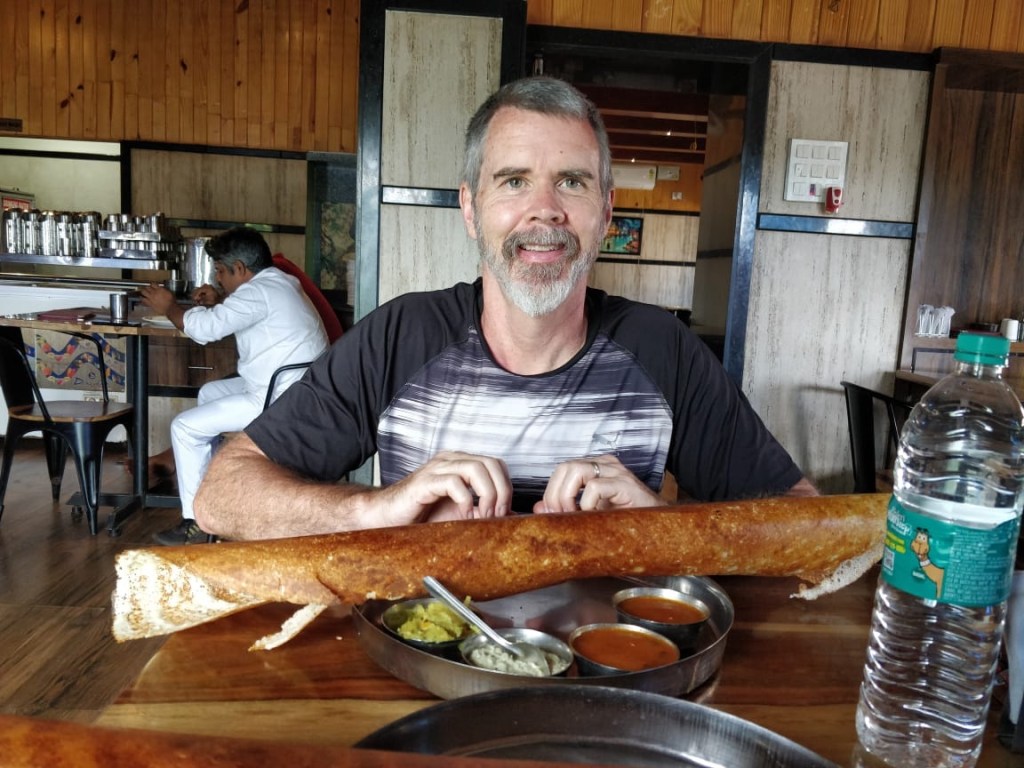
Completely depends on where I am at the moment. Here, in South India, it’s a paper masala dosa.

But [for example] in Budapest it’s túrós csusza, in Bangkok it’s pad thai, in Bombay it’s vada pav, and in Vajrayana Buddhist areas it’s momo.
BOOK REVIEW: Made in Chicago by Monica Eng & David Hammond
Made in Chicago: Stories Behind 30 Great Hometown Bites by Monica EngMy rating: 5 of 5 stars
Amazon.in Page
Release Date: March 21, 2023
Chicago is a food city. Once famous for its stockyards and still a major transit point for the products of America’s breadbasket, the city is home to a diverse people, a gathering of migrants and immigrants who brought a wide variety of foods from their homelands and put the necessary twists on them to make them salable to Chicagoans while using available ingredients. This book features entries on thirty foods and beverages that are products of Chicago ingenuity, be they dishes that were wholly invented in the Windy City or one’s that have a distinctive Chicago-style variant. Foodies know exactly what is meant by Chicago-style hot dogs, pizza, or tamales.
If all you know about Chicago cuisine is that ketchup on a hot dog is considered a sin, you’ll learn about some colorfully named Chicago inventions such as: “the Jim Shoe,” “the Big Baby,” and “the Mother-in-Law,” as well as many others that are more prosaically named, if equally calorically dense. One also sees the mark of Chicago’s immigrant story in the Akutagawa, Flaming Saganaki, Gam Pong Chicken Wings, the Maxwell Street Polish, and Chicago Corn Roll Tamales.
Each chapter discusses the nature of the respective dish, its influences, the [often contentious] origin of each item, where one can obtain said dish, and (for most) includes a recipe for making one’s own home variant. So, it’s mostly food history, but with a bit of cookbook, as well. There are pictures throughout, of the foods and in some cases of the location that invented or popularized each dish.
Be forewarned, while Chicago is a city that loves food, it’s not a place that’s wild about nutrition or moderate serving sizes. In fact, I feel certain that many people attempting to consume every item in this book in, say, one month’s time would drop dead of a coronary shortly thereafter (if not during.) Most of these dishes are foods done fast and served with an allowance of fat, sugar, and / or meat suitable for a family (for several days.)
If you’re a traveler (or a Chicagoan) and want to know more about quintessential windy city foods and where you can sample them, you must read this book.
View all my reviews
BOOK REVIEW: Real Food Fermentation, Revised and Expanded by Alex Lewin
Real Food Fermentation, Revised and Expanded: Preserving Whole Fresh Food with Live Cultures in Your Home Kitchen by Alex LewinMy rating: 5 of 5 stars
Amazon.in Page
Out: December 21, 2021
This is an expanded edition of a book that explores the process of fermenting a wide range of foods and beverages, including – new to this edition – sourdough bread. It’s a great book for a neophyte such as myself as it covers all the basics without getting too arcane (though it does include natto and some other regional foods that may not be widely familiar.) The book provides step-by-step instructions for making sauerkrauts (and variations such as Kimchi,) yoghurt & kefir, fermented fruit condiments, beverages (alcoholic and non-,) bases / starters (e.g. vinegar,) and sourdough products (including, but not limited to, bread.) It describes some of the challenges one may run up against as well as showing what equipment one will need. It also proposes some of the ways a curious person might experiment with variations.
Color photos are used to clarify the production processes as well as to show appetizing finished products that will whet one’s appetite.
If one is looking to get into a narrow domain of fermentation, e.g. making beer or other alcoholic beverages, one may want to look elsewhere for a more specialized and in-depth guide (of which there are many.) However, this book may introduce one to ideas for brewing adventures one wouldn’t have otherwise considered.
This book is an awesome choice for someone looking to get into or to expand their food fermentation activities. It’s well-organized, beautifully presented, and – as I mentioned – not overwhelming. With the mounting evidence of the benefits of fermented foods, this is a great guide to learn more about how one can best begin producing such foods at home.
View all my reviews