BOOK: “Masala Lab” by Krish Ashok

Masala Lab : The Science of Indian CookingMasala Lab : The Science of Indian Cooking by Krish Ashok
My rating: 4 of 5 stars

Publisher Site – Penguin

Many books have come out in recent years that explore the intersection of science and cooking, but this is one of the few that I’ve seen take on the sub-theme of science’s role in a particular cuisine — in this case Indian. Indian food, while broad and diverse itself, does present a unique palette of considerations. Few cuisines can make claims to the same level of complexity as Indian with all its spices and such. Also, Indian food tends to use heat to a different extent / in different ways than other cuisines, which is partly why, while Indian food is as tasty as food gets, aesthetically it tends toward a visually unappealing gloopy-gloppyness.

Ashok examines what applied heat does to food and why, how flavors are balanced and enhanced and why, what acids do and why they are essential, what value added is gained by pressure cookers and other specialty equipment, and how an experimental approach can be taken in lieu of a recipe book? The book takes a few controversial stances, such as in favor of sodium bicarbonate and MSG, but to a large extent is a straightforward discussion of how science informs culinary technique and ingredients.

The author maintains a light and readable tone throughout the book. I’d recommend this book for readers interested in the intersect of science and food, doubly so if one has a particular interest in Indian food.

View all my reviews

PROMPT: Meal Price

What’s the most money you’ve ever spent on a meal? Was it worth it?

Probably about $50 USD.

No. Definitely not. I don’t have fancy tastebuds, so all my system can differentiate is how much pride they are taking in putting such scant portions of edible matter on the plate. I do not find pride filling.

PROMPT: Foods

Daily writing prompt
What foods would you like to make?

Of late, I’ve thought it would be fun to learn to make some of my Chinese favorites — e.g. Kung Pao Chicken (宫保鸡丁,) Twice-Cooked Pork (回锅肉,) and Sesame Chicken (芝麻鸡.)

PROMPT: Meat

What are your feelings about eating meat?

The condensed version is, I’m fine with it. As a traveler, I try to eat mostly things locals eat. While I don’t go to great effort or expense to sample the most rare and exotic foods, I’ve eaten snake in China, croc in Zambia, horse in Kyrgyzstan, and guinea pig in Peru. Anything that regular people eat where I’m visiting is fair game. [That is part of the process of breaking down the invisible barriers between us’s and them’s so as to not enter into the interaction with a feeling of superiority because: “my arbitrary cultural conventions are better than your arbitrary cultural conventions.”]

I do believe that everyone would be better off if they were closer to [i.e. more intimately familiar with] the source of their food. I feel this of myself as well, though I did have the benefit of growing up on a small farm and seeing at close range the origins of food and how life moves on to being food. (By different mechanisms [hopefully — #SoylentGreenIsPeople,] it’s a process that I am fully aware will apply to me, as well. Ultimately, nothing living gets out of this world without being transformed through a process of being food. In my case –probably — I’ll be food to bacteria and fungi, but if I have a good run and am eaten by a tiger or wild dogs, I’d not begrudge them the meal.)

In fact, as I’ve learned more about how plants and trees live, e.g. sending warning pheromone signals to neighboring trees when under attack by insects, I’ve come to see the logic by which people determine what life is edible and what isn’t as mere species-chauvinism and anthropomorphizing. It is true that there are excellent points about the environmental benefits of some form of vegetarian diet. However, when one starts to talk to environmental vegetarians about eating insects (one of the most sustainable protein sources available, supposedly,) many will shove their fingers in their ears and sing, “La-la-La-la, I don’t want to hear this.”

PROMPT: Comfort Foods

What’s your go-to comfort food?

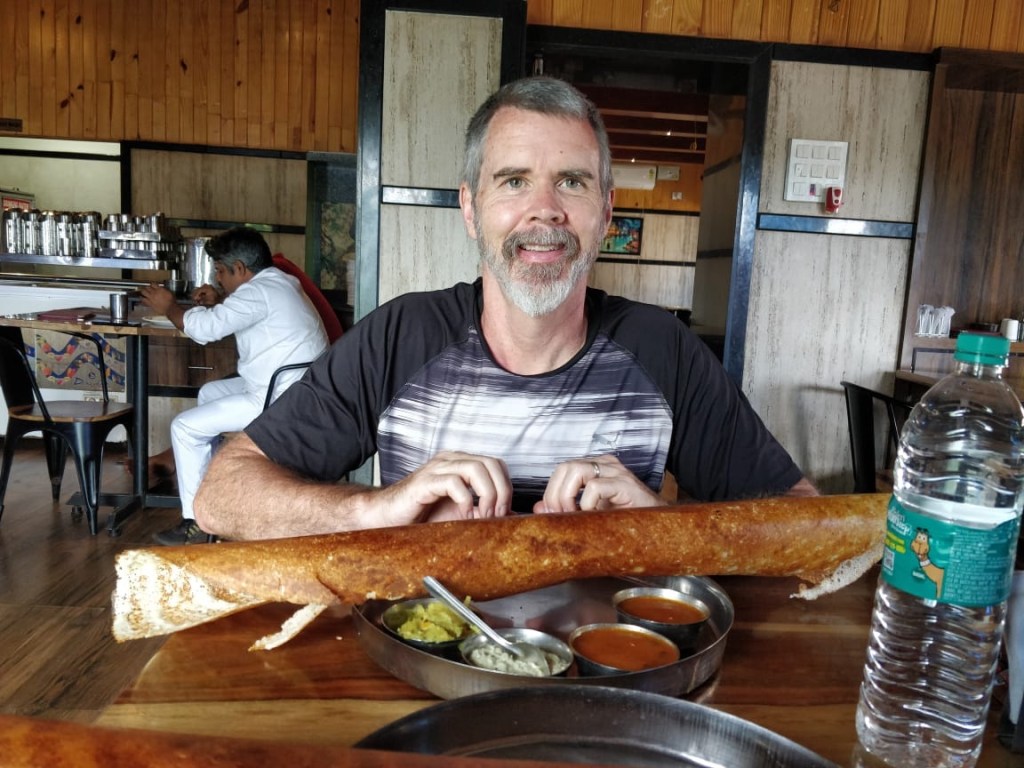
Completely depends on where I am at the moment. Here, in South India, it’s a paper masala dosa.

But [for example] in Budapest it’s túrós csusza, in Bangkok it’s pad thai, in Bombay it’s vada pav, and in Vajrayana Buddhist areas it’s momo.

BOOK REVIEW: Made in Chicago by Monica Eng & David Hammond

Made in Chicago: Stories Behind 30 Great Hometown BitesMade in Chicago: Stories Behind 30 Great Hometown Bites by Monica Eng
My rating: 5 of 5 stars

Amazon.in Page

Release Date: March 21, 2023

Chicago is a food city. Once famous for its stockyards and still a major transit point for the products of America’s breadbasket, the city is home to a diverse people, a gathering of migrants and immigrants who brought a wide variety of foods from their homelands and put the necessary twists on them to make them salable to Chicagoans while using available ingredients. This book features entries on thirty foods and beverages that are products of Chicago ingenuity, be they dishes that were wholly invented in the Windy City or one’s that have a distinctive Chicago-style variant. Foodies know exactly what is meant by Chicago-style hot dogs, pizza, or tamales.

If all you know about Chicago cuisine is that ketchup on a hot dog is considered a sin, you’ll learn about some colorfully named Chicago inventions such as: “the Jim Shoe,” “the Big Baby,” and “the Mother-in-Law,” as well as many others that are more prosaically named, if equally calorically dense. One also sees the mark of Chicago’s immigrant story in the Akutagawa, Flaming Saganaki, Gam Pong Chicken Wings, the Maxwell Street Polish, and Chicago Corn Roll Tamales.

Each chapter discusses the nature of the respective dish, its influences, the [often contentious] origin of each item, where one can obtain said dish, and (for most) includes a recipe for making one’s own home variant. So, it’s mostly food history, but with a bit of cookbook, as well. There are pictures throughout, of the foods and in some cases of the location that invented or popularized each dish.

Be forewarned, while Chicago is a city that loves food, it’s not a place that’s wild about nutrition or moderate serving sizes. In fact, I feel certain that many people attempting to consume every item in this book in, say, one month’s time would drop dead of a coronary shortly thereafter (if not during.) Most of these dishes are foods done fast and served with an allowance of fat, sugar, and / or meat suitable for a family (for several days.)

If you’re a traveler (or a Chicagoan) and want to know more about quintessential windy city foods and where you can sample them, you must read this book.


View all my reviews

BOOK REVIEW: Real Food Fermentation, Revised and Expanded by Alex Lewin

Real Food Fermentation, Revised and Expanded: Preserving Whole Fresh Food with Live Cultures in Your Home KitchenReal Food Fermentation, Revised and Expanded: Preserving Whole Fresh Food with Live Cultures in Your Home Kitchen by Alex Lewin
My rating: 5 of 5 stars

Amazon.in Page

Out: December 21, 2021

This is an expanded edition of a book that explores the process of fermenting a wide range of foods and beverages, including – new to this edition – sourdough bread. It’s a great book for a neophyte such as myself as it covers all the basics without getting too arcane (though it does include natto and some other regional foods that may not be widely familiar.) The book provides step-by-step instructions for making sauerkrauts (and variations such as Kimchi,) yoghurt & kefir, fermented fruit condiments, beverages (alcoholic and non-,) bases / starters (e.g. vinegar,) and sourdough products (including, but not limited to, bread.) It describes some of the challenges one may run up against as well as showing what equipment one will need. It also proposes some of the ways a curious person might experiment with variations.

Color photos are used to clarify the production processes as well as to show appetizing finished products that will whet one’s appetite.

If one is looking to get into a narrow domain of fermentation, e.g. making beer or other alcoholic beverages, one may want to look elsewhere for a more specialized and in-depth guide (of which there are many.) However, this book may introduce one to ideas for brewing adventures one wouldn’t have otherwise considered.

This book is an awesome choice for someone looking to get into or to expand their food fermentation activities. It’s well-organized, beautifully presented, and – as I mentioned – not overwhelming. With the mounting evidence of the benefits of fermented foods, this is a great guide to learn more about how one can best begin producing such foods at home.


View all my reviews

BOOK REVIEW: Dare Eat That by Divya Anand

Dare Eat That: A Guide to Bizarre Foods from Around the WorldDare Eat That: A Guide to Bizarre Foods from Around the World by Divya Anand
My rating: 4 of 5 stars

Amazon page


This book takes one on a journey, sampling exotic foods of the world. The author describes experiences eating bizarre dishes in nine countries: the US, India, the UK, Luxembourg, Thailand, Australia, Cambodia, Vietnam, and Singapore. The foods include insects, balut, reptiles, game animals and fowl, and a wide range of seafood (including blowfish, a type of sushi prepared with surgical precision to avoid tainting the meat with a lethal poison.)

The book is organized by country in the order listed above. Some countries have many sub-chapters and others have as few as one depending upon how extensive the travels and how much unusual food was on offer. The book presents tables for each dining location, showing the cost, taste, and “fear factor” for each of the exotic dishes. Of course, the taste and fear ratings are inherently subjective. I know, among the items I’ve eaten, my subjective ratings would often be a little different. However, there is an inescapable cultural — as well as individual — bias to such ratings. By cultural bias I don’t just mean at a country level, but if you grew up in a coastal region versus a landlocked one, your ratings would probably vary considerably. That said, I thought it was a nice way to give the reader a quick insight into the experience of each food.

The biggest disadvantage of this book is that the experience is once removed. That is, the author is mostly reporting her spouse’s experience. As a vegetarian who shifted to eating chicken, she tried very few of the foods first hand (though, among those she did try was durian melon – proving she’s not a coward, because durian is nastier than much of the insect, seafood, and game food.) Still, because of this distance from the experience, the description could probably be more vivid in places. On the other hand, there is an amusing tension created between the husband who is an intense bizarre food foodie and the author who is squeamish about meat markets that adds to the entertainment value of the book.

Besides the aforementioned tables, the book is loaded with pictures — including a section of color plates — and has maps and diagrams as well.

I found this book interesting, readable, and – as a traveler – a potential reference source. If you’re a traveler and / or interested in exotic cuisine, you should check it out.

View all my reviews

BOOK REVIEW: Food: A Very Short Introduction by John Krebs

Food: A Very Short IntroductionFood: A Very Short Introduction by John R. Krebs
My rating: 4 of 5 stars

Amazon page


This volume in the Oxford University Press AVSI series examines human eating habits. The first chapter puts the human diet in the context of evolution, reflecting upon how we got where we did in terms of food consumption. Here one gains insight into where the Paleo-diet fad is flawed, and one learns how cooking had a huge influence on human evolution.

The second chapter delves into the issue of likes and dislikes in food. We see that there are species-wide commonalities, but there are also differences both at an individual and cultural group level. e.g. Why is spice so common in the tropics and so rare in the great white north?

The third chapter looks at the ways food can do us in and what we’ve done – besides [and including] the aforementioned cooking – to reduce the threat of food gone awry. The penultimate chapter examines nutrition and how we get what we need from food.

The last chapter takes a bit of a turn, but investigates the fascinating topic of how (and whether) we will continue to feed our species. Readers will likely remember the name Malthus from either history or economics classes. He was an economist who suggested humanity was in dire straits, vis-à-vis food. Malthus noticed that population was growing geometrically while agricultural output grew arithmetically, and he reasonably noted that this was unsustainable. Of course, Malthus failed to foresee the huge technological advances from fertilizer to mechanization. However, that doesn’t make his concerns forever moot – perhaps just tardy. It remains far from clear whether the limited land space and resources can take billions more humans – especially without killing off all the other species. (Especially, if we aren’t willing to give up eating resource-intensive foods like cow in favor of less intensive one’s like grasshopper.)

The book has some graphics as well as both a “references” and a “further reading” section.

If you’re interested in food in a general sense, I’d recommend this as a great way to take in the outline of the topic.

View all my reviews

5 Awesome Street Foods [You Should Have Already Tried]

5.) Vada Pav (Potato [fritter] on a bun): India

Tip: Try it in Mumbai. While the one’s shown above were fine. The legendary Vada Pav is to be found at a stall across from Flora Fountain in Bombay.


4.) Pad Thai (Noodles Thai Style): Thailand

Tip: Vegetarians beware. Fish sauce is a standard ingredient in this dish. So if you order it vegetarian, it’s not just the prawns and / or chicken one needs to be wary about–depending upon how strict one is. Soy sauce is the substitute.


3.) Kürtőskalács (Chimney Cake): Hungary

Tip: It can be found at little stands in or near Christmas markets during the winter season. Buy it hot when it’s cold outside, and it will actually steam like smoke rising from a chimney. If  you’re in Hungary during the summer or you want a savory street food, try lángos .


2.) Banh Mi: Vietnam

Tip: Try this sandwich on a baguette from Banh Mi 25, a famous cart at 25 Hàng Cá, Hàng Đào, Hoàn Kiếm in Hanoi.


1.) Momo (Dumpling): Tibet, Ladakh, and anywhere displaced Tibetans reside.

Tip: Try the spinach and cheese momo of The Wok Tibetan Kitchen on Main Bazaar Road in Leh.


Bonus: Masala Dosa: India, particularly in the South

Tip: If you ask for a “Paper Masala Dosa” you’ll probably get something too big to fit on a plate (as shown.) It will be very thin and the potato-based filling will only be in the central part. (So it’s not quite as insane an amount of food as it may appear.)  This one is from Airlines Hotel in Bangalore. Dosa is just the Indian version of a pancake, and it can take many shapes and forms. There are a few varieties, but often it’s a rice & lentil-based rather than wheat-based flour.