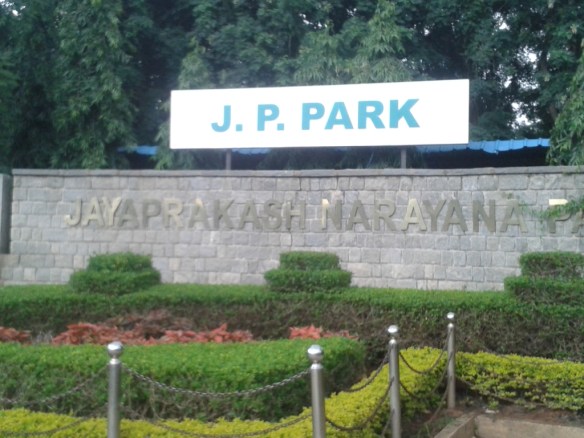


Taken on August 19, 2017 in Bangalore
 On Looking: Eleven Walks with Expert Eyes by Alexandra Horowitz
My rating: 5 of 5 stars
This is a field guide to getting the most out of walks in the city; though it’s presented through a series of essays. City-centeredness is the book’s niche. There are tons of books that teach one how to get more out of the subtle signs and signals seen in nature, but we tend to miss the nature (and a good deal of the culture) in our city walks because we view them in a utilitarian fashion and because there is so much shouting for our attention that it’s easy to miss nature’s subtle cues.
The book consists of 12 chapters—each of which is organized around a city walk. Eleven of these walks are with experts who offer the author (and her readers) greater insight into some dimension of the city walk experience that is often lost to the limits of our attention. When I use the word “expert,” I use it broadly. The reader may find some of these individuals more worthy of the title “expert” than others—e.g. two among them are the author’s 19 month old son and her dog—but they all offer a unique insight. [You may recognize the author’s name from a popular book she wrote on dog behavior, and that’s a particular area of interest for her.] Others are the kind of experts that might testify in court or be asked to give a consultation at a corporation. Along the way, Horowitz inserts more general information on the psychology and science of human attention–and its limits—as is relevant to the larger discussion.
The twelve chapters are organized into three parts. The first part deals with the inanimate dimension of the city. Its four chapters deal with the things that children notice owing to either their height or their unjadedness, the natural materials of the city (rocks and biomass), fonts and signage, and the under-appreciated ordinary.
The second part explores the animate part of the city, including insects, animals, and humans. The reader will learn that–despite the fact that they may only see the occasional bird or squirrel—the city is teeming with non-human fauna. The two chapters that deal with humans take quite different perspectives. One is with the Director of the Project on Public Spaces, an expert on how cities are organized (by planning, organically, and by default) and the effect that this has on people and their movement through cities. The last chapter in this part is by a doctor whose expertise is making diagnoses in the style of Sherlock Holmes by means of close observation of the minutiae of a person’s appearance and posture.
The final part is about the sensory experience of a city walk. The first chapter in this section details a walk with a blind woman who is attuned to moving about the city using her other senses. There’s a chapter with an expert on sound, and the walk she takes with her dog—whose experience is largely informed by its olfactory sense. The last chapter is a short summation of what the author has learned and begun to apply in her own solo walks.
The book has few graphics, e.g. depictions of relevant art. There are source citations arranged by chapter in end-note form.
I found this book to be intriguing and beneficial. I think we could all benefit from city walkers who were more tuned in to what was going on around them. (Sadly, the trend seems to be going the other way.) I’d recommend this book for anyone who likes to take a walk, and nature lovers may find it unexpectedly fascinating.
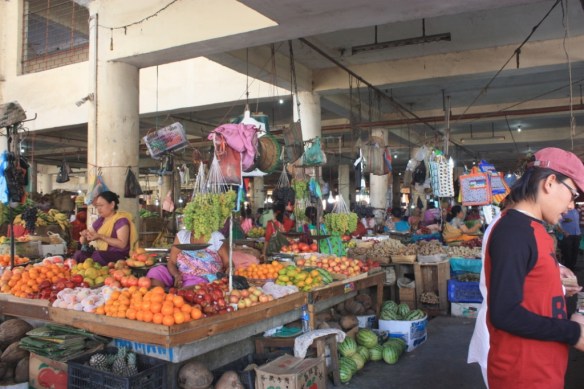
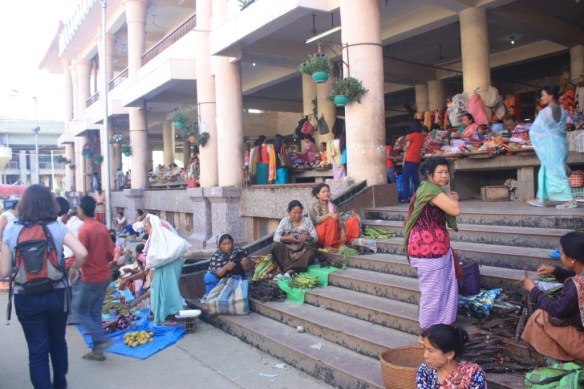
Taken on May 5, 2017 in Imphal, Manipur
Ima Market (a.k.a. Khwairamband Bazar, or “The Women’s Market”) is a sprawling bazaar in the center of Imphal. Here one can purchase: ghost chilies, melons, fish (dried or fresh), bangles, machetes, wicker baskets, incense, and much more all under one roof and sold exclusively by female merchants.

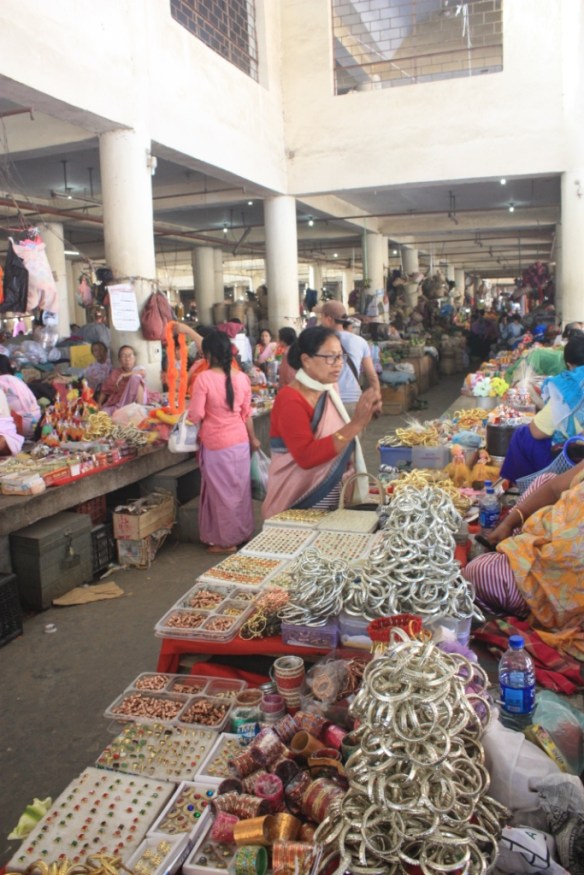

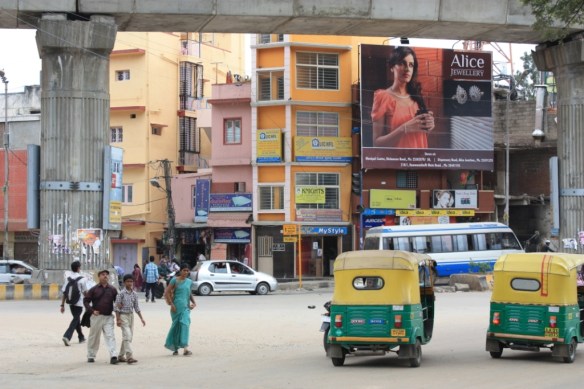
Taken in September of 2013 in Bangalore
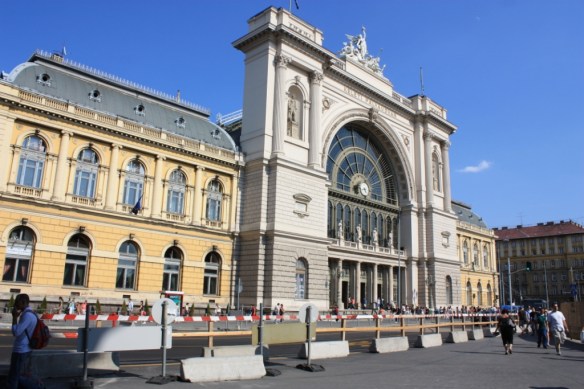
Taken in the summer of 2014 in Budapest
 Askew: A Short Biography of Bangalore by T. J. S. George
My rating: 4 of 5 stars
Bangalore (properly, now Bengaluru) has been my home for the past 3+ years, and I can tell you that it’s a strange and unique city. It has a population of about 10 million, but the surprising part is not the population but rather that half of those millions came over 10 to 12 years. On one hand, this makes Bangalore a chaotic place. I live in the area near the centers of both the Karnataka and the city government, but it can’t be called a city center in the sense that most cities have a central business district. I suspect that residents of Indiranagar, Kormangala, Jayanagar, and many other neighborhoods feel they have as much claim to call themselves the city center as does my neighborhood.
On the other hand, the reason that there has been such an influx is because this is India’s Silicon Valley and that means that Bangalore is (or at least seems) more affluent, well-educated, and cosmopolitan than much of India. I’ve often termed it “India Light” in that all the problems that one associates with India (soul-crushing poverty, rampant disease, etc.) are of a lesser scale in Bangalore. People often ask me whether I get sick a lot living in India, and I can honestly say that Bangalore has never given me a case of intestinal distress more substantial than I got from any given trip to Taco Bell in America, and I’ve delighted in the street food of VVpuram on several occasions. [Whereas a two-day trip to New Delhi nearly killed me.] And, of course, Bangalorean weather is perfect year-round (if you’re saying, “No, it’s not!” that means you’re a Bangalorean who has never spent an extended time period anywhere else in the world–excepting maybe San Diego or parts of the Mediterranean.)
That explanation of my Bangalorean credentials aside, even living in the city for several years, one can feel like a stranger to it. An ex-pat’s insight is much more in-depth than a tourist’s, but remains much less than a local’s. That’s one of the reasons I found this book intriguing. There are a number of books on Bangalore that present sunny travelogues of the city, but not so many that investigate the grittier underside of life. If anything, George inflates the ugly side of the city. He devotes a lot of space to topics like racial violence and gangsters. It’s nothing personal. His theory, suggested by the Introduction, is that any city that grows too big has the wheels roll off in one way or the other—though he also suggests other cities have proven better at fixing the problems of [over-]growth. Still, the author occasionally he comes across as curmudgeonly, with a “back in my day everything was sunshine and roses” kind of attitude.
As the subtitle suggests, this is a short book—less than 100 pages divided among five chapters. The organization of the chapters is not chronological but thematic. The first chapter explores Bangalore from the perspective of the influx of newcomers and the pull and push factors that bring them. This includes both the educated middle-class who’ve come to advance professional careers as well as the less fortunate immigrants who’ve sometimes found themselves victimized as outsiders. (You may wonder how I—as a foreigner—could remain unaware of the extent of racial and xenophobic violence in this city. To understand this one has to understand the long-shadow of biases rooted in colonialism and caste hierarchy. You may get a clue by looking into the reaction to Nina Davuluri winning the Miss America title in 2013. While most Indians, I suspect, were proud of her by way of connection to ethnic heritage [she’s American by birth—much to the confusion of the American nimrods commenting on her victory], it spawned a whole debate about whether she could have one Miss India if she were an Indian citizen given her darkish skin tone. Of course, those Indian dimwits don’t even hold a candle to the American dimwits who ranted against her victory.)
Chapter 2 investigates the role of defective governance in Bangalore’s plight. In many ways this is the heart of the argument that Bangalore is uniquely dysfunctional. Corruption in the presence of huge wealth has created ideal conditions for myopic and self-serving activities that often bite the citizenry square in the backside.
Chapter 3 focuses largely on the culinary history of the city, which means a lot of discussion of MTR, CTR, Koshy’s, and some of the longstanding hotel [restaurants] as well as the individuals behind these institutions.
Chapter 4 contrasts the life of two of the privileged heirs of Bangalore. The two men in question are Siddhartha Mallya and Rohan Murty. The former is of the family of the United Brewing and the later of Infosys. Mallya is the presented as the outsider who could never make roots in Bangalore or the family business and Murty is the insider whose roots are grown into Bangalore and who managed to make a place for himself despite a pact by the Infosys founders that they wouldn’t become a nepotistic venture.
The last chapter is about the intellectual and artistic dimensions of Bangalore, including discussion of bookstores and theaters of note.
As I mentioned, this book doesn’t give one a complete picture of Bangalore. Pardon for appropriating the title to my own purposes, but if this is one’s only introduction to Bangalore than one’s view will be askew. However, when read in conjunction with other sources of information, “Askew” can offer balance as well as nuanced insight into specific issues that might not be covered elsewhere (e.g. food and bookstores.)
There is a conservative-old-man-of-India viewpoint that skews the book’s discussion that will make it seem quite right to that same demographic but off-kilter to others. One example of this is that there seems to be a suggestion that alcohol is a major source of Bangalore’s problem. However, one sees all manner of vice in cities that are both better governed and less dysfunctional as cities—e.g. Amsterdam and Bangkok. For that matter, alcohol is a more prominent fixture in pretty much every European city than it is in Bangalore. So I had trouble buying that viewpoint, which also seems to inform the vilification of the Mallya family (as opposed to the much vaunted Murty family.) Another example is that while an entire chapter is devoted to comparing those two sons, the daughters barely merit a line or two.
All and all, I’d recommend the book as a balance point to other sources of information.