Mindfulness Meditation: Why be Mindful?

IMG_0430“Why be mindful?” That was the question asked to the group assembled at the Thubten Lekshey Ling Tibetan Buddhist meditation center on Sunday.

We had just completed a couple of rounds of mindfulness meditation. We’d been told that there are four themes of mindfulness meditation, but there can be variations on each. First, there is mindfulness of the body. This was the first type of meditation that we practiced. It isn’t about recognizing the body as an object so much as a field of perceptions.

Second, there is mindfulness of one’s feelings or sensations, in other words, mindfulness of the outside world as perceived by our sense organs. We did a meditation in which we were mindful of sound in particular. The key, we were told, was to hear everything–even the sound of silence. “Listening to the sound of silence” may sound like an oxymoron, but it makes sense as one experiences it. When one thinks in terms of hearing sounds, one begins to actively try to “catch” a sound. One may even try to anticipate sounds, particularly sounds in series–like a roofer using a nail-gun on a nearby roof. This active listening, rather than hearing, is not what one wants.

We also did a mindful eating/tasting exercise. We ate a tiny bit of snack mix. The whole processing taking many times what it normally does to shovel a bit of snack into one’s mouth and wolf it down. The food was raised to one’s face, experienced, placed in one’s mouth, experienced, chewed, experienced, and swallowed.

Third, there is meditation on the mind. That is, one watches one’s thoughts. We didn’t do one of these meditations. However, I’ve tried it in the past, and I find this particularly difficult . Watching thoughts go by as if they were rising bubbles or logs floating on a river suggests a division between the observing mind and the thought-producing mind. Recognition of the thought intrudes upon it, and this becomes a whole new line of thought.

Finally, there is meditation on emotion. We did not do one of these in this session either.

Our final meditation was another type of meditation on the body, but it was a moving meditation. We walked and experienced the motion of the body as it moved through the room. I particularly enjoyed this.

However, before the last meditation, we discussed this question of “why be mindful?” I had my own ideas, which I shared. Others had their own ideas, some closer and others farther from my own thinking, but all thought-provoking and valid.

My own thoughts were two-fold. First, mindfulness allows one to be more stable and grounded. Fear is about the future and anger and sadness are about the past. In the present one is neither afraid nor fearful. Second, by being mindful, we can come to see problems before they tumble out of control. We can catch our angry thoughts and dissect them before they do us harm. We can recognize the subtle problems with our bodies before they come full-blown ailments.

Of course, as a martial artist, I had always thought in other terms about mindfulness. There’s no time at the speed of combat to consciously recognize and consciously respond to attacks, one must be mindful to have any hope of surviving a surprise attack.

My First Tibetan Buddhist Meditation & Lecture

Having settled into life in India over the past month, I’m now getting around to some of the self-enrichment activities I’ve planned on taking advantage of here in Bangalore. Today I attended a meditation session and discussion/lecture at the Thubten Lekshey Ling Tibetan Buddhist Meditation Center. I’ve read a few books on Buddhism and even one or two specific to Tibetan Buddhism, but this was my first time attending such a session. Also, while I’ve done several kinds of secular meditation, both in a group and individually, this was my first exposure to guided meditation in the Tibetan Buddhist tradition.

The title of the session was As the Clouds Drift by… The first hour was the meditation portion and the following two hours were the lecture / discussion portion. The session opened with a few prayers that were chanted in what I believe was Sanskrit, but there was an English translation for newbies such as myself to follow along with the meaning. Then we did a few short meditations that were much like others that I’ve done: meditation on breath and meditation on bodily awareness. Then there was a visualization as we read a sutra in English.

Transitioning into the discussion and lecture portion, we first discussed the meaning of life. No, I’m not making that up. While it might seem like a hackneyed question, some intriguing points were raised. We were directed to think of the question as having two alternative meanings. First, why am I here? Second, what is my purpose? The conversation gravitated to the latter topic. I’m not sure if this was because there was a consensus that the question “why am I here?” is meaningless, or if the question of purpose was just more intriguing. There were various opinions about whether there was a purpose, and–if so–whether it is universal or individual-specific.

After a brief tea break, the remainder of the session involved readings from The Way of Bodhisattva followed by analysis and prompted discussion. Much of the discussion revolved around the issue of how compassion is expressed and the difficulty (or ease) of being a Bodhisattva. (A Bodhisattva is one who seeks enlightenment out of compassion for all sentient beings.)

I found the session to be thought-provoking and beneficial, and thought the atmosphere was conducive to growth. Emphasis was placed on discussion rather than straight lecturing. I will no doubt be back to visit in the future.

I did learn something interesting about myself through the process of the class, and that’s that I need to learn to be still for more than two hours. While there was no prohibition on moving around–particularly beyond the meditation portion– in an effort to not be a distraction, I tried to keep fairly still. I practically ran home afterwords. I had all this pent-up energy. I would have thought myself better than average at sitting in a contemplative state. I’m a writer for goodness sake. I spend entire days at my computer. However, in truth, I rarely sit more than an hour without getting up and stretching or doing some sort of movement to limber up my body and get the blood flowing. I was raised Catholic, and so I’m not new to sitting quietly for long periods of time. Though that was a long time ago. I also have three college degrees and have spent more than my fair share of time in classrooms, but the wandering mind is not discouraged in that environment–in a way it’s encouraged.

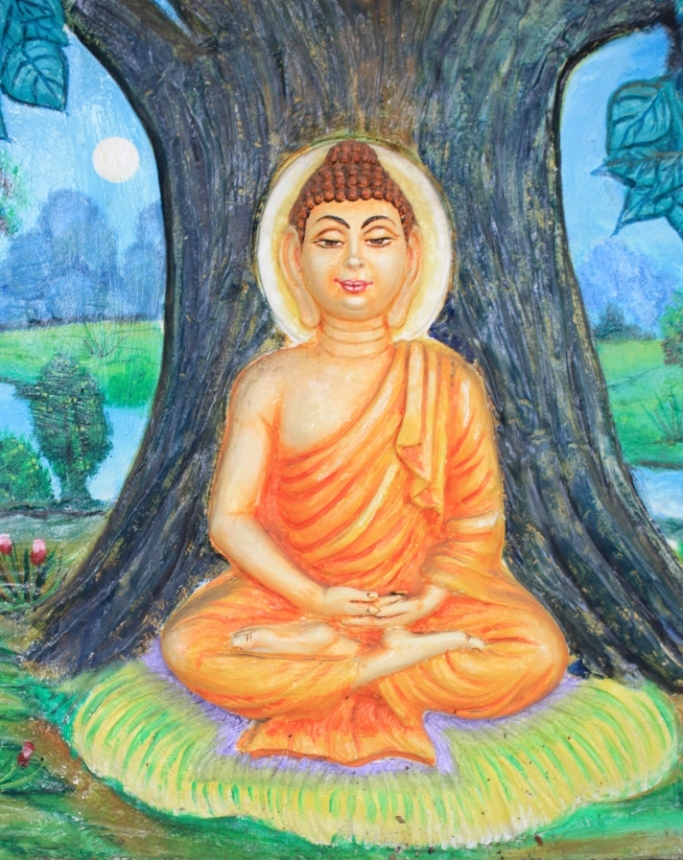
DAILY PHOTO: Buddha Under the Bodhi Tree

Taken September 24, 2013 at the Mahabodhi Society Temple in Bangalore

Taken September 24, 2013 at the Maha- Bodhi Society Temple in Bangalore

There are a whole series of these brightly colored bas-reliefs in recesses in the exterior wall at the Mahabodhi Loka Shanti Buddha Vihara, which is a temple run by the Maha-Bodhi Society. This society was founded by a Sri Lankan monk with the intention of bringing Buddhism back to India. While Buddhism was founded in India, there had been a long period of decline of individuals self-identifying as Buddhists.

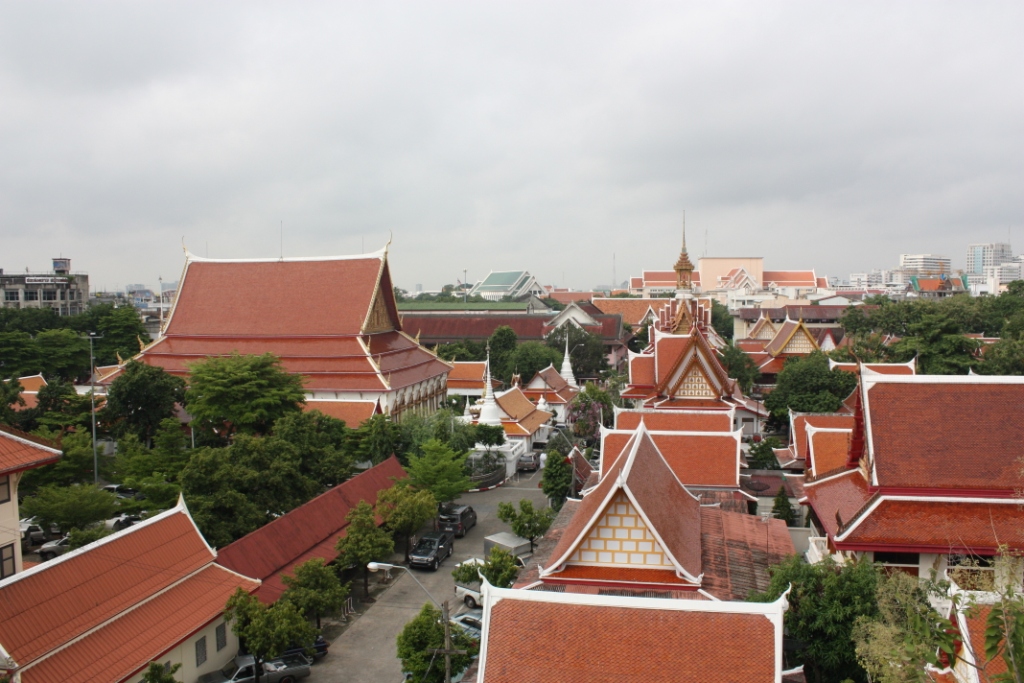
DAILY PHOTO: The Wat Chana Songkhram Complex

Taken October 2012

Taken October 2012 from atop the Rambuttri Village Inn.

BOOK REVIEW: Buddha by Karen Armstrong

BuddhaBuddha by Karen Armstrong

My rating: 4 of 5 stars

Amazon page

Karen Armstrong’s book is a biography of Siddhatta Gotama (a.k.a. Siddhartha Gautama), the man who became the Buddha. However, in the process of telling this man’s life story, she introduces the reader to the basic tenets of the religion he inspired.

Siddhatta’s story is an interesting one that many non-Buddhists know the gist of from the Herman Hesse novel entitled Siddhartha. As a boy, the Buddha-to-be was the son of a wealthy, high-caste man who attempted to shelter his child from all the ugliness of the world, e.g. poverty, disease, and death. Despite these attempts, the young man eventually sees the true world and realizes that he has been living an illusory life. Ultimately, the young man abandons his comfortable life in search of an enlightened view-point.

The Buddha’s life is what one might call “novel-shaped.” That is, the arc of Siddhatta’s life as we know it is ideally suited to being conveyed as a story. It’s a warrior’s quest tale, but one of the mind rather than physical adventure. Armstrong’s book takes advantage of this arc and is arranged accordingly. The six chapters of the book are:1.) Renunciation; 2.) Quest; 3.) Enlightenment; 4.) Dhamma (the doctrines or teachings); 5.) Mission; 6.) Parinibbana (the final rest.)

Renunciation refers to Siddhatta’s abandonment of the world he knew. The quest describes his life as he strikes out in an attempt to become enlightened. The third chapter outlines how he came upon enlightenment. This might have been the conclusion of the story of the man, but that’s when the story of the Buddhist religion becomes entwined with the story of the Buddha. Chapters 4 and 5 deal largely with how the religion spread.

If one is looking for a good overview of Buddhism, Armstrong’s book is a good place to start. It’s readable, and, by tying teaching into the Buddha’s life story, interesting as well.

View all my reviews

DAILY PHOTO: Buddhist Shops Outside the Lama Temple

Taken in the Summer of 2008 in Beijing, China

Taken in the Summer of 2008 in Beijing, China

BOOK REVIEW: Zen Mind, Beginner’s Mind by Shunryu Suzuki

Zen Mind, Beginner's MindZen Mind, Beginner’s Mind by Shunryu Suzuki

My rating: 5 of 5 stars

Amazon page

This thin volume packs a great deal of knowledge about the Zen approach to the mind. It’s divided into three parts: right practice, right attitude, and right understanding. The first section is technical (e.g. posture, breathing, etc.); the second section is inspirational; and the third section is philosophical. This is consistent with the Zen priority of putting practice first and being cautious about philosophizing.

The core concept is captured by the book’s topic sentence, “In the beginner’s mind there are many possibilities, but in the expert’s there are few.” This sentence contains a valuable truth, but I can’t help but think that the related title probably hurt the book’s sales. Sadly, many people would rather read a book entitled “How to be a Zen Master in 90 Days.” Everybody wants to be an expert, and few are open to the lesson that they must look at the world through the eyes of a novice. I’ve noticed this in the martial arts. Most individuals seem to be much happier as mediocre black belts with only a few years of practice than they would be as a highly competent white belt. This, of course, is the lure of external validation, which is a weak salve for one’s private demons.

At any rate, the value of cultivating shoshin (i.e. beginner’s mind)is to avoid have one’s experience jaded or tarnished by one’s past. It’s about avoiding attachment to what one believes one knows, such that one is incapable of learning something new. It’s like that old, but popular, tale that is told in both the Zen Buddhist and Taoist traditions about a cocky, young student who comes to learn from a master and proceeds to tell the master all he has already learned. The master pours tea for the youth, and when the cup is full he continues to pour until the scalding liquid spills over into the kid’s lap. When the student angrily asks why the teacher did that, he is told, “Your cup is already full. In order to take in more you must first empty your cup.”

I enjoyed this book. It’s very readable. The chapters are concise and not the least bit arcane. The bits on practice are not bogged down in minutiae. As I indicated, this book covers a lot of ground. I would dare say that if you are only going to read one book on Zen in your lifetime, this is a suitable candidate.

View all my reviews