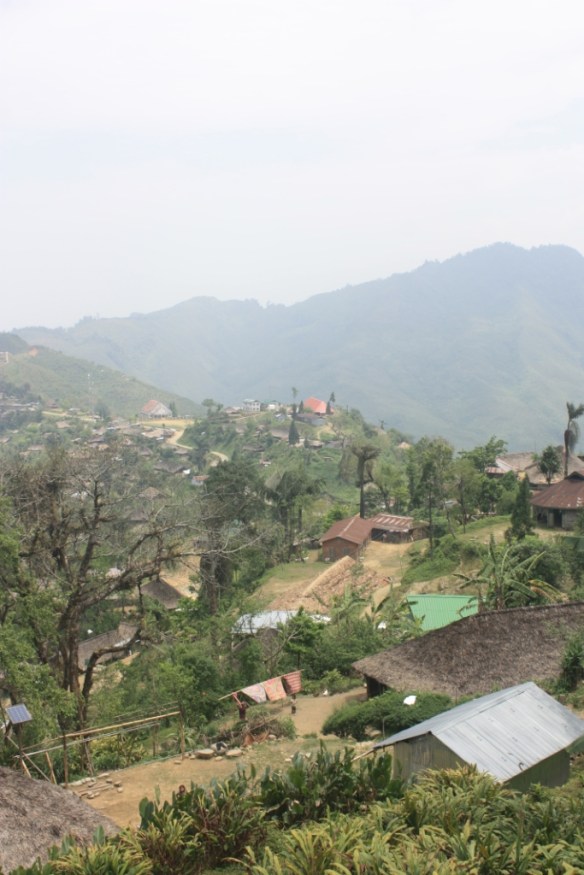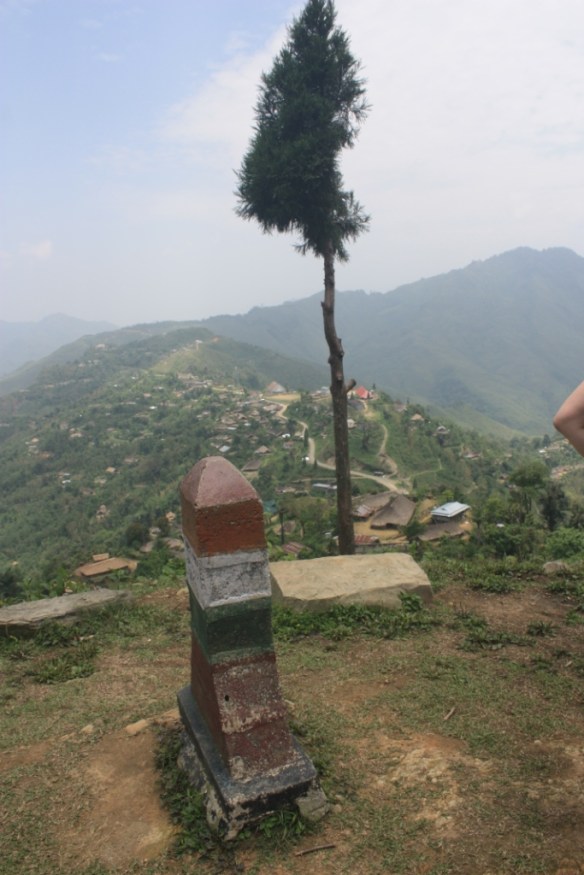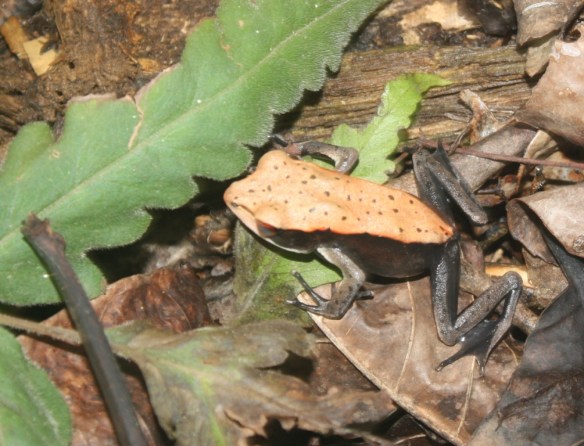
Taken on May 26, 2017 in Coorg


Taken on May 26, 2017 in Coorg
 Collected Poems 1947-1997 by Allen Ginsberg
My rating: 5 of 5 stars
This “collection” is actually 13 collections bound together in one volume that presents much of the published poetry of the Beat poet Allen Ginsberg over the second half of the 20th century—till his death in 1997. Ginsberg is probably best known for “Howl,” which is both the name of the third collection in this book and the poem for which it was named (i.e. “I saw the best minds of my generation destroyed by madness,…”) However, Ginsberg’s work is extensive, and one can find many a lesser known gem inside.
Ginsberg’s body of work isn’t just copious; it’s also highly varied stylistically. While Ginsberg most commonly uses free verse, he also uses rhyming / metered poems, shaped poems, variations on haiku, musical lyrics, and–in rare instances–prose form poems and puzzle poems.
While Ginsberg’s work is also thematically varied, there are a number of recurring themes. First, as one might expect of the author of “Howl,” Ginsberg’s work is highly politically charged. One gets a history review of the latter 20th century from reading this volume. Ginsberg rails against the war in Vietnam, against the Iran-Contra affair, and against alleged CIA drug dealing at home and abroad. It should be noted that while Ginsberg’s views are expectedly counter-culture, there isn’t the delusional glorification of the opposition that one often sees from many political writers. That is to say, as Ginsberg rebukes capitalists and conservatives, he also takes on the Soviets and other leftist regimes who engaged in human rights violations or war-mongering.
Second, as one might expect from the inspiration for Alvah Goldbook in Jack Kerouac’s “Dharma Bums,” Ginsberg frequently references Eastern spiritual traditions—notably Tibetan Buddhism and Zen. There are a number of poems set in places like Varanasi (Benares) and Siem Reap (Angkor) that reflect Ginsberg’s traveling exploration of these systems. Of course, Ginsberg was a traveler in general, and so there are a number of poems set in the Western Hemisphere and Europe as well. Ginsberg also writes a little bit on his birth religion, Judaism, but usually in a secular manner and sometimes while rebuking the actions of Zionists.
Third, there are many [mostly homoerotic] sex poems in the collection. For those who are sensitive about such matters, I don’t use the term “sex poem” as a sloppy substitute for the word erotica. These aren’t erotic love poems in the conventional sense, they are usually graphic and Ginsberg purposefully uses provocative, shocking, and sometimes lurid wording to evoke a response in the reader. If reading about Ginsberg’s sexual adventures will cause you emotional trauma, be forewarned.
There are end-notes that can be quite helpful, particularly if you’ve forgotten some of your 20th century history, are unfamiliar with Beat trivia (all of the characters from Kerouac’s “Dharma Bums” make an appearance), or aren’t familiar with the various yogic and Buddhist gurus who Ginsberg refers to. (The first set of notes oddly comes after the 10th collection. that’s because this collection is actually even more of a matryoshka doll than I suggested. The first 10 collections are actually collections inside a collection (“Collected Poems 1947 – 1980”) that’s inside a collection (“Collected Poems 1947 – 1997”.) The last three collections have their own end-notes immediately following them.
There are few graphics, mostly the music to poems that are—or can be—set to music.
I’d recommend this collection to poetry readers, particularly those who enjoy Beat period language. As I mentioned, the delicate political or sexual sensitivities of some readers may be offended. On the other hand, as I always say: If you’re not reading outside your comfort zone, you shouldn’t consider yourself so much educated as indoctrinated.
 The Doors of Perception and Heaven and Hell by Aldous Huxley
My rating: 5 of 5 stars
The two essays collected in this thin volume recount Aldous Huxley’s experience taking mescalin (a psychedelic drug / hallucinogen derived from a cactus root) in the 1950’s, and the insights derived from that experimentation. The book contains descriptions of what Huxley observed under the influence, such as the hallucinations of “sacred geometry” that are common among those consuming hallucinogens. However, much of these essays are about how what he witnessed mirrors art and the text of mystical religions. Huxley provides a steady diet of food-for-thought on these topics. It is when Huxley relates the psychedelic experience to the mystical, religious, and artistic experience that I found this volume to be the most intriguing. “The Doors of Perception” is a mix of description and discussion of these linkages. “Heaven & Hell” delves much more deeply into said linkages, and I was blown away by some of the ideas in the latter essay. There is also a bit of discussion of the commonalities between schizophrenia and psychedelic experience.
Huxley devotes some space in both essays to discussing the science of these experiences, but I don’t see those parts as the strength of the volume. While Huxley was a scientifically minded fellow, his reporting on science errors on some of the grand scale issues (e.g. memory, which is far more fallible than was thought in his day.) (Specific [small-scale issue] findings are probably accurate.) The thing is, Huxley was also a mystic and he viewed biology as a “reducing valve” that mitigated our experience of consciousness—a grand field existing wholly beyond the nervous system, such that our experience of it was hemmed in by biology—rather than being created by it. This isn’t particularly a criticism. For one thing, when one beholds the bold sensory experiences that Huxley witnessed and contrasts them to the visualization of everyday consciousness, it’s hard not to believe that one is on a plane entirely outside the bonds of biology. While I’ve never done psychedelic drugs, my limited experience with the more-real-than-real world of lucid dreaming makes me sympathetic to this long-held and widely held belief. Additionally, neuroscience was still in it’s infancy during Huxley’s time. [It may still be in its infancy, but a great deal has been learned—particularly since the technology of the 1990’s—that points to biology being the source of many of these experiences that seem amaterial.]
The two essays are each short. “The Doors of Perception” is about 50 pages, and “Heaven & Hell” is about 40. Even with the front matter and appendices, the book comes in at only a little over 120 pages.
There are no graphics in this volume, nor is it annotated—except for in-text references and a few footnotes. With respect to front matter, there is a Forward by J.G. Ballard and an Introduction / bio-sketch of Huxley by David Bradshaw. There are also a series of appendices that report on various topics related to mystical / psychedelic experiences such as the effects of CO2, strobe lights, and starvation, as well as the relationship to lighting, works of art, and mental illness.
If one is interested in alternate states of consciousness, I’d highly recommend this book. Huxley’s ability to capture his experience vividly and his thought-provoking suggestions about the experience make these essays worth the read.
 Lab Girl by Hope Jahren
My rating: 5 of 5 stars
This book is in part the autobiography of a female scientist with a career in a field that is both male-dominated and in which basic science is the meat and potatoes—by which I mean a discipline with few of the commercial applications at which companies, foundations, venture capitalists, and governments are willing to throw millions. Interspersed into the autobiographical chapters are short essays on trees and the ways they survive, grow, and interact with each other and their environments. So it’s a mix of biography and pop science, and was one of the most well-received science-themed books of last year (2016.)
The book is arranged into three parts. The first 11 chapters are entitled “Roots & Leaves” and these cover Jahren’s path to becoming a scientist from her childhood in an unexpressive Scandinavian family in rural Minnesota, through her college job in a hospital lab, and onto her graduate education. Part II consists of 12 chapters that cover Jahren’s years as a junior faculty member, most of which takes place at (my alma mater and former employer) Georgia Tech. The title of this chapter, “Wood & Knots,” gives one some indication of where the author’s story sits in this part of her life. She experiences both growth and set-backs during her time in Atlanta. The last part, “Flowers & Fruit,” describes the period in which not only her professional life, but also her personal life begins to bear fruit. During these years she moved her lab to Johns Hopkins, got tenure, built a family, and eventually moved to Hawaii to work for the University of Hawaii.
Besides Jahren, the only other major character in the book is her side-kick Bill, who was an undergraduate where she did her doctorate in California. The two met when Jahren was the Teaching Assistant for a course that Bill took, and subsequently he followed her from lab to lab as her research assistant. Bill’s mix of workaholic diligence, nerdiness, dysfunction, and adroit sarcasm made him a sort of soulmate of science. Their strange, platonic relationship is at the heart of the book, and is in part what keeps the reader wondering and turning pages. Her dog, her husband, and her child are all secondary characters by comparison (perhaps not in her life but in the science-centric story she is telling) though her son becomes a central player near the book’s end. The other people are cameos by grad students and other faculty members.
Jahren’s use of language is skillful and at times poetically beautiful. There’s a great deal of humor in the book, much of which stems from the dialogue between her and Bill. While the parts of the books about trees didn’t wow me as much as Wohlleben’s “The Hidden Life of Trees,” that may be because I read his book first and, therefore, was clued into some of the fascinating arboreal secrets. That said, these botanical sketches are intriguing and readable. The only place that the book bogged down for me was in incessant complaints about the difficulty of keeping a lab funded. (And this is from a person who was paid from grant money—job perpetually at risk–at the same Institute where Jahren struggled. But now I’ve lived in India for the past four years so… first world problems, right?)
I’d recommend this book for readers generally. I think it may be particularly insightful for young women choosing a career in science, but the book shouldn’t be shunted into a parochial box. There are a number of elements that will keep one reading. For some it will be a fascination with the unexpectedly complex life of trees. For some, the tension of this life story may have a lot to do with the mental health issues that Jahren struggles with. These issues aren’t put front and center in the book, but there are points at which their impact is felt. A few will just be wondering what exactly is going on with her relationship with Bill.

Taken on May 28, 2017 in Coorg, near Madikeri
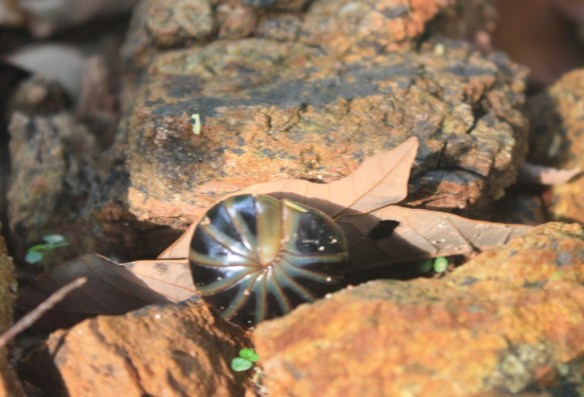
They curl up into a ball to wait out danger. Size: a little smaller than a golf ball.

It’s often thought that rationality and morality can’t coexist under the same roof,
but it’s rationalization and morality that are incendiary roommates.
Mid-monsoon Kolkata, when torrents back up the lines, is as noisome as ever,
but far less noisy as people seek shelter and an incessant spatter shushes.
Everybody gets crapulous on Thanksgiving, but no one will admit as much
because it sounds like one is bragging about one’s dietary roughage.
I’d like to think that I’m generally combobulated, sheveled, and gruntled,
but who could I tell.
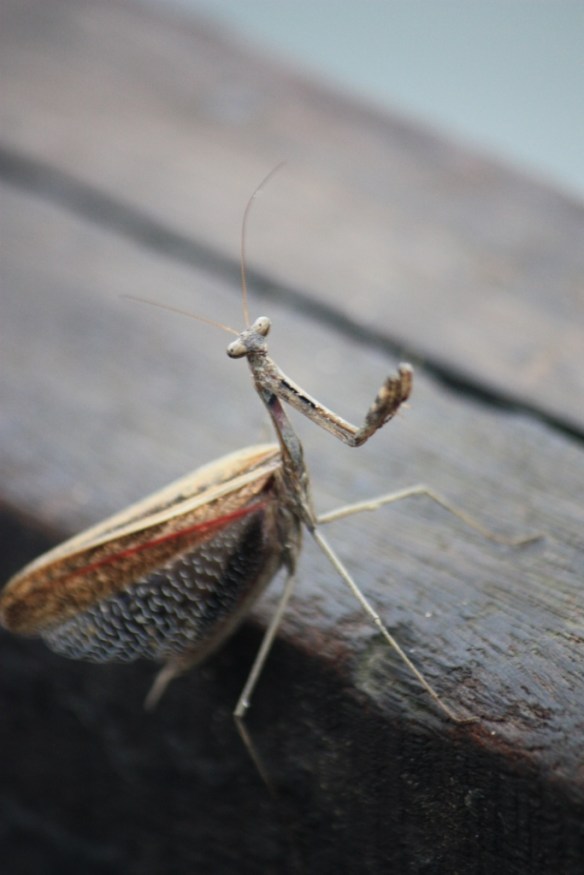
Taken on the Kameng River crossing to Nameri National Park in Assam
Full Disclosure: I know little to nothing about insects. Therefore, it’s possible this bug isn’t in the Praying Mantis family at all. It just had a triangular head with bugged-out eyes and the folded up stabby arms, and I saw some in pics on the internet in which mantises had wings similar to this one.
If you know your insects and I’m wrong, please feel free to comment and I will own my mistake and fix it.