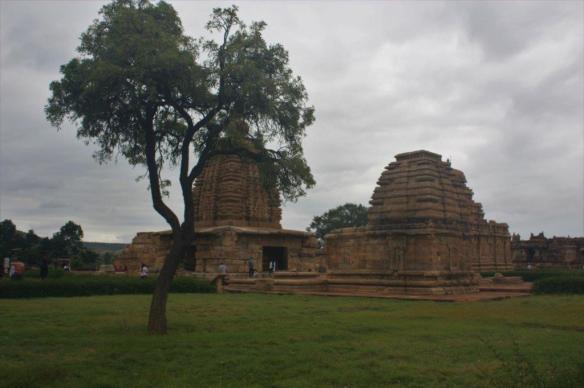
Taken on November 28, 2020 at Pattadakal Temple Group.

Taken on November 28, 2020 at Pattadakal Temple Group.
 Building Great Sentences: How to Write the Kinds of Sentences You Love to Read by Brooks Landon
My rating: 5 of 5 stars
This book goes along with a video course of the same name from “The Great Courses,” but it can be obtained independently as well.
Landon’s book is one of the most beneficial writing books that I’ve read, and is the most beneficial one about sentence-level composition. The book’s core premise is that crafting richer, more interesting, and more artful sentences requires the ability to build longer sentences. This doesn’t mean there is no room for short and simple sentences. It simply means that if all one writes are short and simple sentences, one’s writing will read choppily, will provide limited detail, and – let’s face it – one probably doesn’t need to read a book on the subject after successfully completing elementary school.
Of course, it’s not enough to build longer sentences; the sentences must be enjoyable and readable. This is where learning how to write the right kind of long sentences comes into play. Landon argues the benefits of cumulative sentence syntax, using free modifiers to add propositions about a base clause (and / or about other modifying clauses.) He’s not suggesting that one only use this type of sentence, shunning the other varieties of syntax, but he does show how this approach allows one to build longer sentences that won’t lose the reader, a trait that cannot be claimed of sentences using fixed modifiers.
The first half of the book introduces cumulative syntax, showing how it compares to other syntactic patterns, presenting evidence of its superiority, and demonstrating how sentences using it can be improved and pitfalls avoided.
The second half of the book explores the various directions one can take one’s writing via cumulative sentences. Chapter eight discusses two types of information that can be introduced via free modifiers: comparisons and speculation. If one was taught to avoid injecting personal guesses and commentary into one’s writing, speculative propositions might seem particularly strange, but part of the beauty of this book is that it discourages mindless obedience to writing dogma, a trait that is in rare supply among writing books.
There is a chapter on prose rhythm. As in other sections, the focus is on cumulative sentences, but even with respect to cumulative syntax, the discussion is limited to a few key concepts because the topic is just too complex to address in great detail.
There are two chapters on suspensive sentences. Like the punchline of a joke, a suspensive sentence puts the most surprising or intriguing information at the tail end. This can be used to make sentences that are not only humorous, but also ones that are surprising or memorable. However, suspensiveness is not without a cost. Suspensive sentences are typically left-branching (or middle-branching) such that part or all of the base clause is at the very end. Throughout the book, Landon gives special emphasis / preference to right-branching cumulative sentences, meaning the base clause is the first thing one reads and the modifiers are tagged on behind. The benefit of the right-branching sentence is that it can be made quite long while maintaining readability. On the other hand, a suspensive sentence can lose the reader before they reach the base clause because they don’t have any central concept on which to tag what may read like a disparate collection of modifiers.
Chapters twelve and thirteen delve into writing in a balanced rhythm (Ch. 12) or in a rhythm of threes (Ch. 13.) Balances are phrases, clauses, or sentences presented in opposition. There are many technical terms to describe ways of balancing (e.g. anaphora, epanalepsis, epistrophe, polyptoton, etc.) but the emphasis isn’t on vocabulary building but rather on examples of these effective modes of sentence building.
Chapter fourteen discusses the idea of “master sentences” — long sentences skillfully crafted to not only convey information and to be readable, but also to make for pleasant reading experiences. The final chapter is a wrap-up but also makes an argument for valuing education in sentence-level writing, an area of the discipline that has apparently gone by the wayside in recent decades.
I found this book to be incredibly beneficial. If you are interested in how to grow your sentences longer without having them become an impenetrable thicket of incomprehension, this is the book for you. The author provides plenty of examples to make his meaning clear, and he also references other books that can be of benefit to writers seeking to hone their sentence crafting skills.
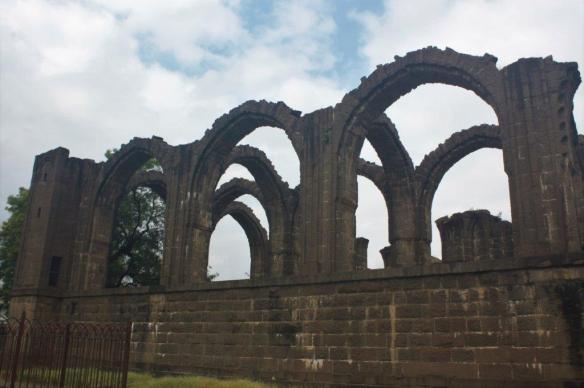

Taken on November 29, 2020 in Bijapur (Vijayapura)
Looking like the remnants of a bombed out Gothic cathedral, this expanse of arches resting on a massive plinth is actually the unfinished mausoleum of Ali Adil Shah II. Shah intended this structure to dwarf other famous tombs — e.g. the nearby Gol Gumbaz and the Taj Mahal in Agra — but when he was defeated by Aurangzeb the structure became stuck in suspended animation.
 Hanuman by Anant Pai
My rating: 4 of 5 stars
This comic book is one volume in a huge collection of graphic depictions of Indian mythology (not only Hindu, but also Buddhist, Jain, secular folklore, etc.) Having lived in India for the better part of a decade now, I must admit that, sadly, my understanding the country’s mythology and folklore is not up to snuff. In my defense, I have often found that my Indian friends tend to have a varied and or tenuous grasp of the subject, a given person might know about some story or deity in considerable detail, but know virtually nothing about others – even if they are relatively popular tales. It’s just such a huge and disparate collection of stories that only experts are capable of both a breadth and depth of understanding of the topic. Even those books that attempt to simplify, making the subject comprehensible to a layman, often get bogged down in the vast number of characters and stories. Having stumbled upon this series on Amazon Prime, I thus decided to change tack and take in Indian Myth and Folklore in the chewable (if child-centric) bites offered by these comic books.
This book tells the story of the monkey-god, Hanuman, particularly his role in the story told in the “Ramayana.” If one is looking for a broader story than that, you may be disappointed. Anyway, this tale seemed like a good place to start because I already knew the story, at least in broad brush strokes. Thus, I had some basis for comparison of how this series tells the story. In a nutshell, the story revolves around the conflict between Rama and Ravana. Ravana has absconded with Rama’s wife, Sita, and is holding her hostage at his stronghold in Lanka, attempting unsuccessfully to woo her. (Though the latter part is not addressed, herein.) Hanuman enters the scene because he allies with Rama, and the monkey-god is sufficiently superpowered to leap the sea from coastal India to Sri Lanka. Hanuman, therefore, goes to Ravana’s territory to reconnoiter. When discovered, Hanuman makes a daring (if mischievous) escape to report back to Rama. The monkey-god then plays a crucial role in Rama’s battle against Ravana.
The only part of the story that I remembered from before that wasn’t addressed was the bit about Rama wrongly accusing Sita of infidelity and her response. I suspect this was primarily because the story is directed at children, and marital unfaithfulness was considered to be too intense of a topic. However, it might have also been the case that this bit of the story was deemed to be too big a can of worms to open in a Hanuman-centric telling of the story.
I enjoyed the book. With superpowered characters and heroic deeds, it’s not all that much different from the superhero tales of modern comic books – which, themselves, are sometimes rooted in varied mythologies. The art is simple and clear (if a bit dated in approach,) and I found the text surprisingly devoid of the clumsy exposition that has historically plagued comic books. If you’re interested in taking in mythology and folklore in bite-sized chunks, it’s worth checking this one out – particularly if you don’t mind that some simplifications are made to make the story more kid-friendly.
 When traveling adopt a student’s mindset;
when studying adopt a traveler’s mindset.
Eat the exotic.
Drink the exotic.
Dance the exotic.
Think the exotic.
I’ve taken journeys by the page,
sitting before the Globe’s great stage,
trolling a knight’s tilt at windmills,
and seen where Grendel made his kills
to kick off a much greater rage.
I learned why birds sing in their cage,
and why the caged go on rampage,
while knights and knaves go quest for thrills.
I’ve read of roads…
I’ve spanned the Stone through the Space Age
while living too briefly to be sage,
I’ve moved by dogsled through the chill,
and opulently, with all the frills.
I’ve read of roads…
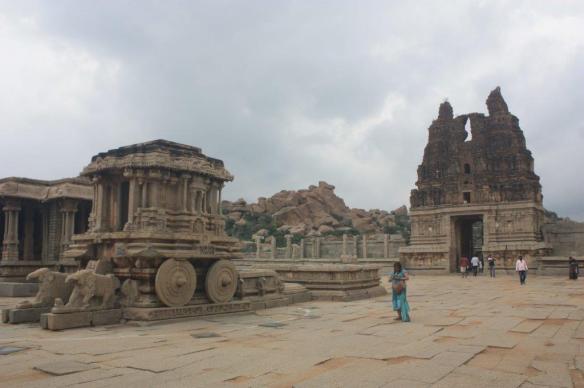
Taken on November 27, 2020 at Hampi.
 Cephalopography 2.0 by Rasiqra Revulva
My rating: 4 of 5 stars
This poetry collection is unique in a couple of ways. First, its running theme is based on the animal class Cephalopoda (i.e. octopi and squid) and how human life likens to that of those many-limbed creatures. It also features ancillary material such as artistic works and interactive exercises – e.g. build your own octi-poem, “squidoku,” etc. The collection consists of free-verse and prose poetry.
The book uses a unique blend of artistic and scientific language. That characteristic creates a niche for the work, but it’s also the source of its greatest weakness, a weakness that lies in the fact that a few of the poems send any reader who’s not a marine biologist running for their dictionaries. That’s a fine quality in a non-fiction book, but can make poetry difficult to absorb — given the importance of the sonic / musical quality of the medium and the need for emotional resonance.
I enjoyed the concept and found it to be clever. While most of the poems were not so laden with scientific jargon to make them incomprehensible for a general reader, a few were. That said, I don’t know how niche an audience the book is targeting. I suspect it will have trouble reaching a general audience of poetry readers, though it may resonate more with oceanographers and biologists.
 The Art of Description: World into Word by Mark Doty
My rating: 5 of 5 stars
Usually, when a book isn’t what one expected, a feeling of disappointment accompanies that mismatch between expectation and experience. For me, this was the rare exception to that situation. I expected more of a how-to manual and less of a collection of essays. [I also expected a book that was less poetry-dominant and which touched upon prose writing to a greater extent. But that was entirely my oversight.] Anyhow, I think I got far more out of this book than I would have if it had been the book I expected. It encouraged me to revamp my thought process about writing description — be it poetic or prose.
The book is short, consisting of six chapters that take varied approaches to the subject. The first few chapters build on an idea that the art of description requires insight both into perception and into the nature of that which we become conscious. That is, one is not trying to perfectly describe the full extent of the world that lies before one. If one did that: a.) one would fail; b.) the reader would not be granted insight into what captures the writer’s eye – i.e. insight into the mind of the artist; c.) one’s writing would become drudgery to read. [I recently started Yukio Mishima’s “The Temple of Dawn” and he begins the first chapter with dense, wall-to-wall description of the story’s Bangkok environs, and I found the thicket of description was losing me. It should be noted that after that opening, the readability becomes excellent – i.e. very story- and character-centric.] There are certainly other issues discussed in the first four chapters. One idea that resonated with me was Chapter two’s discussion of the importance of how we perceive time (as opposed to the orderly pace at which it unfolds,) and the role of temporal perception in description.
The penultimate and final chapters are quite distinct, both different from each other and from the preceding chapters. Chapter five, entitled “Four Sunflowers,” presents four poems that feature sunflowers to show how various poetic masters take on a given subject. The four poems are by William Blake, Alan Shapiro, Allan Ginsberg, and Tracy Jo Barnwell. The final chapter follows a glossary format, and is entitled, “Descriptions Alphabet.” This section actually makes up about half of the book, and it considers a range of relevant topics in an ABC format. Some of these topics are discussed in more detail than others, and are of greater importance than others. Discussions that particularly resonated with me were one on “Economy” versus “Excess,” one about metaphors, similes, and Figures of speech, and those on Qualifiers, Sonic quality, and Verbs. In this chapter, the author delves into the value of common advice that is often (unfortunately) delivered in Biblical – i.e. “thou shall” / “thou shalt not” form. The point being that it’s often bad practice to follow such advice so dogmatically.
As I said, I got a lot out of this book. It’s a quick read, but loaded with food-for-thought. I’d highly recommend it both for poets and for prose writers. (Though, as I mentioned, it’s very much directed toward poets, e.g. all of the examples come from poetry. That said, the approach to thinking about description can be of value to any writer.)


 Tiger Riding for Beginners