
Taken in March of 2014 at Namdroling Monastery

Taken in March of 2014 at Namdroling Monastery
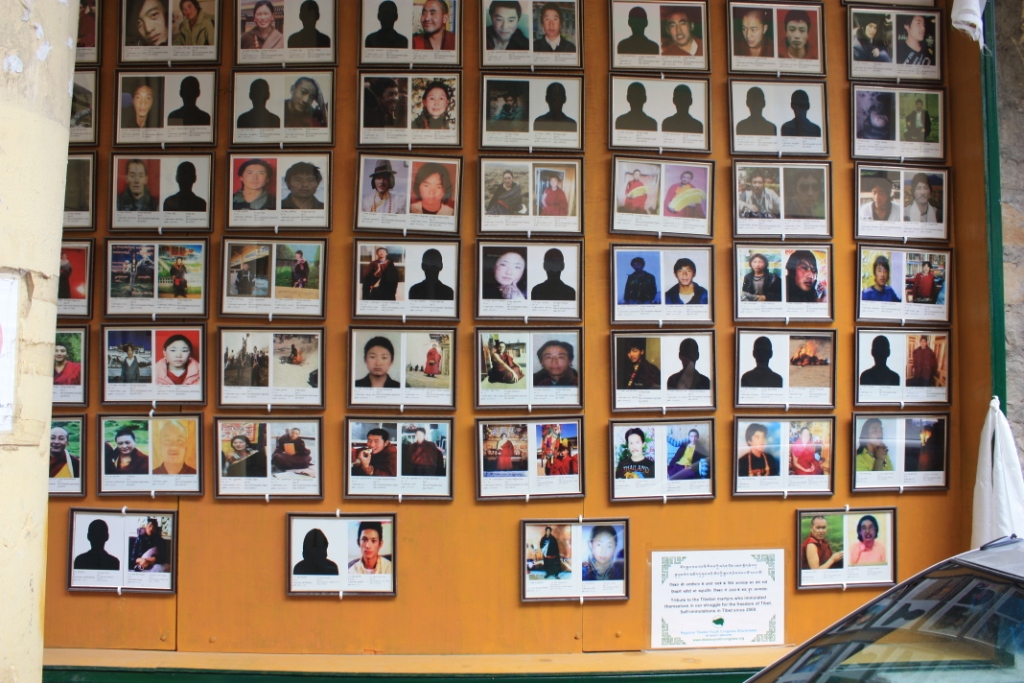
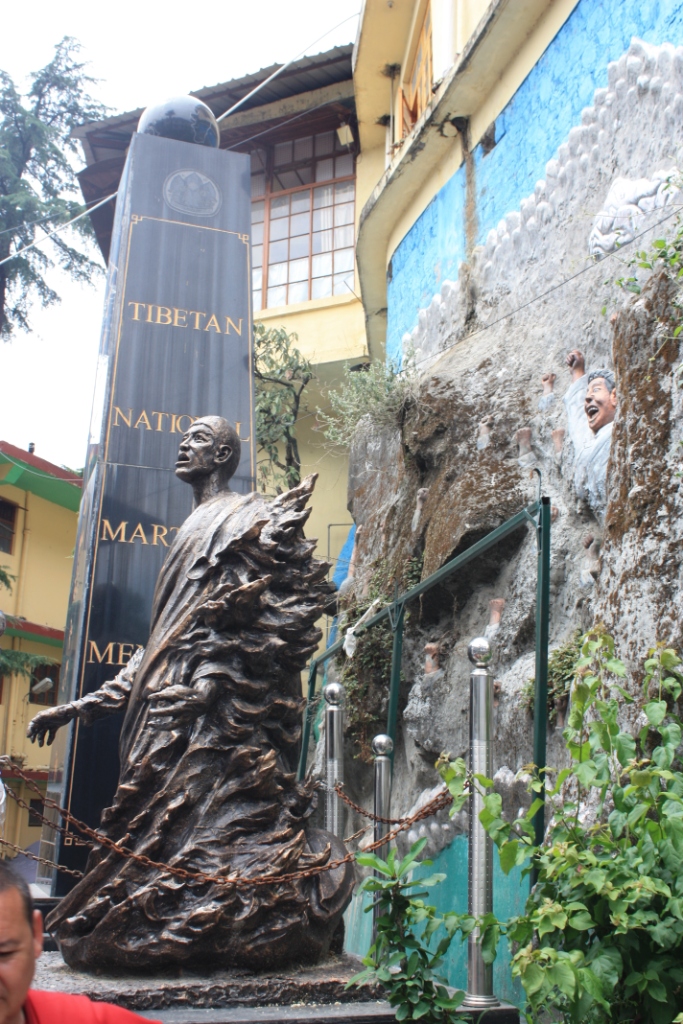
Taken at the Dalai Lama’s Temple (Tsug la Khang) in McLeodganj on June 22, 2015
In the Dalai Lama Temple complex, Tsug la Khang, there’s a monument to Tibetan self-immolators that is located right across from The Tibet Museum (which, incidentally, has its own memorial wall inside.)
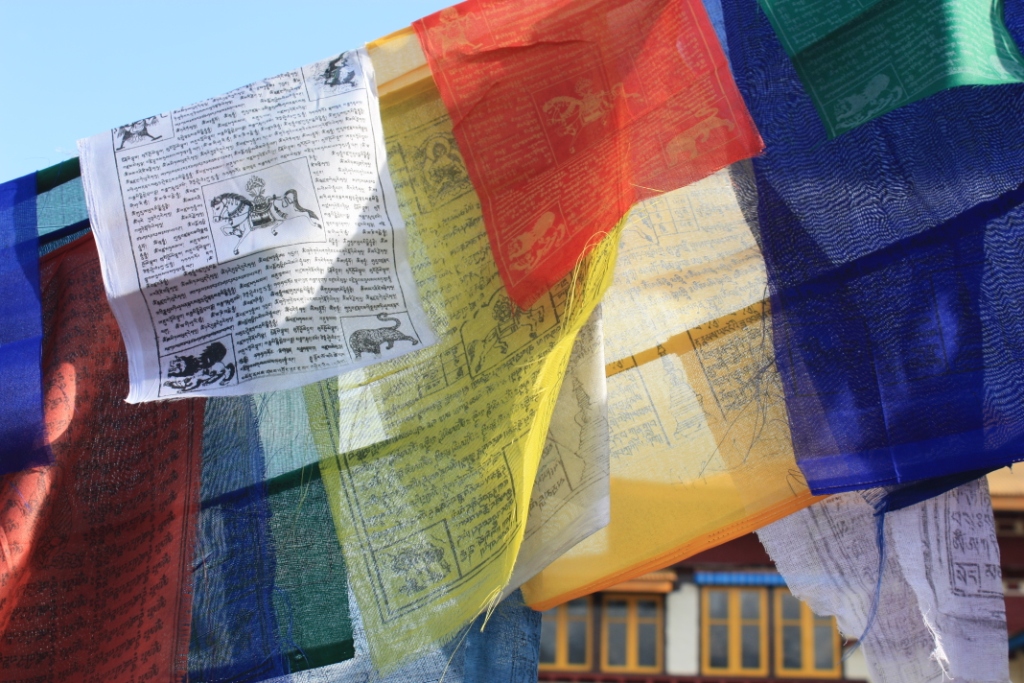
Taken on June 16, 2015 in Manali at Gadhan Thekchoking Gompa
Now heavily associated with Tibetan Buddhism, colorful prayer flags are believed to have originated with Bon–an indigenous religion of Tibet that predated Buddhism’s arrival.
Traditionally, the color progression from left to right is blue, white, red, green, and yellow (i.e. as seen in the top row), but variations can be seen.
Besides monasteries and temples, one will often see strings of flags out in natural settings on mountains.
The day and time of placement of the flags is considered carefully because it’s believed that if they are hung at inauspicious times they may bring bad fortune instead of the desired compassion and peace.
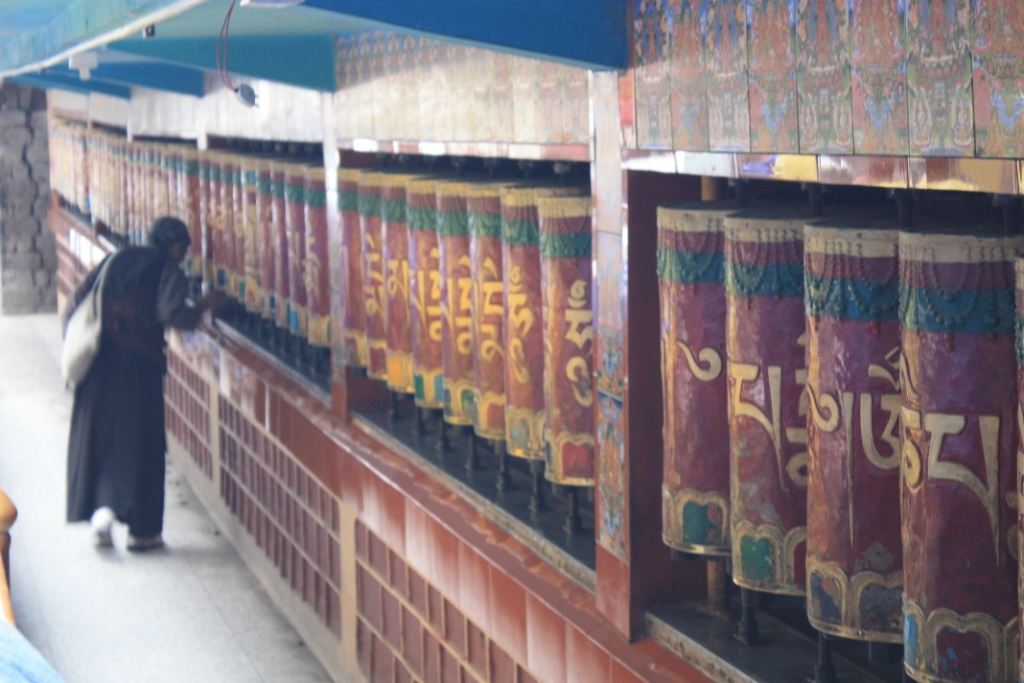
Taken on June 23, 2015 in McLeodganj
 The Mandala of Sherlock Holmes: The Adventures of the Great Detective in India and Tibet by Jamyang Norbu
My rating: 2 of 5 stars
I gave this book the lowest rating that I’ve ever given a book I reviewed. However, there’s a selection bias at work. I don’t finish (and rarely start, for that matter) books that are so horrible that they’d get a lesser rating. Ergo, any book that I finish and review has some redeeming qualities. I’ll leave it to the reader to determine whether these redeeming qualities will outweigh the deficiencies of story in this book.
The Mandala of Sherlock Holmes takes our beloved detective out of London and onto a trip from Bombay to Shangri La by way of Shimla (India) and Lhasa (Tibet.) It’s one of several pieces of Great Hiatus fan fiction out there. (I recently saw an addition that took Holmes to Japan.) Fans of Sherlock Holmes will be aware that Sir Arthur Conan Doyle became tired of the character at one point and killed him off (along with Professor Moriarty) at Reichenbach Falls. Holmes was “revived” several years later due to popular demand (and—perhaps—Doyle’s need for funds), leaving fans / authors to speculate what the detective did during his time in hiding (i.e. the so-called Great Hiatus.) This particular work tells us that Holmes spent his time in the Himalayas. It’s as good a setting as any, given that fascination with the esoteric Himalayan world was building in the West during this time. In an interesting feature, Norbu’s book brings in a fictional character from Rudyard Kipling’s Kim, Hurree Mookherjee, to serve as Holmes’s sidekick. (FYI: Kim was published during the Great Hiatus years.) The story involves shadowy plots against both Holmes and a young 13th Dalai Lama (this was the predecessor of the current Dalai Lama) that are incidental to obtaining a powerful mandala.
I’ll begin with the strengths of the work before I tear into what I found objectionable about the book. The author, Jamyang Norbu, clearly did his research, and there are some fascinating tidbits and insights into that era of South Asia history. As a Tibetan, Norbu, paints an intriguing travelogue of the territory that Holmes and Hurree traverse. Also on a positive note, I’d rate the readability of this work to be high. It doesn’t follow the 19th century so closely that it falls into the purple prose and general verbosity of that century’s literature, and I think that’s a good thing. The author manages to create a bit of the feel of 19th century literature without falling off the abyss.
The book’s negative qualities are disproportionately loaded toward the back of the book. (Part of what keeps one reading and engaged is that it seems like the book could turn out well.) Let me begin with one minor character defect of the book which is that not all of the chapters advance the story; a few are descriptive like travelogues. However, most of said chapters are so short that it’s not that problematic.
I should note that one star that might’ve been obtained for originality must be forfeited because there’s no shortage of books following the same general premise.
But the story’s major flaw is that devolves into supernatural speculative fiction done poorly. Let me say, I’m not against the supernatural genre in theory. However, as with stories about Superman, these tales are exceedingly easy to do poorly and extremely difficult to do well. In the real world, tension is easily created because the reader knows many of the limits that characters face, and a good writer forces his characters up against some of those limits. However, when characters seem to be limited by the laws of physics, but then just start pulling magic rabbits out of their hats, the tension drains. We assume our protagonist will prevail and the antagonist will be thwarted. The odds stacked against our hero(es) don’t matter if one expects they’ll pull out a—proverbial or otherwise–magic wand and claim a cheap victory. If one wants to do the supernatural well, one needs to not only make the antagonist stronger (which Mr. Norbu does), but one has to know what everybody’s limits are. Otherwise, it’s just a cheap spectacle. [I should point out that Hurree does engage in a non-magical action that is critically timed during a key moment of the story, and some readers may feel that this absolves the novel of its ham-handed introduction of the supernatural.]
There’s another problem with the degree to which the book hinges on the supernatural, and that is specific to the domain of Holmes. The supernatural is usually something to be debunked in the Holmesian domain. Sir Arthur Conan Doyle’s Holmes is a product of the dawning of the age of rationality, and he is a man of science. [Want to know more? See this Tor article entitled “No Ghost Need Apply.”]Doyle’s Holmes may accept the possibility of the supernatural and apparently supernatural elements may make appearances, but Holmes is always looking for an explanation rooted in logic and favoring the possible. While Norbu goes to great lengths to capture the flavor of Holmes in many aspects, he abandons the character altogether in favor a world that looks neither like our own nor the one Arthur Conan Doyle created.
The disappointment of this book is that it looks like it’s on a trajectory to hit its mark, but then sails wildly off target.
If you like supernatural fiction and you don’t mind that magic suddenly pops up to shape the climax of the book out of the blue, by all means pick this book up. Otherwise, I can’t say that I’d recommend it for Holmes’ fans.
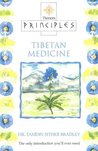 Principles of Tibetan Medicine by Tamdin Bradley
My rating: 3 of 5 stars
Full disclosure: let me first state that I’m a scientific-minded person and skeptic by nature, and if you’re expecting a review by a true believer, you may be disappointed.
A couple of questions may arise from the disclosure above. First, why do I feel I need to make such a commentary? Well, because this is a book about a system of medicine (i.e. gso-ba rig-pa) that developed within a country that was isolated for centuries and in which every aspect of knowledge was infused with and influenced by religious belief—both pre-Buddhist and Buddhist. Because of this, while some of the advice offered is surely sound, some of it is—from a skeptic’s point of view—bat-shit crazy. For example, there are herbal and dietary preparations to aid in digestion that may be completely sound and reasonable, and then there is the idea that Zombie spirits (one of 18 types of evil spirits) cause constant shivering.
The second question is, “If I’m not a believer, why read the book and review it?” For one thing, as I indicated above, I don’t think that just because the beliefs behind the “theory” of this system of medicine are baseless, it means that there is nothing in the book that is true or of value. The theory is that there are three kinds of energy (Loong, mKhris-pa, and Bad-Kan) and that excesses or deficiencies cause health problems. But it’s a 2500 year old system of healing; certainly they learned a thing or two in the process. It’s quite possible that they have learned things that scientific medicine has not. (Consider for example, Tibetan Buddhist monks have repeated and verifiably demonstrated capabilities—i.e. consciously controlling autonomic systems, that Western medicine would have thought impossible.)
The analogy that I always use is with kid’s Christmas presents. Parents hide the presents, and tell the kids that if there’s any tampering with them the kid won’t get anything but a lump of coal (you say that was just my parents?) Anyway, the kids find the packages, but are afraid to invasively tamper with them. Therefore, they feel the heft of them, they shake them, and they listen to said shakes. From that limited investigation, they develop a theory. The theory may be spot on, it may be completely wrong, or over several gifts it’s probably a combination of wrong and right. However, the question of whether the present does what it’s supposed to (i.e. bring joy) is not closely connected to the child’s theory, because it’s based on the parent’s observation of what the kid likes. That, my friends, is why systems of healing that are based on notions that are empirically wrong sometimes produce good results.
Second, while I’m a believer in science, I don’t always believe that Western medicine (rooted in science as it may be) consistently does a good job. Part of this is the fault of economists, policy types, as well as lazy patients who’ve created a system in which medicine only pays off if it can cut one open or give one an expensive medication. This leaves room for alternative systems of medicine that may not be so scientific, but that allow for the fact that changing patient behavior is often key to improving health.
I’ve taken a long time to get to the actual review, but I thought the reader should know from whence this reviewer was coming. The book is a little under 200 pages long. Its 11 chapters are logically oriented, and it’s easy to navigate the book. The author writes in a readable style, and jargon and foreign terminology aren’t a problem. It doesn’t have an index, but each chapter is broken up into many smaller subunits–so finding what one is after shouldn’t be hard.
The chapters cover the history of Tibetan Medicine, the nature of gso-ba rig-pa, the theory of Tibetan Medicine, causes of illness, human anatomy and physiology (not of the physical body as we know it), common diseases and illnesses, treatment techniques involving changing diet and behavior, medicinal treatment, representative case histories, and the nature of the Tibetan Medicine physician.
It’s not clear who the target audience for this book is. It’s not a self-help book as the implication is that the patient should see a doctor of Tibetan Medicine and not self-prescribe. Furthermore, while the book provides a good overview of Tibetan Medicine, it’s not an all-inclusive description by any means. The book seems to have been written primarily to make individuals aware of Tibetan Medicine and to give enough insight into the system that readers can differentiate it from Traditional Chinese Medicine or Indian Ayurvedic Medicine, both of which display similarities and differences.
I’d recommend this book if you’re interested in alternative approaches to healing, or if you’re interested in Tibetan culture in detail.
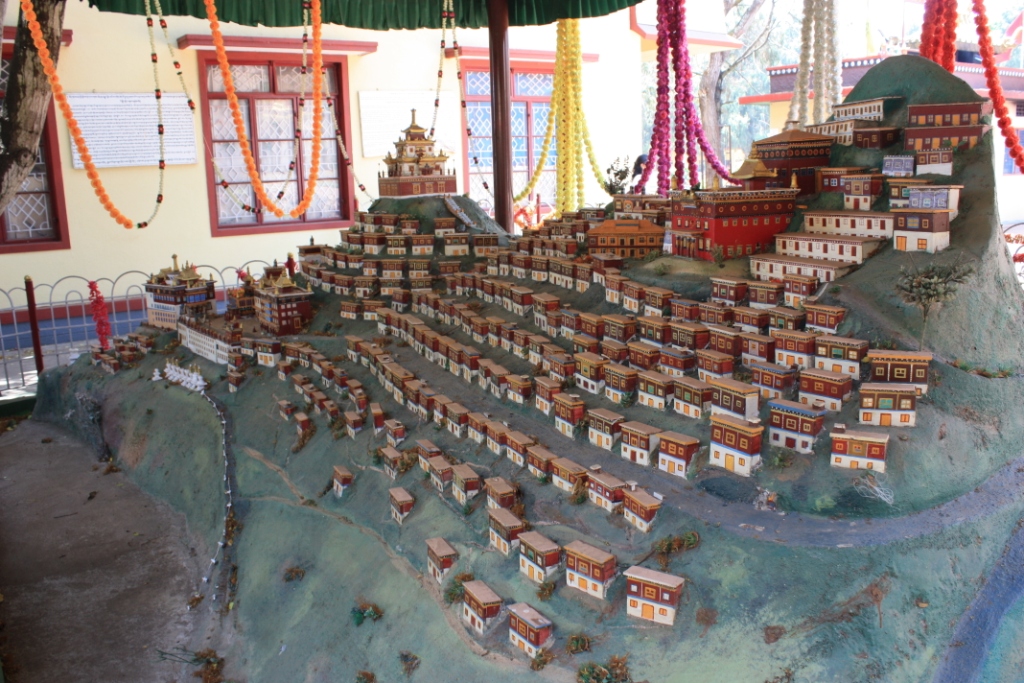
Taken in March of 2014 at the Namdroling Monastery
This model of the Palyul Monastery and its environs is located at Namdroling Monastery in Bylakuppe, India. Palyul is the parent monastery of Namdroling. It is one of the six major monasteries of the Nyingma branch of Tibetan Buddhism.

Taken in March of 2014 at Bylakuppe.
The large photo is of Pema Norbu Rinpoche, the 11th head of the Palyul Nyingma Buddhist tradition. He passed away (achieving Parinirvana in the lingo of Buddhism) in March of 2009. At the end of July of 2014, the new Rinpoche will be enthroned.
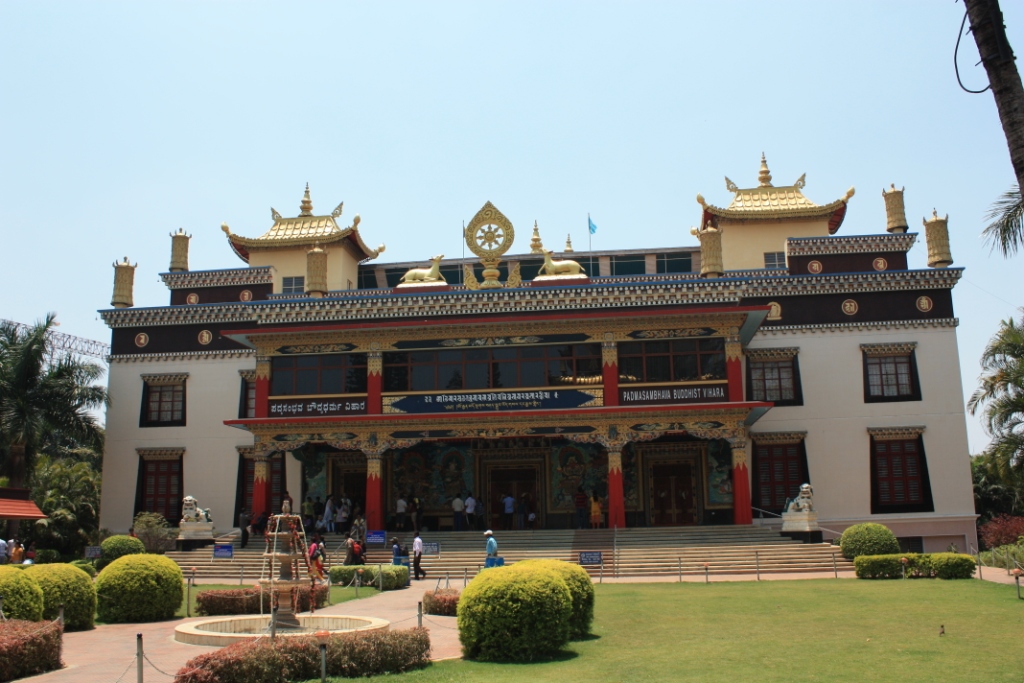
Taken March 29, 2014 at Namdroling Monastery in Bylakuppe.
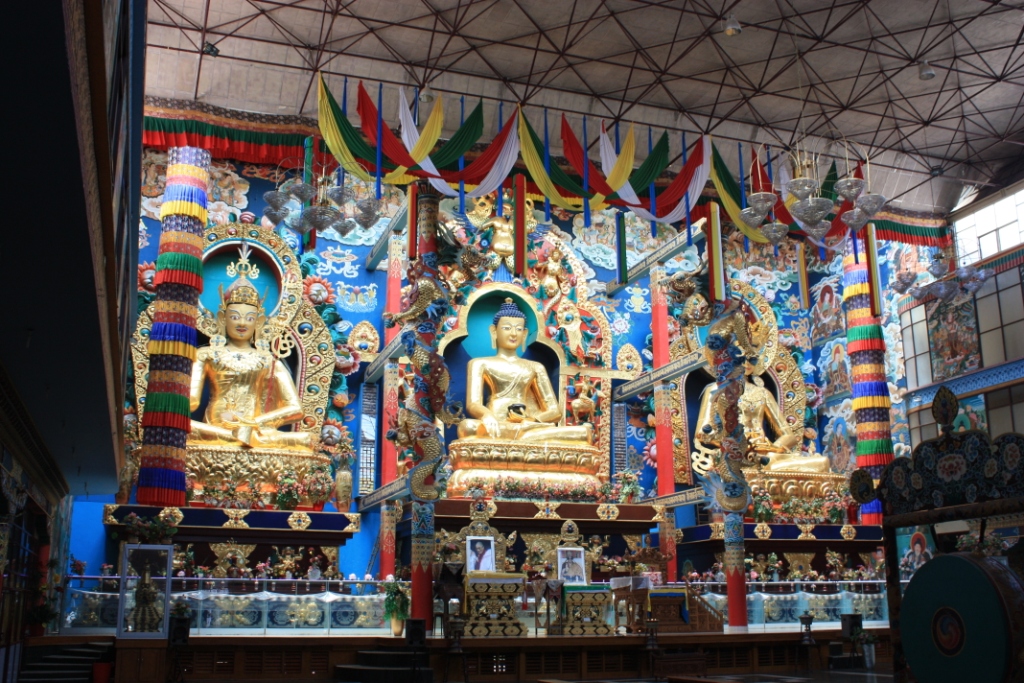
Namdroling Monastery is the largest teaching center of the Nyingmapa sect of Tibetan Buddhism in the world. It is located in Bylakuppe in southern Karnataka. Bylakuppe is a series of settlements that constitute one of the largest collections of Tibetans in Southern India (about 20,000 Tibetans live here.) This monastery was established by the Penor Rinpoche in 1963, after the Tibetan diaspora of 1959. The original monastery was a small bamboo temple, from that it has grown to a large campus of buildings.
This, the “Golden Temple”, is a must stop visit for travelers in southern Karnataka. For those with interest in Tibetan Buddhism, one may want to arrange a longer stay. Be aware that there are certain permitting requirements for visits longer than day visits.


 Tiger Riding for Beginners