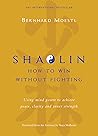
BOOKS: “Shaolin: How to win without fighting” by Bernhard Moestl

Shaolin: How to win without fightingShaolin: How to win without fighting by Bernhard Moestl
My rating: 4 of 5 stars

Publisher Site

This is a self-help book that nominally draws on the philosophy of Shaolin Kung fu and its Chan Buddhist underpinnings, but – more broadly – employs quotes and examples from many, mostly Eastern, sources. For example, the ideas and stories of Miyamoto Musashi are perhaps as common as any source (Musashi was Japanese, not Chinese, and was not noted for being Buddhist. In his own words, he respected the gods and buddhas, but didn’t expect their help.)

The book offers a fine discussion of Eastern philosophic thought in action, particularly that which arose from warrior sources, but it isn’t particularly ground-breaking in any way. For those who like homework, the book does include many exercises to make the reading a more interactive experience.

I enjoyed reading this book well enough, but it didn’t distinguish itself and will soon fall into the mind-space of a fuzzy amalgamation of similar books I’ve read over the years.

View all my reviews

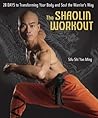
BOOKS: The Shaolin Workout by Shi Yan Ming

The Shaolin Workout: 28 Days to Transforming Your Body and Soul the Warrior's WayThe Shaolin Workout: 28 Days to Transforming Your Body and Soul the Warrior’s Way by Yan Ming
My rating: 4 of 5 stars

Amazon.in Page

This book presents an exercise regimen based on Shaolin Kung fu as taught by a prominent New York City martial arts teacher. The book moves from gentle joint articulations suitable for anyone through to movements that require some degree of flexibility and athleticism. The sequence is presented in such a way as to build on itself, adding a bit more each time until one is doing the entire sequence.

Interspersed with the descriptions of the physical exercises are meditations, mostly of a contemplative nature. The illustrations are color pictures and provide the sequences of movement, though the textual descriptions will be necessary in many cases to clarify the transitional movements. There are a number of full-page color plates that are very well shot, though mostly for aesthetic (versus educational) purposes.

The book is probably the most pep-talk laden book I’ve ever read. That said, there’s not much discussion of modifications or capacity building for individuals who are incapable of doing the full expression of the techniques.

The practices often reminded me more of yoga than of martial arts. There are many deep stretches and low positions, e.g. similar to Warrior I (Virabhadra I.) It’s true that there are punch and kick movements, but they are done in more of a range-of-motion building way than as one would in combative arts.

It is an interesting set of movements, and I’d recommend it for those who like to work with unconventional workouts and movement systems.

View all my reviews