POEM: Lonesome Road


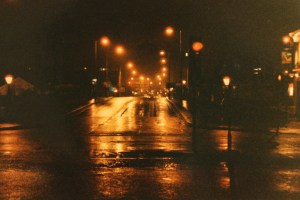
I’ll not sing down that lonesome road.
Who knows what haunts the ditch down there.
So, I’ll walk down the middle line,
listening through still ringing ears.

Should the moon fail to light the road
in milky glow of distant rays,
I’ll wish myself invisible,
but not sing down that lonesome road.

POEM: Decomposing the Sun

a mushroom cap

mango and red, burnished

rises from the forest floor

decomposition painted into a setting sun

what a masterpiece nature makes of rotting gunk

POEM: Falling

Oh, I can feel the force of your allure.
It tugs my chest, and I am leaning fore.
Have you bent space and time to your contour?
For I fall into you, not down to the floor.


But feet, they fail, anchored in place by nerves,
so I cannot escape toward your force.
Tumbling to a place past knowledge can’t serve,
and time, it fails to flow or rejects course.


Drifting in this dark and humorless void.
Can I salvage this perilous tumble?
Or cruise space like an aimless asteroid
by lack of grace being ever humbled?


As I regain footing and state of mind,
I find that we’ve become somehow entwined.

POEM: Animal Observations

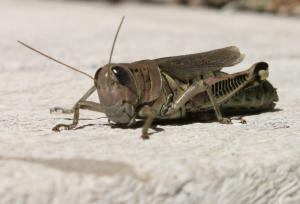
 sitting on a stone

-grassless

-hopless

and you call yourself a grasshopper!


I know I shouldn’t, but I anthropomorphize.

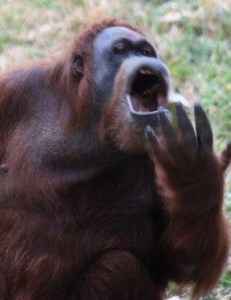
I can’t see this orangutan without hearing the words,

“Ya borin’ me!”

play in my mind


parents lunged to cover impressionable eyes,

but someday they will be adults

who wonder about the mechanics

of how baby giraffes get made


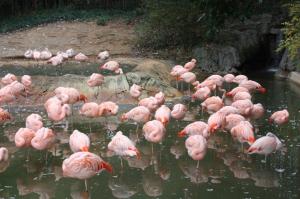
Dear Flamingos,

Stop hiding your heads.

It freaks out the tourists,

making them think there is a pile of heads in some other corner of the Zoo.

POEM: Neighborhood Rhythm

Hear the “schwoop-CLACK-schwoop-CLACK” of an automated loom playing in steady, relentless repetition. It’s an iron machine, but listen to those wooden parts clap against each other, the hardwood timbre. Note the metallic jingle, a subtle accompaniment. Strings, stretched out like the innards of a piano, ironically, remain silent as the tune plays around them.


Walking, one picks up the rhythm from one building to the next, wondering whether the machines are in synch, or if your mind deceives you that they play one tune.


All else, the horns and hollers, sing in discord.

POEM: Crossing


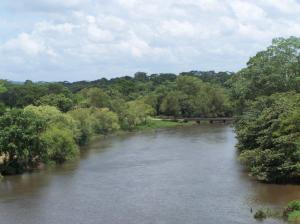
Walking into the river,
sliding chin deep in the waters,
pulled, thrashing, toward the channel,
riding the rim of an undertow –
like astronauts slingshot around the moon.

Fond memories invade my mind,
steeling me for a dire fate,
but I’m ejected at the bend.
Clawing mud and gnarly roots,
I come out on the other side.

POEM: Thinking

I think,
but without Descartes’ insistence that I am.

In fact, the more I think, the less confident I am about knowing what “being” means.

I think — without knowing,
and recognize the hazard of that condition.
It’s what got Socrates killed.

A smart person who claims to know may raise hackles,
but is dismissed as arrogant.

It’s the smart person who admits he doesn’t know…
[let’s hope I’m not wrongly classed among them]
… that’s the one who arouses murderous intent.

For what hope exists for priests, professors, or politicians —
or any of the many oracles of our age —
when the most astute confess that uncertainty is inescapable?

What airy sands are our castles built upon?

And, yet, I think.

BOOK REVIEW: Faust [Part I] by Johann Wolfgang von Goethe

FaustFaust by Johann Wolfgang von Goethe
My rating: 5 of 5 stars

Amazon page


This review will cover the first part of the play in verse by Johann Wolfgang von Goethe. I start with that statement because there is some potential for confusion, because: 1.) there are many tellings of the Germanic legend loosely-based on Johann Georg Faust; 2.) there are two parts to Goethe’s play and some editions include both and others just one; 3.) Goethe’s play was apparently not written with the intention that it would be in two parts and so the proper title of this isn’t “Faust, Part I” but rather that became a common title, retroactively and after the author’s death. I’ve done my best to link to the same edition as I read (which seems to be sometimes erroneously listed as containing both parts one and two – when it is really just the first.) Part I is said to be more closely based on the myth than is the second.

The gist of the story is so well-known that it will be recognized even by those who’ve not read this play (or works like Marlowe’s “Doctor Faustus” [written well before Goethe’s play(s).]) The successful but bored Doctor Faust makes a deal with the devil in which Mephistopheles gets Faust’s soul if Faust can ever be made to feel truly satisfied. Goethe’s “Faust” opens with a wager between God and the Devil. The Devil believes he can corrupt God’s favorite (i.e. Dr. Faust) and turn him from a righteous path. Faust’s deal leads to a series of adventures that culminate in an ill-fated love relationship with a woman named Gretchen (a.k.a. Margarete.)

The story and its theme are straightforward. The idea is that there is a ceaseless yearning – be it for pleasure or understanding or whatnot – that is insatiable, and that giving into a desire to quench that yearning can lead even the best of humanity into tragedy.

The play is delivered in rhymed verse, and the translation by Bayard Taylor makes for pleasant reading.

I’d recommend this book for readers of classic literature. It’s an old tale, and is well conveyed in this translation of the play.

View all my reviews

POEM: Overwritten

the jungle writes over the acts of man
without rage or animus
but with infinite patience

growing one vine at a time
a cracked brick will be clay again in due time

grand palaces will become strange mounds
only the crease of a cornerstone,
hidden in the shadows,
to betray the grandiosity beneath

not even Alexander the Great escaped being overwritten

POEM: Pelican on a Piling

wings flare,

a nanosecond of hover,

and a deft drop onto the column —

the piling of a pier of years long past?

it waits with chin tucked to chest,

perhaps, to look down for fish,

or, perhaps, so that the fish in the water

can’t see the fish flapping in its pouch

or is that only in the cartoons?

long before I’d seen a pelican in person

they’d been popular on the cartoon shows

mind you, not as popular as the storks —

unitaskers who delivered animated babies

precariously — I might add — in loose linen bundles,

clenched into their pointy needle-beaks.

And I can’t remember how the storks landed

without impaling the baby with its pointy beak

or bouncing baby’s head off the ground.

Maybe, that’s why there are so many mentally defective cartoon characters:

e.g. Goofy, Ralph Wiggum, Patrick Star, Chris Griffin…

Not to mention the emotionally ill-adjusted ones:

e.g. Yosemite Sam, Eyore, Pepe LePew, Ariel,…

Because it’s all about sticking the landing.