BOOKS: “Great Minds on Small Things” by Matthew Qvortrup

Great Minds on Small Things: The Philosophers' Guide to Everyday LifeGreat Minds on Small Things: The Philosophers’ Guide to Everyday Life by Matthew Qvortrup
My rating: 4 of 5 stars

Amazon.in Page

This book was inspired by Voltaire’s Philosophical Dictionary, a collection of essays by the French polymath put out in several editions and which covered topics such as: “Adultery,” “Free Will,” “Kissing,” and “Nakedness.” In some ways, the inevitable comparison that results from such a “reboot” as this proves the connection between the books to be apt. But in at least one sense, the comparison is unfortunate.

On a superficial level, comparison is apt. Not only does this book expound upon a range of alphabetized topics, often of an “everyday” nature, but it uses many of Voltaire’s topics. It should be noted that Qvortrup’s book also includes many topics that Voltaire didn’t address, notably topics such as “cars” that didn’t exist in Voltaire’s day. One difference that benefits the book greatly is that (as the title suggests,) Qvortrup’s book draws on ideas of a wide range of thinkers, mostly philosophers but also artists of a philosophical bent. [Whereas, Voltaire’s book is a single-point of view, his own.] The “great minds” in this book range from the ancient world to that of the present. While it is (by the author’s admission) Western-centric, it does reference Eastern thinkers (e.g. Taoists and Buddhists) more than many books I’ve read that weren’t as self-aware of their own Eurocentrism.

Where the comparison to Voltaire’s dictionary is not so apt is that Qvortrup’s book rarely mixes wit and stimulation in the way for which Voltaire had a genius. This doesn’t mean Qvortrup’s book isn’t witty or thought-provoking, but just that it’s rarely both, simultaneously. In dealing with a topic like flatulence it can be witty but trivial, in expounding on the ideas of Kant it is intriguing but not usually amusing. That said, the book is laden with interesting ideas and insights into seminal thinkers that most people will find unexpected, if quirky. It is also the case that the overall tone of this book is lighter and more aimed at amusement than is Voltaire.

I found this book to be compelling, readable, and well worth the time, and would recommend it for readers of pop philosophy.

View all my reviews

BOOK REVIEW: Zeno and the Tortoise by Nicholas Fearn

Zeno and the Tortoise: How to Think Like a PhilosopherZeno and the Tortoise: How to Think Like a Philosopher by Nicholas Fearn
My rating: 5 of 5 stars

Amazon.in Page

This book presents twenty-five philosophical tools or concepts fundamental to thinking philosophically. Fearn does an excellent job of making these ideas comprehensible while exploring how they can be of practical value in philosophizing (as opposed to diving into conceptual minutiae and the conflicts and debates around them.) The author uses stories, metaphors, and examples extensively, while avoiding jargon or complicated expressions and explanations.

The book is entirely Western-oriented, and one won’t see any discussion of ideas originating outside Europe (or North America by way of immigration from Europe.) That’s not uncommon for English language popular philosophy books, and I don’t think there’s anything nefarious to be read into it, though some will find it a shame. The philosophers whose ideas are addressed span from pre-Socratic Greece to Richard Dawkins (who I’m pretty sure is the only one still living.) The reader learns about reductionism, relativism, the Socratic method, analogy / allegory, teleology, thought experiments, parsimony, pragmatism (of sorts,) induction, skepticism, social contract, utilitarianism, dialectics, falsifiability, memes, deconstruction, and more.

I found this book to be readable and absorbing and would highly recommend it for anyone who would like an overview of the major ideas of Western philosophy and how they can be applied to thinking more philosophically.


View all my reviews

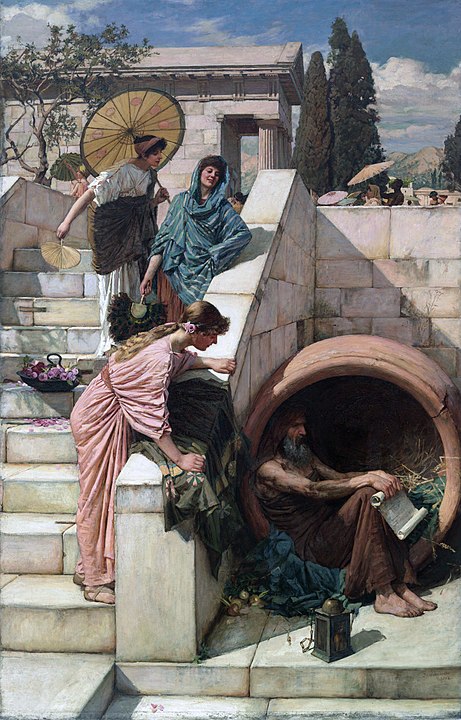
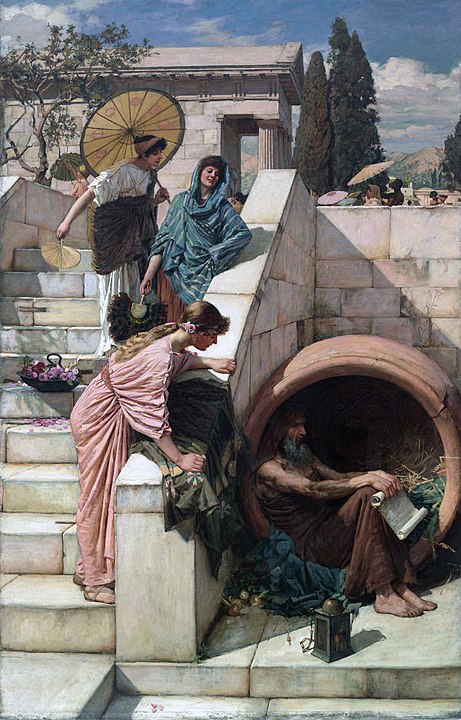
Cynic Limerick

The philosopher named Diogenes
was like a dog... known to have fleas.
-failed to find an honest man.
-didn't let "Greatness" block his tan.
But he lived simply, and as he pleased.

In Praise of Diogenes the Cynic [Free Verse]

Owning only a cloak, 
staff, and satchel,

he broke his bowl
after seeing a child
drink from cupped hands,

feeling the dunce 
for being out-simplified
by a mere child.

When pirates,
eager to sell him off,
asked what skill he had,

he said, "Governing men.

"If you find someone 
interested in buying 
a master,
I'm your man."

He couldn't be driven
away with a stick,
much as the downright-dog,
Antisthenes, tried.

He was expert
at adulterating the currency -
literally and figuratively.

When Alexander the Great
offered him whatever he wished,
A sunbathing Diogenes replied,
"Stand out of my sunlight."

I fear
they don't make 'em like
that anymore.