BOOK REVIEW: Neverwhere by Neil Gaiman

NeverwhereNeverwhere by Neil Gaiman

My rating: 5 of 5 stars

Amazon page

Neverwhere taps into a reader’s imagination and the fantasy that beyond closed doors and locked grates, beyond the prying eyes of common men, lies something magical—not just the mundane sewers and conduits our rational mind tells us exist there. This magical world is “London Below,” and–to a lesser extent–rooftop London. It’s a world that exists below the workaday London that we know. It’s a London of angels and cutthroats, witches and warriors. It’s a London trapped in time, but unconstrained by the laws of physics or men as we know them.

The lead character is Richard Mayhew, a perfectly normal resident of London Above. He has a fine—if boring—job in the business world, and a fiancé isn’t right for him, but who he believes is close enough for an imperfect world by virtue of her being pretty, smart, and capable.

Mayhew is living an ordinary and comfortable life until he and his girlfriend come across an injured young woman on the street. While his fiancé, Jessica, steps over the girl because the couple are on their way to meet Jessica’s VIP boss, Richard refuses to leave the girl. The injured girl is a resident of London Below, and had collapsed to the sidewalk after escaping from the two London Below master assassins who killed her family. It turns out the girl, Door, is from a family whose magical gift is the ability to open doors—even doors that are locked, sealed, or that no one even recognizes the existence of. As no good deed goes unpunished, Richard’s assistance of Door pulls him into the world of London Below, and he soon finds that he’s almost invisible to the residents of London Above and that he’s been forgotten by Jessica, his friends, and his coworkers.

The rest of the book is a hero’s quest in which Door is trying to discover who ordered the assassination of her family and why, and Richard is trying to find out whether (and, if so, how) he can get back his life in London Above. Because the fates of Richard and Door are intertwined, they travel together along with a bodyguard named Hunter and a Marquis / conman in the debt of Door’s father named the Marquis de Carabas.

I enjoyed this book immensely. It’s highly readable and the reader will be drawn to the fate of the characters. It has that page-turner quality. I’d highly recommend this book for anyone who reads fantasy / speculative fiction–or who doesn’t but is willing to give it a try.

Neil Gaiman is, as always, the master storyteller. When the story calls for humor, it is genuinely funny. When it’s time to be scary, it creates shivers. The storytelling was good enough that I was willing to overlook an ending that—in less capable hands—would have felt flat and too easy.

I didn’t realize that Neverwhere was based on a BBC miniseries. In other words, for a change the book is based on the movie rather than the other way round. However, the book does concisely but vividly portray setting—a task that one might imagine being easier having gone in this developmental direction. And, of course, setting is extremely important in this book. The distinct feel of London Below, London Above, and Rooftop London must be conveyed.

Here is a link to a piece of said BBC miniseries:

View all my reviews

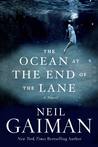
BOOK REVIEW: The Ocean at the End of the Lane by Neil Gaiman

The Ocean at the End of the LaneThe Ocean at the End of the Lane by Neil Gaiman

My rating: 4 of 5 stars

Amazon page

As the title suggests, The Ocean at the End of the Lane takes place in a world in which the supernatural and spectacular lay camouflaged amid the most mundane of settings. The story is about a boy’s interaction with a tri-generational household of women who I’ll—controversially—call “good witches.” The characters explicitly gainsay the title of “witch,” but for lack of any better term with which to describe these ladies other than “a trio of females with supernatural abilities and benevolent purpose,” I’ll call them good witches.

In particular the boy befriends the youngest good witch, a girl who physically appears not much older than he, but whom he comes to realize seems much older. It’s the girl who refers to the pond on her family homestead as the “Ocean.” The girl introduces the unnamed boyish male lead to a supernatural parallel universe, but—in doing so—unwittingly gets the boy tangled up in peril. The boy tracks a portal into his world through which a malevolent creature can slip through. The shape-shifting creature becomes his nanny. However, he is the only one in his family who can recognize the creature’s true nature, and it will do anything to keep the boy from ruining its new gig.

The good witches become the boy’s protectors, and powerful protectors they are. But they aren’t omnipotent, and the forces arrayed against them are formidable as well. Among the morals of the story are that the more powerful enemy of one’s enemy is not only not necessarily one’s friend, but may spell one’s doom. The book also speaks to the rashness of youth running headlong into trouble, and the value of wisdom and experience to find solutions.

This book is short and highly readable. It’s appropriate for young adult readers, but can be enjoyed by adult readers as well. The ending is slightly too deus ex machina for my taste, but overall it’s an intriguing book.

View all my reviews

BOOK REVIEW: Marvel 1602 by Neil Gaiman (Art: Andy Kubert)

Marvel 1602Marvel 1602 by Neil Gaiman

My rating: 5 of 5 stars

Amazon page

This is anachronism done right by Neil Gaiman. The title gives one the jist of this graphic novel’s theme. It’s the Marvel Universe circa 1602. There’s a big cast of Marvel characters in this collection of eight comics. However, those who don’t follow comics might not recognize some of the characters because they are decidedly less comic-esque in this take. The characters mostly go by their given names rather than their superhero nom de guerre and not one of them wears spandex—and even capes are fairly few and far between. While the cast is large, there’re just a few main players and some major Marvel superheroes play only minor or unheroic roles.

The principal heroes in this book are Nicholas Fury (as head of the Queen’s Intelligence Service), Carlos Xavier (principal of a school for mutants), Virginia Dare (the first girl born in the Roanoke Colony), Rojhaz (the–decidedly Caucasian but–Native American protector of Dare), Stephen Strange (close to his modern-day namesake), Matthew Murdoch (think Daredevil), and a smattering of other X-men, Avengers, and Fantastic 4 members.

The principal villains are King James I (as himself), Count Otto Von Doom (similar to the modern character), The Inquisitor Enrique (a Magneto-esque character), David Banner (advisor to James I and–it would appear–the gray Hulk), and Natasha (think Black Widow). Before one bemoans the fact that the slate of heroes seems much stronger than the slate of villains, it should be noted that there is a threat that far exceeds the likes of Von Doom.

The world of Marvel 1602 is quite similar to Earth 1602, but there are differences such as the existence of pterodactyls and dinosaurs in some locales. The plot includes political intrigue in the form King James I of Scotland’s desire to nudge an ailing–but beloved—Queen Elizabeth I out-of-the-way. We soon find out that three assassins have been dispatched to target Fury, the Queen, and Virginia Dare, but finding out who hired them and why takes up a fair piece of story line. There’s a substory that features Matthew Murdoch and Natasha on a mission to retrieve what can only be described as a McGuffin (a highly sought after artifact whose value and purpose remain completely unknown until a big reveal, but for which characters are none-the-less willing to lay their lives on the line on pure faith) that offers its own intrigue. There is also the matter of strange weather that increasingly comes to be considered a harbinger of doom (not Von Doom the character, but actual doom.) Ultimately, this is a bigger threat than is presented by any of the human villains, and it can only be overcome through a combination of Richard Reed’s brilliance, Nicholas Fury’s courage, and Rojhaz’s sacrifice of what matters most to him.

I enjoyed this graphic novel. First, having a top-rate writer like Gaiman was certainly a help. There was none of the juvenile / poorly written dialogue that usually plagues comic writing. Gaiman is his usual clever, witty self. Second, while the anachronisms often border on silly (e.g. 1602 Reed’s noodling out Einstein’s discovery of 300+ years later), they are intriguing and recognize real science. Third, the last being said, there’s a lot of effort put into making the comic appropriate for the era in which it’s set. It’s not just putting frilly shirts on modern-day characters. The blending of fact into the fiction is thought-provoking.

If you read graphic novels–even sparsely–this is one that you should definitely check out.

View all my reviews

BOOK REVIEW: American Gods by Neil Gaiman

American Gods (American Gods, #1)American Gods by Neil Gaiman

My rating: 5 of 5 stars

Amazon page

American Gods is the story of a hapless and gentle brute who goes by the nickname “Shadow.” We meet Shadow as he is being released from prison a few days early because the wife that he loved dearly has passed away. While the description of Shadow’s imposing size and criminal activity might lead us to believe he’s an unsavory character, we find him sympathetic from the outset–though we don’t learn that it was virtue more than vice that landed him in prison until late in the book.

Given that the name of the book is American Gods others who’ve read it may wonder why I say it’s about Shadow instead of being about a war between America’s old gods and its new ones (e.g. technology and mass media.)The latter statement is more likely what one will read on the dust jacket. However, for me it was the character of Shadow that kept me reading. As with any great novel’s main character, Shadow is put in predicament after predicament, and one must see how he’ll handle them. Eventually, we suspect that enough will be enough and he will have to choose to act in his own best interest rather than in the moral manner.

The importance of character in this novel doesn’t mean that it’s lacking a plot. Early on we are given a great hook when Shadow is introduced to the character of “Wednesday.” The hook is that Wednesday seems to know things about Shadow that no one could, and he makes a proposal to Shadow. The reader is thus drawn in and wants to know how Wednesday knows the impossible and whether Shadow will agree to the vague offer. While we don’t know what agreeing will mean for Shadow, we suspect that it’s tailor-made to land him back in hot water.

While Shadow seems to be always ending up with the short end of the stick, what makes things interesting is that he’s not dumb. He doesn’t stumble into these traps unwittingly. Rather, Shadow defies convention and, by some measures, is really quite a sharp man. Often, he sees the folly of his decisions but is compelled by virtue to act in ways that put him at risk.

Shadow is on a journey of self-discovery throughout the book, and what he ultimately discovers about himself is spectacular.

In a way American Gods is Neil Gaiman’s commentary on America, and Shadow represents America at its most virtuous. We see plenty of America’s faults and failings in the process, its vainglory and hunger for power. But in Shadow we see a character who is honor bound to do what he thinks is the right thing–even when it comes at great personal cost and even when he knows he is being manipulated.

I found this novel to be highly readable and would recommend it. It has Gaiman’s characteristic humor, darkness, and dark humor.

View all my reviews