Living Root Bridge (both has plants growing in it and roots still growing); Taken in Riwai on April 19, 2017

One of the longer root bridges; Taken near Nongthymmai on April 18, 2017

Double Decker Root Bridge; Taken on April 18, 2017 near Nongthymmai

Living Root Bridge (both has plants growing in it and roots still growing); Taken in Riwai on April 19, 2017
One of the longer root bridges; Taken near Nongthymmai on April 18, 2017
Double Decker Root Bridge; Taken on April 18, 2017 near Nongthymmai
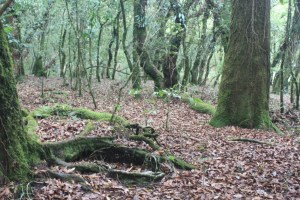
In a sacred forest
a Rodent roamed
who owned a sword
it freely loaned.
This was no hacking
machete blade,
but made of metal
of unmatched grade.
One day Lightening
made a request:
To borrow the blade
believed the best.
Lightening zigged,
sliced, and zagged.
Claiming ownership
in its boastful brags.
The rightful owner
requested its return.
But the rodent’s
plea met only spurn.
So the critter devised
a clever, sensible plan
in order to bridge
the requisite span.
It needed to climb
from Earth to the sky
because it had no
wings with which to fly.
But it wasn’t just wings
which Rodent lacked.
It had only one item
to be skyward stacked.
So it piled its poop
as high as it could,
from the base of a tree
past the top of the woods.
Stacking and piling, the
poop nearly touched cloud.
When a thunder crack
struck ear-splitting loud.
Lightening saw rodent
would reclaim the sword
that Lightening had come
to so ardently adore.
Down fell the Rodent
to a pile of fried dung
that had once been its
steps and its ladder rungs.
You may think that
Lightening got its way.
But the Rodent piles
its poop to this very day.
Someday when Lightening
is momentarily distracted,
Rodent’s sword will be
surreptitiously extracted.

Taken on April 23, 2017 at Kaziranga National Park in Assam
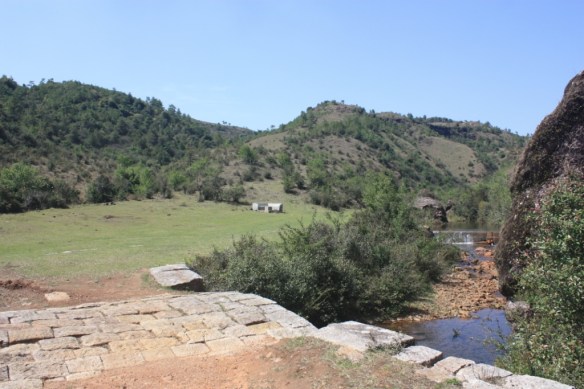
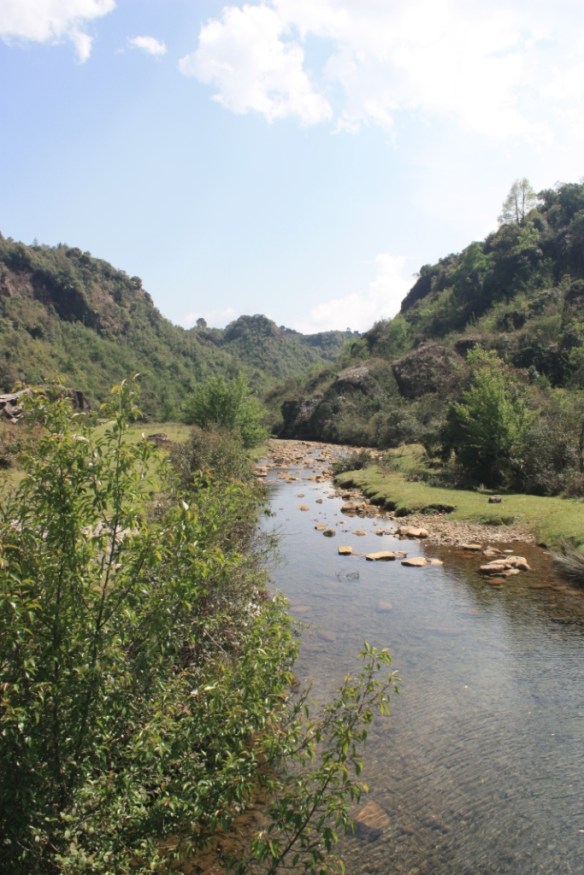


Taken on April 17, 2017 on the David Scott Trail

This was the view were we came off the trail near Lad-Mawphlang
I’m back after three weeks traveling about the Indian Northeast, i.e. the states of Meghalaya, Assam, Nagaland, and Manipur. And I’ve got a pile of pics.
The David Scott Trail is a hiking trail that was built as a carriage trail from Burma into India at the behest of the British colonial leader whose name it bears. Since it was made for traffic by animal-drawn carriages, it makes for easy hiking. It’s a scenic trail. It should be noted that (like most trails in India) it isn’t well-marked, however, the fact that it is wider than most trails and has old paving stones along much of the route makes it fairly easy to avoid getting lost.
We hiked only the section from Mawphlang to Lad-Maphlang. It’s an easy day hike.

blocks of rubble
corners & edges eroded round
bas reliefs dulled
&
adorned by jagged cracks
once the Earth’s most massive city
in its day London was a hamlet
thriving,
dying,
&
swallowed
infinitely patient arboreal adversaries
claimed the light
drilling down into cracks
making chasms
to set roots
strangler figs, literally,
strangled
figureheads
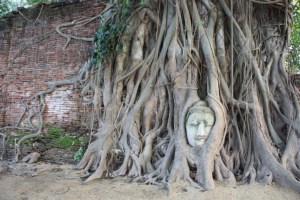
[National Poetry Month: Poem #8]

Taken in March of 2015 at Savandurga

Taken in May of 2014 at Ramanagara

Taken in July of 2015 in Ladakh at Namikala Pass

Leh

Nubra Valley

Pangong Tso
 The Hidden Life of Trees: What They Feel, How They Communicate—Discoveries from A Secret World by Peter Wohlleben
My rating: 5 of 5 stars
I picked up this book because it was on one of those “Best Science Books of 2016” lists, and it turned out to be the most important book I read last year. Like most of humanity, I’ve been guilty of thinking about trees largely as objects. Don’t get me wrong. Like others, I never forgot the basics of biology and always remembered that trees are alive because they grow, reproduce, and whatnot. I’ve also never failed to realize that without trees to suck up carbon dioxide and exude oxygen, we couldn’t exist—though I’ve probably not been sufficiently grateful. Still, because of the molasses-like time flow of trees, their immobility, and the fact that many can live for decades after someone chainsaws off a limb, it’s possible to feel they have more akin with rocks than with we members of the animal kingdom. (Note: trees don’t always respond as well as people think to random “trimmings.” As will be a recurring theme, our misunderstanding of this has a lot to do with time perception. If your dog’s head was in the way of the TV screen, and you cut it off with a chainsaw. You’d immediately realize that you’re a homicidal maniac and an idiot because the dog would be dead right then and there. When there’s a branch in front of your window and you hack it down, the tree may stay green for a couple of years [a blink on its time scale] and by the time it dies you’ll have completely forgotten that it was your action that lead to its demise.)
The author, Peter Wohlleben is a German forester, and this book was originally released in German before being translated to English (as well as other foreign languages.)
Wohlleben systematically dismantles the barriers between trees and us by showing the many ways in which they’re more like us than we could possibly fathom at a mere glance. The subtitle’s dual question of “What They Feel, How the Communicate” reflects just a couple of aspects of how trees are more like us than we realize. There are also chapters that investigate how trees share from strongest to weakest, and how the tough love parenting strategy of trees produces robust offspring. (Experience of time may be the way in which humans have the most trouble relating to trees. We believe there is benefit in virtually everything coming to us faster, whereas trees benefit greatly from growing slowly. Slow growth makes for sturdier trees.)
Moving back to that question of communication, one may be dubious that trees communicate because we can neither hear them nor see their gestures. But not only do trees communicate with other trees, some species communicate with members of the animal kingdom as when a tree under attack from insects releases a scent that attracts birds that feed on the attacking insects.
Wohlleben does a great thing by showing us how trees should be more relatable to us than we imagined. However, the lesson needn’t stop there. One might also take away a broader lesson that we shouldn’t assume that our frame of reference maps to the sum of reality. That maybe we should have sufficient humility to recognize the impressive intelligences of species we view too simplistically. There have been a number of books that have come out in recent years that have noted the ways in which monkeys, ravens, owls, and even octopi are much more astute than we give them credit for. Seeing this extended to the plant kingdom takes the discovery to a new level of mind-blowingness.
This book consists of 36 short chapters, each of which deals with a specific topic of interest (e.g. forest etiquette, social interdependence, climate effects, hibernation, illness, and how trees survive under challenging conditions—droughts, introduction of competitors, etc.) There are a few graphics throughout the book, mostly line drawings of trees with the species identified. The book does have notes. However, it’s really set up more like a book of short essays by a naturalist than it is your usual work of popular science.
I’d highly recommend this book for anyone who breathes oxygen.