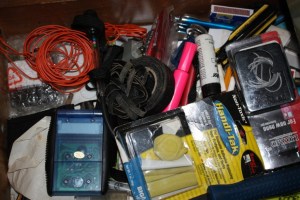
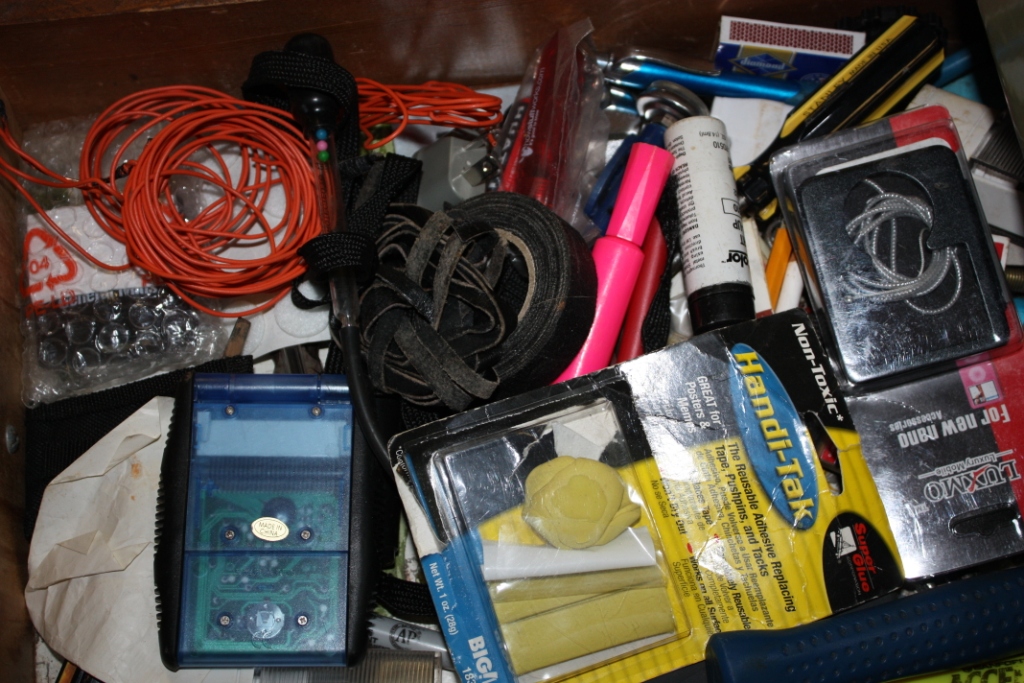
 I don’t like to use words like “stuff”, “things”, or the vague but picturesque “crap.” Such words have low information content and are thus semantic lightweights. However, there are few words for the random compilation of tchotchkes, trinkets, baubles, gewgaws, kit, tools, devices, objects, gadgets, contraptions, contrivances, gizmos, widgets, thingamajigs, and doohickeys that line the drawers, shelves, and closets of my house.
You may think I’m some sort of packrat, but the sad fact is– I’m not. I’d say our household buys less than average for homeowners. For one thing, we have no children. For another thing, both my wife and I might be classified as, for lack of a more eloquent term, cheapskates. (She’s an accountant and I’m trained as an economist, what do you expect?) Of course, many people, perhaps most people, organize their junk better than I.
I do have one consumption fetish, and that is books. If you live in a very small town (or a large city with many small, local libraries) I may have more volumes in my house than does your local library. However, two things have slowed me down in collecting [physical] books. First, I buy most of my books on my Kindle these days. Second, I’ve come to realize that the reason I’ve bought so many books is the hope that one of them would provide some impetus for me to say something interesting, insightful, and valuable, and the entire English language canon has failed me utterly in this regard.
Still, I have a lot of miscellaneous detritus floating around in my home. You’ve heard of the 500-year flood? I have 500-year tools; that is, tools that are specifically for some task that only comes up once every few lifetimes or so. In a reasonable world, one would rent such tools. However, most tool rental places are also tool sellers. Such businesses have learned that if the tool sells new for $60, they can rent it for $50. Most people will buy it on the principle of the matter, and if they don’t… CHA-Ching. Who would rent a tool that costs almost as much to rent as it does to buy? I’ll tell you who (you thought that was rhetorical, didn’t you?), people who have the good sense to think of every object that comes into their home as an item being warehoused at their expense. People who have garage sales are brilliant. They are getting paid to store their junk in your home.
When I’m doing spring cleaning, as I am now, I frequently find containers that contain nothing. I guess I’ve just kept them around in case some pressing containment needs pop up. I keep all sorts of things because I think one day I’ll need them. However, I never do need such items again, except the day after I throw them out. To avoid such a situation, I don’t pitch them. However, if I keep them I won’t need them. If Joseph Heller was still alive, he could write a novel about my life.
Of course, sometimes I do need such items, but–owing to my poor organizational paradigm–I can’t find them. I then face the ultimate dilemma. Do I put the new one that I just bought with the old one that I found after I made the purchase, or do I put it in an entirely different location in the hope that when I need it again I’ll have a better chance of finding it.
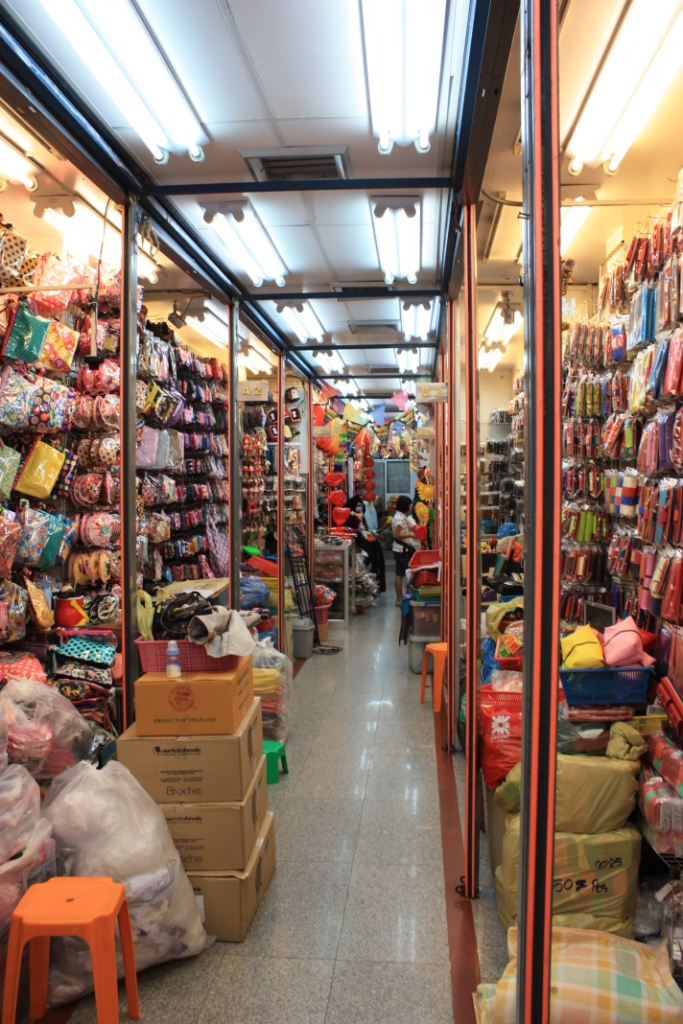
No place have I felt the weight of how much “junk” is swirling through our planet as when I was in Bangkok’s Chinatown last fall. There are miles of cramped alleyways and corridors packed to the gills with little plastic-wrapped junk, much of which seems to serve no purpose other than to satisfy the aesthetic needs of people with really poor taste or as gifts for people to whom you really want to send a statement of loathing. I had to get out of there, owing to a fear that shelving would collapse and I would be buried alive under a pile of knock-off Hello-Kitty coin purses. I can think of no death that is more embarrassing and yet apropos of life in the modern world than that.
Of course, one of the many downsides of an economics education is the knowledge that our high standard of living is dependent upon people making and buying ever more stuff. If you are saying “what high standard of living?” and you haven’t hand-churned your own butter, darned some socks, and killed a mastodon today, I would encourage you to look into how people lived in the past. People unburdened of an economics education can make statements like, “People shouldn’t be materialistic and everybody should have a job and all jobs should pay a living wage.” However, that is like saying, “I should be able to keep my cake and I should be able to eat it as well and somebody should pay me $100 for it.”
We are still hunter-gatherers. We just hunt for bargains, and gather up geegaws.
Share on Facebook, Twitter, Email, etc.

 Hipparchus by Plato



 Tiger Riding for Beginners