Publisher Site
This brief book discusses Taijiquan primarily from a philosophical perspective. Though a significant amount of the book’s page-count consists of full-page pictures of various taijiquan movements, it isn’t so much a how-to book. Readers who enjoy an eclectic book that’s short and sweet but also kind of all over the place have a good chance of liking this book and gaining from its varied tidbits of wisdom. Readers who favor books with a clear organization and internal logic will probably find this to be an odd stew of short writings (essays, guides, poems, scriptural excerpts, etc.) It should be noted that not all of the writings are from Kuo Lien-Ying, himself. It includes a translation of a manual by Wang Tsung-Yue (13th Century) as well as an appendix consisting of writings from the Daodejing, Tang Dynasty poetry, and quotes from Mencius and Confucius. It also features a chapter on the I-Ching and Taiji philosophy by Kuo’s wife, Simmone Kuo. Besides the Wang manual, which is right up the alley of Kuo’s writings, it’s not clear why the other pieces were selected (not that they aren’t beneficial, but that they seem random.)
One thing I really liked about this book is that a lot of it is presented in bilingual format. For someone learning Chinese, this is quite beneficial. (Especially, given that it consists of short pieces that can be more easily consumed by a new reader.) That said, those who don’t read Chinese may see the translations as further indication of padding a pamphlet up to book scale. The monochrome photos are well-done and could definitely be of use to someone who practices taijiquan (though would not be of much use to someone new to it.)
This book is an insightful mess, make of that what you will.
Ip Man led an interesting life. The master of Wing Chun Kung Fu lived through tumultuous times that included the Boxer Rebellion, the Sino-Japanese War, and China’s Communist revolution. After the Japanese occupation he served for a time as a police chief. Coming from a wealthy family, he experienced a riches to rags fall when the Communists took over. He had to move from his home in Foshan to Hong Kong. His use of kung fu was not restricted to the training hall, but, rather, included a few real world altercations. A couple of films have been made(loosely) about his life.
All that being said, this book doesn’t do a great job of capturing the life of this intriguing man. To be fair, the book isn’t really a biography proper–though the title might lead one to believe it was. However, it’s not entirely clear what the book is. Its fifteen chapters are each built around a principle and use vignettes from Ip Man’s life to illustrate how the Grandmaster lived virtuously. This makes the book seem more like treatise on martial arts philosophy and/or strategy. However, some chapters do a better job of making clear what the actual principle is and how the events of Ip Man’s life exemplify them than do others. In some parts it does a great job but in others it’s only lackluster.
There are some fascinating stories about the man’s life in the book, but they are generally told in a lifeless manner. In part this may be done on purpose as we are told that Ip Man eschewed embellishment and favored humility, but it makes the reading experience less than gripping. It’s also probably that some of the details were lost when Ip Man died in 1972. This lack of detail leaves one at times wondering. Throughout most of the book we get a picture of Ip Man as a virtuous warrior. However, there is one vignette in which we read about the Grandmaster picking a fight with a man by taunting him with humiliating insults about the man’s appearance. Ip Man does this to teach his student a lesson in courage. His lesson notwithstanding, this behavior paints Ip Man as anything but virtuous–rather than a humble martial arts master he becomes a pathetic bully. The author, Ip Man’s son Ip Ching, suggests that this might have been a setup for the student’s benefit, but with the prior assent of the bullied man. At any rate, there was no fight because the bullied man backed down–whether because it was staged or out of genuine fear remains unknown.
For some readers the most surprising omission will involve a lack of any mention of the man who was far and away Ip Man’s most famous student, namely Bruce Lee. There may be a number of reasons for this omission, including a desire to prevent the teacher’s story from being overshadowed by his student’s fame. However, most readers would probably like some inkling of how the ill-fated superstar came to train with Ip Man and what he learned from him. In fact, the only reference to the entertainment aspect of kung fu is a picture caption that shows Shek Kin, the villain “Mr. Han” from Enter the Dragon, at Ip Man’s funeral.
I would recommend this book only for those that have a particular interest in martial arts. It does offer tidbits of interesting events from Ip Man’s life as well as a few great life lessons. It benefits from being a concise book, and thus is not a major time investment to read. However, I don’t know that–short as it is–it would hold the interest of the general reader. Hopefully, someone will take on a more extensive English-language biography of this fascinating man’s life while there are some key people still alive to be interviewed about his life story.

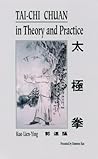 Tai-Chi Chuan in Theory and Practice by Kuo Lien-Ying


 Tiger Riding for Beginners