5 Haiku on Consciousness


thoughts form & float,
reflections of a gliding bird
over murky pools.


sleeping deeply,
universe? where art thou?
do you rest too?


within my dreams,
i feel the familiar,
but see the strange.


images gel,
but seeking sense in them
sends them hiding.


next car rolls fore,
i yank the parking brake,
halting false back drift.

BOOK REVIEW: Conversations on Consciousness ed. by Susan Blackmore

Conversations on Consciousness: What the Best Minds Think about the Brain, Free Will, and What It Means to Be HumanConversations on Consciousness: What the Best Minds Think about the Brain, Free Will, and What It Means to Be Human by Susan Blackmore
My rating: 4 of 5 stars

Amazon page


Blackmore gathers together interviews from a veritable who’s who of consciousness experts from neuroscience, philosophy, physiology, psychology, and physics. While the interviews are in part tailored to tap into the special insights of the given expert, a consistent series of questions is asked of each of the interviewees. Each expert is asked what they think is challenging about consciousness, what they think about the feasibility of philosopher’s zombies (a popular thought experiment about an individual who seems to behave like an ordinary human but who has no conscious experience), what they think about the existence of free will, what happens to consciousness after death, and what got them interested in the subject. This makes it easy for the reader to see not just differences in thinking across disciplines, but also different schools of thought within disciplines. There’s enough variety to make for intriguing reading. There is also a mix between individuals who have experience with meditation (e.g. the interviewer) and those who don’t, and so it’s interesting to compare views of those with such insight to those who study consciousness entirely abstractly.

I won’t list all the authors, but they include: David Chalmers (who famously coined the term the “hard problem” of consciousness, which is one of the most widely discussed ideas in the book), Francis Crick (of DNA fame who later shifted focus), Daniel Dennett (a well-known philosopher), V.S. Ramachandran (a neuroscientist famous for work on phantom limbs and behavioral neurology), and Roger Penrose (a physicist who believes that quantum mechanics may prove crucial to figuring out consciousness.)

It’s a straightforward book. There’s an Introduction by Blackmore and then the 20 or 21 interviews (one “chapter” is a married couple – Pat and Paul Churchland — whose insights are presented together.) The only back matter is a glossary, which is quite in-depth and which helps to clarify the many confusing concepts from various disciplines. There are a few cartoon drawings that lighten the tone, but serve no essential purpose.

I enjoyed this book and found it thought-provoking. It’s quite old at this point – having come out in 2005 – but since consciousness is so intractable, it’s not like any of the questions have been cleared up. (If it were a book on AI, I’d probably say it was worthless at this point, but not this book.) I’d recommend it for anyone looking to understand the lay of the land with regards thinking about consciousness.

View all my reviews

BOOK REVIEW: The Spread Mind by Riccardo Manzotti

The Spread Mind: Why Consciousness and the World Are OneThe Spread Mind: Why Consciousness and the World Are One by Riccardo Manzotti
My rating: 3 of 5 stars

Amazon page


Manzotti puts forth a bold and intriguing hypothesis that one’s mental experience is the physical world and not a model or representation of the world. Unfortunately, his book doesn’t make a compelling case for “The Spread Mind” (as he calls it) over its competition. Consciousness is one of those still dim corners of our world that isn’t yet fully understood by anyone, and this has spurred many competing ideas ranging from: a.) it being illusory; b.) it being purely a construct of a complex brain; c.) it hinging on some quantum mechanical action not yet understood; d.) panpsychic (all-pervading consciousness) arguments that may or may not resonate traditional Indian / Eastern conceptions; and e.) this idea that consciousness is identical with the physical world of which one is conscious.

However, for simplicity’s sake, one can contrast Manzotti’s idea with the most widely accepted view offered by science, which is that our brains construct mental models of the world often based on [but not identical to] sensory information they take in. (If my statement isn’t clear, you can check out neuroscientist Anil Seth’s TED Talk on “how our brains hallucinate reality,” which is as diametrically opposed to Manzotti’s hypothesis as one gets – and which, unfortunately for Manzotti, also makes a more cogent argument.)

At first blush, Manzotti’s idea might look appealing. It does, after all, simplify the picture. It eliminates the middle-man of mental models and seemingly solves the mind-body problem. The mind-body problem is how to reconcile how the body (wet, physical, objectively observable matter) relates to mind (intangible, subjective, ephemeral thoughts and feelings,) — if it does. Descartes famously suggested that mind and body were simply two separate things (i.e. dualism), and while that notion has remained popular with homo religiosis it’s all but dead in the world of science. However, there is no one monism that has unambiguously replaced Cartesian dualism. The most popular variant among those who study the brain is that some action in / across neurons creates a series mental imagery, internal monologuing, and emotional sensations that make up our mental experience. The mechanism by which this could happen is still not understood, but it’s an inherently hard problem to peer into because on can’t observe mind states directly and the best tool for studying it – i.e. functional Magnetic Resonance Imaging (fMRI) is only a couple decades old (and it’s still looking at brain blood flow and not consciousness, itself.) [I defend that this mechanism isn’t yet explained because one of Manzotti’s points seems to be: neuroscience hasn’t yet explained how neurons produced mental experience so just believe in my hypothesis which offers not even a hint of a mechanism by which it could work.] Manzotti’s is also a physical monist argument, but one that denies the mind is anything more than our experience of the physical world. In other words, there is a spoon, but there’s no mind separate of it.

So, what’s the problem? The reader may have already thought of some challenges confronting Manzotti’s hypothesis, and many of the most common ones the author refutes in the middle portion of the book. Dreams, hallucinations, fantasies, and even memory (certainly false memories, which we know are a wide-spread phenomenon) should utterly destroy the Spread Mind, given the simple definition we’ve given so far. After all, if your mental experience consists entirely of the physical objects that you are exposed to, then how does one explain the doughnut-shaped, sprinkle-breathing dragon that you hallucinated when you did ayahuasca on your trip to Iquitos? OK, you say you’re not such a wild child? Alright, how do you explain your detailed remembrance of putting that water bill into the mailbox, but then finding it under the seat of your car after you got a late notice from the water utility? If our mental experience is identical to the physical objects we experience, mentally experiencing things that don’t exist or events that never happened should never occur.

Manzotti elaborates upon Spread Mind to fend off these crippling attacks to his “theory.” (I use quotes because a theory is usually defined as “a well-substantiated explanation of a phenomenon” and it doesn’t seem to me there’s much in the way of substantiation of this idea.) There are two main prongs to his defense, one of which is unproven but soundly stated and consistent with the thinking of many physicists. The other defense seems to simply be a post-hoc rationalization used to make his “theory” work. Even though these ideas are presented in the opposite order in the book, I’ll deal with the first one I mentioned first because it’s relatively simple to cover. That’s the idea that past and present all exist always and at the same time. That may seem like an out-there idea because we can only ever be in touch with a moment we think of as the present and everything else is memory or fantasy /forecasts. However, it’s not exactly a rogue notion in science, especially once one starts thinking about making sense of Einsteinian Relativity. So, without this idea, if Spread Mind was correct, we could never have that fond memory of Mr. Fluffers, the pet we had in first grade who died decades ago. If our mental experience is Mr. Fluffers and not our mental model of Mr. Fluffers, we can’t have such an experience so long after he passed away. But if all time exist simultaneously, then one can conceive of how such a remembrance could happen. The only thing special about the present in Manzotti’s conception is that it’s the time during which we can interact with objects that also exist in the same time. This may or may not prove to be true. If it proves false it will kill Spread Mind, but if proves true the theory still has many questions to answer to prove itself worthy.

The second, and far less well-supported, defense could actually be divided in two ideas, but I’ll deal with it as a unit for simplicity’s sake. The parts of this defense our: a.) misbelief about our mental experience can happen, somehow [potential mechanisms by which this might occur are not described and that’s a huge problem for the author]; b.) objects we’ve experienced can be reshuffled to make objects appear to be entities that we know do not exist [Again, the mechanism by which this could occur is never explained or even seriously speculated about.] Let me give an example to explain how these defenses work. Say you drop a tab of acid and are having a hallucination of a dragon flying through the sky. Manzotti’s idea is that you are experiencing a reshuffled creature consisting of legs, a serpent, maybe some fire, a backdrop of sky, and you have a misbelief that all these constituent parts are in the present and co-exist together in space and time (as opposed to being disparate objects from varied past times.) This is a very convenient idea for Manzotti’s “theory” but it’s not really clear why we should buy it. In the competing notion that a mental model is built, one can imagine how the mind might construct something that doesn’t exist due to neuronal cross-firing or something like that. (The bigger question, in fact, might be why it doesn’t happen more often.) However, if our experience consists of objects that we’ve shared space-time with at some point, how and why should such weirdness occur? If the author made a compelling attempt to explain how this occurrence is reasonable, one might leave the book thinking his “theory” is – in fact — a theory and give it equal or superior footing to other approaches to consciousness, but as the book mostly offers gratuitous statements telling us to accept this all as a given, it’s not very powerful.

I’d like to get into one crucial example where I think Manzotti’s thinking is flawed in a way that could prove devastating to the Spread Mind. The author admits that an extraordinary hallucination would kill the Spread Mind. He defines an extraordinary hallucination as one consisting of objects that are non-existent in our world. Earlier, I used the example of a dragon which we know doesn’t exist, and we can be reasonably certain never existed. However, Manzotti would say that it’s just a reshuffling of parts like legs and snakes that we do know exist, combined with a misbelief about when these objects exist and that they co-exist in the same time. Manzotti says that there is no evidence that a hallucination that can’t be explained by reshuffling and misbelief ever existed. I have no doubt that if one read accounts of hallucinations; one could come away with that conclusion. However, I think it’s more convincingly explained by the nature of language as a unit of communication (hence necessitating common vocabulary.)

Example: Let’s assume for a minute that I had an extraordinary hallucination, and I decide to document it. I could take one of two approaches. On one hand, I could describe every completely novel element with a new word. I could say I saw a gruzzy-wug which had three separpals and a florgnak and a long and bushy krungleswam. Of course, I’m not communicating at this point because communication requires common vocabulary. Manzotti would likely argue that I’m just reshuffling letters [linguistic objects] to make up non-sense. On the other hand, as soon as I use a common vocabulary and analogy saying such and such is “kind of like a leg, but sort of with a curly-cue spiral and a mouth on top” Manzotti would say, well it’s a reshuffling of a leg and a pig’s tail and a mouth all of which the individual has seen before.

However, an even more devastating oversight is ignoring vast tracks of what most people would consider their mental experience. It’s the penultimate chapter before the book even touches upon emotion, which most would argue is a huge part of mental experience. Throughout most of the book, one is left wondering whether the author thinks of such things as emotion and language as part of consciousness. One imagines Manzotti’s experience of the world is one physical object after the other (mostly red apples with the occasional pink flying elephant – examples he uses ad nauseam) without any conceptual experience. Manzotti does explain that one must revise one’s conception of an object to think in terms of the Spread Mind, and one can see how this might explain language – which has a huge and powerful role in one’s mental experience and which is left unexplored by the book. But while language could arguable be explained as consisting of objects, emotional experience seems hard to fit Manzotti’s hypothesis.

The book consists of nine chapters. It has graphics and bibliography as one would expect of a scholarly work

I think most readers will find this book to be repetitive and frustrating in its lack of explanation. It’s not that it’s speculative; it’s that it just bludgeons the reader with gratuitous assertions that we expect will pay off in at least a hint of how the Spread Mind could work, but it never does. (For example, I greatly enjoyed Max Tegmark’s “Our Mathematical Universe” that speculates that our world is a mathematical structure – not that it can be described mathematically but that it fundamentally is mathematical.) Spread Mind is an interesting idea, but I can’t say I’d recommend the book unless one is really interested in knowing all of the varied lines of thinking about consciousness that exist out there. I must say it was a beneficial read because it made me consider some interesting ideas, but nothing in it swayed my thinking.

View all my reviews

5 Essential TED Talks on Consciousness

5.) Anil Seth: Your Brain Hallucinates Your Conscious Reality


4.) David Chalmers: How Do You Explain consciousness?


3.) Max Tegmark: Consciousness is a Mathematical Pattern


2.) Antonio Damasio: The Quest to Understand Consciousness


1.) Oliver Sacks: What Hallucination Reveals about Our Minds

BOOK REVIEW: The Tale of the Dueling Neurosurgeons by Sam Kean

The Tale of the Dueling Neurosurgeons: The History of the Human Brain as Revealed by True Stories of Trauma, Madness, and RecoveryThe Tale of the Dueling Neurosurgeons: The History of the Human Brain as Revealed by True Stories of Trauma, Madness, and Recovery by Sam Kean
My rating: 5 of 5 stars

Amazon page


Once upon a time, our knowledge of what the brain did, how it worked, and the degree to which its parts were specialized came from observing people who had brain injuries or a disease of the brain. Kean’s book examines the evolution of our understanding of the brain by way of investigations of historic cases. Looking at damaged brains is obvious not the ideal way to study the most complex system in the known universe—accidents and brain-eating diseases aren’t discriminating. Still, over time, a few conscientious [and sometimes warped] doctors and scientists pieced together important clues. From the rudimentary observation that people conked on the head often pass out temporarily, doctors began to learn about the degree to which brain parts were specialized and how changes in the brain effected beliefs, memories, and behavior.

Kean’s book is in part a history and in part a work of popular science, and the cases selected are often of interest both as history and as science. We learn about the damaged brains of kings, assassins, soldiers, adventurers, and those with more mundane jobs but no less fascinating brain trauma (e.g. Phineas Gage, one of the most well-known cases in the book, a construction foreman who had a steel tamping rod rocketed through his skull.)

It’s this historical approach that builds a niche for Kean. There have been a massive number of popular science books on the brain in recent years. (You’ll note that I’ve reviewed many of them.) While other books discuss many of the same intriguing neuroscientific phenomena (e.g. synesthesia [mixing of sense and / or mental data, e.g. people who see colors with musical notes or even with numbers], phantom limbs, epilepsy’s effect on beliefs, and the brain’s role in aberrant behavior) most of them are rooted in the mother-lode of discoveries that have come out of functional Magnetic Resonance Imaging (fMRI) and other modern technologies. Even the works of V.S. Ramachandran, which largely deal in discoveries rooted in low-tech but exceedingly clever science, are placed in the context of present-day science. (You should read Ramachandran’s book “The Tell Tale Brain” also.)

Kean’s book is complementary to the body of works on popular neuroscience. While some of those books mention the same (or similar) cases as Kean, they do so to illustrate the Dark Age origins of many of these questions. Kean delves into the intriguing details of such cases. On the other hand, while Kean is dealing in the historic, he brings in modern science on occasion to give the reader insight into what ideas have been confirmed and which overturned. That’s important as Kean is often telling the reader about the opposing theories of the day—as the title suggests.

The book contains an Introduction and twelve chapters that are arranged into five parts. The book’s organization is by brain structure and key (interesting) functions tied to those various parts. It’s logically arranged, starting with a question as crude as the skull’s role in brain injury and ending on a topic so challenging that there remains a great deal of mystery (and controversy among scientists) about it, i.e. consciousness. In between, we learn about neurotransmitters, neuroplasticity, and the brains role in sensory processing / presentation, bodily awareness / movement, emotion, belief, delusion, and memory—as well as the degree to which the two halves of our brain are independent and what severing the connection does.

The book is end-noted and has a works cited section, but it has a couple other noteworthy features. A fun feature of note is that each chapter begins with a rebus, a kind of word puzzle that relates to an anatomical part relevant to that chapter. There are also graphics in the form of both diagrams and black-and-white photos, and they are interspersed throughout the book with the relevant text (as opposed to in special sections.)

I’d recommend this book for individuals not only interested in neuroscience, but in the history of science generally. Even history buffs who don’t think much about science will likely learn a thing or two from Kean’s presentation of the cases—e.g. there is much discussion of Civil War wounds.

View all my reviews

BOOK REVIEW: Consciousness by Susan Blackmore

Consciousness: A Very Short IntroductionConsciousness: A Very Short Introduction by Susan Blackmore
My rating: 4 of 5 stars

Amazon page


Consciousness remains one of the least understood phenomena of our world. It’s also one of the most intriguing subjects, and fascination with it has spurred debate both between science and religion and within science. While science has been moving toward the belief that consciousness is rooted in the brain, there remain many important questions to be answered. Of course, historically, it wasn’t at all common to think of consciousness as arising from the action of a material object (e.g. the human brain), it was beyond humanity’s intellectual capacity to comprehend how something as grand as consciousness could arise from a 1.2kg (<3lb) organ. Consciousness was intertwined with ideas of “the soul”—a non-material self-ness.

So it is that Blackmore takes on a shadowy subject in which questions are as likely to lead to more questions as they are answers. She lays out the arguments between scholars of science and philosophy as to what exactly consciousness is, how it operates, and how important it is or isn’t.

The book consists of eight chapters. The first chapter attempts to define consciousness and discusses the degree to which there is a lack of consensus on the subject. In doing so, it outlines why consciousness is such an elusive subject.

Chapter two describes the attempt to find correlates of consciousness in the brain, and it describes some of the case of brain damage that support the notion that consciousness is a product of the brain. Many beliefs of duality (i.e. the idea that body and mind are separate) have been in decline because of cases in which brain damage is specifically linked to changes in consciousness. Consider life-long love being uprooted by a scalpel.

Chapter three deals with a number of topics related to time and space, such as whether consciousness lags behind reality. That sounds ridiculous. However, remember that we experience the world from inside the frame of reference of consciousness.

Chapter four examines a number of illusions to which our conscious minds are systematically subject. We have a number of blind spots, many of which result from the fact that a great deal of what the brain does, it does without letting the conscious mind in on events.

In the fifth chapter, the author presents the link between consciousness and perception of self. It has long been taken for granted by most of the world that there is some soul that exists beyond the body, and it’s in this chapter that the author reflects upon whether this is an illusion or not.

Chapter six covers a topic that is integrally linked to consciousness and the idea of self, and that is free will. Free will is another notion that humanity historically took for granted that is coming under fire in the face of our increasing understanding of the brain. Current scientific evidence suggests that free will as we perceive it (i.e. thinking things through consciously and then making a decision at a conscious level) is an illusion.

Chapter seven is about the many altered states of consciousness, including: dreaming, drug-induced effects, meditation, and some of the widely reported experiences that seem to involve separation of consciousness from body (e.g. out-of-body and near-death experiences.)

Chapter eight ponders the evolutionary advantage offered by consciousness (especially if a major part of what we think we use our conscious minds for is an illusion.) One thing is clear; evolution doesn’t hand out vast and complex advances in capability if they don’t serve to make one more likely to survive to procreate. However, could consciousness—majestic as it may seem—be a mere side-effect of a big brain developed to facilitate survival in a world in which we weren’t the strongest, fastest, or most athletic creatures by a long shot?

The book uses a wide variety of black-and-white graphics including cartoons, technical diagrams, and photographs. These graphics help to communicate important ideas and are more likely to do so with levity than technical complexity. The book is readable, considering the challenging topic.

I’d recommend this book for those interested in an overview of the state of understanding and debate about what consciousness is.

View all my reviews

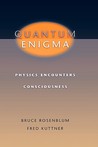
BOOK REVIEW: Quantum Enigma by Rosenblum & Kuttner

Quantum Enigma: Physics Encounters ConsciousnessQuantum Enigma: Physics Encounters Consciousness by Bruce Rosenblum
My rating: 4 of 5 stars

Amazon page

Consciousness remains a great mystery. While it has increasingly begun to look like consciousness is an output part of the brain, intriguing questions remain unanswered, and some of these unknowns are hard to reconcile with a materialist model (materialism says all phenomena are born out of matter.) It isn’t just pseudo-scientists and cranks that have a problem with the materialist approach. Major names in physics have pointed out that everything is not accounted for by a model that imagines consciousness as the computational product of the brain. Rosenblum and Kuttner address one such hiccup, the so-called Quantum Enigma that lends its name to the book. In brief, the quantum enigma reflects the fact that physical reality is created by observation. This may seem hard to believe, because it’s only been observed at the levels of the really small—i.e. primarily the atomic and subatomic, though the authors propose that there is theoretically nothing to limit the phenomenon to that level and experiments are being conducted at molecular level.

Rosenblum and Kuttner remind us that while the quantum world behaves oddly, quantum theory is exceptionally successful in scientific terms. Meaning that it has been validated by every single experimental inquiry, and the knowledge gained from quantum mechanics has made possible many of the advanced technologies that shape our world (laser, transistor, CCD, and MRI.) The oddness of Quantum Mechanics can be seen in several issues. One is the two-slit experiment in which atoms and photons behave like either a particle or a wave. Another is quantum entanglement, in which two atoms that have interacted become “wired” together such that changes in one are instantaneously reflected in the other—even if they have been separated by great distances.

The book is a bit repetitive, but perhaps this is necessary. People seem to have trouble grasping the nuances of the arguments being made, and this can lead to some wrong conclusions. For example, some people have leapt to the conclusion that ESP is supported by quantum entanglement, but the evidence doesn’t support the idea that one’s thoughts can control anything. Observation causes some physical reality to coalesce, but one has no influence over what reality displays itself. (In other words, with observation the wave function collapses and some state of being comes into existence from what was a field of probabilities.) Randomness remains. Physicists tell us that this is the problem with the idea of using quantum entanglement for instantaneous communications across light-years of space. A further example of a nuance that is hard to grasp is the notion that quantum probability doesn’t describe the likelihood an atom is a certain place, but rather it describes the likelihood you’ll find it there (and that that is a distinction with a difference.)

One may be wondering how consciousness is central the issue. If a non-intelligent entity observed, would the wave forms collapse? Consciousness doesn’t necessarily equate to intelligence as we know it. Consciousness can be thought of as merely the ability to observe and recognize significance in what is observed. So a thermostat is a very primitive form of consciousness. However, the authors do outline why a robotic observer wouldn’t end the controversy.

I found “Quantum Enigma” to be readable despite the challenging subject being explained. The authors to a good job of both describing the relevant phenomenon in terms the average person could understand (Ch.2 though which doesn’t reflect reality) before going on to explain the experiments in which the phenomena is actually observed (i.e. Ch. 7.) The authors use simple line drawings as graphics as necessary as well as staged dialogues to help make the concept clear by anticipating objections and dealing with them as they come.

I’d recommend the book for those interested in the unresolved questions of science with respect to Quantum Mechanics. In particular, there is the issue of consciousness—though it might not seem as central to the book’s discussion as the subtitle would lead one to believe. The last few chapters do deal in consciousness, though in a way that creates more questions than they answer. (It often feels like another summation of the strangeness of quantum mechanics, but that may be because the issues regarding consciousness remain so unclear. Furthermore, a lot of background is necessary to make sense of these complicated issues.)

View all my reviews

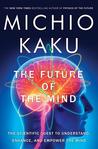
BOOK REVIEW: The Future of the Mind by Michio Kaku

The Future of the Mind: The Scientific Quest to Understand, Enhance, and Empower the MindThe Future of the Mind: The Scientific Quest to Understand, Enhance, and Empower the Mind

by Michio Kaku

My rating: 4 of 5 stars Amazon page

The Future of the Mind continues a line of inquiry that Michio Kaku has been following with his earlier books Physics of the Impossible and Physics of the Future. The central question remains: what sci-fi imaginings might come to fruition, which of them are impossible given the laws of physics in the known universe, and what breakthroughs or discoveries would be necessary to achieve the achievable. Technology is the inevitable gateway to these advanced breakthroughs. Humanity has eliminated gross evolutionary pressures through technology—this might not remain true, but we can certainly not expect X-men style mutations as a result of the foreseeable progression of humanity (which is more likely to be described by the horrible—though probably presagious 2006 movie Idiocracy than it is by the X-men movies.)

The theme of the book, as the title suggests, is the mind. As the most complex system that we know of, the human nervous system offers fertile ground for investigation. Among the sci-fi mainstays considered by Dr. Kaku are telepathy, telekinesis, false memories (think Total Recall), intelligence enhancement, mind control, artificial intelligence, and the nature of alien minds. Along the way he considers the challenges of reverse engineering the brain and whether consciousness could take a non-material form (e.g. embedded in a beam of light.)

As always, Kaku’s book is easy to follow, even for the scientific neophyte. Few others write on the topic with such clarity. While part of Kaku’s book deals with the same concepts covered by Roger Penrose in his book Shadows of the Mind, the Kaku book scores much higher in readability. Of course, the flipside is that Kaku’s book offers less explanatory power. So if one isn’t looking for pop science simplification, The Future of the Mind is probably not for you. However, if you want the jist of the science and have neither the background nor the energy to digest the mathematical and biological nuance, you’ll find this book readable.

Incidentally, Kaku is more optimistic about the ability to computationally replicate consciousness than Penrose, which the latter argues is impossible. Professor Kaku’s optimism runs through all of his books. He takes the stance that if one can imagine it–and figure out a technological or theoretical loophole around the known barriers –one can achieve it. Therefore, some of his discussion of what could come to pass depends upon theories about, for example, black-holes being true. It should be noted that Kaku is quite clear about the differences of opinion that exist about these theories and the role that differences between theory and reality could play in making science fiction into scientific reality.

I enjoyed this book. I’ve been reading a lot about neuroscience lately—entirely on the pop science level- and found this book to be beneficial to my understanding of the subject. It begins by discussing what is known about the brain and consciousness—it turns out that a lot remains unknown, but the technology of recent years has vastly improved our understanding of the brain, and it continues to do so by the day. The book also delves into the depths of what could come to be. There is definitely pragmatic understanding to be gained as well as outlandish, but fun, science fiction ruminations.

For sci-fi fans and writers, it’s definitely worth reading. I had many new conceptions of the future as I read the book. (I might suggest reading Physics of the Impossible first, which gives an overview many “impossible” technologies and explains how few are just flat impossible regardless of technological development and scientific discovery. My review of that book is here.) Many of the ideas covered may seem a bit eccentric, such as what first contact with an alien race would look like. (Kaku is of the notion that the transmission of an immaterial consciousness(es), possibly in conjunction with self-replicating machines would be the likely shape of such an alien presence.)

I recommend this book for almost anyone. We are really only beginning to venture out of the dark ages understanding the mind, and this book provides an interesting map what might be possible.

As I mentioned it, sadly, this may be the more likely future of the human mind:

View all my reviews