“On His Blindness” by John Milton [w/ Audio]

When I consider how my light is spent,
 Ere half my days, in this dark world and wide,
 And that one Talent which is death to hide
 Lodged with me useless, though my Soul more bent
To serve therewith my Maker, and present
 My true account, lest he returning chide,
 "Doth God exact day-labour, light denied?"
 I fondly ask. But patience, to prevent
That murmur, soon replies, "God doth not need
 Either man's work or his own gifts; who best
 Bear his mild yoke, they serve him best. His State
Is Kingly. Thousands at his bidding speed
 And post o'er Land and Ocean without rest:
 They also serve who only stand and wait."

NOTE: This poem is sometimes called “Sonnet 19,” sometimes “On His Blindness,” and sometimes “When I Consider How My Light Is Spent.”

“Rooms” by Charlotte Mew [w/ Audio]

I remember rooms that have had their part
  In the steady slowing down of the heart.
The room in Paris, the room at Geneva,
The little damp room with the seaweed smell,
And that ceaseless maddening sound of the tide --
  Rooms where for good or for ill -- things died.
But there is the room where we (two) lie dead,
Though every morning we seem to wake and might just as well seem to sleep again
  As we shall somewhere in the other quieter, dustier bed
  Out there in the sun -- in the rain.

“The Night Has a Thousand Eyes” by Francis William Bourdillon [w/ Audio]

The night has a thousand eyes,
 And the day but one;
Yet the light of the bright world dies
 With the dying sun.

The mind has a thousand eyes,
 And the heart but one:
Yet the light of a whole life dies
 When love is done.

“When I Was One-and-Twenty” by A.E. Housman [w/ Audio]

When I was one-and-twenty
 I heard a wise man say,
"Give crowns and pounds and guineas
 but not your heart away;
Give pearls away and rubies
 but keep your fancy free."
But I was one-and-twenty,
 No use to talk to me.

When I was one-and-twenty
 I heard him say again,
"The heart out of the bosom
 Was never given in vain;
'Tis paid with sighs a plenty
 And sold for endless rue."
And I am two-and-twenty,
 And oh, 'tis true, 'tis true.

“Invictus” by William Ernest Henley [w/ Audio]

Out of the night that covers me,
 Black as the pit from pole to pole,
I thank whatever gods may be
 For my unconquerable soul.

In the fell clutch of circumstance
 I have not winced nor cried aloud.
Under the bludgeonings of chance
 My head is bloody, but unbowed.

Beyond this place of wrath and tears
 Looms but the Horror of the shade,
And yet the menace of the years
 Finds and shall find me unafraid.

It matters not how strait the gate,
 How charged with punishments the scroll,
I am the master of my fate,
 I am the captain of my soul.

“So We’ll Go No More a Roving” by Lord Byron [w/ Audio]

So, we'll go no more a roving
 So late into the night,
Though the heart be still as loving,
  And the moon be still as bright.

For the sword outwears its sheath,
 And the soul wears out the breast,
And the heart must pause to breathe,
  And love itself have rest.

Though the night was made for loving,
 And the day returns too soon,
Yet we'll go no more a roving
  By the light of the moon.

“The Flea” by John Donne [w/ Audio]

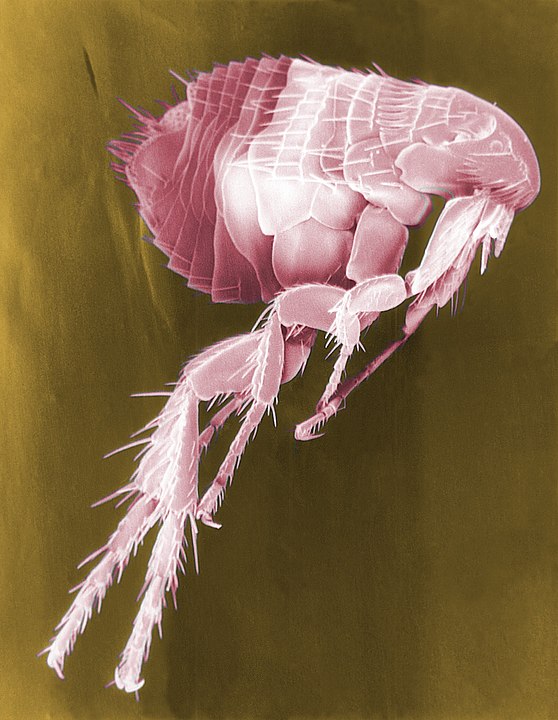
Source: CDC
Mark but this flea, and mark in this,
How little that which thou deniest me is;
It sucked me first, and now sucks thee,
And in this flea our two bloods mingled be;
Thou know'st that this cannot be said
A sin, nor shame, nor loss of maidenhead,
  Yet this enjoys before it woo,
  And pampered swells with one blood made of two,
  And this, alas, is more than we would do.

Oh stay, three lives in one flea spare,
Where we almost, nay more than married are.
This flea is you and I, and this
Our marriage bed, and marriage temple is;
Though parents grudge, and you, w'are met,
And cloistered in these living walls of jet.
  Though use make you apt to kill me,
  Let not to that, self-murder added be,
  And sacrilege, three sins in killing three.

Cruel and sudden, hast thou since
Purpled thy nail, in blood of innocence?
Wherein could this flea guilty be,
Except in that drop which it sucked from thee?
Yet thou triumph'st and say that thou
Find'st not thy self, nor me the weaker now;
  "Tis true; then learn how false, fears be:
  Just so much honor, when thou yield'st to me,
  Will waste, as this flea's death took life from thee.

“The Darkling Thrush” by Thomas Hardy [w/ Audio]

I leant upon a coppice gate
 When Frost was spectre-grey,
And Winter's dregs made desolate
 The weakening eye of day.
The tangled bine-stems scored the sky
 Like strings of broken lyres,
And all mankind that haunted nigh
 Had sought their household fires.

The land's sharp features seemed to be
 The Century's corpse outleant,
His crypt the cloudy canopy,
 The wind his death-lament.
The ancient pulse of germ and birth
 Was shrunken hard and dry,
And every spirit upon earth
 Seemed fervourless as I.

At once a voice arose among
 The bleak twigs overhead
In a full-hearted evensong
 Of joy illimited;
An aged thrush, frail, gaunt, and small,
 In blast-beruffled plume,
Had chosen thus to fling his soul
 Upon the growing gloom.

So little cause for carolings
 Of such ecstatic sound
Was written in terrestrial things
 Afar or nigh around,
That I could think there trembled through
 His happy good-night air
Some blessed Hope, whereof he knew
 And I was unaware.

“Sonnets from the Portuguese 43” by Elizabeth Barrett Browning [w/ Audio]

How do I love thee? Let me count the ways.
 I love thee to the depth and breadth and height
My soul can reach, when feeling out of sight
 For the ends of being and ideal grace.
I love thee to the level of every day's
 Most quiet need, by sun and candle-light.
I love thee freely, as men strive for right;
 I love thee purely, as they turn from praise.
I love thee with the passion put to use
 In my old griefs, and with my childhood's faith.
I love thee with a love I seemed to lose
 With my lost saints. I love thee with the breath,
Smiles, tears, of all my life, and, if God choose,
 I shall but love thee better after death.

“Bright Star” by John Keats [w/ Audio]

Source: NASA
Bright star, would I were stedfast as thou art --
 Not in lone splendour hung aloft the night
And watching, with eternal lids apart,
 Like nature's patient, sleepless Eremite,
The moving waters at their priestlike task
 Of pure ablution round earth's human shores,
Or gazing on the new soft-fallen mask
 Of snow upon the mountains and the moors --
No -- yet still stedfast, still unchangeable,
 Pillow'd upon my fair love's ripening breast,
To feel for ever its soft fall and swell,
 Awake for ever in a sweet unrest,
 Still, still to hear her tender-taken breath,
 And so live ever -- or else swoon to death.