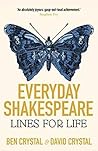
 Everyday Shakespeare: Lines for Life
 by
Ben Crystal
My rating:
4 of 5 stars
Amazon.in Page
This is like a word-a-day calendar, but with a quotation from Shakespeare for each day (rather than a vocabulary word.) Also, each quote has accompanying text that explains what the quote is from, what it means, why the language says what it does, and the context in which an individual might use Shakespeare’s words today. [Note: while that last bit (i.e. how to employ the Bard’s words today) is a major theme of the book, I wouldn’t recommend it. It will make one look more like a pretentious nincompoop than like a clever wordsmith.] That said, the book still has great value for anyone interested in Shakespeare’s work, specifically, or the evolution of the English language, more generally. In dealing with many phrases that describe workaday activities that were common then as now, the book builds a niche different from books that deal in the grandiose phraseology of war and aristocratic life.
Many people struggle with Shakespeare, and this book helps make clear why some of the statements that were about mundane matters had the meaning they did. I would put people’s difficulties with Shakespeare into three buckets. First, poetic and non-colloquial language in which the reader knows all the words and their meanings, but the poetic / stylistic language and grammar throws them for a loop. This book shouldn’t really need to deal with this one, but it does a little bit. Second, evolutionary language drift, in this case the reader knows the words but is thrown off because they don’t mean what they once did. The book is quite helpful in clarifying these changes. Third, the revolutionary shifts, these involve words and phrases wholly unfamiliar to the reader because they deal in activities and perspectives not present in our daily lives. The book explains these changes, as well, but there aren’t a great deal of them because the selections are supposed to be applicable today.
The book draws from the entire Shakespeare canon, but more heavily from the plays than from the sonnets or long form poems. (Also, not surprisingly, it draws more heavily from the popular plays — i.e. many of the tragedies and the popular comedies — than it does from the more obscure plays (i.e. most histories and a few of the others.) This only makes sense, and I was happy to see references to sonnets, histories, and other Shakespearean poems at all.
All in all, this is an informative book and is recommended for those who are interested in getting into Shakespeare, or who are intrigued by the ever-shifting landscape of the English language.
View all my reviews
Share on Facebook, Twitter, Email, etc.

 Les Fleurs du Mal by Charles Baudelaire