Ninja Nursery Rhymes

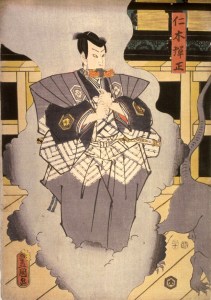
Public Domain image from Wikipedia

Ninja be nimble,

Ninja be quick,

Ninja knock you on the noggin with a big stick.

***

Ninja be stealthy… healthy… and wise,

Ninja snatch like a snake, pull out your eyes.

***

Biscuit in a basket,

Ninja put you in a casket.

***

Heading home from the archives,

I met this cat who had five lives.

He’d met four ninja in lives past.

One life was lost in a big blast…

two were stabbed,

and the last one gassed.

Reaching home, ninja at his door,

his lives remaining numbered four.

***

Uh, oh, Ninja,

Have you any heads?

Yes, sir, yes, sir,

Three over in the shed.

One for my Lady,

One for my Lord,

One for the practice,

’cause I got a new sword.

***

Eeny, meeny, miny, egg.

Catch the Shogun by his leg.

If he hollers, make him beg.

Eeny, meeny, miny, egg.

***

Hey, Willie Winkie, you’re making too much noise.

Running around town, checking on girls and boys.

If you’d have done your job, and shut the kid up.

I’d not have had to put Ambien in his juice cup.

***

POEM: Desert Story


Play it out, like a six-gun Western.
Let the sun hang in the mid-day sky.
Have him search for a cool-water cistern.
Croaking and choking that “the end is nigh.”

Hand him a glimpse of clear, clean water,
but let the mirage vanish into sand.
Trotting up to it as lamb to slaughter,
let him know he’s surely been damned.

Then he’ll succumb to a parched stupor.
The light fades from that cowboy’s eyes.
No spur-jangle of a nearing trooper,
but dark clouds off in the western skies.

A good story would see him wake with droplets on his cheeks.
But this ain’t that kind of story, the desert plays for keeps.

DAILY PHOTO: Kameng River at Dusk


Taken in May of 2017 at Nameri National Park in Assam

5 Haiku on Consciousness


thoughts form & float,
reflections of a gliding bird
over murky pools.


sleeping deeply,
universe? where art thou?
do you rest too?


within my dreams,
i feel the familiar,
but see the strange.


images gel,
but seeking sense in them
sends them hiding.


next car rolls fore,
i yank the parking brake,
halting false back drift.

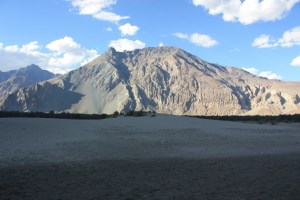
DAILY PHOTO: Gray Weather Ladakhi Landscapes

Taken in August of 2016 in Ladakh.

BOOK REVIEW: The Sonnets of William Shakespeare by Wm. Shakespeare

The Sonnets of William Shakespeare (Wisehouse Classics Edition)The Sonnets of William Shakespeare by William Shakespeare
My rating: 5 of 5 stars

Amazon page


This book consists of 154 sonnets that were published in a quarto dated 1609. It’s not all of the sonnets written by Shakespeare because there were a few stashed in his plays. It’s also not the entire contents of that 1609 quarto, which also included a long-form narrative poem entitled “The Lover’s Complaint.” However, these are the poems typically included in collections of Shakespearean sonnets.

For those unfamiliar with the sonnet, it’s a 14-line poem that’s metered and rhymed. In English language sonnets (and Shakespeare’s, in particular) that metering is iambic pentameter (five feet of alternating unstressed and stressed syllables.) Shakespeare’s sonnets follow a rhyme scheme that is often named for him: ABAB CDCD EFEF GG. (It’s also called English Rhyme, and is differentiated from Petrarchan Rhyme which has an octave of ABBA ABBA and a sestet that can vary, e.g. CDCDCD.) As with all rules of poetry, there is the occasional exceptions taken here and there.

Love, beauty, and death are common recurring themes in the sonnets, but there are occasional forays into tangential topics like lust, infidelity, and immortality through poetry. There are also humorous twists on the expected approach. The most famous Shakespearean sonnet is probably 18 “Shall I compare thee to a summer’s day?”, but we see in another popular contender, Sonnet 130 (“My mistress’ eyes are nothing like the sun;”), Shakespeare mocking hyperbole. Of course, he’s not just mocking hyperbole; he’s also saying that he can still love his lover despite the fact that she isn’t in all ways more beautiful than the most pleasing elements of nature (and might even have halitosis.)

There’s no division or formal organization of the sonnets. However, scholars do divide them up in various schemes. One simple way that they are divvied up is to put the first 126 in a category in which Shakespeare addresses a young man. The first 17 sonnets are a subgroup in which the poet attempts to convince the young man to be fertile and multiply. Sonnets 127 – 154 are sometimes called the “Dark Lady” (a.k.a. “Black Mistress”) sequence as they frequently refer to a brunette woman (i.e. the woman whose lips are not as red as coral in Sonnet 130.) One can see the difference in tone extremely contrasted in the two poems mentioned in the preceding paragraph – Sonnets 18 and 130.

Besides the aforementioned sonnets, a few others stand out as personal favorites:
– 55 “Not marble, nor the gilded monuments”
– 27 “Weary with toil, I haste me to my bed,”
– 1   “From fairest creatures we desire increase,”
– 65 “Since brass, nor stone, nor earth, nor boundless sea,”

But you should read them and find your own favorites. It’s Shakespeare, of course they are highly recommended.

View all my reviews

BOOK REVIEW: The Electric Kool-Aid Acid Test by Tom Wolfe

The Electric Kool-Aid Acid TestThe Electric Kool-Aid Acid Test by Tom Wolfe
My rating: 5 of 5 stars

Amazon page


This book offers an account of the activities of Ken Kesey and the Merry Pranksters during the mid-1960’s. Kesey is best known as the author of “One Flew Over the Cuckoo’s Nest,” a best-selling novel that was adapted into an Oscar-winning film starring Jack Nicholson. The charismatic Kesey led a group of nomadic hippies who came to call themselves “the Merry Pranksters.” There were many counter-culture strains during those years. Some looked East, and pursued spiritual traditions like yoga and Zen. Some were academics who sought to maintain scholarly rigor in adventures through the doors of perception. Kesey and the Merry Pranksters occupied more whimsical territory. As the “prankster” name suggests, taking things seriously wasn’t their way. Their mythology was in comic book superhero tales, and their moral code hedonistic. The titular prank had to do with spiking Kool-Aid with LSD (a.k.a. Acid) – not to be confused the Jim Jones cult which poisoned Kool-Aid and engaged in collective suicide over a decade after the events described in this book took place.

LSD plays a major role in the events of this book. While it’s not mentioned in Wolfe’s book, an interesting thing to note is that Kesey was introduced to hallucinogens through a program funded by the CIA’s nefarious MK-Ultra program. Kesey was working as an Aide at the Menlo Park Veterans’ Hospital, and he volunteered for a study on the effects of a number of psychoactive / hallucinogenic drugs. It seems that Kesey took a shine to these substances (most notably LSD) because he kept pursuing psychedelic experiences long after the study was over and even after he’d run afoul of the law (though his arrests were marijuana-related and not about hallucinogens.)

Tom Wolfe used beat-poetic prose to convey the feel of Merry Prankster life. There are even a few free verse poems in the book as well. And, of course, the dialogue conveys the tone of this community. The language is often fun and trippy in a way that contributes to the story. Wolfe put an author’s note amid the book’s back matter that explains his desire to not only tell people about the events but to convey the atmosphere, and I felt he did a nice job in that regard.

The central story hinges on Kesey faking his death (not skillfully) and fleeing to Mexico to evade punishment on his initial marijuana charges, and then — after some time in Mexico — he returned to the US, ultimately doing his time. Over the course of the book, the Pranksters develop a rapport with the Hell’s Angels, they cross paths with the likes of Beat giant Allen Ginsberg and the founders of the Grateful Dead. While it’s nonfiction, and thus not meant to follow a story arc approach beat for beat, Wolfe does tie things up with a nice bow, ending with the Prankster “Graduation” which would see the end of that group before Kesey went off to serve time on his combination of marijuana and evading justice charges. We see a change in Kesey in the last couple chapters as he’s advocating pursuit of the psychedelic state of mind without the use of drugs. It’s hard to say how much of this is trying to cooperate to get better terms, how much it was just growing up, and how much it was a true change in his core beliefs.

I enjoyed this book. It’s fun to read and offers insight into an era with which I wasn’t particularly familiar. I’d only known Kesey from his blockbuster book and a vague reference to his being a participant in a MK-Ultra funded program, and so it was interesting to learn about the intriguing life of this author.

View all my reviews

DAILY PHOTO: Glass House, Lalbagh

Taken in September of 2013 in Lalbagh Gardens in Bengaluru

This greenhouse-like structure dates back to 1889.

POEM: Flower Market

Taken in September of 2013 in Bangalore at K.R. Market

Garland coils in saffron and yellow.
Burlap bags of loose blooms in many hues.
Free petals strewn across the floor.

Vendors sit like stamen, still amid the chaos.
Customers waft around like pollen on the wind.
And workers flit about like industrious bees.

DAILY PHOTO: Merdeka Square

Taken in December of 2013 in Kuala Lumpur