5 Traits Confused for Introversion

There are a number of personality traits or temporary states of mind that may be wrongly attributed to introverts. One reason for this is that introverts aren’t the most expressive of individuals, and in the absence of information people write their own stories — and when writing their own story, they tend to put themselves at the center, even if it’s a story to explain another person’s behavior. So it is that, faced with a lack of verbal or nonverbal feedback, many individuals will assume that the introvert’s behavior has something to do with them. For example, the introvert — lost in thought — who doesn’t acknowledge another person’s entry into the room may be seen assumed to be miffed or irritate, when the truth is that they were just so deeply absorbed in thought that they didn’t notice said person.


5.) Arrogance: If the introvert has a high level of self-confidence in his or her abilities in a particular domain, they may be believed to be arrogant or narcissistic, generally. I, for one, am plenty arrogant in some regards, but that doesn’t mean I’m at all arrogant about what people have assumed me to be arrogant about.

4.) People-hating: Introverts burn energy quickly in interactive, or highly stimulating, situations. That means that they aren’t going to jump on every invitation. An introvert has to manage energy with respect to activities and events where he or she has to interact with others. Choosing to stay home alone rather than go to a given party doesn’t equal hating people.

3.) Shyness: Introverts can be shy, i.e. have anxiety about being in social situations. However, the two don’t necessarily go together.  Shyness, or social anxiety, is also much less stable a condition. In other words, people can overcome social anxiety just like they overcome fear of spiders or heights. However, introversion isn’t conditioned away, generally speaking. One needs to think in terms of managing introversion rather than extinguishing it.

2.) Unintelligence: As Susan Cain discusses in her book “Quiet” this isn’t a global tendency, but it’s common enough in the Western world and America, specifically. In Taoism, it’s famously said that “He who speaks does not know, and he who knows does not speak.” But in the West, if you don’t broadcast your ideas loudly its assumed that you don’t have ideas, and — alternatively — if you are loud enough people may begin to assume you know what you’re talking about. [Which, needless to say, need not be true.]

1.) Hostility / Passive Aggressiveness / Anger: An introvert may be assumed to be giving others the “silent treatment” when — in fact — there’s no “treatment” just a love of silence.

DAILY PHOTO: Graffiti in Almaty

Taken in Almaty in July of 2019.

DC5FDEEE-AD6D-458A-8127-D65D259CD387

POEM: Kyrgyz South Shore

standing on a green mountaintop
with snowcaps to my back
ahead, angular arid lands
crinkled, as marked by wrack

beyond, a lake still and turquoise
waters frigid as clear
not a sound but for bird or breeze
at habitat frontier

where do desert, beach, and meadow
mingle as in this place?
a thousand square miles condensed
into a hundred acre space

DAILY PHOTO: Kolsai-1

Taken in August of 2019 at Kolsai-1 Lake

DAILY PHOTO: Baza Karakol Ski Lift in Summertime

Taken in August of 2019 at Baza Karakol

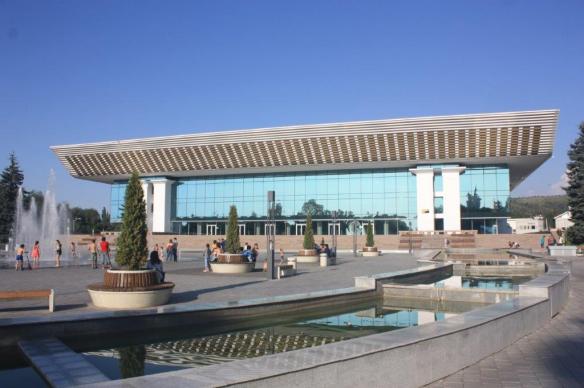
DAILY PHOTO: Republic Palace, Almaty

Taken in Almaty in August of 2019

BOOK REVIEW: Kulager by Ilias Jansugurov [Trans. Belinda Cooke]


Kulager by Ilias Jansugurov
My rating: 5 of 5 stars


This narrative poem was written by Ilias Jansugurov about the life of another poet, a man named Akan who lived from 1843 to 1913. More accurately, it’s about Akan’s horse, the eponymously named “Kulager.” The story revolves around a horse race that is takes place in Kazakhstan. An important, if unloved, man passed away, and as part of the wake there is a massive get together of people from far and wide, and it features a horse race.

Kulager is a crowd favorite, and in the cut-throat Kazakh steppe, that love seals the animal’s fate. The opening chapters acquaint us with setting, with Akan, and with Kulager, and then proceed into the story of the Akan’s arrival, the pre-race braggadocio that confronts him, and the race, itself. There is another favored horse who isn’t so beloved as Kulager but who has an owner willing to do anything to secure a victory. The tragedy that ensues is one in a long line that have confronted Akan.

It’s worth mentioning the tragedy of the author’s own life. Jansugurov was killed in 1938 in Stalin’s purges. He was considered too outspoken, and his criticisms were not so well veiled to keep him from drawing the ire of the state.

The book includes monochrome artwork and a glossary that comes in handy for those who aren’t acquainted with the Kazakh language. There are two forwards and a translator’s post-script, but it’s not the case (as is sometimes the case for poetry and thin volumes, more generally) that the ancillary matter exists to pad the book out to a publishable length. The ancillary matter is of reasonable length, contains useful information, and the bulk of the page count consists of the poem.

I found this book interesting and readable and would recommend it for those interested in life on the steppe. I picked “Kulager” up because I try to read indigenous literature from each country I visit, and this was the only Kazakh literature I could find translated to English. That said, it seems to be the first work to be put out by Kazakhstan’s National Bureau of Translations, and so – hopefully – there will be more to follow.

View all my reviews

DAILY PHOTO: Seven Bulls Rock, Jeti Oguz

Taken in July of 2019 at Jeti Oguz

BOOK REVIEW: Plant-Based Sports Nutrition by D. Enette Larson-Meyer & Matt Ruscigno

Plant-Based Sports Nutrition: Expert Fueling Strategies for Training, Recovery, and PerformancePlant-Based Sports Nutrition: Expert Fueling Strategies for Training, Recovery, and Performance by D Enette Larson-Meyer
My rating: 5 of 5 stars

Amazon page


This is an updated and revised edition of a book previously called “Vegetarian Sports Nutrition.” The name change not only reflects the rise of veganism and other more restrictive diets, but also an increase in “flexitarianism” — or the reduction (but not elimination) of animal-based foods that is driven by health factors, by environmental concerns, or by a combination of both. One of the things I like about this book is that it offers a balanced discussion of how to meet the nutritional needs of athletics through a diet that is mostly or entirely plant-based. That is to say, it’s not trying to sell the reader on a particular dietary approach, and, therefore, doesn’t fall into the trap of pretending that the move is purely upside. Those trying to persuade readers of a given diet tend to overemphasize the studies showing the benefits of plant-based diets while neglecting to discuss the challenges to meeting dietary needs without animal-based foods – particularly if one has the substantial needs incurred by athletes. [Which isn’t to say there aren’t health benefits — and even performance benefits — to be gained, but thinking that one can make the switch without giving thought to the details is a bit naive.]

The book consists of fifteen chapters that take one from an introduction to the various forms of plant-based diets through specific dietary considerations (i.e. meeting caloric requirements, macro-nutrient needs, and micro-nutrient needs) and – finally – to practical matters of what to eat and how to prepare it. After an opening chapter that lays forth background information, chapters two and three deal in the related topics of getting adequate calories and getting enough carbs. Vegetables, after all, aren’t typically calorically dense, and so salad and steamed vegetables – while a beneficial part of a diet — aren’t going to meet the needs of an athlete.

Chapter four delves into meeting fat requirements. While carbs have come to be wrongly villainized in current fitness environment, there are some who are still working under the old “fat is the enemy” paradigm. In truth, one needs a diet that includes all three macro-nutrients: carbohydrates, fats, and protein. Those on plant-based diets who don’t (or can’t) eat nuts and legumes can run into problems with getting enough fat. Chapter five rounds out the chapters focusing on macro-nutrients by exploring protein needs. This is the chapter many readers will be prone to make a beeline toward. Athletes who are considering a plant-based diet are most likely to be concerned that they can’t get enough protein. This is a contentious topic because vegan and vegetarian athletes often want to pull their hair out over what they feel is a great misconception. They say it’s no problem hitting protein targets on a plant-based diet, and — depending upon one’s sport and one’s body — that can be true. But for some it takes planning. (e.g. It’s true that one can get a complete protein by eating rice and lentils. The challenge is that if you do go about getting the 2 gms of protein per kg of body weight that some athletes require by just eating rice and lentils you are likely to find yourself becoming obese because those high-protein foods are even higher in carbs.)

Chapters six and seven shift into critical micro-nutrient considerations. Chapter six is about bone health, which is a greater concern with respect to some forms of plant-based diet than others. Chapter seven is about iron intake and absorption. One thing that I found very important and interesting in this book is the discussion of how foods and nutrients that one might think of only in terms of their positive effect can also have a negative effect. That is, some nutrients that we need in a given quantity will block the absorption of other nutrients if taken in excess quantities. Chapters eight and ten are about eliminating the need for multivitamins or other vitamin and mineral supplements. Another thing that I appreciate about this book is its emphasis on getting all of one’s nutritional needs through food. While it doesn’t take an iron-clad opposition to supplements, it suggests that one should first make great efforts to meet needs with food before considering any supplement.

Chapter nine is about timing of food and fluid intake for optimal performance. It’s one thing to know what to eat, but one must also know when to eat and when not to eat. Chapter eleven investigates common problems that are often attributed to food and fluid intake, namely cramps and inflammation. The part dealing with cramps was particularly informative, as I learned that much of what I’ve heard on the subject (and / or that is commonly believed) is either not well-established in the literature or is plain old poppycock.

Chapters twelve and thirteen are about building a meal plan to meet one’s requirements, and modifying the plan to cut or gain weight as necessary, respectively.

The last two chapters are about preparing meals to meet an athlete’s needs with plant-based foods. The penultimate chapter is more about the quick meals and snacks, and the last chapter provides a collection of recipes.

There are several appendices containing information about nutritional information and various approaches to building a balanced diet. There are also graphics including photographs, tables, and diagrams. I can’t speak to how effective these are as I read a review copy that was unformatted, but I do know they are frequent throughout the book.

I’d highly recommend this book for athletes, trainers, or coaches who are considering moving to a plant-based diet or who work with clients or athletes who are vegetarian, vegan, or otherwise eat a predominantly plant-based diet.

View all my reviews

BOOK REVIEW: Thirteen Steps Towards the Fare of Erika Klaus by Kazat Akmatov

Thirteen steps towards the fate of Erika KlausThirteen steps towards the fate of Erika Klaus by Kazat Akmatov
My rating: 4 of 5 stars

Amazon page


This book is set in Kyrgyzstan shortly after the breakup of the Soviet Union in a border region that has become the fiefdom of the head of the border patrol force, Colonel Bronza. This condition exists because Bronza had always reported to Moscow, which is no longer concerned with borders beyond those of Russia, and because the Kyrgyz government has been so busy getting its feet under it that it neglected its far reaches.

Into this fiefdom, comes a Norwegian volunteer, Erika Klaus, to teach English. Klaus’s naivete keeps her from grasping the dire nature of the situation and so her fate becomes worse and worse. She fails to realize that she isn’t in democratic and progressive Scandinavia anymore, but rather is in a place that is governed in part by the old Soviet KGB playbooks and in part by a man who is essentially a warlord. Even the reason she is in Kyrgyzstan shows her lack of sophistication. A childhood ailment resulting from lack of sun exposure (a not uncommon factor in Scandinavia) had a profound effect on her psyche and she chooses this location because she read that the locals were “sun-worshipers.” What she didn’t realize is that the reason they have so much affinity for the sun is that they live in a valley where they, at most, get two hours of non-shadow existence per day. But, worse, her naive ways keep her from playing the game that the locals are playing to get along. The story is supposedly based on a true story. However, I don’t know how much dramatic license Akmatov took with the narrative.

I picked up this book in Bishkek as part of my continuing effort to read a work indigenous literature from each country to which I travel – particularly a work that sheds some insight into the culture of that particular country. As I couldn’t find any translated books by Chingiz Aitmatov, I ended up with this book because – for some reason – a few books by this author, Kazat Akmatov, were all that were available in English translation. (This is a little surprising as Chingiz Aitmatov is a much more globally recognized Kyrgyz author.) All that being said, I think this was a good book for my purposes. The fact that it features a Westerner trying to get by in a rural region puts culture and history front and center. The reader learns both about life in Kyrgyz village household as well as how the locals got through this sad time as the protagonist is exposed to these lessons.

I should point out that this isn’t a happy tale. The story has a grim feel throughout, and gets progressively more so. It does have some happy moments in which we see how kind and hospitable the Kyrgyz people are, but they are sparse contrast to the tale of woe playing out. The story is particularly dark when one considers that some version of these events actually happened. That said, it’s a very readable book. The story is engaging and it’s hard to put down.

The book is factually confusing at times. In places it suggests this is the border with Afghanistan (which is relevant to the story because of the past history – i.e. the Soviet-Afghan War), but Tajikistan lies between Kyrgyzstan and Afghanistan and the two post-Soviet countries gained independence within a few days of each other. In other places it reads like the border is with China (which Kyrgyzstan does border.)

The book has a few plates of black-and-white artwork to accentuate certain scenes.

If you’re looking for a book to offer you some insight into Kyrgyzstan, I’d recommend this book. It’s also an interesting, if sad, story for more general readership.

View all my reviews