


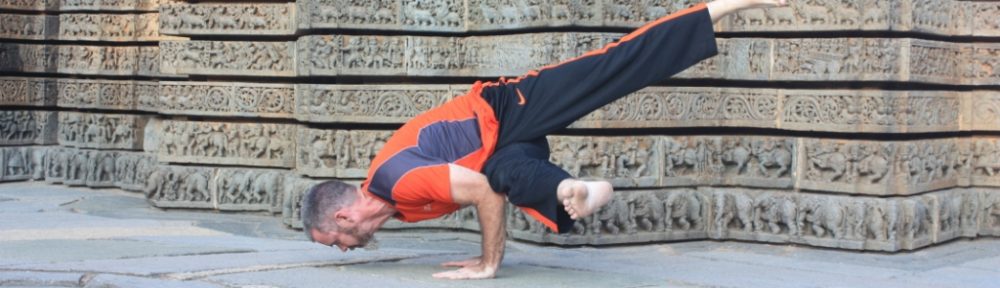
Taken in Gokarna on August 30, 2020.
 Introducing Kant: A Graphic Guide by Christopher Kul-Want
My rating: 4 of 5 stars
This volume is part of a large series of guides that are put out by Icon Books with the goal of providing concise overviews on various topics. In this case, said topic is the philosophy of Immanuel Kant. Kant was an eighteenth-century Prussian philosopher who greatly influenced modern and post-modern philosophy. Among the ideas that Kant shaped and influenced were skepticism, morality based in reason, and the need for an understanding of knowledge that was neither purely empiricist nor purely rationalist (but which acknowledged the strengths and limitations of each.)
The book largely follows a chronological approach in presenting Kant’s ideas as he came up with, and published, them. Along the way, there are sections that are biographical rather than being focused on the philosophical ideas. These sections are largely in the beginning, middle, and end as they discuss the philosopher’s entry into the field, the changes in the midst of his career, and the end of his life. I thought it was useful to gain a bit of insight into the man as a man (rather than just as a philosopher) because it helps one understand the nature of the mind that came up with those ideas. That said, if there were space constraints, I would have preferred more examples and narrative explanation of the ideas – which are intensely definitional and abstract, making them both dry and less effective than they could be – over that biographical information (much of which boils down to Kant being quirky and peculiar.) The bulk of the book follows the flow of ideas contained in the three publications that were the colonnade that undergirded Kant’s philosophy (“Critique of Pure Reason,” “Critique of Practical Reason,” and “Critique of Judgement.”)
Between the last biographical section and the book’s conclusion, there is a nice section that discusses Kant’s influence on other philosophers, including: Hegel, Nietzsche, Heidegger, Foucault, Lyotard, and Derrida. When I say “influence” I’m not just talking about those who paid homage to Kant, but also those who critiqued his work and advanced the discipline by way of critiquing Kant.
As the subtitle suggests, graphics are used throughout. The graphics are black-and-white and are a mix of diagrams and cartoon drawings. I thought the drawings were well-rendered, but weren’t necessarily arranged to gain the most explanatory power. As with other books in the series, many of these are cartoons that merely restate ideas from the text. Other graphics are diagrams that arrange ideas in a way that I’m sure made sense to whomever was putting them together, but whose immediate explanatory value (if any) was not always readily apparent to me. I have no way of knowing whether this was purely the illustrator, or (more likely) a collaboration between author, illustrator, and editor.
This is an okay overview of the philosophy of Immanuel Kant. I’d describe it as accurate but not as clear or interesting as I’d wish it to be. I will admit that if it hadn’t been available without extra cost via Amazon Prime, I probably would have obtained a different guide. There is loads of competition in this concise guide market (e.g. “Kant: A Very Short Introduction” by Oxford University Press.) You might benefit from shopping around a bit.
 Flex forward and a row of rounded, fleshy knobs form in that muscled valley — straight and evenly-spaced.
Chest up & shoulders back and the knobs shrink, enshrouded; while those low, rolling knolls become bounded by scapular cliffs.
Dance about and a million topographies form and disband: all without a sharp corner — nothing but smooth transitions, gracefully made.
Fronts get all the attention, but backs are masters of the beauty of subtle change.
My spine bends and flexes, and I’m alive.
Sparks run in riffles down that line, and I’m alive.

The rain bands slant across the narrow track
between the leaden clouds and churning seas.
The vastness, standing before ocean’s edge,
is boxed by rain, low clouds, and rising waves.
My view of infinite space shrivels up.
The water curtain hides what lies behind —
the lost horizon lies, disguised by lines
of squall that crawl with all the time allowed.
What brought me to this shore is now mislaid:
some sense that I could never be contained.
I’m sure that storm intends to push me home —
back to the box where it thinks I belong.
But then it passes by; blue skies beyond,
and I can see out past the trawler’s shapes.

The jungle paints the ruins green —
brown blocks are made verdant.
So, you can’t see its ordered shape
’til you part the curtain
of palms and vines and mammoth leaves
that hide those old remains —
once hacked back by muscled men who,
daily, took great pains
to clear the rampant jungle growth
out beyond moat and berm.
‘Til the invading army won,
and Fort was deemed infirm.


