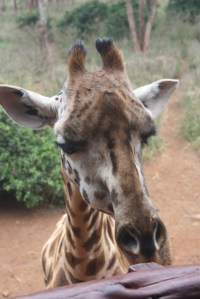
POEM: The Humorless Giraffe

So now, tell me, Mister Giraffe:

How come I never hear you laugh?

Are you too tall to hear the joke,

or are you just an uptight bloke?

Human humor is elation

vis-a-vis

circumvented expectation.

Since I never do misconstrue,

I never need let them know I knew.

BOOK REVIEW: Turtle Island by Gary Snyder

Turtle Island (Shambhala Pocket Classics)Turtle Island by Gary Snyder
My rating: 4 of 5 stars

Amazon page


If you’re not a reader of latter-20th century American poetry, then maybe you’ve heard of Gary Snyder’s fictional doppelgänger, Japhy Ryder, even if you haven’t heard of Snyder, himself. Ryder appears in Jack Kerouac’s “Dharma Bums” as a friend and mentor to Kerouac’s own fictional persona, Ray Smith. If you do remember Ryder, you have some insight into the themes that recur throughout this collection. Said themes include reverence for nature and an appeal to Eastern philosophical and religious traditions–most specifically Zen. Though there are other themes that you might not be expecting, such as fatherhood and the overarching theme of North America.

This collection consists of 63 pieces divided into four parts. Except for those of the last part, the pieces are all poetic. In other words, there are 58 poems and five short prose essays. The poems cover a lot of ground, though they are all free verse. Some of them are spare and others are prose poetry. They range from a few lines to a few pages. The vast majority of the poems put nature at the fore. Some have the tone of haiku—though not its form. By that I mean the tendency to describe without letting in analysis or judgement, attempting to offer a pure reflection of scenes from nature. There are some points at which Snyder veers into political commentary, e.g. with lists of statistics—some of which have no meaning as written (see: “Fact” the first piece in the section “Magpie’s Song”) and rants against the Liquid Metal Fast Breeder Reactor (LMFBR)–a technology that one suspects the poet knows no more about than does the reader. But for the most part the poems are portraits of North American wilderness, and can be enjoyed as such.

I found this collection to be enjoyable and evocative. Snyder transports one into North America’s great outdoors. I’d recommend this work for poetry readers.

View all my reviews

POEM: Figment

i’m a figment

a wisp of consciousness

once spun across the universe

now unspun and dangling

once entangled with

all that is, was

or

ever could be

now

a

dead wire

POEM: Roadside Dog

Tail tucked.

Eyes weary and watery.

A roadside dog.

A part pulls it to the edge,

seeking to shoot into the street.

Amid the roaring chaos machines

that rumble and surge

–shrill or silent.

A part pulls it back,

claiming the comfortably known.

A stretch of sidewalk free of danger,

free of metal monsters,

devoid of food.

Sitting at the roadside,

fear fades as its hunger heightens.

Until the dog is compelled to propel

itself in among the hurried humans

& their rolling death boxes.

POEM: Stone

someday someone will stumble on the stone

a stone outlasting skin and bone

a stone surface pocked and mossy

though once it shone polished glossy

brushing off letters worn shallow

on a stone face bleak and sallow

rendered so by nature and time

twins spoiling all not in its prime

they’ll read a name with bookend dates

and be shown they hold a common fate

should one become legend and myth

you’ll still not outlive your monolith

POEM: Crack

When it travels through the crack,

who knows if it will come right back?

Is it a crack in space or time,

or in the fabric of your mind?

“Maybe it’s matter” said the Mad Hatter,

“But if it goes in fat, it’ll come out flatter.”

POEM: River to Sea

The river twists through a barren landscape.

Filling with flotsam, detritus, and silt,

dragging death downstream,

it will pour into a bright, blue sea.

You should savor that scene,

but your view is from above,

and so you see a shit-colored plume

splaying into the clear, calm waters.

And you fear the shit stain

will spread across the sea.

But it doesn’t.

It seems to settle.

You never knew the clear and calm could

subdue those murky, mucky waters.

POEM: Stumbling into the Edge of Never

Running into an old gas station,
I found it but a thin facade.
I’d tripped into a simulation
coded by a tacky two-bit god.


I checked my watch, the world stood still.
Eternity lived on this back lot set?
Should’ve taken that damn red pill,
for this world has gone over-budget.

POEM: Free


What are you free to do or be?

Can you set out across an endless sea?

What deserts can your mind go roam

from which your fears won’t send you home?

Epictetus asked, “Are you free?”

Can you stand, while others flee?

Can you escape the default mode

that’s locked into your mental code?

Can truth change your way of seeing?

Are you sectless in the art of disagreeing?

POEM: Lady Weeping

An old woman in a sari
weeps at the bus stop.


It’s 6am. Nobody out
but joggers and tired
telemarketers, heading
home from a night of
being Chad from Denver
to be Arjun of Bangalore
once more.


And this woman sitting
solo on a bench–weeping.
Shunning assistance,
her story feels clear.
There’s no space to
grieve in their home.
No instant free of
someone who wants to
fix the unfixable.
So she slips away
from a quiet house
to unburden her grief
at a distance from the
loved ones it might
rain down upon.